

















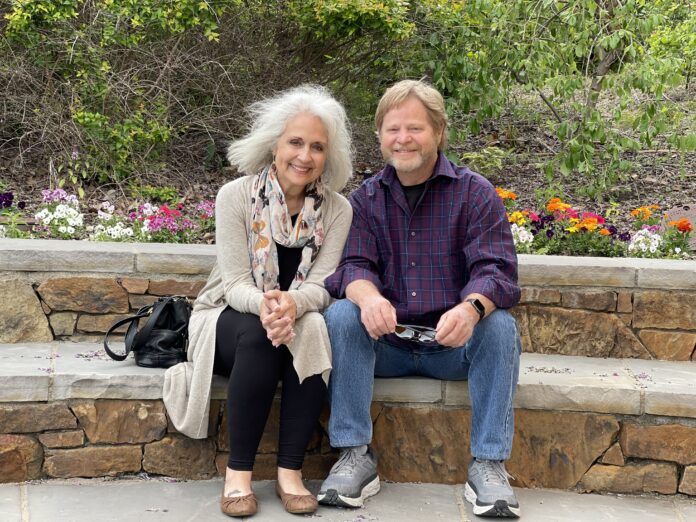
For some five decades now, the husband-and-wife team of Vern and Lisa Robertson Stefanic have – both separately and together – been entertaining and enlightening Tulsa-area theatergoers in a dizzying variety of productions. And their fans, myself included, undoubtedly have favorite moments from the careers of actor-director Lisa and director-writer Vern.
I fondly remember, for instance, Lisa’s performance as a potential vampire bride in American Theater Company’s Halloween 1989 production of The Passion of Dracula. She was so powerful and engaging that, after reviewing the play for the Tulsa World, I felt compelled to go back and see it again on my own dime. That was the same year the Tulsa-lensed movie UHF was released, and people all over the world got a chance to glimpse Lisa’s talents as the bubbly contestant on the game show “Wheel of Fish.”
Meanwhile, thousands – again, myself included – have enjoyed Vern’s adaptation (with music by collaborator Doug Smith) of the Christmas movie Miracle on 34th Street, which not only had a long Tulsa run, but continues to be performed on stages across the country. His extensive list of directorial credits also include the historical fantasy Thomas Conner and I wrote, Time Changes Everything, about two imaginary meetings between Oklahoma musical icons Bob Wills and Woody Guthrie. Starring Brad Piccolo and John Cooper of the Red Dirt Rangers, it had a nice little statewide run several years back, and I know Vern’s steady hand had a lot to do with its success.
Between them, the Stefanics have been involved with hundreds of stage productions over the years. And yet, when I float the idea the they’re basically our Alfred Lunt and Lynn Fontanne, they both just laugh.
I’m sticking with that evaluation, though. And what’s more, I think their historic collaboration may have been foreshadowed when they were both very young, with Lisa already interested in theater and Vern virtually growing up backstage at the famed St. Louis Municipal Opera Theater, where his grandfather was lighting director.
“When I was in eighth grade,” recalls Lisa, “my family took a vacation to St. Louis. We saw Damn Yankees with Ray Walston and Gwen Verdon – and Vern was working that show!”
“I was there that night as an usher,” he says, “and helping out the crew afterwards. Of course, we figured that out later.”
As in the theater, the curtain falls, and time passes.
St. Louis resident Vern, attracted to the University of Tulsa by both its sports programs (he played a year of football at TU as a walk-on) and journalism department (“I liked that the professors were all newspaper professionals”), got his degree and began working for the Tulsa World. Tulsan Lisa, meanwhile, had become deeply involved in TU theater.
“That was back around ’74, and in those days, the World would review college productions. So Ron Butler, the entertainment editor of the World, asked me to review a TU show,” says Vern. “I said, ‘Oh, well. Okay,’ and I went, and I was really, really impressed. So the following semester, I returned to school to study playwriting.”
While he was on campus, signing up for classes, Vern saw that the TU theater was presenting a couple of one-act plays by Tennessee Williams. Photos of the cast were on display in the lobby, and one in particular caught his eye.
“I thought, ‘Wow. This woman really looks interesting. I hope I get to meet her.’”
Of course, it was Lisa Robertson, who by that time was beginning to make a name for herself on Tulsa stages. He did soon get to meet her.
“We were in a stagecraft class together,” explains Lisa. “And I noticed this guy who was always leaving class a little early. He’d have a tie in his jacket pocket and a notebook in his hip pocket, and I thought, ‘Who is this guy? What’s he doing? He’s kinda cute.’”
Of course, the tie and the notebook were accoutrements of Vern’s Tulsa World job, which he often had to rush out of class to attend to.
“We were doing a horrible show called Fashion, which was written by the first American playwright, Anna Cora Mowatt,” continues Lisa. “And he ended up working on the crew, backstage. We were playing cards in the green room, and I asked him if he’d ever played Smoke and Fire. He said no, and I said, ‘It’s real easy. I’m going to hold up a card. If it’s black, you say “smoke.” And if it’s red, you yell “fire.”
“So I start showing him the cards, and it’s smoke, smoke, smoke and then he yells, ‘fire!’ and I just go phhhhfftt! with the cards and throw them all in his lap.”
“Yes,” says Vern. “I was the butt of the joke, and apparently, because I didn’t fly off into a Donald Duck fury, I was acceptable in the theater.”

He was also acceptable to the young woman who’d tossed the cards at him. And the feeling was mutual. After they’d been dating for what Lisa laughingly remembers as “a full two months,” he proposed, and she accepted.
“It was the first of December or so. We’d gone out on a date, and we were talking, and I don’t remember exactly what he said, but I think it was something about sharing a toothbrush holder.
“I said, ‘Are you asking me to marry you?’ And he turned away, looked back at me, and he said, ‘Yeah.’”
Married in July, they never stopped working at their craft, with Lisa acting and Vern penning his first play, Last Chances, Lost Dreams.
“A real knee-slapper,” he says, laughing. “I was trying to be the next Eugene O’Neill, but all I was was a tremendous failure. I will say that without the TU theater department, I would never have gotten the opportunity to write my first plays and figure out what I was doing.”
The first production they collaborated on was one Vern wrote called Stories from the Attic, starring Lisa. That would eventually become Third Street, Vern’s first musical. He directed both versions.
“Although Lisa had done other of my works before, this was the first time I was with her on a show,” he says. “We always hear our lines in our head, the way they should be said, but Lisa said one of mine a completely different way, and it was a million times better than I’d ever envisioned it. At that point, I pretty much trusted the actress I was living with.”
Over the years, they’ve done a number of other productions together, usually with Vern directing and Lisa acting. Lisa, however, has become an in-demand director herself, and their collaborations have moved mostly off-stage, becoming more personal as well as theatrical.
“When we’re both working on separate projects, we’ll come home and talk about our rehearsals,” explains Lisa. “Whatever show I’m doing, I’ll kick it around with him. That’s a kind of fun collaboration, just bouncing stuff off each other.”
“We’ve always heard about how Robert Redford was an actor’s director, because he himself was an actor,” Vern adds. “Lisa approaches directing more like that. It’s a different perspective. As a director, she can help her cast do things.
“I come at it from a writer’s perspective. I’ve been told what I can do is help people understand what the story is that we’re trying to sell. So she and I complement one another. It’s not a rivalry. It’s a complementary approach.”
Most recently, Lisa directed the just-concluded Love Letters for Theatre Tulsa. A cabaret show of hers is forthcoming. Meanwhile, Vern helms the Pembroke Players production of Shakespeare in Love, running March 6-15 at the PAC.