

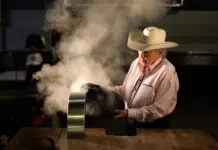



















The Oklahoma Mesonet, designed and implemented by scientists at the University of Oklahoma (OU) and at Oklahoma State University (OSU), is a world-class network of environmental monitoring stations. The entity is unique because it is the only state Mesonet operated as a 50/50 partnership between two competing flagship universities.
The Oklahoma Mesonet was commissioned on January 1, 1994, and consists of 120 automated stations covering the state, with site locations in all 77 counties in Oklahoma.
“When the Oklahoma Mesonet was created more than 30 years ago, computers and IT infrastructure were vastly different from what we have today. However, our forward-thinking founders recognized the future potential of the internet and how it could be used to disseminate weather information to core users,” says Cindy Luttrell, director of the Oklahoma Mesonet.
Early on, the station computers could only store five days of observations, but as technology evolved, so did the Mesonet, which can now store several years of data locally. It is also now possible for the weather events to be collected, processed and disseminated every five minutes, 24 hours per day, year-round.
The Mesonet monitors weather events, such as thunderstorms, wind gusts, heat bursts and dry lines that range in size from one mile to about 150 miles. The commitments between the two universities have built long-standing, trusted relationships with professionals across weather, climate, agriculture, energy, public safety and education to offer more than just simple weather monitoring.
“A core value of the Oklahoma Mesonet is providing research-quality weather observations that are useful across all industries. We maintain rigorous standards for site selection, station maintenance and data quality to ensure that observations shared with the public are accurate, representative and reliable,” says Luttrell. “Equally important, we place strong emphasis on making sure the final products are useful and actionable.”
Although there are other networks that are now referred to as ‘mesonets’ that existed prior to 1994, their scope was typically limited to agricultural applications; however, the Oklahoma Mesonet was groundbreaking because it was designed from the outset as a statewide, multipurpose weather monitoring network built to research-quality standards that served a broader purpose and use base.
The partnership between OU and OSU have allowed for the development of tools that place weather observations into context for specific needs, including crop disease advisories, irrigation planning tools, spray drift advisories and agricultural fire management tools; prescribed burning and fire management tools for agriculture and fire professionals; weather training and visualization tools for public safety officials; and a wide range of accumulation, extremes and real-time observation products for weather and climate professionals.
These observations are delivered in multiple formats, including text products, APIs and static and interactive maps, to meet the needs of residents, businesses, and farmers in Oklahoma.
The Mesonet data is a highly trusted resource during extreme weather events due to high observational standards that are upheld by those who monitor the Oklahoma Mesonet.
Many U.S. states and international partners have sought the guidance of the Oklahoma Mesonet in developing or improving their own mesonets, which has helped foster a collaborative community of mesonet operators who regularly share ideas and solutions.
“While our commission to provide useful, real-time weather observations remains unchanged, we will continue to adapt to new technologies and the evolving needs of our users well into the future,” Luttrell says.
Main image cutline: A statewide network of Oklahoma Mesonet stations collects and delivers research-quality weather data every five minutes, supporting industries, public safety and communities across all 77 counties. Photo courtesy the Oklahoma Mesonet