











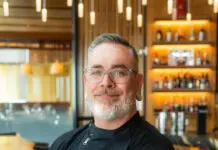
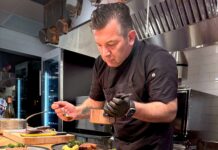




Marco Herrera cuts an imposing figure – larger than many bears – but that’s not what you notice first: it’s his intellect. In fact, when he first moved to Tulsa, he was a Ph.D. candidate. However, as he said at the time and later repeated to me, “there are too many Ph.D.s in the world, and too few good tacos.

Herrera was born in El Paso, Texas, and more or less grew up in his dad’s small Mexican restaurant. His earliest memories are of being in the kitchen, watching the chefs prep, then watching the somewhat ordered chaos of the breakfast and lunch rush.
“From my earliest years,” he told me, “if you’d asked me what I wanted to do with my life, I’d have said I wanted to cook. It was always present, this desire, and as I got older and older it got louder and louder, and in the end, I couldn’t deny it.”
He taught himself to cook by trial and error, and “in many ways,” he says, “I’m still learning. It never ends.”
One day, at a restaurant in east Austin named Suerte, Herrera had a tortilla that, he declared, “changed my life. It was so good I couldn’t believe it existed.” That sent him researching down the never-ending rabbit hole of corn, masa and nixtamalization and its place in Mexican life and cuisine. And that’s why, when he joined his friend Colin Sato in establishing what began as a pop-up and grew into the James Beard Award semi-finalist Et Al, he specialized in a program of Tuesday heirloom corn tortillas and tacos that helped the restaurant garner national attention. And himself too. The Wall Street Journal even called him “one of America’s best new chefs.”
Lately, Herrera’s been a happy man. He’s back in Tulsa, and he’s helping design Little Belly, where he’ll be executive chef. He’d spent many months in Denver, where he was culinary director of a Michelin-starred restaurant group. But Tulsa always seems to pull him back like a magnet, and he couldn’t pass up an opportunity to work with Sheamus Feeley again – the wunderkind restaurateur behind James Beard semifinalist Noche.

But what is Little Belly? It’s an American izakaya, says Herrera, located on Tulsa’s Brookside within the old Pei Wei at 3535 S. Peoria Ave. In Japan, an izakaya is a place like a pub or tapas bar. It’s a casual drinking establishment that serves food, but over centuries of evolution in Japan, a subtle web of customs, etiquette and tradition governs how you behave in one. But there’s none of that here.
“This is a place focused on fun and it’s supposed to feel easy,” says Herrera. “It’s Japanese and American cooking and tradition coming together and playing together.”

There’s a long bar on the southern side of the vibrantly decorated restaurant, with a Suntory machine for making highballs and lots of fun cocktails. The list of sake and whiskey on offer will be small but constantly changing. But if you know Herrera, you won’t be surprised to learn that most of his efforts have gone into obsessive design of his dishes.
“Sheamus and I do everything 50-50,” says Herrera. “We created each dish together. There’s Magic Cabbage Salad, very umami-driven, there’s creamy butter ramen with fresh corn and chives, there’s yuzu pepper tonkatsu (chicken-fried pork).”
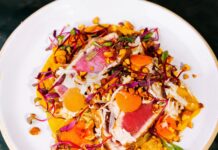
As a nod to Nikkei cuisine developed by Japanese immigrants in Peru, there’s a tiradito, the impeccably fresh fish caressed by Peruvian leche de tigre and a sauce made of Peruvian yellow peppers. The recipes are playful and bend the rules but, Herrera stresses, “we approach Japanese cuisine with respect and reverence.”
When you visit Little Belly, it’s a pretty safe bet that Herrera will be there.
“I love restaurants and I love good food,” he says. “After all these years it’s still one of my favorite things in the entire world.”
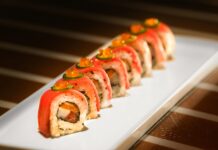
Featured photo credit: Left: Sushi lovers should try the Tekka Don and Sake Don Handroll Sets, made to order. Right: The Chirashi Royale is a premium, high-end sushi bowl featuring a luxurious assortment of seasonal fish. All photos by Hunter Herrera