
















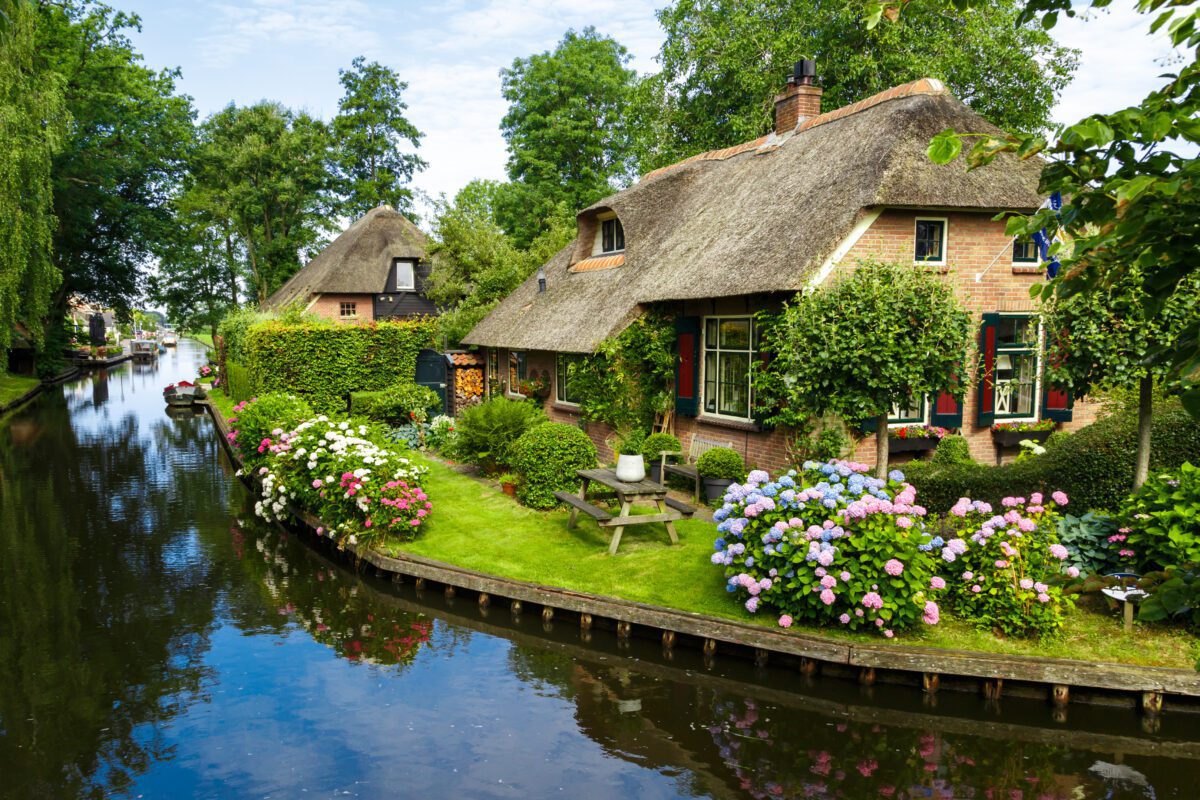
Storybook cottages are roofed with thatch, accented by shutters of bold colors and surrounded by dense, romantic gardens. Oh, and the only way to get anywhere is by climbing aboard a self-driven whisper boat (fluisterboot), so named because, you guessed it, they’re electric.

Welcome to Giethoorn (geet-horn), a water-rich village in the Netherlands interwoven by miles of tranquil canals fronted by fairy tale homes, lush flower-filled landscaping, shops, cafés and no cars. Wait, what?
There are no cars because there are no roads. Everything happens on the canals. Shopping, accommodations, eateries. You park outside of town and grab a boat, a bicycle or hoof it. Getting around is made easier by the 177 wooden bridges crossing the canals, many festooned with boxes filled with geraniums and hydrangeas. Ah, to sit in a café by the side of a canal watching silent boats slide by, the peace only broken by the sometimes noisy ducks and swans.
The Dutch have a lot of experience handling water and reclaiming land and even though Giethoorn is inland, 70 miles northeast of Amsterdam, it sits on old marshes that once were laden with peat, an essential fuel 800 years ago. The digging for the peat (back then done by hand) created lakes and ditches were dug to transport the peat, ditches that became the town’s canals. All that excavating also uncovered great deposits of goat horns, hence the name, Giethoorn.
Many older homes in town are now small hotels, such as De Dames Van De Jonge Hotel Restaurant, serving locally-sourced dishes since 1958, and Hotel de Harmonie, with waterside terraces for your morning coffee. At Waterresort Bodelaeke, luxuriate in privacy in a detached villa, enjoy a sauna and then access the water via your own personal jetty.

For a good look at the origins of Giethoorn and how the Netherlanders lived 100 years ago, the Museum Giethoorn ‘t Olde Maat Uus is the place. The living museum is actually a traditional farmhouse with furnished rooms, costumed reenactors and a nearby boathouse.
Amethyst geodes are on display at the De Oude Aarde in Giethoorn, along with a large collection of gemstones, fossils and phosphorescent rocks. Around the corner and down the next canal is the Gloria Maris Schelpengalerie, specializing in coral and pearl jewelry and its namesake, the Gloria Maris shell. They have two of the precious four-inch mollusk shells.
It’s interesting that for a place that eschews the automobile, one of its most popular museums is Histomobil, a collection of old cars, carriages, motorcycles, tools and toys. A small pub is also on site.
Smart shoppers gravitate to the exquisite blue and white Delftware ceramics, hand-crafted wooden items (besides shoes) and the famous Dutch cheeses, Gouda and Edam.
Local dishes at the small, homey cafés are likely to feature thin Dutch pancakes, fish of some sort (Giethoorn is surrounded by lakes; smoked eel and perch are popular) and a stew they call stamppot, made with vegetables, mashed potatoes and smoked sausage or meatballs.
The village is surrounded by the Weerribben-Wieden National Park, one of the largest wetland nature reserves in Europe. Its many walking trails through reed beds and marsh forests bring visitors close to European otters, roe deer, purple herons and white-tailed eagles.
For a 360-view of Giethoorn, tour boats with narration also ply the canals. And for a truly immersive experience, rent a canoe, kayak or stand-up paddleboard and tackle the canals face-to-face.
Fans of the tulip will want to be in the village May through August when the blooms are at their peak. The 2,600 villagers are fastidious about their foliage. In the winter, ice-skaters take advantage of the frozen canals and later take refuge in nearby cafés with hot chocolate and mulled wine.