















Drone racing is gaining popularity in Oklahoma. In fact, our state played host to the 2025 MultiGP Drone Racing Championship, and hosts the Thunderbird Drone Festival in Tulsa.
Tad Douce, executive director of MultiGP Drone Racing, explains the burgeoning phenomenon.
“Drone racing is special because the pilot is wearing a set of goggles, getting a video feed from a camera mounted on the drone, so it feels like being in the drone, like in the pilot seat if it were an aircraft, and it feels like you’re flying – not like a radio-controlled car or airplane.”
Drone racing, Douce says, has been around for ten to 15 years.
“My background is in education, and I saw some people doing it with small drones you fly indoors, so students could build and repair. And I thought it was great for kids to learn the skills.”
MultiGP is the largest organization for drone racing across the world, started by Chris Thomas in Florida. He wanted to fly with others as a hobby, so he started the first real community of hobbyists and racers. The organization now has 30,000 pilots all over the world.
“It’s getting more mainstream,” says Douce. “When I started in 2019, there weren’t a lot of resources; you had to know somebody. The drones are not simple to set up, fly and repair; it takes some knowledge, and there’s a learning curve. Now it’s getting easier to get started, as in the last three years, there are more companies selling them with the drone already put together and the ability to buy a kit and open up drone racing for more people.”
Douce says that with time spent building skills, anyone can participate in drone racing.
“It’s a skill that anyone can do, as it’s not hard to learn the basics, but to get good at it, it’s like any sport,” he says. “Like basketball – if you give someone a ball, they can dribble it, shoot a basket. But it takes practice to get any real skills. With drone racing, it’s a skill. When I was first getting started, it was hard for me to fly accurately.
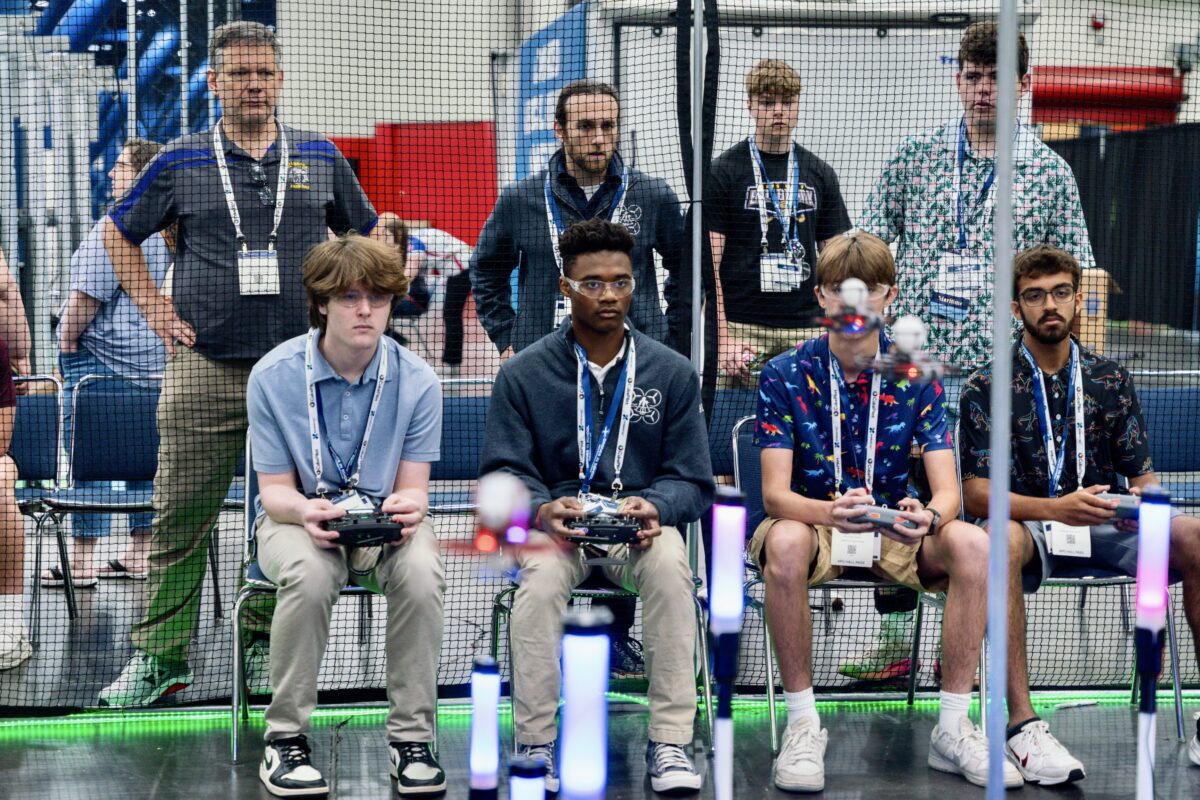
“A lot of people use Veloci-drone – a software that you can plug your controller into a computer and you can practice in virtual mode, and you get better,” Douce continues. “I realized it got me better, but it takes hours of practice to get muscle memory. There’s a lot of strategy to it. Every track is different, and can have spirals, loops, turns and structures, so you’re learning different maneuvers. Children often learn quickly, and I admire some of our students in the Drones in School programs as they can develop real speed like a real-life video game.”
For adults and children alike, drone racing has the added benefit of getting people outside.
“It’s like a video game, but outdoors,” he says. “You interact with other people and touch grass. It crashes, you figure out how to fix it [and you gain] real life skills.”
If you want to get involved in the activity, Douce says, “find a chapter close to you and, most of all, practice. The MultiGP community people are enthusiastic, and they’ll help you and give advice on equipment and share their knowledge. Plug into an organization in your community.”