





















Oklahomans with an interest in the lithium industry agree on this: there is a learning curve.
Roshan Pujari, founder and CEO of Stardust Power, is an Oklahoma native who says he spent a couple of years just educating himself about the industry after his boutique investment firm was first approached in 2018. His study culminated in a venture poised to bring hundreds of well-paying jobs to eastern Oklahoma.
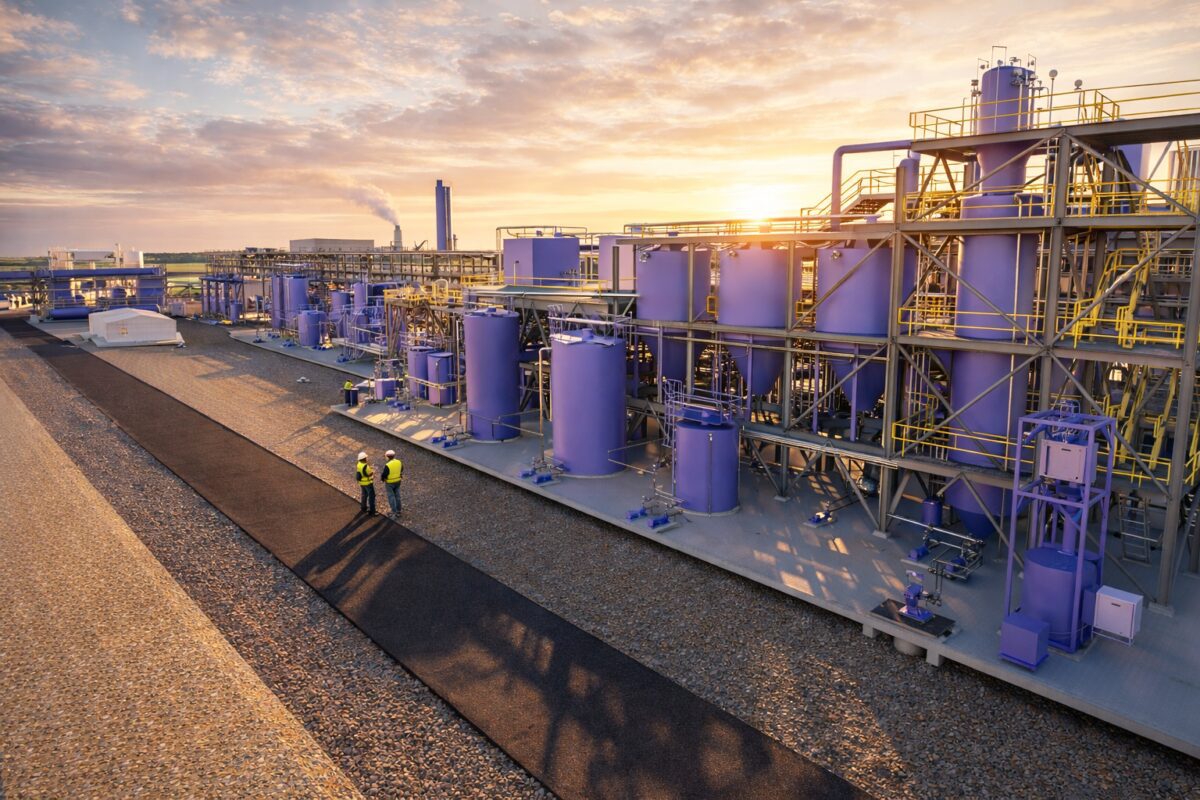
Stardust Power broke ground in January 2025 on a lithium refinery plant in Muskogee that will develop battery-grade lithium carbonate. Pujari says there is an “overwhelming demand for battery-grade lithium,” ranging from batteries for electric vehicles to handheld electronics to defense and space applications to energy storage systems for data centers.
Jay Shidler, director of business recruitment for the Oklahoma Department of Commerce, says he travels the world to stay abreast of what he calls the “critical minerals industry” and how Oklahoma can support it.
“Critical means that something manufactured depends on them,” Shidler says. “Lithium, nickel, cobalt, graphite – all those minerals will be required as we continuously grow. Many U.S. companies are making lithium batteries but getting most of the lithium from abroad.”
Oklahoma is becoming a critical minerals hub for processing and transporting, Shidler says, primarily because of its strategic location and ready worker pool.
“We are an energy state,” Shidler says. “We’ve been in oil and gas for decades. There are skills in the workforce here to move right into this industry.”
The state is also positioned in the heart of the nation, with interstate highway systems leading to the coasts, Class 1 rail and ports that connect with the Mississippi River shipping system.
Stardust Power plans to refine lithium taken from brines sourced from across North America, including “produced water” from Oklahoma’s oil and gas industry. The end product, a fine, white powder, will be sold to battery manufacturers.
“Produced water is a term for fluids produced during oil and gas production, separate from drinking water,” says Nick Hayman, Ph.D., director and state geologist of the Oklahoma Geological Survey, which is based at the OU’s Mewbourne College of Earth and Energy.
Lithium can be stored in water, clay and rock, Hayman says. And while minimal mining for critical minerals takes place in Oklahoma, that does not mean they are not to be found, he says.
The Smackover Formation, which runs beneath Texas, Arkansas, Louisiana, Mississippi, Alabama and the Florida Panhandle, is a significant lithium brine resource, Hayman says. It’s especially productive in southern Arkansas.
“Because the Smackover Formation is such a well-known formation but doesn’t come into Oklahoma, it sits there making fun of us,” Hayman says. “The point people miss is that the Smackover is one of many lithium-bearing systems.”
Lithium is one of the most abundant elements in the world, Pujari says, and the United States “has potentially the fourth-largest reserves of lithium, in hard rock and brine form.”
In the meantime, Oklahoma’s entry into the supply chain includes Blue Whale Materials, which opened last year in Bartlesville, Shidler says.
“They are able to take existing battery-grade material and grind it down into a black mass and sell it, so it doesn’t have to go back to China,” Shidler explains.
The product is sold to companies such as American Li-on in Atoka, “which extracts lithium as one of the materials out of that black mass, and re-sells it in the United States to create a closed-loop system,” says Shidler.
Pujari says Stardust employees have spent the past couple of years on the permitting process, and in January obtained the final significant clearance, the air quality construction permit from the Oklahoma Department of Environmental Quality.
“We are doing the financing now,” Pujari says. “We would like to start construction this year.”