















Temple Israel, one of Tulsa’s oldest congregations, is preparing to enter a new chapter in its 112-year history. Construction is underway on a new building scheduled to open in 2027, a project designed to balance modern worship needs with the congregation’s deep historical and cultural roots.
The new facility is estimated to cost $14.5 million, with the leading gift donated by the Bernstein Family Foundation. It will replace the congregation’s current place of worship, a 43,000-square-foot structure built in 1955. While beloved by many members, the building has become increasingly difficult to maintain and adapt to contemporary religious life, prompting a conversation about whether to renovate the aging facility or start anew.
The First Decision: Renovation vs. New Build
Temple leadership began studying the challenges roughly four years ago, exploring the possibility of renovating the existing structure. However, the building’s age presented significant obstacles; it lacked many systems required in modern buildings, including updated fire suppression technology. Over decades, mechanical systems had been added piece by piece, eventually resulting in dozens of separate units tied into the facility. Maintaining and repairing those systems has become increasingly complex and costly.
Renovation would have required substantial investment simply to bring infrastructure up to current standards before any improvements to the worship or community spaces could begin. In addition, leaders realized the large footprint of the building no longer matched how the congregation used its space. Some areas went underutilized, while others lacked the flexibility needed for modern programming and gatherings.
Ultimately, it was determined that constructing a new building would allow the congregation to design a more efficient and intentional facility. The new structure will be about 23,000 square feet – nearly half the size of the existing building – but with every space carefully planned for a specific purpose, and with improved flow between areas.
“It really wasn’t that we made a right decision or a wrong decision,” says David Weil, a Temple Israel congregant helping to lead the new construction project. “It was just what we thought was the better decision after looking at all the options. When we [designed] the new space, every square foot had a purpose. Every flow from one location to another has a place in the plan.”
The decision was not without emotional weight. For generations of congregants who grew up attending services, celebrations and life-cycle events in the original sanctuary, the building held deep personal significance. Temple leadership sought to honor those memories while designing a space capable of serving the congregation for decades to come.
“It’s hard to leave something behind that you’ve watched for your entire life if you grew up in this community,” Weil says. “We want to make sure that we honor the past of that building, [the community] and all the great work that was done by the architect Percival Goodman.”
Finding the Right Partners
To guide that effort, Temple Israel conducted a nationwide search for the right architectural partner. Leaders reviewed roughly 17 firms, focusing on those with experience designing religious buildings. Such projects require specialized knowledge, as the architecture must balance ritual traditions, symbolism and community functions while also meeting modern design standards.
The congregation selected Finegold Alexander Architects, a Boston-based firm with extensive experience working on Jewish cultural buildings. The firm has had a hand in dozens of synagogue projects nationwide and was involved in work connected to the United States Holocaust Memorial Museum. Crossland Construction out of Tulsa was also recruited to lead the construction, adding a local touch to the project.
For the architects, Temple Israel’s story was a compelling one. The congregation’s century-long presence in Tulsa reflects the endurance of the city’s Jewish community, and the project offered an opportunity to honor a historic building while responding to evolving worship practices and community needs.
“The over 100-year history of Temple Israel as a congregation speaks to the resiliency and strength of Tulsa’s Jewish population,” says Rebecca Berry, Principal, President and Director of Sustainability with Finegold Alexander.
The Design Elements
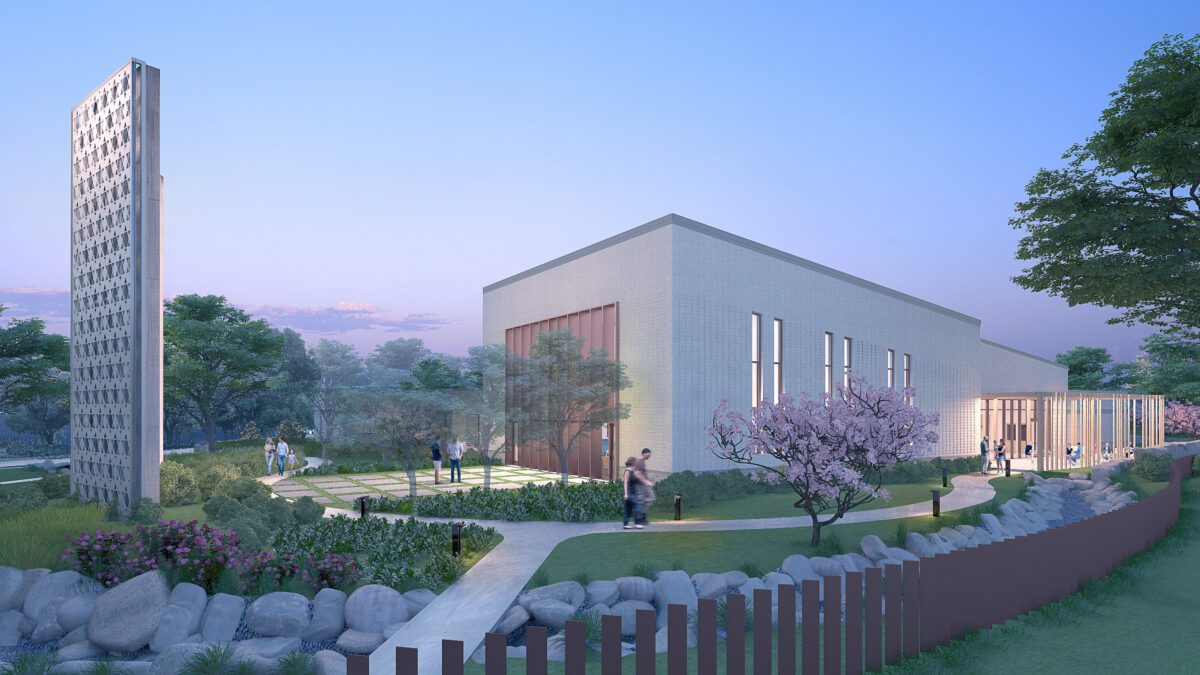
The new design draws heavily on Jewish tradition while remaining grounded in Tulsa’s local character. Salvaged materials from the original building – including Jerusalem stone and wood elements – will be incorporated into the new structure, linking past and present. Natural materials will also appear throughout the building, reflecting longstanding traditions in synagogue architecture while creating a warm and welcoming environment for congregants.
“With every design move that we make in creating these buildings, we ask ourselves how we can ‘respect the past and design for the future,’” Berry says.
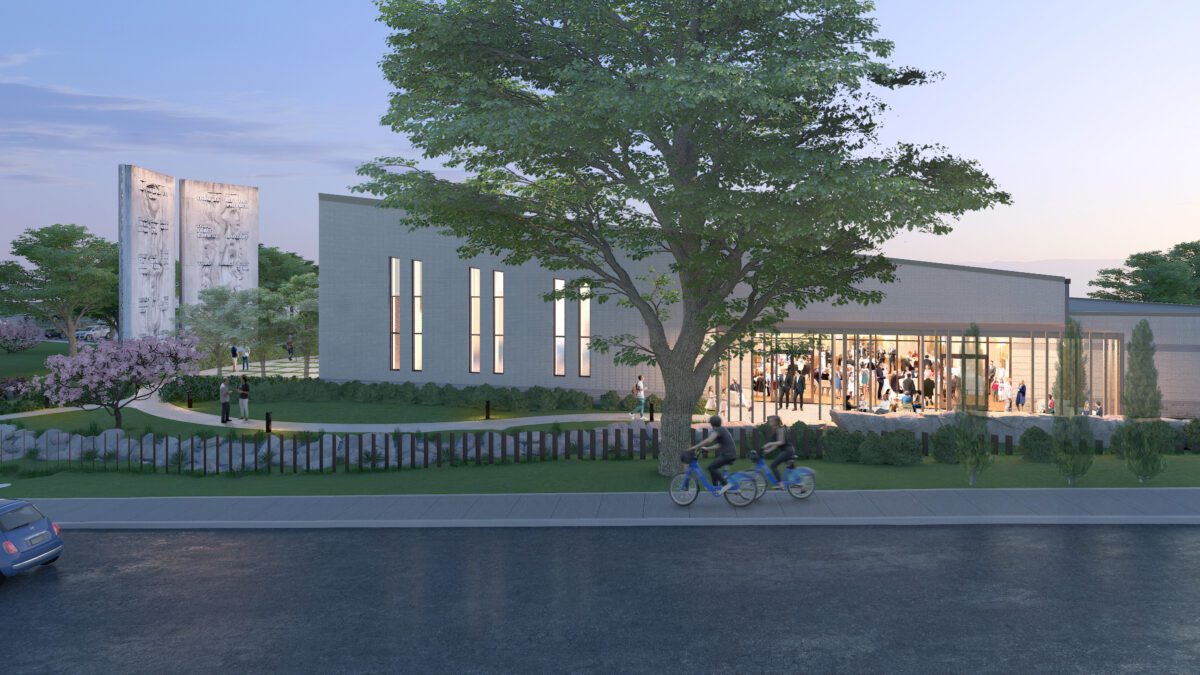
Architecturally, the building will respond to Tulsa’s distinctive landscape and design heritage. Its exterior will feature textured white brick and angular detailing inspired by the city’s Art Deco architecture. Native landscaping and storm-water design elements will respond to the site’s geography, which sits above the buried Crow Creek watershed.
A Major Undertaking: The Ten Commandments Tablets
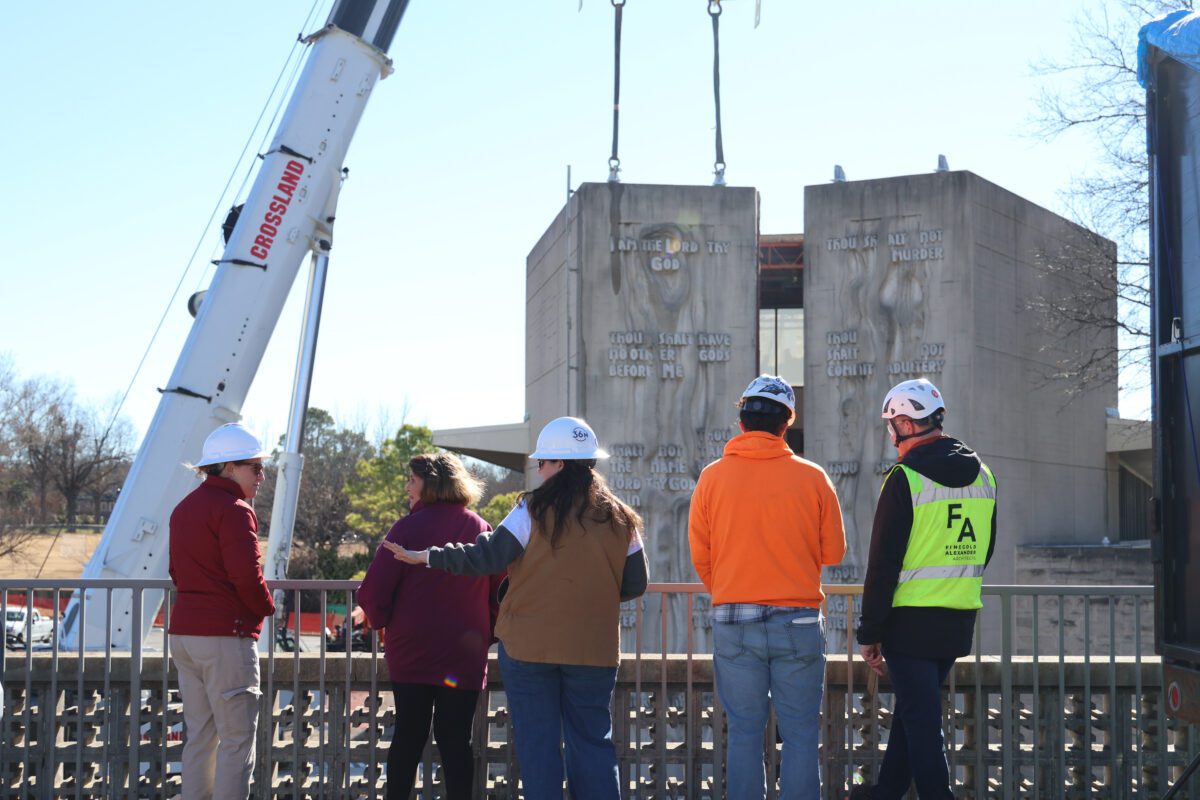
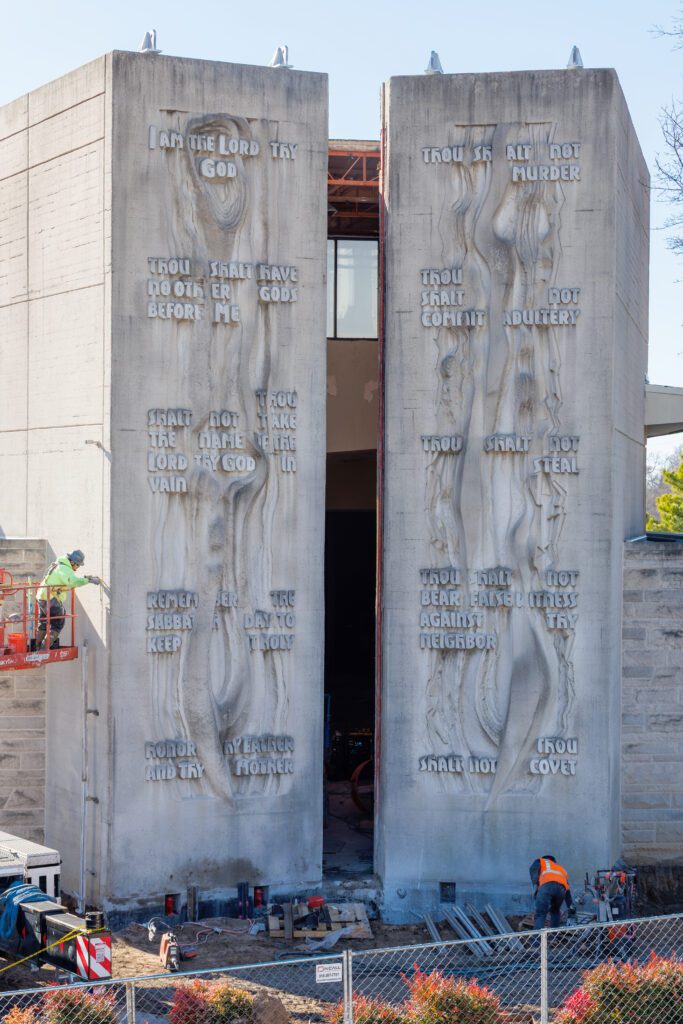
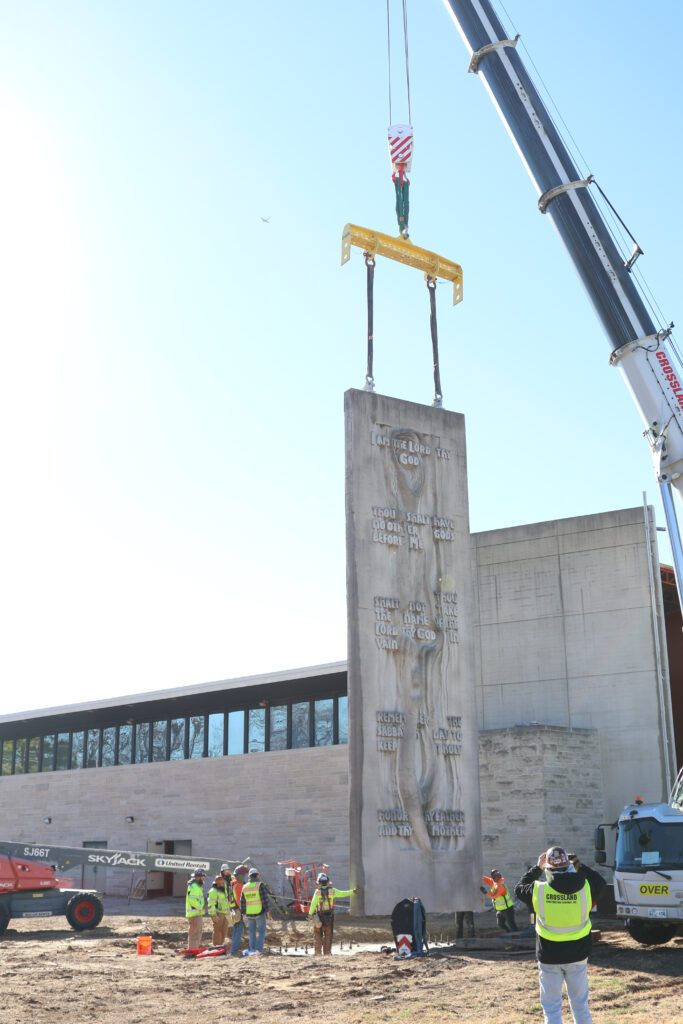
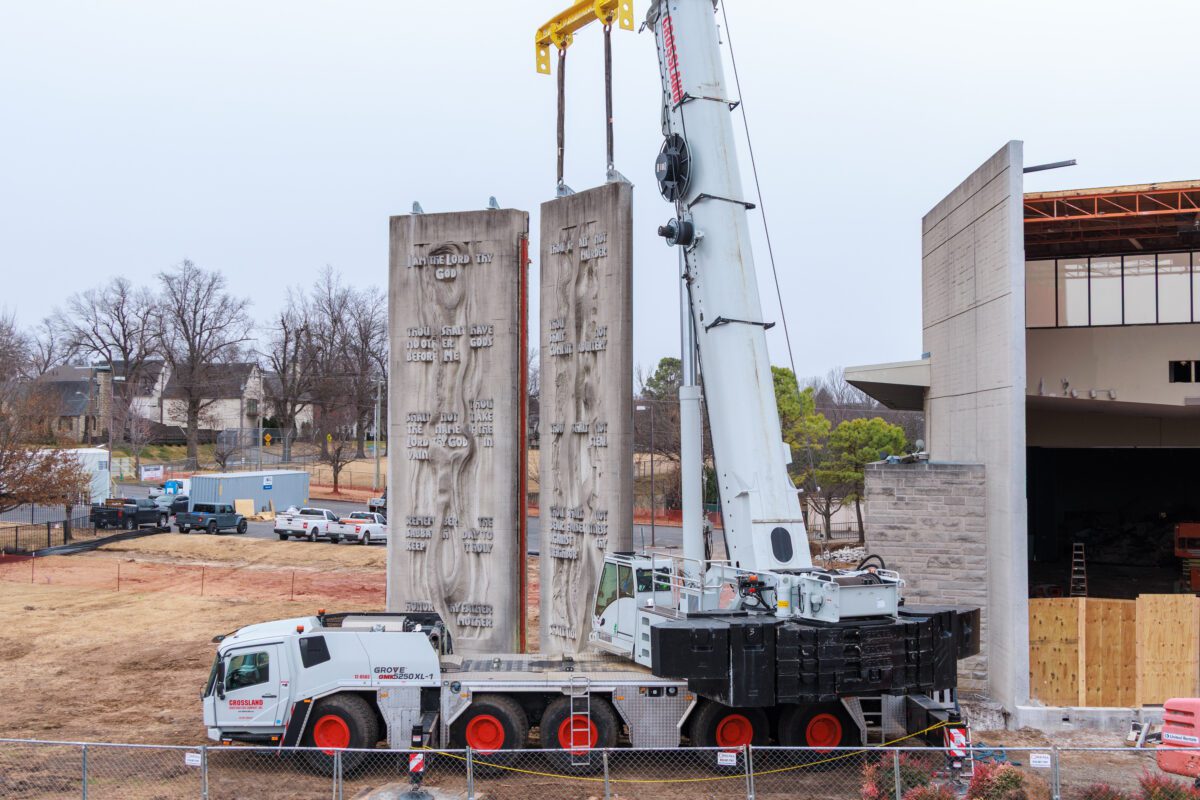
One of the project’s most complex challenges has been preserving two massive concrete tablets depicting the Ten Commandments from the 1955 building. Each weighs approximately 90,000 pounds and both were integrated directly into the original sanctuary wall.
Moving them safely required a significant engineering effort. Specialists reinforced the tablets by drilling dozens of holes into the concrete and inserting structural pins and plates that distributed their weight across a supporting framework. Once stabilized, the tablets were carefully cut free from the building and lifted for relocation.
“The scariest part of the project right in the beginning was figuring out— can we actually get those [tablets] out?” says Weil.
Another consideration for moving the 45-ton tablets was navigating the site’s flood-prone areas.
“There’s a significant floodplain running through the site,” says Tim Smith, project manager with Wallace Design Collective, an Oklahoma-based engineering consultant that is also involved with the project. “As a result of that, the new building is set roughly four feet higher than what the previous one had been.”
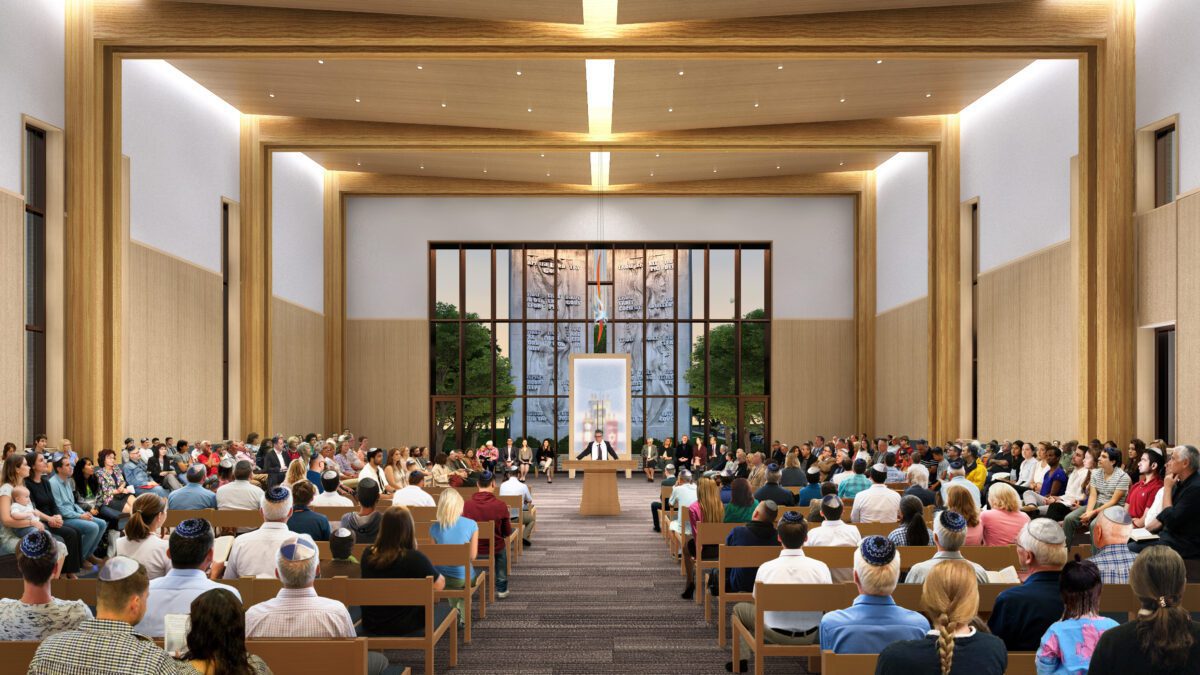
Rather than existing within the place of worship as before, the tablets will now stand as freestanding elements within a sacred outdoor garden adjacent to the new sanctuary. From inside the sanctuary, congregants will be able to see the tablets during services – an intentional design decision meant to strengthen their symbolic presence.
The Community Court
Another central feature of the new Temple Israel is the “Community Court,” a large, multi-purpose gathering space designed to serve as the heart of the building. Modern Jewish temples increasingly function not only as houses of worship but also as civic and social gathering places. Temple Israel’s new design embraces that role.
The Community Court will serve as a flexible hub for congregational life. Large doors will allow the space to open directly into the sanctuary, expanding seating during high-holiday services. At other times, it can host celebrations such as bar mitzvah and bat mitzvah receptions, educational events, community programs or informal gatherings before and after services.
“[Temple Israel] is more than just a sanctuary – it is a house of worship, a house of gathering and a house of learning,” Berry says.
The space will include lounge seating, a serving area and access to both teaching and commercial kitchens, enabling cooking classes, holiday meal preparation and community events. The design also incorporates memorial displays honoring past congregants and historical artifacts from earlier buildings, ensuring Temple Israel’s history remains visible within the new facility.
Meeting Modern Needs
Throughout the building, architects have emphasized natural light and connections to outdoor courtyards, creating a gradual transition from everyday life into sacred space. Congregants will enter through landscaped grounds before passing interior courtyards and gathering areas on their way to the sanctuary.
The result is intended to reflect the three traditional roles of three traditional roles of a Jewish communal space: a house of worship, a house of learning and a house of gathering. By weaving those functions together through architecture, the design aims to create a spiritual and civic center for the congregation and the broader community.
When the new Temple Israel opens in 2027, it will represent both continuity and transformation – preserving the symbols and memories that shaped generations of Tulsa’s Jewish community while creating a modern space designed for those still to come.
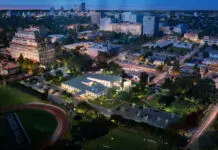
Main image cutline: An aerial rendering showcases the layout of the new Temple Israel campus, highlighting the sanctuary, community gathering spaces, landscaped grounds and the sacred outdoor garden. All renderings courtesy Finegold Alexander Architects