Drone racing is gaining popularity in Oklahoma. In fact, our state played host to the 2025 MultiGP Drone Racing Championship, and hosts the Thunderbird Drone Festival in Tulsa.
Tad Douce, executive director of MultiGP Drone Racing, explains the burgeoning phenomenon.
“Drone racing is special because the pilot is wearing a set of goggles, getting a video feed from a camera mounted on the drone, so it feels like being in the drone, like in the pilot seat if it were an aircraft, and it feels like you’re flying – not like a radio-controlled car or airplane.”
Drone racing, Douce says, has been around for ten to 15 years.
“My background is in education, and I saw some people doing it with small drones you fly indoors, so students could build and repair. And I thought it was great for kids to learn the skills.”
MultiGP is the largest organization for drone racing across the world, started by Chris Thomas in Florida. He wanted to fly with others as a hobby, so he started the first real community of hobbyists and racers. The organization now has 30,000 pilots all over the world.
“It’s getting more mainstream,” says Douce. “When I started in 2019, there weren’t a lot of resources; you had to know somebody. The drones are not simple to set up, fly and repair; it takes some knowledge, and there’s a learning curve. Now it’s getting easier to get started, as in the last three years, there are more companies selling them with the drone already put together and the ability to buy a kit and open up drone racing for more people.”
Douce says that with time spent building skills, anyone can participate in drone racing.
“It’s a skill that anyone can do, as it’s not hard to learn the basics, but to get good at it, it’s like any sport,” he says. “Like basketball – if you give someone a ball, they can dribble it, shoot a basket. But it takes practice to get any real skills. With drone racing, it’s a skill. When I was first getting started, it was hard for me to fly accurately.
Students compete during the 2025 Season Championship in Houston, Texas, hosted by EduEverything, a nonprofit organization dedicated to expanding technology and robotics education for schools and educators.
Photos courtesy EduEverything
“A lot of people use Veloci-drone – a software that you can plug your controller into a computer and you can practice in virtual mode, and you get better,” Douce continues. “I realized it got me better, but it takes hours of practice to get muscle memory. There’s a lot of strategy to it. Every track is different, and can have spirals, loops, turns and structures, so you’re learning different maneuvers. Children often learn quickly, and I admire some of our students in the Drones in School programs as they can develop real speed like a real-life video game.”
For adults and children alike, drone racing has the added benefit of getting people outside.
“It’s like a video game, but outdoors,” he says. “You interact with other people and touch grass. It crashes, you figure out how to fix it [and you gain] real life skills.”
If you want to get involved in the activity, Douce says, “find a chapter close to you and, most of all, practice. The MultiGP community people are enthusiastic, and they’ll help you and give advice on equipment and share their knowledge. Plug into an organization in your community.”
While river otters are objectively adorable, experts advise not to interact with or feed them. “You don’t want them to get habituated to people and view people as food sources,” says biologist Mark Howery.
Photo by Stacy Freeny courtesy the Oklahoma Department of Wildlife Conservation
River otters feed on small fish, crayfish and turtles, and thus “are an important part of river systems in keeping those populations in control,” says Mark Howery, a non-game biologist for the Oklahoma Department of Wildlife Conservation.
And, Howery says, “they are often a species that people find very endearing. They enjoy watching them and having them around.”
But as with most wild animals, it’s a case of look, but don’t touch.
“It’s a bad idea to try to feed them,” Howery says. “You don’t want them to get habituated to people and view people as food sources. They might come up around houses and attack small pets and chickens, and get into fights with small dogs.”
And it’s illegal to capture river otters and try to make pets out of them, Howery says. As a non-game biologist, Howery works primarily with wildlife species that are not hunted or fished.
River otters were absent or nearly so during the first 60 years after statehood, Howery says, but “now we have them in nearly every county east of I-35,” and a few in the southern part of the state, as far west as the Wichita Mountains.
River otters were heavily trapped in the late 1800s and early 1900s, before wildlife laws were enacted, Howery says.
“They were harvested for their fur,” he shares. “As a result, the Oklahoma population was decimated prior to statehood.”
In the late 1960s and early ’70s, river otters began making their way back, migrating from Texas and Arkansas. Historic predators such as wolves, bobcats and mountain lions were gone or diminished. Another factor in the population rebound was a “population augmentation” by the wildlife conservation department, Howery says.
Two employees who have since retired, John Skeen and Richard Hatcher, “worked out a trade with the state of Louisiana, and traded wild turkey in exchange for river otters,” Howery says. Eighteen river otters were placed at the McGee Creek and Wister reservoirs between 1985 and 1987.
“The populations increased to the point that by about 2008 or 2009, we reopened a limited fur harvesting season on them in certain counties,” Howery says.
As many as 2,000 people still work as fur trappers in the state, primarily harvesting bobcats, beavers and raccoons, Howery says.
River otters are now plentiful in such rivers as the Arkansas, Canadian, Kiamichi, Washita and Red River, Howery says, but also thrive near streams.
At night, they disperse to ponds to look for fish, he says, moving overland up to a couple of miles. They aren’t so welcome by property owners who are nurturing fish and turtles in their ponds, however.
River otters typically live eight to nine years in the wild, and Howery estimates the Oklahoma population is now between 3,000 and 5,000. They create their dens in river and stream banks and produce litters of two to four pups, also known as kits.
The animals will usually slide into the water when they encounter people.
“They are a curious animal, but don’t tend to approach people,” Howery says.
“In Oklahoma, yard trimmings and grass clippings can make up 15 to 25% of a community’s waste,” says David Hillock, a consumer horticulturist with the Oklahoma State University Extension. “The costs of collecting and transporting yard waste and the subsequent landfill tipping fees may be a considerable portion of a community’s waste management budget. These costs may be reduced if communities encourage and practice backyard yard waste composting.”
Compost systems can be simple and slow, such as a heap or pile, which is turned occasionally during the year.
“In general, a bin of some sort makes it easier to manage,” says Hillock. “This can be a large container or a structure made from simple materials like wood, wire or concrete blocks. A more relaxed method is just creating a pile in the corner of the landscape where you throw all your scraps. You can dig a wide but shallow hole to help keep it somewhat contained.”
But what, exactly, can be composted? Most yard waste, such as grass clippings, leaves, twigs and excess vegetation, alongside food scraps without fat, twigs or chipped branches, coffee grounds and tea leaves. The list of what can’t be composted is a bit longer, including large branches, fatty foods, grease, meats, dairy products, fish, bones, synthetic products like plastics, diseased plants, weeds and vegetables that produce abundant seed, and pet or human waste.
The benefits of composting are vast. You’re recycling natural materials; reducing the amount of chemical fertilizer and the amount of material going to landfills and the landfill tipping fees; and extending landfill life.
And if you aren’t sure what to use your compost for, it can:
Improve soil structure and texture;
Increase the water-holding capacity of sandy soil;
Loosen clay soil and improve drainage;
Add nutrients to improve soil fertility;
Aid erosion control;
Work as potting soil;
A sign from Tulsa County Master Gardeners shows which materials are great for composting, and which are not. Photo courtesy TCMG
Substitute as mulch around landscape plants to retain moisture.
“Essentially, we are helping nature do its work by turning ‘free’ plant-based material into a rich source of organic matter and nutrients that improve soil health, which helps plants grow,” says Hillock.
So, you have decided to start composting. Where do you place the compost pile? The best place for a pile is where you’ll actually use it, says Patrick Morey with the Tulsa County Master Gardeners.
To harvest compost, it should ideally be sifted through 1/4”-1/2” hardware cloth, says Morey.
“Whatever falls through can be used in gardens. What doesn’t fall through can be tossed back into the pile to decompose further,” he says.
The best compost has a variety of carbon material (browns) and material with higher nitrogen content (greens).
“For example, carbon rich browns would be dried leaves, straw, shredded paper and paper towels,” says Morey. “Nitrogen rich material would be kitchen scraps like veggies and fruits, even potato peels, orange peels, celery stalks, carrot ends. Finished compost can be turned into the soil prior to planting veggies, or can be used as a top-dressing for perennial flowers, shrubs and trees. Compost helps everything grow better.”
Main image cutline: Composting is a relatively low-maintenance activity that can help communities thrive and gardens grow. Photo courtesy OSU Extension
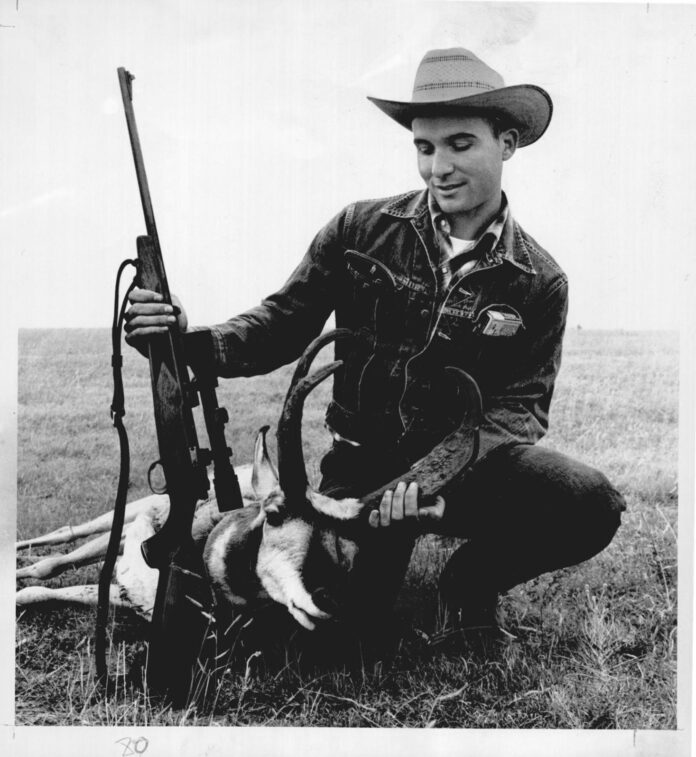
Photograph used in the Daily Oklahoman has a caption that reads: "Showing off the antelope he killed during the recent open antelope season in the Oklahoma Panhandle is Bob Williams of Houston, Texas." c. 1966; photos courtesy of The Oklahoma Historical Society
The Oklahoma panhandle is a curious part of state. Previously known as No Man’s Land, the approximately 6,000 square miles were added to Oklahoma upon statehood in 1907.
“The Oklahoma panhandle is a product of the reduction of the boundaries of the Republic of Texas following its admission to the Union, as the Missouri Compromise and later the Compromise of 1850 mandated any territory above the 36’30 line to be ‘free,’” says Matthew Pearce, Ph.D., state historian with the Oklahoma Historical Society. “About a decade later, the creation of Kansas Territory in 1854 left a tiny sliver of land to the south between Kansas and Texas,” he continues.
The 36’30 refers to a line established within the Missouri Compromise that dictated where slavery was permitted. South of the line permitted slavery, while north of the line prohibited it.
“One could argue that slavery had almost everything to do with the creation of what became the Oklahoma panhandle, starting with the debate over the boundaries of Texas upon its admission to the Union,” says Pearce. The Compromise made Texas relinquish any claims north of the line while also establishing boundaries of New Mexico Territory west of the panhandle.
“The Kansas-Nebraska Act established what ultimately became the panhandle’s northern boundary. Upon gaining statehood in 1861, Kansas designated its western boundary as the 102nd meridian and ceded any of its territorial claims west of that line, which ultimately became part of Colorado,” he continues. “All of this helps explain why the panhandle is bordered by four states.”
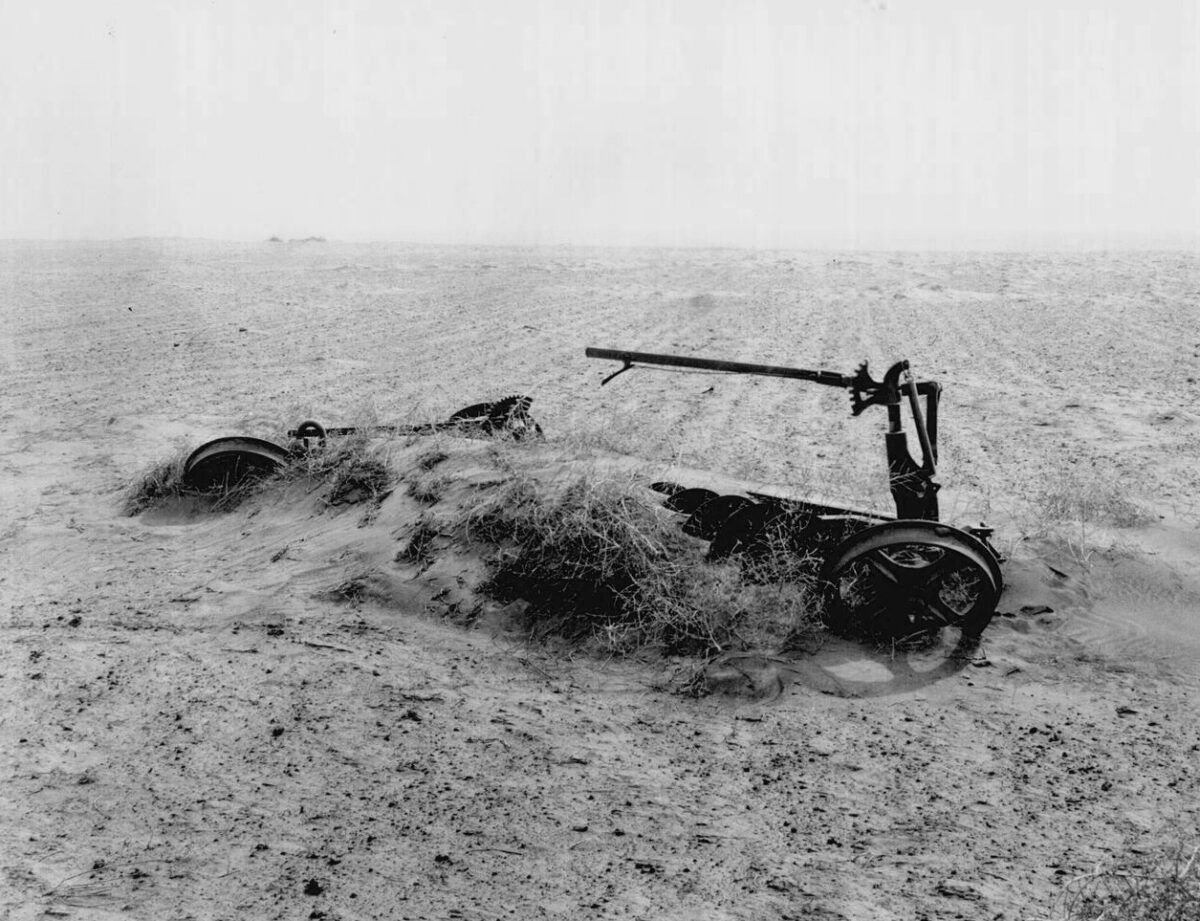
This photo depicts a one-way plow covered by sand from the field. Pictures of this type are quite common in the Panhandle area; this plow is covered by the soil which it helped remove. This was one way plows were blamed for much of the destruction of cultivated wheat fields. c. April, 1935.
With the Organic Act of 1890, which organized Oklahoma Territory, the panhandle was formally placed within the territory.
“The panhandle originally comprised one county, Beaver County. Upon statehood, the panhandle was divided into three counties: Cimarron, Texas and Beaver,” says Pearce.
Because of the almost disconnected nature of the panhandle, the area has developed a distinct identity from the rest of the state.
“Historically the panhandle was cut off from the rest of Oklahoma, and the region remains an afterthought for many in Oklahoma even today,” says Pearce. “Economic development in the region occurred later than the rest of the state and the population in the panhandle was relatively small, with about 3,000 people in 1890.” The first railroad didn’t arrive until 1901, nearly thirty years after other areas in the state, and even now, Cimarron County has the smallest population of any county in Oklahoma.
“As a result, the area has developed a sort of ‘frontier’ identity not all that different from the nearby Texas panhandle,” continues Pearce. “There are a lot of similarities culturally, socially and economically between the Texas and Oklahoma panhandles. For these reasons, the historian Richard Lowitt described the panhandle as ‘America’s Outback.’”
Across Oklahoma, and the country at large, more pets are tipping the scales, and not in a good way, says Rob Miller, DVM, with Woodland West Animal Hospital in Jenks. National surveys show nearly 60% of dogs and 61% of cats are overweight or obese, and Oklahoma veterinarians here report seeing similar, if not higher, rates in practice.
“Obesity in pets isn’t just about appearance,” says Miller. “Extra weight increases the risk of arthritis, diabetes, heart disease and cancer. In cats, it’s especially dangerous. If an overweight cat becomes ill, the stress can trigger a potentially fatal condition called hepatic lipidosis, or liver failure. The good news? With a few changes in routine and mindset, most pets can return to a healthier weight and a more active life.”
After all, if domesticated animals are overweight, it’s not their fault.
“Sometimes there are hormonal shifts, a slowed metabolism after spaying or neutering, or underlying conditions like hypothyroidism or Cushing’s disease,” says Miller. “These conditions can make weight loss far more difficult, even with strict diet and exercise. If your pet is gaining weight despite careful feeding, or if you notice other symptoms, such as hair loss, changes in thirst or urination, or unusual lethargy, it’s time to see your veterinarian for bloodwork and a full exam. Treating the underlying medical issue is often the key to unlocking healthy weight loss.”
Sometimes, lessening the serving size isn’t enough — the type of nutrition has to change. Today, clients have options, including specialized diets and foods. Pet owners can also measure amounts based on a veterinarian’s calculation for exact daily caloric needs based on weight, age, breed and activity level.
Speaking of activity levels, “movement matters just as much as diet,” says Miller. “Regular walks, scent games and short training sessions help burn calories and keep pets mentally sharp. And here’s the bonus: walking your dog doesn’t just help them, it helps you. That movement benefits both species, reinforcing the idea that shared exercise routines improve longevity, emotional well being and cardiovascular resilience.”
If you’re not sure how to make that exercise fun, Miller has some suggestions.
“Dogs may enjoy scent games, puzzle feeders, agility courses, dock diving, fetch with a twist, swimming or group walks,” he says. “Cats can benefit from climbing towers, feather wand play, food dispensing toys, laser pointer chases or window perches for bird watching. Both species can enjoy short training sessions using part of their daily food allowance, or low impact rehab exercises for pets with mobility issues.”
The best – and lowest calorie – pet treat is a pat on the head, a kind word or a moment of play.
“Food rewards have their place, but affection and interaction go even further toward building the bond between owners and their fur kids,” says Miller. “A hungry dog can make you feel like you’re the villain in their life story just for eating a cracker. And while that ‘feed me’ face is undeniably cute, it’s not good for them — or for us — if it works every time.”
He concludes: “With the right support and a little consistency, most pets can lose weight safely and keep it off. The payoff isn’t just physical. A healthier pet moves more, plays more and lives longer for more love and fun.”
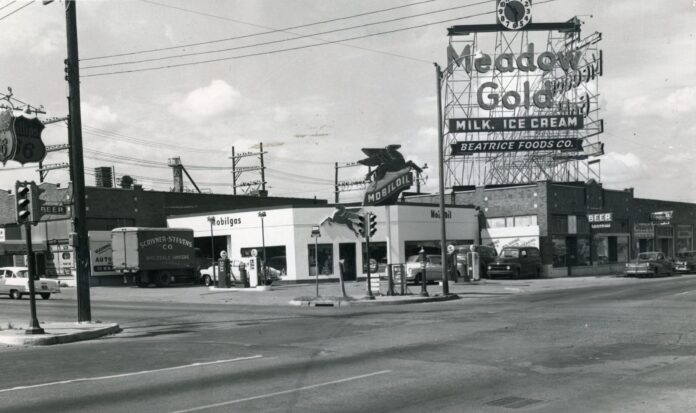
This photo from the 1950s showcases Tulsa’s Meadow Gold sign in its original location on 11th St. at Lewis Ave. The sign was later refurbished and moved two miles west. Photo courtesy Beryl Ford Collection/Rotary Club of Tulsa
Somehow, I missed the news a couple of years ago about how Tulsa had been officially designated as the Capital of Route 66.
In case you missed it, too, here’s what happened: In April 2024, following what the City of Tulsa website calls a “process that lasted more than two years and involved exhaustive research and surveys,” the federal government approved Tulsa’s request to copyright the title “Capital of Route 66.” That process came about through the city’s Route 66 Commission, and it concluded in plenty of time for the Mother Road’s big centennial celebration, kicking off this year.
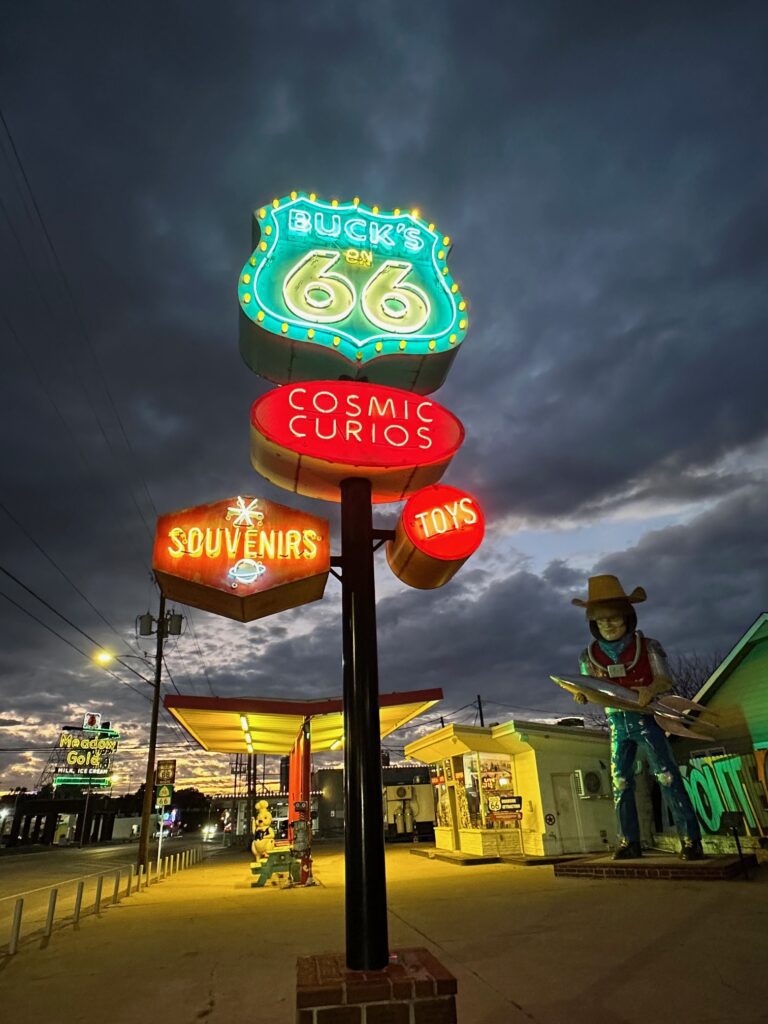
Those driving down Route 66 in Tulsa can view the Buck Atom Space Cowboy, one of several giants on the Mother Road. Photo courtesy Melissa Winterscheid
One of the first 100th-birthday celebrations comes with Route 66 in Tulsa, a new book compiled and written by Tulsans Steve Clem and Becky Hatchett. Published by the South Carolina-based Arcadia Publishing as a volume in its “Images of America” series, Route 66 in Tulsa combines vintage and a few contemporary photos with prose chapters and captions that give historical context.
Thanks to all the hubbub around the centennial and the strong Tulsa-66 connection, there’s little doubt that the release of this book was perfectly timed – which, of course, was Steve Clem’s idea all along. At least, sort of.
“A year or two ago, I did plan to write a [Route 66] book for the centennial,” he says. “But really, I started the project that became this book about a decade ago, when I began driving around Tulsa with a spreadsheet on my computer, chronicling and documenting where every old motel used to be – on 11th Street, on Southwest Boulevard, on Admiral Place. I’ve had a longtime fascination with the old motels and their neon signs, so I devised that spreadsheet and went to all those locations to see what was there now.
“I was asked [by a publisher] if I wanted to do a ‘then and now’ book about Route 66 and Tulsa, but you can’t really do that,” he adds with a chuckle. “You’d be photographing too many parking lots. So much of what was on Route 66, especially when it comes to the old motels and restaurants, were just razed.”
If that sounds like the observation of a longtime Mother Road aficionado to you, you’re right on the money. Clem has, for many years, been an admitted “fanatic” about the Main Street of America; he’s attended events with fellow members of the Oklahoma Route 66 Association for more than a quarter of a century.
“I’ve always been fascinated with the strong connection Tulsa has to Route 66,” he says. “The father of Route 66, Cyrus Avery, was a Tulsan, and he was incredibly instrumental in not only getting Route 66 founded, but also in getting it routed through his adopted hometown of Tulsa. And the other connection is Michael Wallis, who started the renaissance of Route 66 back in 1990 with his book Route 66: The Mother Road. Both he and Cyrus Avery came from other cities to Tulsa and did some of their most outstanding work while they were living here.”
Like all of the books in the “Images of America” series, Route 66 in Tulsa is extensively photo-illustrated. Most of those vintage shots, Clem says, came from the collections of the Museum of Tulsa History and the Tulsa City-County Library.
“It was the combination of those two sources, which both do such a wonderful job with archival photos, and three postcard-collector friends of mine,” he notes. “They’re Route 66 friends I see at conferences and conventions and festivals, and they have massive collections of Route 66 and other postcards. All three of them were kind enough to lend their images to this book.”
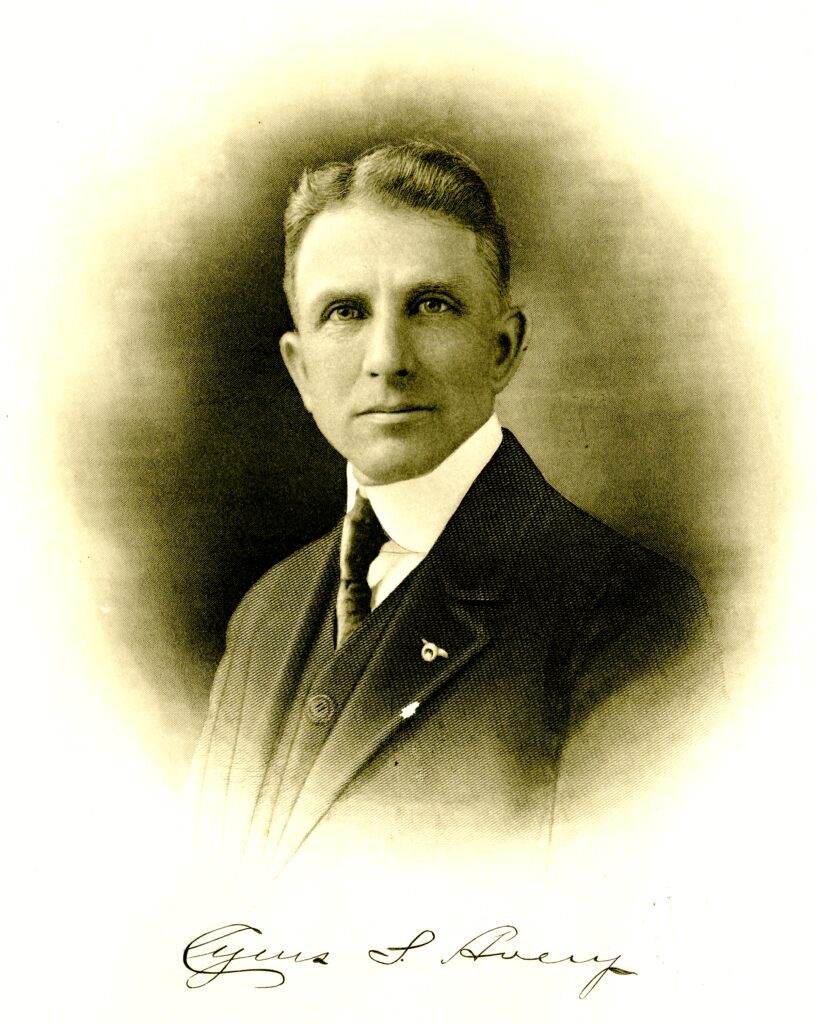
Tulsan Cyrus Avery, known as the Father of Route 66, was part of the committee that created the national highway system in 1926. Avery ensured that U.S. Highway 66, from Chicago to Los Angeles, came through his adopted hometown of Tulsa. Photo courtesy Cyrus Stevens Avery Collection/Department of Special Collections and Archives/
Oklahoma State University-Tulsa
Clem also had assistance in the text department – which is where his co-author, Becky Hatchett, first came in.
“I was searching for an expert on the west side of Tulsa,” he explains. “I research a lot of stuff, and I could’ve just researched the west side and written something about its history. But I didn’t want to be a guy on the outside looking in at that particular area of town. It’s got its own character, its own feel. There’s a kind of east-meets-west dynamic there that we mention in the book, the uptown oil interests vs. the people on the west side who worked in the refineries and had the neighborhoods. So I was looking for expertise and ran into Becky, who’s connected to the west side in so many ways.”
“Steve and I have many mutual friends,” adds Hatchett, “but we had never met each other. He was asking around for someone who could help with the west side perspective – and he knew that Westsiders are kind of sensitive about some things. We want to be called by the correct names, for example.
“People will talk about that whole side of town as being West Tulsa. That is not West Tulsa. West Tulsa is just that little area right across the 11th Street Bridge. It was an incorporated town from 1907 to 1909.
“I’m from Red Fork, and when it was annexed to the City of Tulsa in 1927, the Tulsa World, I believe, ran a contest, trying to come up with a name for the whole area. They were going to give a prize, but it was never decided,” she notes with a laugh. “I think Darla Hall, who was the city councilor over there for a long time, finally decided to just call us all Westsiders, and that’s what’s stuck. But we are all these little towns. We are not a unified whole.
“I also think that people forget we even have Route 66 over there; we have four miles of it. And we have some great attractions. Maybe a lot of Tulsans don’t know about the Route 66 Historical Village, but the people who come in from out of town and from all over the world to the Historical Village know we’re there.”
Originally, Clem sought Hatchett’s help on Chapter Four of Route 66 in Tulsa, the one that deals with the city’s west side. However, he says, “she did such a great job describing it and coming up with archival images that she just started helping me with the rest of the book, and it rose to the level that I asked her if she wanted to be a co-author. That’s how it happened.”
“It was,” says Hatchett of the co-author offer, “nice of him, gracious of him, to do that. And I’ve learned a whole lot from Steve. For instance, I don’t think I understood how important the 11th Street Bridge [spanning the Arkansas River] was to Route 66 being routed through Tulsa. I didn’t really realize the effort that it took to build the road all the way through, that it started out as all these little patchworks of roads working around people’s property lines, until the government got involved.”
The authors devote the book’s final chapter to current Route 66 roadside attractions. Some of them, like Tulsa entrepreneur Mary Beth Babcock’s giant statues and the aforementioned Route 66 Historical Village, are bona fide tourist attractions. Others are less well-known – what both Hatchett and Clem call “hidden gems.”
For example, says Clem, “There’s a wonderful historical marker near Howard Park on Route 66, which is also officially known as the Will Rogers Highway. Right after Will’s death [in 1935], Tulsans lobbied Congress to give it that name because it was a road that connected Tulsa to Los Angeles, and Will lived in Los Angeles. Then, in 2001, a few different organizations got together to place these markers along Route 66, and the one I’m talking about is a beautiful large granite marker with Will Rogers’ image – and a Michael Wallis quote.”
Route 66 in Tulsa is available at the Museum of Tulsa History, Buck Atom’s Cosmic Curios and online at amazon.com.
Main image cutline: This photo from the 1950s showcases Tulsa’s Meadow Gold sign in its original location on 11th St. at Lewis Ave. The sign was later refurbished and moved two miles west. Photo courtesy Beryl Ford Collection/Rotary Club of Tulsa
The Gothic-style Hungarian Parliament building in Budapest is a show-stopper.
Let’s do some travel math. Here’s an equation some might not know: Buda + Pest + the Danube River = Budapest! A city made up of the three aforementioned places is bound to delight! Buda is the hilly area where castles and cathedrals astound, while Pest is flat and full of boulevards. Between the two is the romantic Danube River, flowing underneath ornate bridges of sheer excitement as people stroll across, marveling at the lion statues and grandiose details.
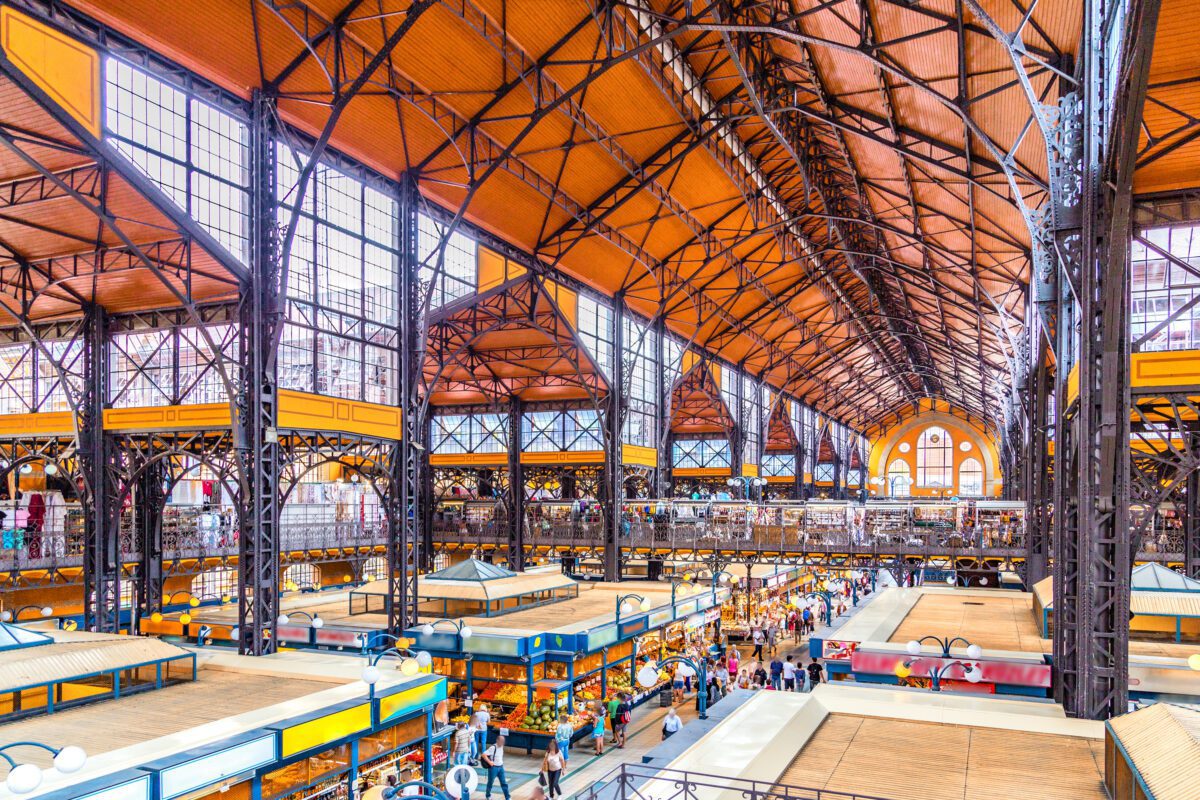
A popular Budapest tourist destination is the Central Market Hall.
Budapest is a city of daily celebration. Restaurants along the Danube River are filled with people simply gawking at the beauty cresting on the Buda hillside. Riverboats glide by with passengers surrounded by “two cities in one,” Buda and Pest, where one side feels modern and the other feels historic. Whatever your mood fancies, just go there; Buda for castles and a town of yore or Pest for places like Andrassy Avenue with its boutiques and taverns.
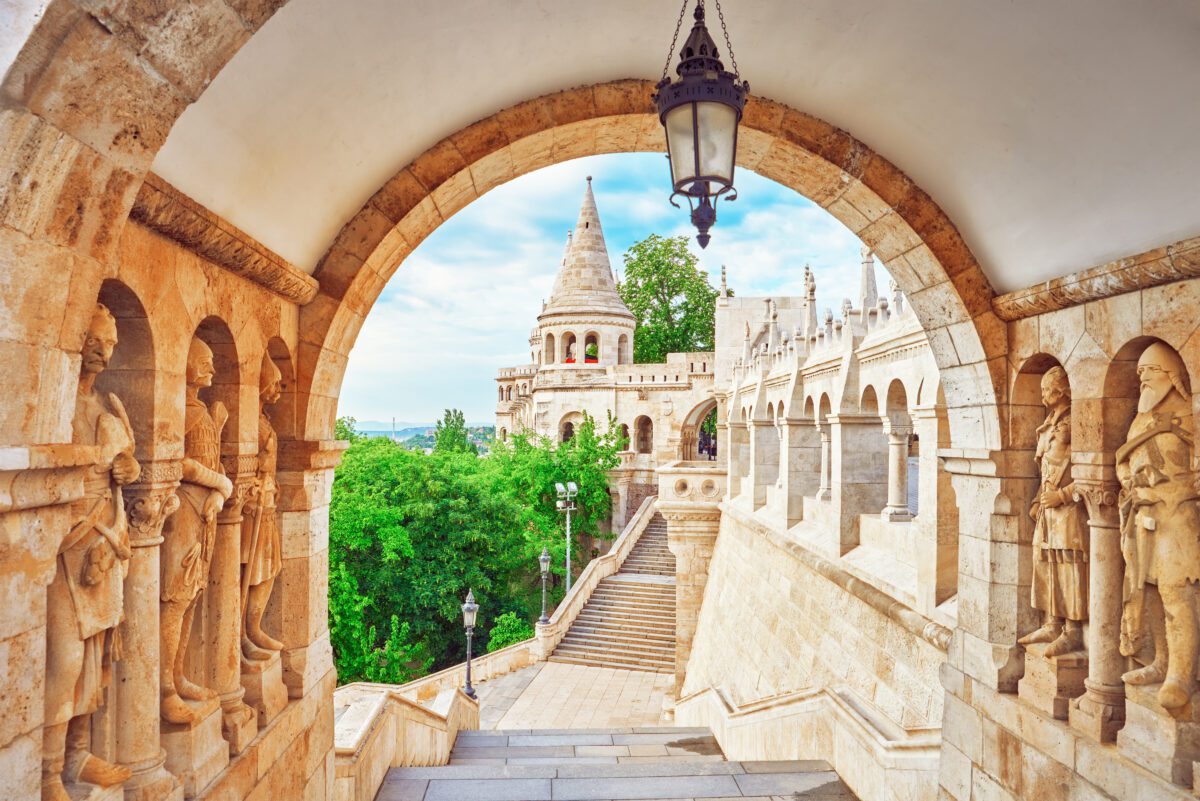
The Old Fisherman Bastion offers stunning views.
Distinct features like the Opera House and the thermal baths make Budapest the epicenter of culture that it is. In fact, the opera house motif happens elsewhere in the city at cafes and hotels. The mind-blowing New York Cafe is a three-story restaurant designed as an opera house with Venetian chandeliers. People pose on various perches there for photos to celebrate the glamour. This travel writer enjoyed a Cortado coffee beverage with gold leaf sprinkles, a famous menu feature. Not only was the beverage delicious but the resulting gold lips afterwards made it a memorable moment. Reportedly, the Dalai Lama has even dined there.
Imagine starting your Budapest adventure with mystery … like at the Mystery Hotel. Entering the boutique hotel, there’s a magic carpet suspended from the ceiling over the front desk. Instantly, you’re in the mood for something special. The elevator doors are designed to look like stage curtains and the elevator interior has “portraits” of famous royals from floor to ceiling. A massive piece of art hangs over the bed. The room has red velvet everything, from the banquette to drapes covering the bathroom and closet areas. You are literally draped in the glamour of an opera house or art museum. Best of all is the “Turkish bath” experience in the spa where a sauna and whirlpool await you within a solarium. The opera-like restaurant even has a balcony.
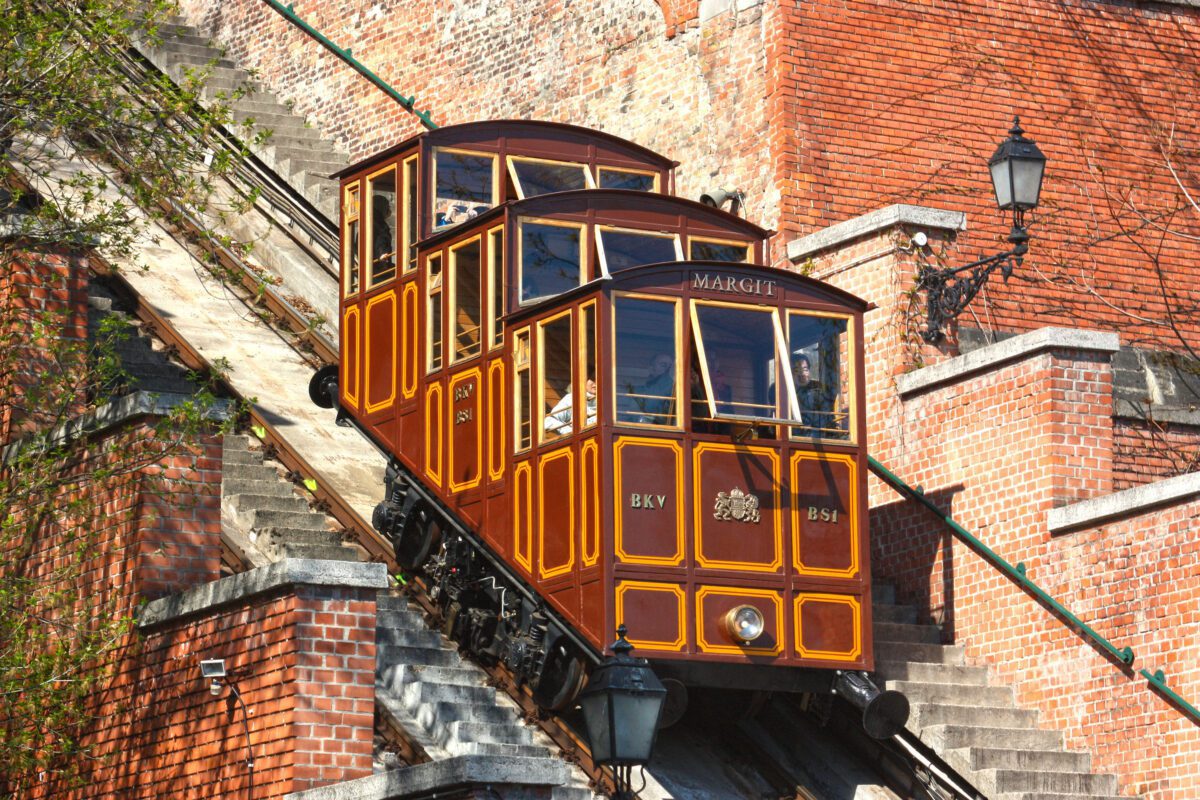
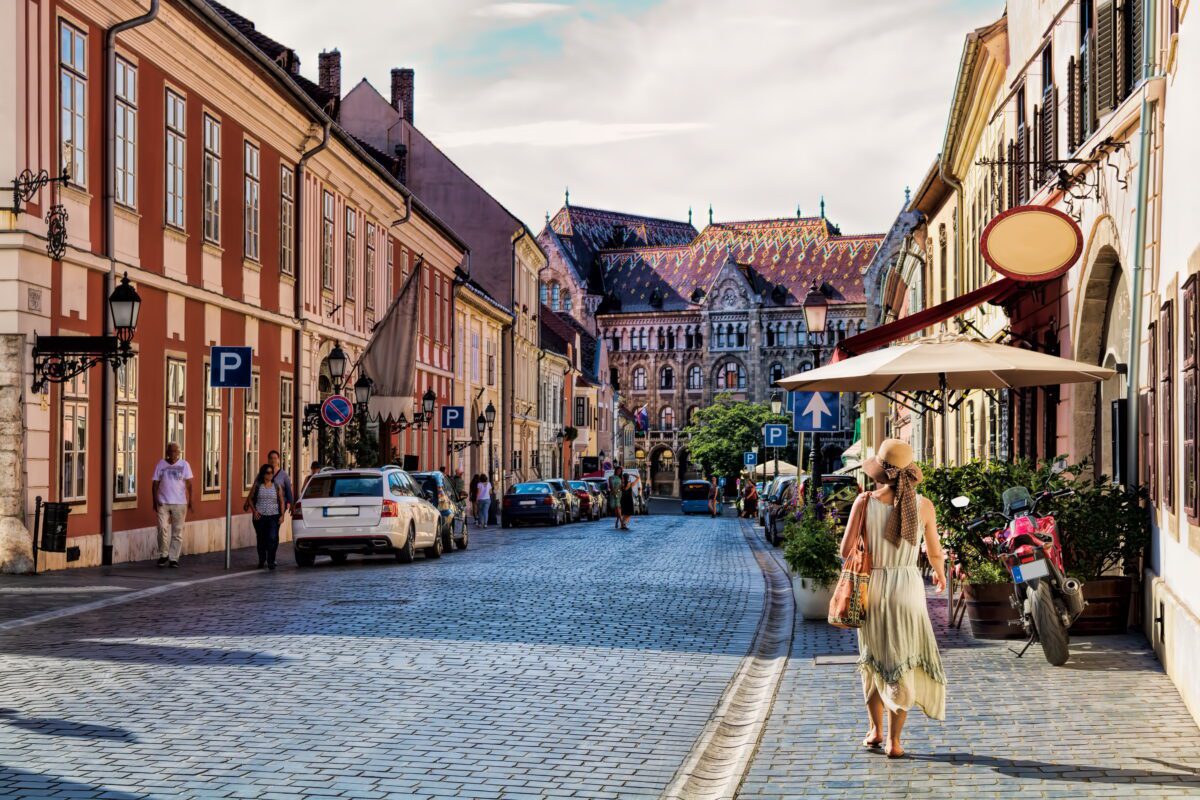
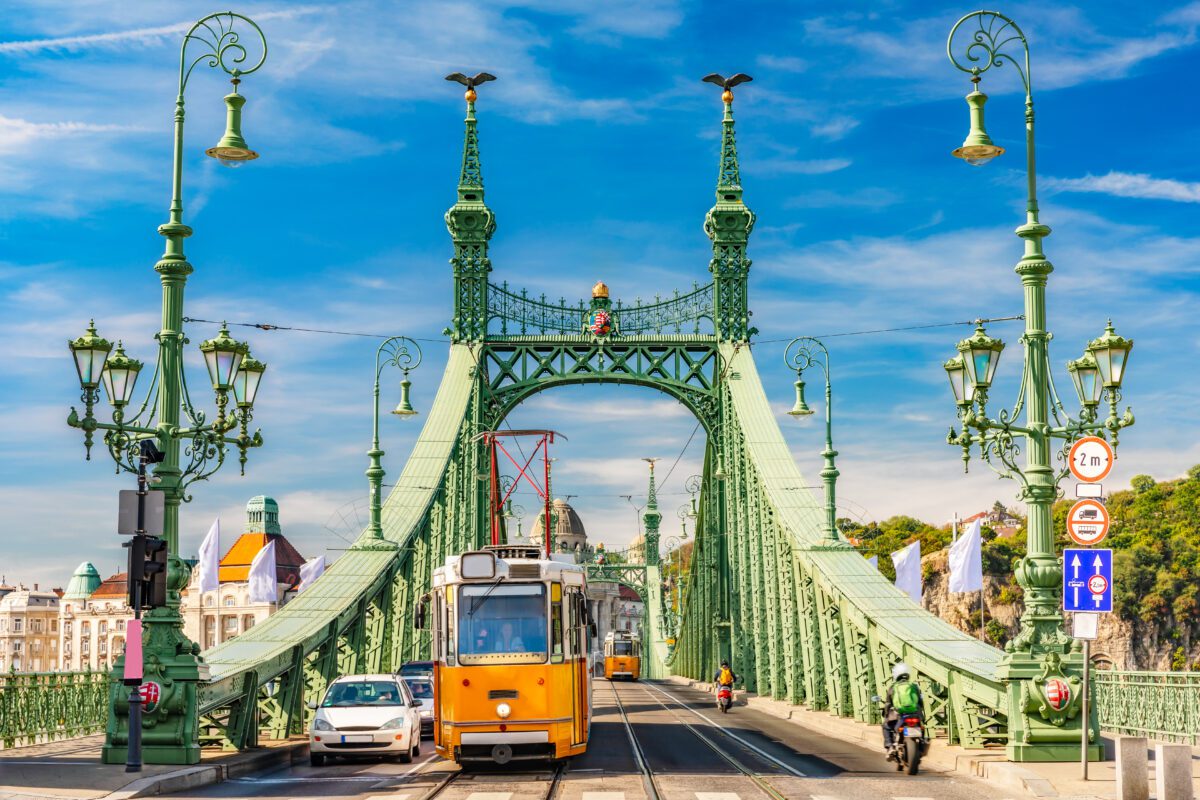
Train cars in Budapest are ideal to avoid steep stairs.Burgviertel is a picturesque neighborhood in Budapest, perfect for window shopping.Liberty Bridge is just one example of Budapest’s outstanding architecture.
All this luxuriating is helpful for your vigorous strolls. You won’t leave Budapest without a stunning outfit or two. After dinners of goulash or other local food, have a beverage at the Callas Cafe across from the Hungarian Opera House in homage to Maria Callas. After all, what is more opera than the diva herself?
Walk into Buda over the iconic Szecheny Chain Bridge, a symbol of unity of the two cities, and take the funicular or tram that ascends the steep hill. You’re instantly transported to historic times as you gasp through buildings within the castle complex. Enter the St. Matthias Church where the gonging bells lift you up into heavenly heights. The palace isn’t only glorious, but it also has interactive experiences like the sketching room where visitors can engage in art activities.
Luckily, there are cafes where you can catch your breath and recharge with refreshments overlooking the Danube River and the city in one fell swoop. The Ottoman influence and Hungarian style in the architecture puts its stamp on the landscape. The gothic, massive Parliament building dominates the rivers’ edge and serves as the centerpiece of the city.
Feast your eyes on Budapest. It’s a travel buffet that leaves you Hungary for more.
Autoimmune diseases can be complex and difficult to diagnose, often lacking visible symptoms. Providing insights to this vast and diverse category of diseases is Mary Beth Humphrey, M.D., a rheumatologist with OU Health in Oklahoma City.
“Autoimmune diseases most often occur when the immune system is unable to distinguish healthy cells and tissues (self) from foreign or abnormal tissues (non-self), such as those resulting from infections or cancer,” says Humphrey. “Autoimmunity results from a combination of genetic factors that lead to increased stimulation or decreased ability to turn off the immune system, coupled with environmental triggers, including infections, sex hormones, chemicals or toxins and smoking, among others.”
She says there are many autoimmune diseases, with estimates ranging from 80 to 150, depending on classification criteria. Some target specific organs, like Hashimoto’s thyroiditis, Graves’ disease and Type 1 diabetes. Others are systemic, affecting multiple organs and tissues, such as lupus and scleroderma.
While autoantibodies are detectable in many cases, diagnosis requires clinical symptoms.
“For some diseases, autoantibodies may be found many years before the autoimmune disease causes symptoms,” says Humphrey. “At this time, there are no cures for autoimmune diseases, but most can be managed lifelong with therapies. In the near future, we may achieve cures with advanced cellular therapies, including genetically engineered immune cells that will target the autoreactive cells.
More than eight percent of the United States population has an autoimmune disease. The most common include psoriasis, rheumatoid arthritis, type 1 diabetes, Hashimoto’s thyroiditis and Graves’ disease. Others include multiple sclerosis, myasthenia gravis, Sjogren’s disease, systemic lupus erythematosus and inflammatory bowel diseases.
Some autoimmune diseases are more common in women due to several factors including sex hormones and X chromosome genes, with lupus occurring nine times more often in women than men. However, some conditions like type 1 diabetes and Crohn’s disease are more common in men.
Humphrey explains that early in the course of the disease, symptoms like painful joints, severe fatigue, mouth sores and headaches may come and go, making diagnosis challenging. Patients may feel unwell but lack obvious signs of illness like casts or surgical scars, which could lead others to underestimate their condition.
Humphrey says there are many ways to help manage chronic illnesses, including autoimmune diseases.
“It is very important to find a provider that listens to you and offers you treatment plans that address your symptoms and conditions,” she says. “Staying active with walking, Tai Chi, yoga and water aerobics can help maintain joint and muscle health and improve pain and sleep. Some people find that changing their diet to a Mediterranean diet or a more restrictive elimination diet for autoimmune conditions (Autoimmune Protocol) can improve their symptoms. For those working or avid hobbyists, an occupational therapy assessment can be useful for modifying their environment and work or hobby tools to help them be as productive as possible.”
In addition, she says illness-specific support groups can help with anxiety and depression while providing practical management tips, and cognitive behavioral therapy and meditation can help manage illness-related stress.
Humphrey also shares that recent research breakthroughs have led to new treatments providing sustained remission for many autoimmune diseases, with promising new therapies using genetically engineered immune cells in early trials.
“We also now understand that uncontrolled diseases like lupus, rheumatoid arthritis and psoriasis lead to early heart disease, causing strokes and heart attacks,” she says. “Therefore, we treat these diseases more aggressively to prevent these early conditions. Overall, we have significantly improved our ability to get patients into remission and allow them to remain free of disability or early death.”
With colder temperatures here to stay (for now), folks who burn wood in fireplaces, backyard firepits and chimeneas are on the hunt for good firewood. Most are undoubtedly aware that in burning wood, they’re literally playing with fire, but might need some additional guidance finding good firewood and using it safely.
A lot of newer homes have built-in, gas-fueled fireplaces, says an official with the Oklahoma City Fire Department’s fire marshal office, but there’s still plenty of demand for firewood, and plenty of opportunities for things to go wrong in outdoor fireplaces, chimeneas and firepits.
“Before you go to bed or leave the house, make sure that the fire is completely out, cool to the touch,” is the advice from Capt. John Chenoweth, assistant public information officer with the Oklahoma City Fire Department, for families with wood-burning fireplaces. “Embers can burn for several hours. Even if you think it’s completely out, it can still burn and potentially cause a house fire.”
Chenoweth also advises making sure any wood being burned indoors is dry – completely – and seasoned. Wood that isn’t completely dry tends to produce a lot of unwelcome smoke inside a residence, he mentions.
The location for storing firewood, whether it’s for an indoor fireplace or an outside firepit or fireplace, chimenea or barbecue grill, should be at least 20 feet from the house.
“Fire piles can attract pests, and can potentially catch fire and set your house on fire,” he shares.
Further, Chenoweth recommends an annual chimney inspection and cleaning.
For wood-burning fireplaces, Chenoweth says that a good metal screen in front of the fireplace can catch any escaping embers.
Riley Coy, Urban Forestry Coordinator for Oklahoma’s Agriculture, Food and Forestry Department, is also adamant about making sure any kind of fire is completely out before leaving the space. Coy’s particular area of emphasis, working for the state in forestry management, is outdoor burning, but the same rules apply indoors.
Regarding campfires, Coy urges attention to the old advice from Smoky Bear about forest fires: Feel what’s left of the embers with the back of your hand. “If you feel heat, bury it with a shovel,” he says.
Coy says many people locate firewood by word of mouth: “I know a guy who knows a guy,” is how he puts it. Firewood can also be found at most big-box retail stores, he mentions.
The most desirable woods to burn are Osage orange and black locust.
“Those are the two hottest burning trees we have in Oklahoma,” he says. Oak and hickory continue to be popular woods, as well. He recommends against burning elm in indoor fireplaces.
“Elm produces a nasty smell,” he says.
Coy mentions that a big problem with firewood is invasive pests, such as the emerald ash bore and the spotted lantern fly, all of which he says travel in firewood. His department’s advice for anyone burning wood outdoors is to “burn it where you find it.”
Chenoweth offers a final word of caution in burning logs inside the home: “Our winter months, not only here but nationwide, are our busiest time for structure fires, and that does include fireplace fires.”
Located along the iconic Route 66 highway in Lincoln County, Chandler offers a mix of nostalgic Americana and attractions that make it a great stop for travelers and locals alike. As the county seat, this vibrant small town captures the essence of the Mother Road with its historical landmarks, all while buzzing with new developments, especially as the Route 66 Centennial approaches this year. Whether you’re cruising the highway or seeking a weekend getaway, Chandler’s blend of pioneer spirit, interactive museums and community energy promises something unforgettable.
Start your journey at the Lincoln County Museum of Pioneer History on Main Street, a free, donation-supported gem that’s been welcoming visitors since the 1980s. Here, you’ll often find volunteer Liz Gulliver sharing stories with locals and Route 66 explorers, highlighting the town’s deep roots in Oklahoma’s frontier past.
For a true immersion in Route 66 lore, head to the Chandler Route 66 Interpretive Center, housed in a 1937 WPA-built former National Guard Armory made of locally quarried, hand-chiseled sandstone, 20 inches thick. The structure served the Oklahoma National Guard until 1971, and executive director Susan Pordos emphasizes its interactive appeal with “six video stations and a cozy theater [which] enhance the individual experience with state-of-the-art technology. The glitter-speckled, vintage-style motel beds bring a whole new meaning to the term ‘Rest Stop.’
“Your Route 66 journey takes place from the seats of a Model A, a Willy’s Jeep, a Ford Mustang and from relaxing motel beds – all of it designed to cultivate a nostalgic mood for a cruise through yesteryear,” she concludes.
The center appeals to all ages, taking visitors on an “interactive trip on the Mother Road – a pilgrimage experienced through an array of audio/visuals portraying the sights, sounds and history of America’s legendary highway,” says Pordos.
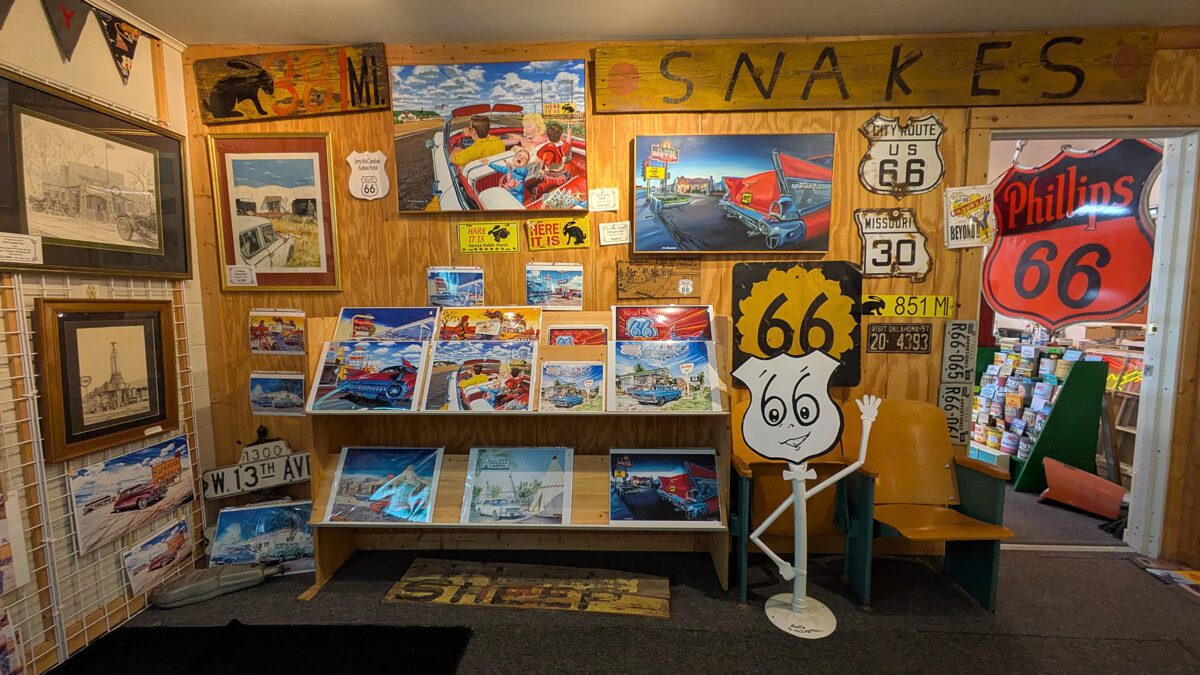
McJerry’s Route 66 Gallery in Chandler offers Route 66 artwork, maps and travel guides. Photos courtesy McJerry’s Route 66 Gallery
The center also features photography of Oklahoma Route 66 icons donated by Tulsa Community College students.
Chandler’s designation as the “Hometown of the Oklahoma National Guard” shines through, thanks to Howard Dickman’s efforts in documenting its history since 1898, with a framed citation proudly displayed on Main Street.
Pordos urges visitors to explore the Route 66 Bowl, where owners Sid and LaDonna invested years in planning the space.
“They have the original Route 66 Bowl Neon Sign from OKC as well as hundreds of vintage signs, gas pumps and multiple [pieces of] memorabilia,” she says.
Chandler celebrates roadside culture artist Jerry McClanahan, recently inducted into the Oklahoma Route 66 Hall of Fame. He authored the Route 66 EZ Guide and coauthored the Here It Is Map Series with Jim Ross, exploring the highway since 1980.
“The City of Chandler was recently awarded grant funding from the Oklahoma Department of Commerce to partially fund a new park in honor of McClanahan to celebrate the 2026 centennial,” built on land that was formerly a baseball/softball field and will be called McClanahan Park, shares Pordos. “You can view his artwork at McJerry’s Route 66 Art Gallery downtown.”
Beyond downtown, gems like the Seaba Station Motorcycle Museum, a 1920s building with 140 vintage bikes curated by Jerry Ries, draw global visitors.
“Visitors from all over the world come in, you can’t name a spot they haven’t come from,” Ries says.
Nearby, Painted Gate Farm, a working cattle ranch and Airbnb owned by Wayne and Janis Baldwin, offers rural charm.
“We fell in love with Chandler because it’s a ‘live’ small town, not a bedroom community,” says Janis Baldwin. “The downtown is alive every day, all day except Sunday, then the churches are alive.”
She praises the active movie theater, Lincoln County On Stage theater group, beautiful parks with walking trails and murals, and agricultural hubs like veterinarians and farm centers.
With its historical significance on Route 66 and exciting additions like McClanahan Park on the horizon, Chandler isn’t just a pit stop – it’s a destination brimming with fun, history and heart.