


















Home Blog Page 665

A Marvelous Merger

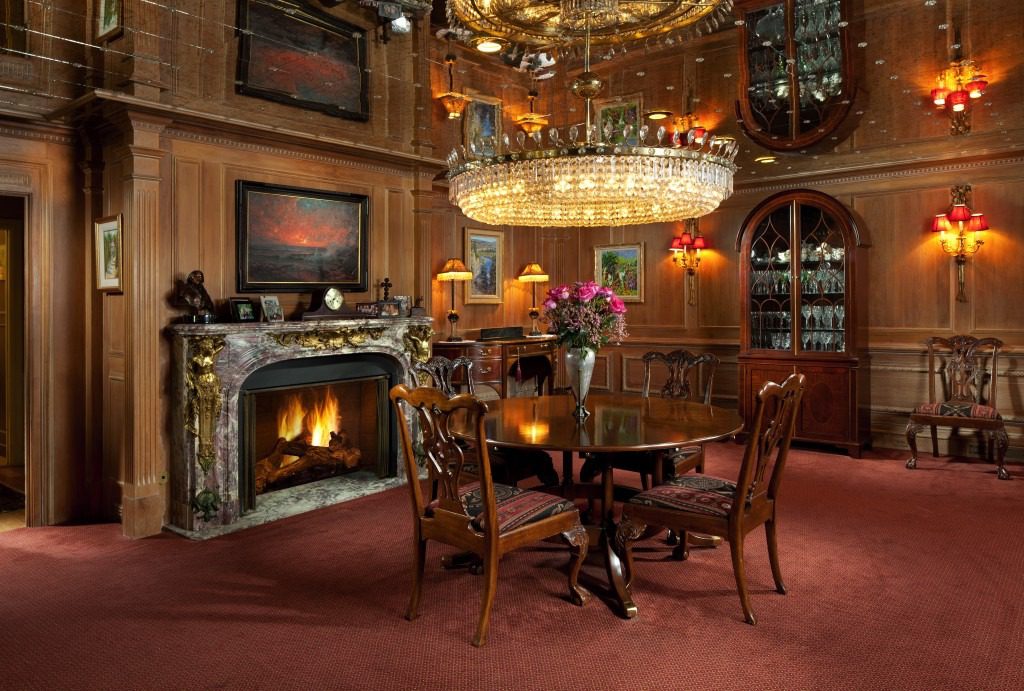
The Chambers-Toal dining room.
Photo by David Cobb.
The Chambers-Toal dining room.
Photo by David Cobb.

For decades, two houses stood side by side, overlooking Oklahoma City’s Crown Heights Park. Both were stately homes.

Roger Dolese wanted a larger showplace, so he bought his neighbor’s home in the 1940s and created a mammoth merger. At last, he had a Midtown country estate.

Roger and Ardith Dolese traveled often to Europe, bringing home exquisite souvenirs, such as crystal chandeliers, marble fireplaces, gleaming wood paneling and ornate crown moldings.

The Doleses divorced and then died, leaving the elegant corner mansion a forlorn, unfinished beauty.

With 12,000 square feet, 46 rooms, 14 bathrooms and an acre of lawn, the home begged for a special new owner. Drs. Susan Chambers and Kyle Toal were ideal buyers for this fabled estate. With a new baby, their existing Crown Heights home seemed too small,

“We definitely got more room,” Chambers notes.

The couple loaned the empty home to the Oklahoma City Orchestra League for its 1997 Designer Show House; among those designers was Jason Johnston, who designed a boy’s bedroom.

Little did Johnston know that project would lead to an ongoing relationship with the couple and a love affair with the residence, now listed on the National Register of Historic Homes.

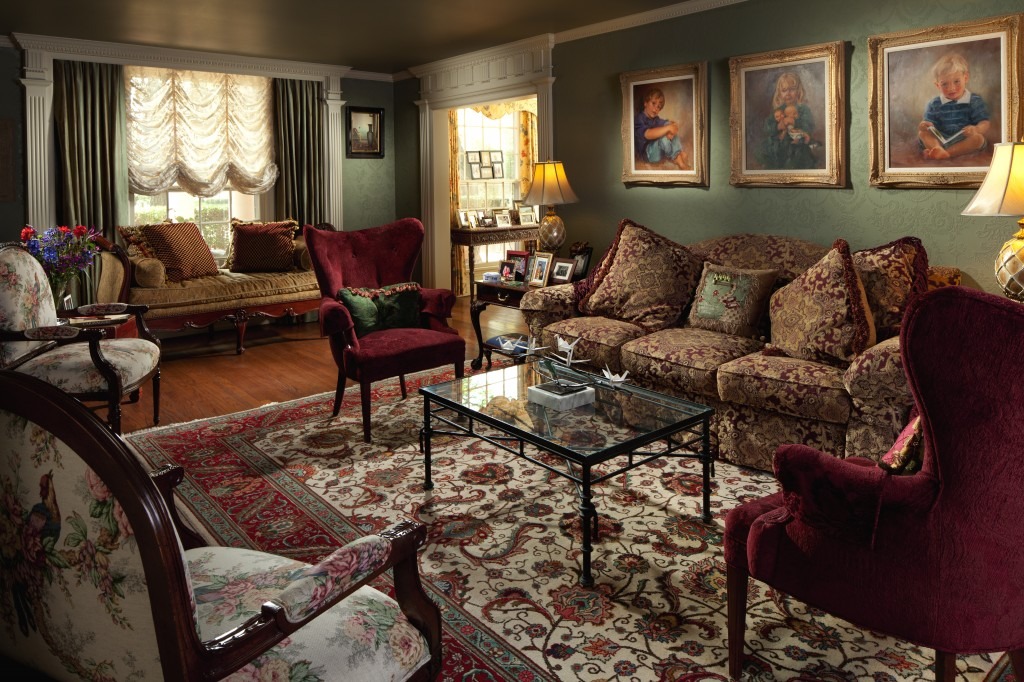
The original consolidation required extensive engineering and architectural feats. When renovation began in 2005, Johnston wanted to update the interiors to complement the couple’s lifestyle, but he also remained mindful of the Doleses’ original plan to make the two homes appear seamless.

“We kept quite a few of the designs from the Show House,” Chambers says. “We also retained as much of the original Dolese home as possible.”

She praises the Doleses’ elegant taste in purchases made on those European trips.

“They did not buy ordinary souvenirs,” she says.

As Johnston worked on the home, the need to study the original blueprints emerged. The Dolese family kept a large, bank-style vault in the basement to store jewelry and other treasures while they were away on frequent trips, especially to Europe to buy antiques. The blueprints had been stored in the vault for years, and no one knew the combination – not even Chambers and Toal.

“I knew those moldy blueprints had to be in the basement bank vault,” Johnston says. “No one had the combination, so I hired a safecracker. Finding those [blue prints] was a real blessing during construction of a new suite upstairs. Those detailed blueprints helped me work within the extensive labyrinth of chimneys, wiring and copper plumbing pipes, which included piped-in chilled water for all bathrooms.”

As the couple’s family grew from one child to three, nurseries became bedrooms and, later, sophisticated suites for teenage and college lifestyles.

The formal entry is Johnston’s favorite area. It makes a grand statement about luxury, sophistication and elegance – hallmarks of the Doleses’ tenure, which the current homeowners have embraced.

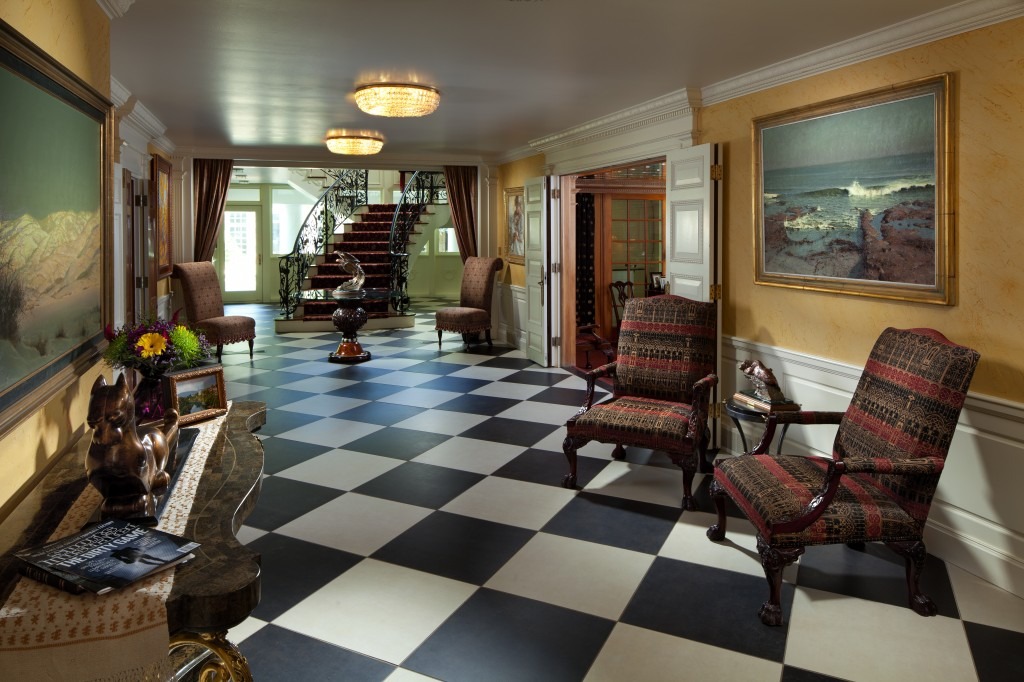
This area posed the greatest challenge for Johnston and LWPB Architects. This formal entryway resembles a movie set with its 1920s-style black and white tile. Custom filigree railings flank two elegant stairways, leading to a landing the size of some living rooms.

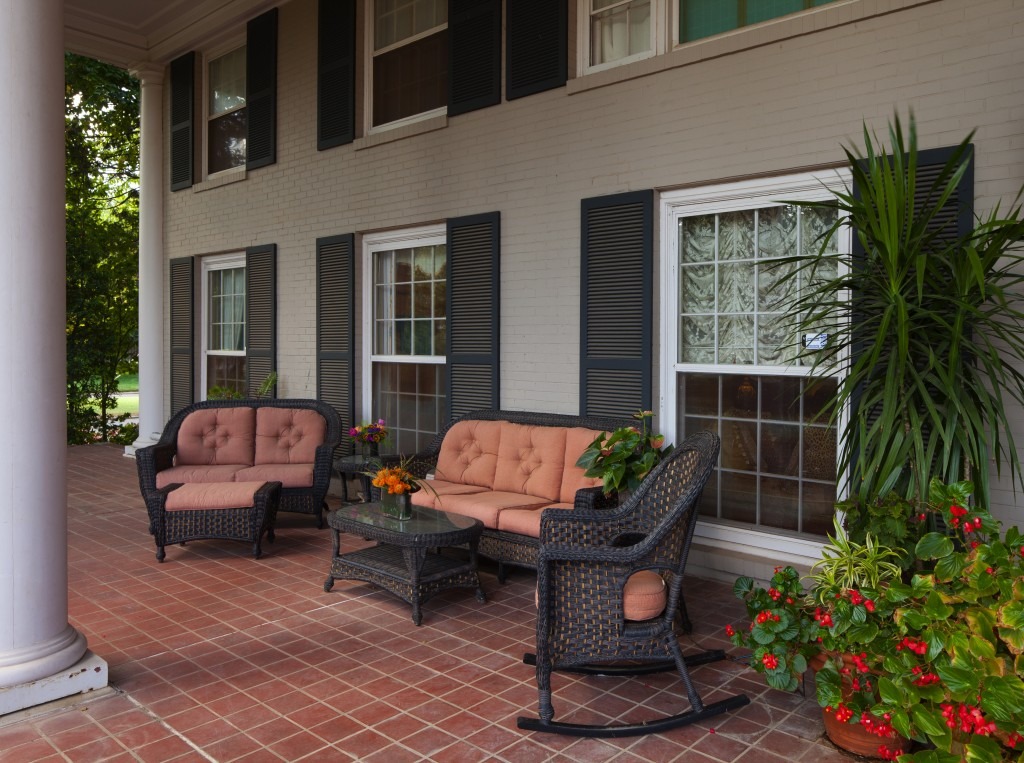
Backing up to the entry is a second story semi-circular veranda, overlooking the back lawn, pool and cabana.

“Kyle wanted a Teddy Roosevelt-style porch, just like the one at the White House,” Johnston notes. “I’m glad we were able to achieve that. The porch leads to the upstairs bedroom suites and finally created a cohesive connection between the two homes.

Johnston’s master plan for the home’s renovation fits the couple’s lifestyle perfectly. Both are civic-minded, and the home’s entry, dining, living and music rooms are settings for civic and cultural events. The upper floors are guest havens.

For Johnston, working on the house has been like an archeological dig. He reverently preserved architectural details, the distinctive wood paneling and crown moldings. He was ecstatic to salvage two delicate panels of 50-year-old pleated Fortuny drapes.

“Now the home really functions well for Susan and Kyle’s lifestyle,” Johnston. “Good design makes spaces work and a house livable.”

Monochrome Class

Jimmy Choo black-and-white woven pumps, $595, Saks Fifth Avenue.

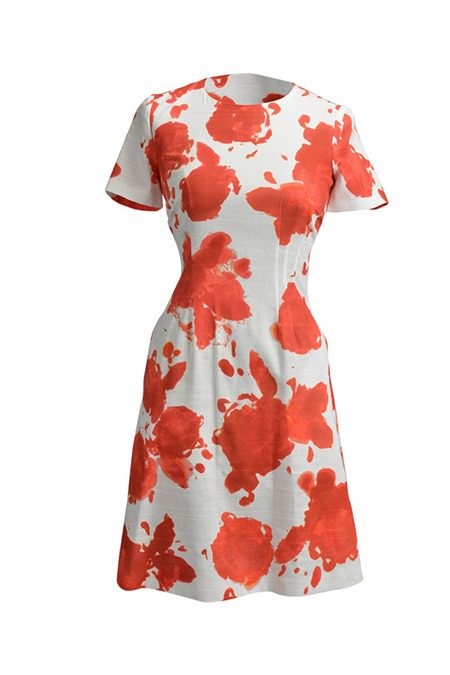
Flower Power

Les Copains coral-and-white floral print dress, $545, Saks Fifth Avenue.


Single in the City

Despite the frigid temperatures, a good crowd checked out the scene at the I.D.L. Ballroom on Feb. 4 for Oklahoma Magazine’s Single in the City. The night, which benefited Emergency Infant Services, included happy hour, delicious bites from some favorite area restaurants, great entertainment from Eric Himan and the main event singles auction.

The Scene

Mellow Yellow

Jimmy Choo yellow-silver ombre pumps, $695, Saks Fifth Avenue.


Poolside Views

It’s the time of year to begin thinking about being pool-ready. From an extra couple minutes at the gym to waxing, springtime means getting the body in shape for warmer temps.
Feet should not be neglected as we enter pedicure weather, either. Clarisonic has a new tool that is specifically designed for feet. The Clarisonic Pedi Foot Transformation Set includes three formulas to smooth, exfoliate, soften and hydrate. The head moves at a powerful “foot frequency” to ensure safe treatment. Included are a buffing brush that can be used wet or dry and a smoothing disc to exfoliate. Pedi-Balm, also included, softens skin. In a study, women reported a 10-times smoother feel than with regular manual buffing. Bring on the sandals!


Crafting Ancient Tradition

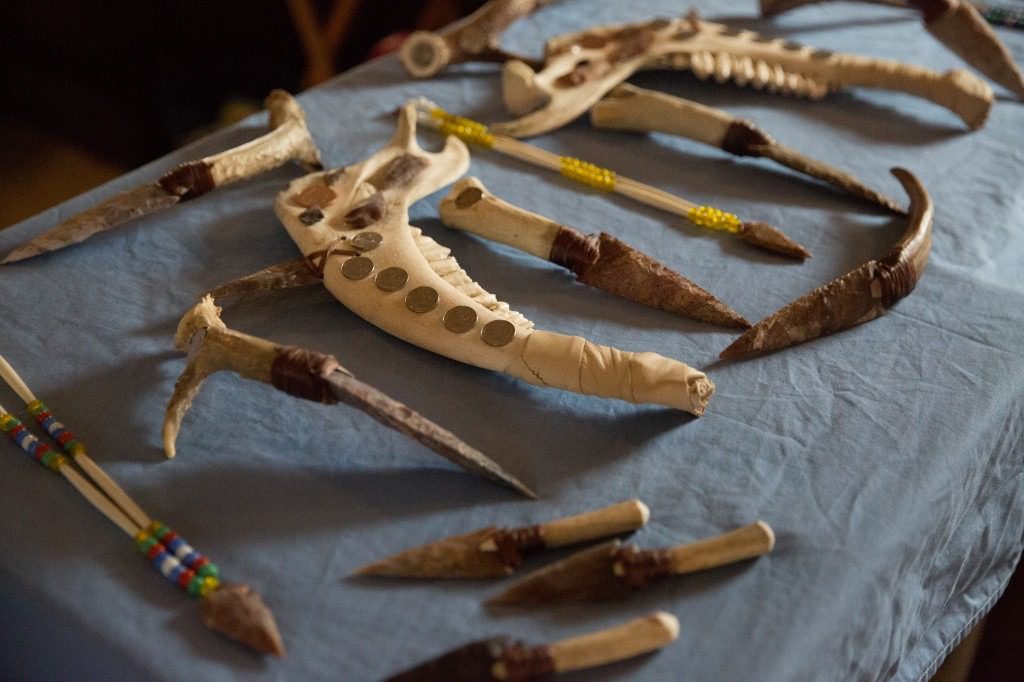
John Knifechief makes traditional warrior tools.
Creations from deer buckhorn, feathers and sinew are traditional tools for Pawnee warriors. Photo by Brandon Scott.
John Knifechief has embraced traditions of his ancestors by crafting traditional native tools. Photo by Brandon Scott.

Six years ago, Chouteau resident John Knifechief’s life changed forever.

While riding his motorcycle on a rainy day, Knifechief was hit head-on by a driver who swerved into his lane. The accident took a grim toll. Knifechief’s foot had to be reattached by surgeons, and he spent almost eight months in the care of his brother, Charles. Unable to work to this day, the single dad says he turned to his past to secure his and his then-5-year-old son’s futures.

“My dad was a farmer in Pawnee, Oklahoma, and when he would plow the fields, I would pick up the arrowheads and flint and watch him make bows and arrows,” the full-blood member of the Pawnee Tribe says. “When the accident happened, I went back to my dad’s old teachings. That’s how I pay the bills and raise my son.”

In addition to bows and arrows, Knifechief creates other traditional Pawnee tools and weapons. Using such materials as deer buckhorn, wild turkey feathers, deer and calf sinew and flint collected from around the region, the artist knows the history and tradition behind each handmade object.

“When the young men of the tribe first became warriors, they would use these to hunt,” he says of his four-foot-long buffalo arrows. In addition to the arrows and bows, he also makes such tools as buffalo knives and spears, hide scrapers, tomahawks and war clubs and shields.

Knifechief says there are many personally rewarding aspects of his work, including teaching the craft to others, including his son.

“I’m the only one left in my tribe to carry on the handmade tradition of bows and arrows,” he says. “I get to honor my father…I think this is a dying art, and I’m happy and honored to carry on the tradition of bow- and arrow-making.”

Leah’s Song

Paul Rossler’s first foray into recording Red Dirt music came in the mid-‘90s, when Tom Skinner and Jeff Parker each recorded one of his compositions for producer Bob Kline’s Red Dirt Sampler. The artists and songs on that CD helped further define the Stillwater-based musical style known as Red Dirt – an unequivocally Oklahoma sound blending folk, rock, blues and country elements with intelligent, close-to-the-soil lyrics that recall both the social consciousness of Woody Guthrie’s populist anthems and the joyous escapism of Bob Wills’ western swing.

Now, some 20 years later, Rossler and an eclectic group of musical associates, known as Diffident Rebel, have thrown another ingredient into Red Dirt’s bubbling musical stew. The band’s new disc, Red Dirt Reggae, puts a distinctly Jamaican twist into songs written and sung by Rossler, creating something that’s even a bit outside the generous parameters of the Red Dirt genre.

According to Rossler and musician-engineer Heath Ham, Red Dirt Reggae was born on a summer’s night in Sapulpa in 2013. Rossler was jamming with his friend Roger Johnson in a room at Johnson’s Over Edukated Music and Arts when Ham, who had his studio in the same building, came by and asked if he could sit in.

“What Paul and Roger were doing was folky,” Ham recalls, “and I just started adding a little reggae groove to it. It easily transferred over; he was able to do the same things vocally that he was doing with just his acoustic guitar. So I figured if we could take that Red Dirt sound and kind of change the groove, we could get some people dancing to it, maybe.”

“The more we talked about it, the more I realized they [Red Dirt and reggae] had a lot in common,” adds Rossler. “I’m probably not saying this the right way, but reggae is a takeoff on the pick strum – you just don’t have the pick. It’s got the strum on the two- and four-beat. It seemed to just fit.”

Rossler, who grew up in Detroit, began strumming guitar in the late 1980s – around the time Ham was born – while doing graduate work in engineering at Virginia Tech.

“That’s when I first began hearing that mountain sound, that Appalachian folk music, and started digging it,” he remembers. “I just liked that folksy, rootsy sound. I got a guitar, learned my first three chords and started writing songs.”

After earning his doctorate, he came to Oklahoma State University to teach, and that’s when he became involved in Stillwater’s Red Dirt scene.

“There was something about the land, the people and the sounds,” he says, that began taking him and his music in a new direction. Just starting his Cimarron Sound Labs (since moved to Tahlequah), producer-musician Jeff Parker was the first Red Dirt figure to take an interest in Rossler’s songs. Others soon followed, including Skinner.

“Tom Skinner told me I needed to go out there and start playing,” he says, “but I just didn’t. I didn’t think I was good enough.”

Then came what he describes as “some of the twists and turns that you get in life.” The Red Dirt roads receded in his rear-view mirror when he returned to Michigan to live. And his guitar – a Seagull S6 Original he’d purchased at Daddy O’s Music Company in Stillwater – remained in its case, unplayed and unacknowledged. Rossler didn’t even get it out when in 2000 he returned to Oklahoma, settled in the Tulsa area and began working as a patent attorney.

Then came the emotional evening in 2012 that he visited a friend and co-worker who’d been diagnosed with terminal cancer.

“I saw how she and her husband interacted with one another,” he adds. “We were looking over Riverside Drive, and he reached out and held her hand and told her everything was going to be okay. I was deeply moved by that. Then, a couple of days later, she came to my law firm to pack up her belongings. She was resigning from the firm. I walked back to my office, shut the door, and wrote the words to ‘Leah’s Song.’

“When I got home and pulled out my guitar, it was trashed. The braces were broken on it. My kids had jumped up and down on the case. And I had the old strings on it. But I wrote ‘Leah’s Song’ on that guitar and played it for her a week later.”

“Leah’s Song” broke the dam that had been holding back his music for more than 15 years, and the songs began cascading out. Since then, Rossler estimates he’s composed more than 75, including all the tunes on Red Dirt Reggae. And in classic Red Dirt style, the members of Diffident Rebel who came together to play them did so in a manner that Rossler terms “really organic.”

“The first song we recorded was ‘Leah’s Song,’” he remembers. “We put a reggae beat to it, and Heath said, ‘You know, I think this would sound good with horns in it. Would you object to me putting a trombone in it?’”

The trombonist was Steve Ham, Heath Ham’s father and a well-known Tulsa-area bandleader and musician. Soon, Steve Ham’s contemporaries Mike Bennett (trumpet) and Gary Linde (saxophone) were adding their own ingredients to the mix. Meanwhile, Ham was programming all the drums and some of the bass tracks, with Antjuan Robinson playing the rest.

“He’s kind of my mentor as a producer, and his mentor was Wayman Tisdale,” says Ham of Robinson. “He played some of the real good, funky-sounding bass, and he let us go over and cut vocals in his studio, the Kontracktors Music Group.”

The main background vocalist is Teddy Soliday, whom Rossler describes as “a musical savant.” Ham was passing out flyers for his studio when he first encountered Soliday, who was working his regular job at Reasors Foods in Sapulpa.

“He said, ‘Yeah, man, I play a little bit,’ and I said, ‘Well, come on by and check it out.’ He came by, and he shredded guitar – just ripped it,” says Ham. “Then he sang for me, and I was blown away. He has one of those real smooth, really in-pitch voices. I was like, ‘Dude, we need a background voice for the record.’ So he just stepped in there and did it.”

Guest artists on the disc include trumpeter Dave Johnson, cellist Cathy Radd, ukulele player Mike Schmidt and background vocalists Jeremy Carlock, Dusty Dobson, Addison Johnson and Rossler’s jam partner Roger Johnson.

Diffident Rebel is now in the process of going from studio group to live act, planning several appearances in support of the disc. Meanwhile, both Rossler and Ham want people to know that gravy-training the popular Red Dirt scene is not their ambition at all.

“By calling it Red Dirt Reggae, we just want to let you know that here’s a reggae album organic to Oklahoma,” says Ham. “We’re not trying to tag along with anybody. That’s not our intent. We wanted to make some authentic Oklahoma reggae, and it just flew out that way.”

Remodeling & Renovation

With the winter over, homeowners across the state assess the condition of their homes and consider necessary repairs and desirable upgrades in time for the year’s warmer months. Whether it’s a roof in need of fixing, an addition to your home, or a brand-new kitchen that’s on your agenda, Oklahoma Magazine’s April feature on remodeling and renovations is sure to provide inspiration, ideas and practical help in making sure your vision is transformed into a reality.   For this feature, we talk to industry leaders and veterans of remodeling and renovating in order for them to share their expertise with our readers, provide handy tips and to discuss the latest trends in transforming your home into your family’s castle.