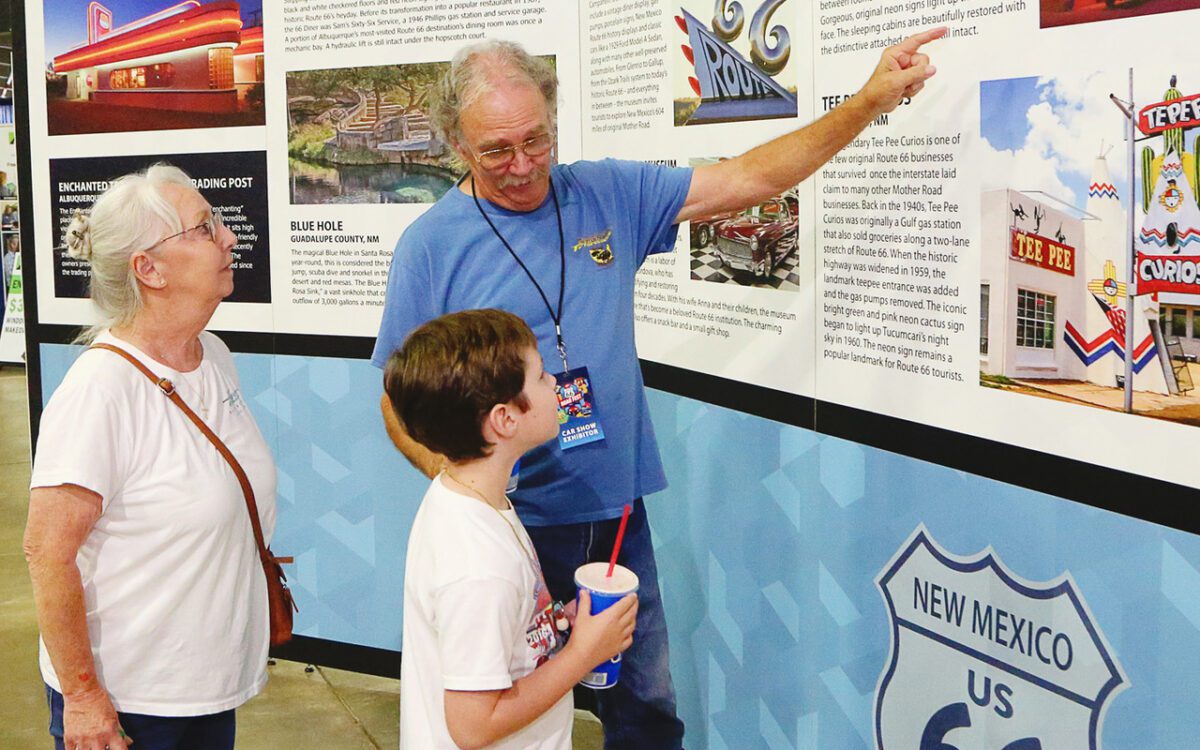
Route 66 Road Fest, June 22-23 at Tulsa’s Expo Square, welcomes Mother Road enthusiasts from around the globe. Photos courtesy Route 66 Road Fest
Route 66 – often dubbed the Mother Road or America’s Main Street – was one of the original highways created in the United States. Established on Nov. 11, 1926, the road has become one of the country’s most famous, as it originally ran through Illinois, Missouri, Kansas, Oklahoma, Texas, New Mexico, Arizona and California. The freeway was officially removed from the United States Highway System in 1985 due to its replacement by segments of the Interstate Highway System. However, there’s an event happening right here in Oklahoma that celebrates and commemorates the history and cultural significance of Route 66.
The Route 66 Road Fest, running June 22-23 at Tulsa’s Expo Square, offers guests just about everything there is to know about the Mother Road. There are plenty of activities and sights to behold this year, just as they have been in years past – plus a few new things to get excited about, too.
“We will still have the historical exhibits, car shows and vendors from across the country, but this year we’ve added a couple of new things to the activities area that we think people will really like,” says Wade Bray, the producer and curator of the event. “We also updated something in The Journey,” he says.
The Journey, an interactive and educational exhibit, looks back through Route 66’s long history, complete with photos, music, artifacts and fun facts for the entire family. It covers all the sights and sounds of America’s Main Street from its beginnings in the 1920s right up to today.
Other attractions include a pinewood derby, miniature golf, Hot Wheels races, interactive art, a virtual reality arena and even some wandering dinosaurs. There will also be a car show with photo opportunities with special guest Richard Rawlings – star of the reality TV show Fast N’ Loud.
Bray says that enthusiasts often make repeat yearly visits, so he tries to have different exhibits when possible.
“We strive to add new elements each year so that our returning visitors have something fresh to see and do,” he says. “One of the really fun things to put together each year is the Presentations Stage lineup. This is where we have conversations with Route 66 authors, experts and online personalities, covering a wide range of subjects from the history of the Route to the Centennial preparations to UFOs and haunted places along the Mother Road.”
Previous guests have included authors Michael Wallis (Route 66: The Mother Road) and Candacy Taylor (Overground Railroad), as well as author/historian Bob Blackburn (Oklahoma City: Film Row). As of this writing, the 2024 schedule has not yet been released, but will be updated on the website – route66roadfest.com – when it’s finalized.
Preparing for the Centennial
2026 marks the 100th anniversary of the creation of Route 66, and enthusiasts are planning to celebrate accordingly.
“Centennial preparations are underway across the country, and each of the eight states the Route passes through have commissions working on their respective celebration plans,” says Bray. “As for the Road Fest – 2026 will have a special feel and extras not seen at previous events.”
A century’s worth of history and festivity will soon come to pass, and Bray couldn’t be more excited.
“The Mother Road is such a unique piece of America’s history and it deserves a special celebration,” he says.
FlyTulsa offers everything from sky tours to East egg drops, outdoor festivals and gender reveals. Photo courtesy FlyTulsa
Oklahoma’s legendary sunsets are a spectacle, painting the horizon with hues of gold, purple and crimson that linger in the memory. Now picture yourself witnessing this natural wonder from the unique vantage point of a helicopter cockpit, where the vast expanse of Oklahoma sky becomes your canvas.
SkyTours Hochatown and FlyTulsa Helicopters are just the ticket to see the colors of the sun like never before – along with other stunning views.
SkyTours operates a Robinson R44 helicopter equipped with advanced safety features to ensure a secure and thrilling adventure, says manager Colby Dye.
“Our streamlined process begins with a comprehensive safety briefing led by experienced staff members,” he says. “Guests are provided with headphones for clear communication and the opportunity to ask questions during their flight.”
At SkyTours Hochatown, flight times range from 3-minute adventures to 30-minute journeys, all at reasonable prices. Photo courtesy SkyTours
Nestled in southeast Oklahoma, Hochatown boasts stunning natural vistas, including Broken Bow Lake, the Mountain Fork River and Beavers Bend State Park.
“These scenic locations offer a plethora of activities, from helicopter tours to zip-lining and fishing excursions,” says Dye. “We offer a range of flight options, starting from a 3-minute adventure priced at $45 per person to a 30-minute journey beginning at $299 per person. Our commitment to affordability and inclusivity ensures that everyone can share in the joy of aviation.”
But the experience doesn’t end when the flight touches down.
“After an exhilarating flight, guests have the opportunity to leave their mark on our hangar walls, commemorating their unforgettable experience alongside fellow adventurers,” says Dye.
At FlyTulsa Helicopters, you’ll experience something similar; the pilots also fly Robinson R44 helicopters, which have capacity for three passengers and the pilot, says Becky Woodward, the company’s location manager.
“Everyone gets a large window, so it’s great for tours, and we can take the doors off if we want,” she says. “We do everything from flight training to the perfect date night flight. We also do Easter egg drops, corporate events, outdoor festivals, gender reveals. You name it, we can probably do it.”
Woodward mentions that the company wants to make flying as accessible as possible to Oklahomans.
“Passengers of all ages and abilities can fly with us,” she says. “We have flown two-day old twins and a 101 year old grandma on a trip.”
She mentions that passengers do not need to bring anything special for a flight, except a phone for photos. The team will always ensure you have ample opportunities to get the perfect shot.
“The Metro Tour is one of our most popular 24-mile flights,” says Woodward. “It takes you north along the Arkansas River and into downtown Tulsa. After a loop through downtown, you’ll travel south and get excellent views including the Gathering Place, Oral Roberts University, the River Spirit Casino and the Aquarium.”
Passenger Safety Tips
Remove any loose items from your person and pockets before boarding the helicopter.
Never approach a helicopter without a pilot’s permission to do so – especially if the engine and rotors are on.
Approach and exit the helicopter from the front or side, never outside of the pilot’s line of vision.
Keep your seatbelt firmly fastened at all times.
Do not open helicopter doors unless instructed to do so by your pilot.
WildCare Oklahoma rehabilitates injured, ill and orphaned wildlife before releasing it back into the wild. Photos courtesy WildCare Oklahoma
Providing medical and rehabilitative care to wildlife, one nonprofit organization works to return these animals back to their natural habitats. WildCare Oklahoma, located in Noble, is one of the ten largest wildlife rehabilitation and conservation organizations in the country, and is among the few with a wildlife hospital in the midwestern United States.
Last year, the organization cared for 7,374 animal patients representing 215 distinct species, and nearly all were negatively impacted due to some sort of human interaction – such as displaced habitats, car collisions, domestic animal attacks, or injuries from utility lines or barbed wire.
“WildCare is a unique organization in the state of Oklahoma,” says Inger Giuffrida, WildCare’s executive director. “We are the only center with a wildlife hospital in the state, and we are open 365 days a year. In addition to the medical and rehabilitative care of injured, ill and orphaned wildlife from throughout the state of Oklahoma, we help people humanely resolve conflicts they are having with wildlife, provide in-person education for thousands of Oklahomans every year, and serve as the voice for the intrinsic value of wildlife and the places they live.”
WildCare Oklahoma rehabilitates injured, ill and orphaned wildlife before releasing it back into the wild. Photos courtesy WildCare Oklahoma
Last year, WildCare answered 18,000 calls addressing a wide range of animal-related questions, concerns and conflicts, says Giuffrida. The public is often unaware that Oklahoma is one of the most ecologically diverse states in the nation. And with myriad unique regions like prairies, cross timbers and mesas, there comes a wide array of plants and wildlife. WildCare emphasizes education to share its appreciation for natural wonders.
“WildCare’s active leadership in conservation education has an impact far beyond our direct care for wildlife in the state,” says Kyle Abbott, DVM, WildCare’s medical director. “As a wildlife rehabilitation center, we incorporate findings from research and best practices from the field of wildlife medicine to provide the best possible care given our infrastructure and resource constraints.”
Animals affected by human activity that receive care from WildCare Oklahoma include amphibians, reptiles, mammals and birds including raptors, waterbirds and songbirds.
“WildCare’s impact extends throughout and beyond the state, particularly with our care of migratory birds,” says Elise Gundlach, certified wildlife rehabilitator and WildCare operations director. “Every spring and fall, millions of birds transect our state through the central flyway. Sadly, many of these birds get hurt during this journey. Luckily, caring Oklahomans get those birds that need help to WildCare for help.”
The nonprofit provides wildlife rehabilitation with its hospital, and animals are only kept until they are well, healed or fully developed, then released. Wildlife rehabilitation centers like WildCare should not be confused with for-profit wildlife collections open to the public (many depicted in the Netflix documentary Tiger King). It is also not an animal sanctuary where visitors interact with animals spending their lives in captivity.
“Our goal is to heal wildlife or help them develop from orphaned infants or juveniles to adults that can survive in the wild, and then we give them that second chance in the wild they deserve by releasing to appropriate habitats throughout the state – in many cases back to the area from which they originally came,” says Giuffrida.
To achieve this, WildCare does not permit visitors to the center – except during its annual baby shower, the one time a year a limited number of guests can see the work of WildCare from behind the scenes.
WildCare’s wildlife rehabilitators and veterinary team also minimize interaction with animals. Why?
“To keep them wild,” says Giuffrida. “One of wildlife’s best defenses is to steer clear of humans once released to the wild.”
WildCare does not receive any federal, state, county or municipal funds and instead depends on donations from people that care about wildlife and its future in the state. Learn more at wildcareoklahoma.org.
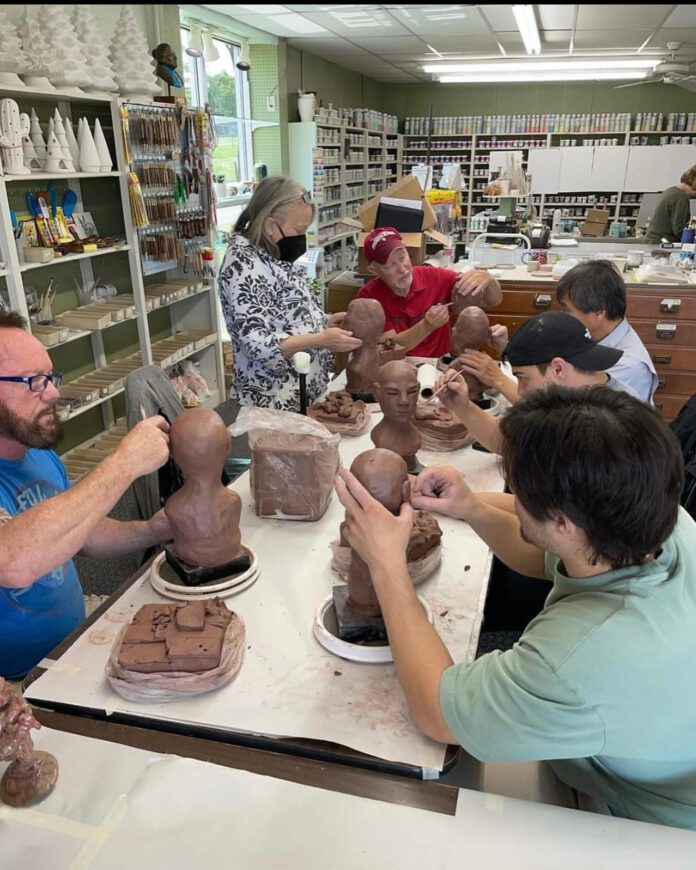
At OKC’s House of Clay, patrons can try throwing and sculpting classes, or take home bags of clay to practice. Photo courtesy House of Clay
Creating pottery has a storied history that goes back millennia and spans myriad cultures. It has endured and thrived as an artform, and is still popular today, both as a livelihood and a hobby fit for children and adults alike.
“There’s a lot to learn in ceramics and pottery, and you make it as simple as you want to or it can get pretty complicated if you really, really get into it,” says Judith Wagenseller, owner of House of Clay in Oklahoma City. The business has been serving Oklahomans for 74 years, since Wagenseller’s parents bought it in 1950.
The simplest way House of Clay customers can enjoy pottery is to paint pre-made pieces. Individuals or groups can come in, pick a piece of bisque pottery in whatever shape or design they like, paint the piece, leave it behind to be glazed and fired in a kiln, then pick up the finished piece at a later date.
Jeff Stunkard, who owns Purple Glaze Studios with two locations in Tulsa, has also offered this fun pastime to customers for more than 30 years. Stunkard mentions that in the past, the biggest challenge for people was coming up with ideas for how to decorate their pieces. But today, ideas are more accessible due to the accessibility of the internet. Customers can get as much or as little help as they need, he says.
“A lot of people will come in with the image off the internet that [they] want to do,” he says. “We’ll teach them [and] try to get them to achieve the effect they want.”
No matter your level of artistic talent, Purple Glaze in Tulsa has a pottery piece or activity for you. Photo courtesy Purple Glaze
At Purple Glaze, walk-ins are welcome and “primarily, it’s just open studios for anybody to come in and get creative for a couple hours,” says Stunkard.
House of Clay also offers a few other options for those who get swept up in their artistry. These come in the form of potter’s wheel throwing classes, sculpting classes and even 25 pound bags of clay that anyone can take home and use to sculpt their very own works of art. House of Clay offers a class on creating raku pottery which is a way to fire pottery in large outdoor kilns and using flammable materials that creates beautiful bright colors that look iridescent or metallic.
Many of these activities and classes can be fun for the whole family. Children enjoy painting the ceramic pieces, and acrylic paints (which don’t require firing) can be used for decorative pieces that do not need to be food safe. And anyone can be an artist with a large piece of clay.
“[Anyone] can come in and get a bag of clay for the whole family and you all can go home one night and just create together,” says Wagenseller.
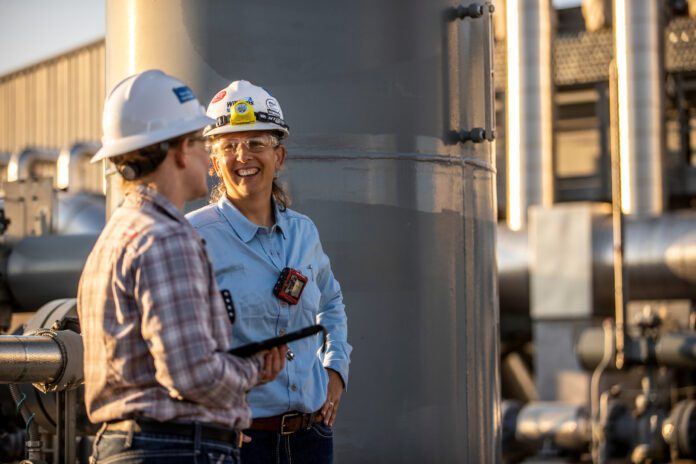
Williams Companies, Tulsa; photo courtesy Williams
John Lindsay, president and CEO of Helmerich & Payne Inc., has worked his way up the leadership chain since joining Helmerich & Payne International Drilling Co., the company’s wholly owned drilling subsidiary, in 1987.
Starting as a drilling engineer, he later served as operations manager, vice president for U.S. land operations and executive vice president for U.S. and international operations.
John Lindsay, CEO of Helmerich & Payne, partcipates in H&P’s annual United Way Day of Caring in Tulsa. Photo courtesy H&P
Lindsay held the position of executive vice president and chief operating officer for the parent company, Helmerich & Payne Inc., from Dec. 7, 2010, to Sept. 5, 2012, before being named president and chief operating officer effective March 5, 2014.
“The business has changed so dramatically during my career,” he says. “H&P has always been a leader in how we focus on the customer, the shareholders and our employees. We have a continuous improvement mindset as part of our culture, so we are always determined to get better, each and every year, in a very cyclical business.”
The oil and gas industry will always be dynamic, Lindsay says.
“For companies that are in the service business, we must have the best people, technology and solutions that satisfy our customers – and in turn, satisfy our shareholders. I believe H&P is well-positioned for the future,” he says.
Lindsay has had many mentors along the way as he advanced and stepped into different leadership roles within the company.
“What I have learned is that every position is important to the success of the company – from the floorhand and driller on our rigs, to our operational teams in the field offices, to the many business functions housed in our corporate headquarters. Every level of the organization has to be aligned and collaborating to deliver the best value to our customer. My leadership style is focused on building strong teams that are empowered to ‘do the right thing’ and leverage technology and innovation.”
H&P – an international drilling and tech company – has been in existence for 104 years, and 98 of them have been in Oklahoma. That said, the company is about to make an even bigger investment in its hometown.
“Tulsa is our home, and we love being a part of the community. This summer, our headquarters are moving to a modern, vibrant space located in the downtown Arts District,” says Lindsay. “From daily in-office employees to our hybrid workforce, to the field and international teams traveling in, this exciting new space will serve as a hub for collaboration, innovation and creativity for the future.”
Beyond Tulsa, the company’s commitment to the communities it serves is stronger than ever.
“Our community investments focus on STEM education, health and human services, disaster relief and environmental sustainability in the 11 states where H&P has a presence. We acknowledge the important role we play in influencing the efficiency, safety and environmental impacts of our industry,” he says.
Lindsay says he enjoys seeing the company’s core values demonstrated every day by its employees.
“They are the driving force behind our success, behind our innovative spirit, behind our service attitude,” he says. “They are the ones who will steer us into the next century, and for me, that’s very exciting to see.”
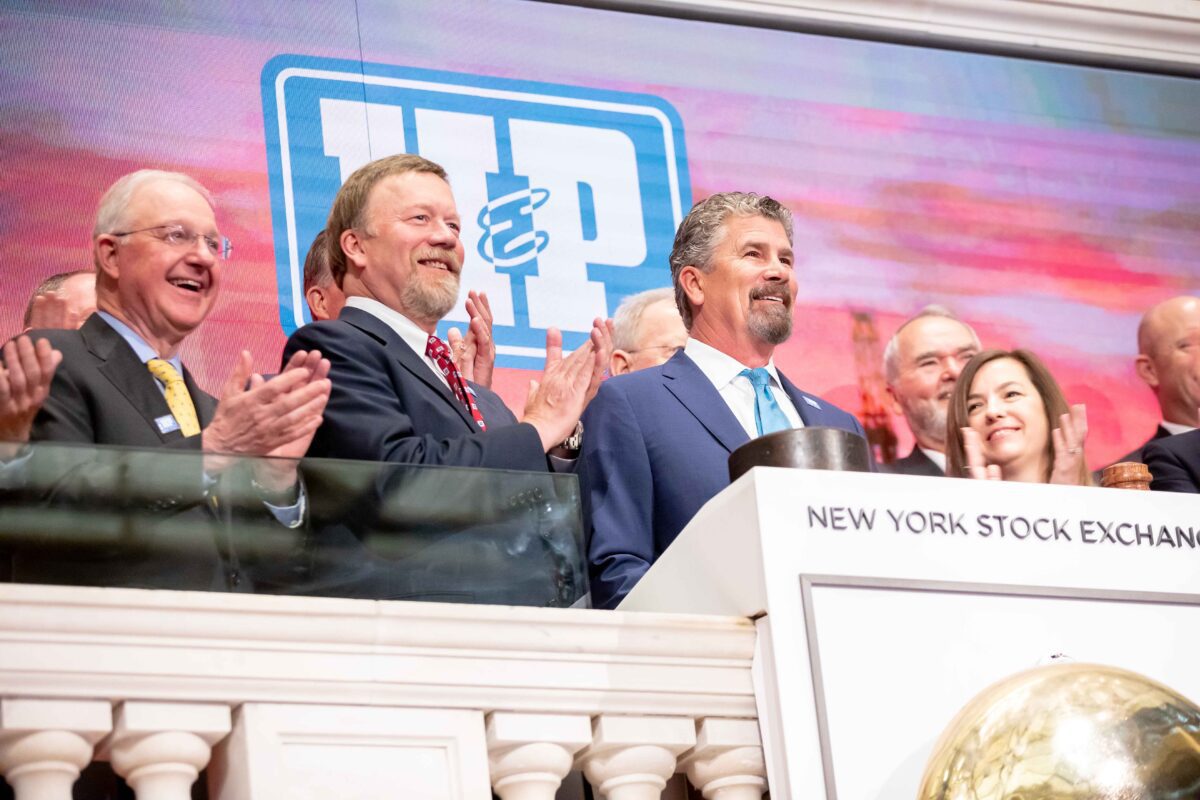
John Lindsay (center) rings the opening bell at the New York Stock Exchange to celebrate Helmerich & Payne’s 60th anniversary on the exchange. He is joined by H&P’s board of directors, including the Chairman of the Board, Hans Helmerich, and H&P executive leadership. Photo courtesy H&P
What is a Publicly Traded Company?
When a company decides to “go public,” that means it starts trading its stocks on the public exchange market. Investors can become shareholders by purchasing shares of the company’s stock.
The company is considered public because any interested investor can purchase shares in the public exchange to become equity owners. Taking a company public can provide a greater pool of capital, enhanced liquidity and reputational benefit, according to SEC.gov, the Securities and Exchange Commission website.
A company might also go public to acquire other businesses with the public company’s stock, to attract and compensate employees with public company stock and stock-options, or to create publicity, brand awareness or prestige, according to the SEC.
ONEOK, Tulsa; photo courtesy ONEOK
Oklahoma-Based PTCs
ONEOK (OKE) is one of the largest diversified energy infrastructure companies in the U.S. The company was founded in 1906 and has a century-plus history of transformation, transporting natural gas, natural gas liquids (NGLs), refined products and crude to help meet domestic and international energy demands today, while innovating to meet the needs of tomorrow.
Devon Energy (DVN), with its corporate headquarters in OKC, is an oil and natural gas exploration and production company with operations focused onshore in the United States. It has a multi-basin portfolio headlined by a world-class acreage position in the Delaware Basin.
Williams Companies (WMB) uses its 33,000-mile pipeline infrastructure to move a third of the nation’s natural gas to where it’s needed, supplying the energy used to heat homes, cook food and generate low-carbon electricity. Williams is based in Tulsa.
Chesapeake Energy (CHK) develops its leading positions in the Haynesville and Marcellus shales, producing natural gas for domestic and international use. It is based in Oklahoma City with field offices in Louisiana and Pennsylvania.
NGL Energy Partners (NGL) is a diversified midstream master limited partnership that provides services to producers and end-users, including transportation, storage, blending and marketing of crude oil, natural gas liquids, refined products / renewables and water solutions. It’s headquartered in Tulsa.
Continental Resources (CLR) is an independent oil producer based in Oklahoma City. It’s the largest leaseholder and largest producer in the Bakken play of North Dakota and Montana. It also has significant positions in the SCOOP and STACK plays of the Anadarko Basin of Oklahoma, Powder River Basin of Wyoming and Permian Basin of Texas.
Paycom, OKC; photo courtesy Paycom
Matrix Service Co. (MTRX), founded in 1984 as a petroleum tank provider, provides construction, maintenance and fabrication to the energy and industrial markets across North America. It’s based in Tulsa.
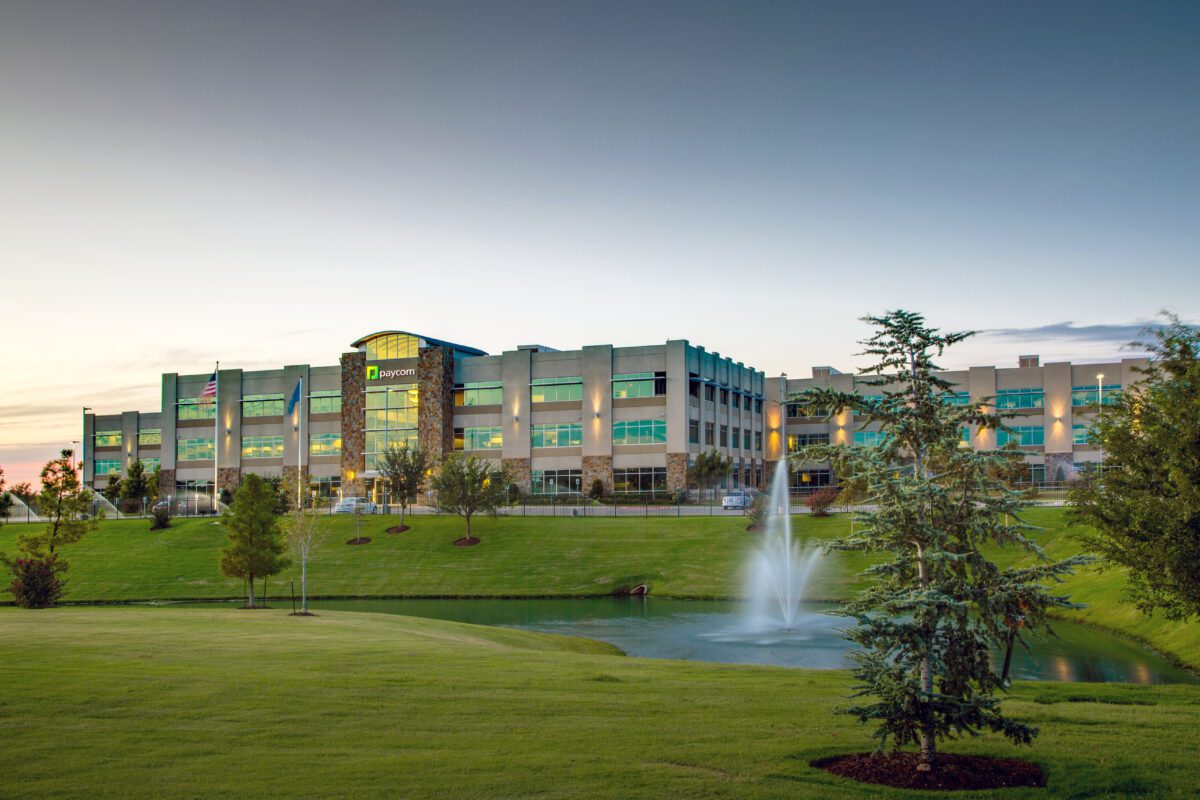
Paycom (PAYC) is a payroll and human resources software provider that simplifies business and empowers transparency for employees through direct access to their data. From onboarding and benefits enrollment to talent management, Paycom’s software streamlines processes and drives efficiencies.
Helmerich & Payne (HP). Through its subsidiaries, the company designs, fabricates and operates high-performance drilling rigs in conventional and unconventional plays around the world. H&P also develops and implements advanced automation, directional drilling and survey management technologies. It is based in Tulsa.
Based in Oklahoma City, the Oklahoma Mineral and Gem Society
provides an educational space for members to learn about jewelry
making, fossil collecting and geology. Photo courtesy OMGS
Photo courtesy OMGS
One man’s rock is another man’s treasure. Or at least, that’s the case for rockhounds – the self-identifying moniker for people who enjoy collecting rocks and minerals.
Oklahoma is home to hundreds of said rockhounds, spurring the formation of groups like the Tulsa Rock and Mineral Society (TRMS) and the Oklahoma Mineral and Gem Society (OMGS). These groups act as a community for people to learn more about the earth sciences and lapidary arts.
Groups to Join
TRMS, which has over 600 members, was first organized in 1958. The group meets every second Monday of the month at 7 p.m. at Tulsa’s College Hills Presbyterian Church. The society also has a special program for children, Pebble Pups, which meets directly before the meeting at 6:15.
The member meetings include a social hour, along with an expert speaker who educates on topics like geology and paleontology.
Eric Hamshar, show chair for TRMS and director at the D.W. Correll Museum, invites Tulsans who are interested in rock hunting to check out the group.
“The name of the club might sound a little hoity-toity, but we’re very down-to-earth people with all different levels of knowledge and interest,” he says. “You don’t have to be an expert to join.”
Photo courtesy OMGS
Based in Oklahoma City, OMGS provides an educational space for members to learn about jewelry making, fossil collecting and geology. The group meets three times a month at the Rogers Garden Exhibition Center.
“It’s always a pleasant evening with friends getting together and visiting,” says Dale Moore, board member for OMGS.
Moore first learned how to make cabochons – gemstones that have been shaped and polished – through OMGS.
“There were a lot of fine craftsmen in the club,” he recalls. “Jewelry making is what brought me into the club, but my interest in rock collecting … has been a part of my journey.”
Members can get involved in a variety of activities, from cutting and polishing demonstrations to rock swaps. OMGS also hosts social gatherings, including an annual club picnic and a Christmas Party.
The Big Shows
Both TRMS and OMGS hold annual shows that bring together vendors, kid’s activities and competitive and noncompetitive displays. OMGS will hold the 2024 Annual Mineral and Gem Show on Oct. 25-27 at the Oklahoma City State Fair Park.
The Tulsa Rock and Mineral Society, which has over 600 members, was first organized in 1958 and meets monthly for socializing and educational speakers. Photo courtesy TRMS
TRMS’ annual show will run July 14-15 at Tulsa’s Expo Square.
“You can bid on different rocks, minerals and fossils,” says Hamshar. “You can get some good deals.”
The show will also feature a booth where visitors can get their rock and mineral questions answered by geologists.
Rock-Hunting Field Trips
Oklahoma was once covered by the Western Interior Seaway millions of years ago, making it a hotbed for marine fossils. OMGS and TRMS often take field trips across the state to see what prehistoric remnants they can find.
During a field trip to Bartlesville, Hamshar discovered a tooth from a Petalodus, an ancestor of sharks that had petal-shaped teeth.
“It’s a 275 – 300-million-year-old tooth,” he says. “Once I figured out what it was, man – I was excited,” he says.
Photo courtesy TRMS
Other common finds in Oklahoma are petrified wood, rose rocks, selenite and jasper. Very little equipment is needed to embark on the clubs’ field trips. Protective sun gear and a rock hammer are recommended.
“We just go as a group and hope we find something interesting,” says Moore. “We have a lot of fun.”
Southern Hills Country Club in Tulsa partners with First Tee, which helps kids of all socioeconomic statuses get interested in the game, free of charge. Photos courtesy SHCC
Golf’s popularity in Oklahoma continues to skyrocket. And whether you’re a pro looking for the next challenge, a beginner swinging a club for the first time or someone in between, there are plenty of places to play.
At Southern Hills Country Club in Tulsa, promoting the sport to Oklahomans has been a mission for decades.
“In March 2000, Southern Hills’ board of governors approved the application of the foundation assets toward the promotion of golf and tennis to children of all diversities and social strata,” says Reagan Kingsley, the club’s director of marketing and communications. These funds eventually led to a partnership with the First Tee program.
“The program is an initiative to provide all kids with access to the game of golf [and] is grounded on golf’s unique way of instilling and nurturing essential values such as honesty, integrity, sportsmanship and a solid work ethic in young people,” she says. “As of today, more than 130,000 students have participated in the First Tee of Tulsa, and the program remains free of charge to all students.”
In Midwest City, the John Conrad Regional Golf Course just underwent a large-scale redesign.
“The word has spread. The course now has open fairways that appeal to players of multiple skill levels, but challenging greens that give even experienced golfers a few surprises,” says Larry Denny, Midwest City’s director of golf. “Couple the Conrad redesign with the quality and consistency of Hidden Creek Family Golf Course, and we believe the diversity of play found in Midwest City is what continues to bring in new and seasoned golfers alike,” says Denny. Hidden Creek Family Course is a nine hole course, perfect for shorter play or for those just learning the ropes.
To some, golf may be a sport for the older generations. But programs like First Tee are working to change that perception.
“We’re building game changers by empowering kids and teens to be the best versions of themselves,” says Kingsley. “Our trained coaches not only introduce junior golf and provide an opportunity to enhance golf skills, but they also create a safe, supportive and empowering environment to help your child prepare for life ahead,” she says.
Midwest City also utilizes First Tee, but the Carl Albert High School golf teams provide a good channel to find new and interested players.
“Being the home course for successful school golf programs helps to keep us busy with players of all ages,” says Denny.
Etiquette 101
Beginners might be confused about etiquette before they hit the green, but Denny has a simple solution: “The best thing to do would be to golf with a mentor or an experienced golfer. Jump in a cart with someone who can at least give you the basics,” he says. “It will help to reduce your frustration and could help get you more interested in the game.”
A few tips should you not have a mentor on hand:
1. Stay quiet when others are taking shots.
2. Be aware of the pace of play or allow faster groups to play through before you.
3. Follow any dress code requirements.
4. Maintain the course as you play, with a ‘leave no trace’ mentality.
5. Tee times are specific; always be punctual and, if possible, early.
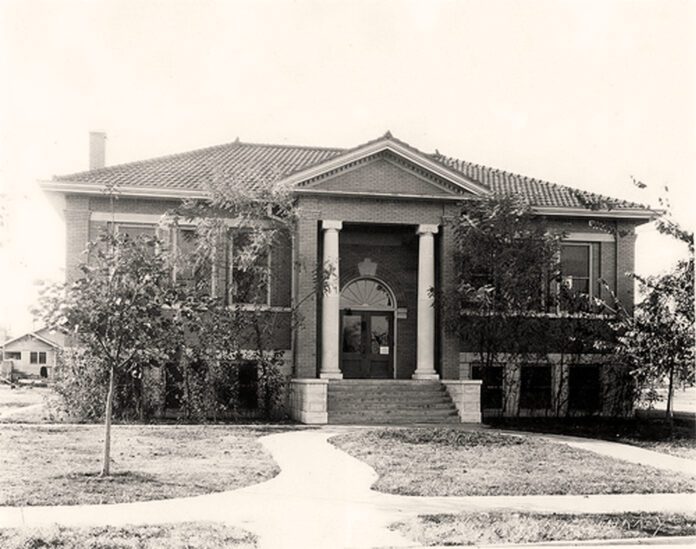
Pictured here is the original Bartlesville Public Library where Ruth Brown worked. Photo courtesy the Bartlesville County Commission
On July 31, 1956, Columbia Pictures released a movie titled Storm Center. Starring Bette Davis as a small-town librarian, it’s been called the first feature film to directly confront the excesses of McCarthyism. (Named after its figurehead, Wisconsin senator Joe McCarthy, McCarthyism was a Cold War phenomenon that sought zealously to root out and ruin communists and their fellow travelers in government, the entertainment business and elsewhere, ultimately destroying the reputations of many of the innocent as well as the guilty.) It was directed by Daniel Taradash, who’d won an Oscar for scripting From Here to Eternity a few years earlier.
The picture’s credits open over a page from the 1859 book On Liberty, written by the famed philosopher John Stuart Mill and including the passage, “Strange it is that men should admit the validity of the arguments for free speech but object to their being ‘pushed to an extreme,’ not seeing that unless the reasons are good for an extreme case, they are not good for any case.”
The case in Storm Center involves a book called The Communist Dream, which librarian Alicia Hull (played by Davis) refuses to pull from her shelves, igniting a firestorm of controversy that rages through the town of Kenport. Kenport, in fact, is actually Santa Rosa, California, where Taradash shot much of the movie.
While Kenport was fictional, McCarthyism was, of course, very real. And while Storm Center is fiction, it also was inspired by real-life events – not in Santa Rosa, California, but in Bartlesville.
A little over 74 years ago, Bartlesville city librarian Ruth Brown was relieved of duty by the city’s commission’s library board. According to a July 27, 1950 piece in the Tulsa Tribune, Brown had been fired “after an investigation of reports that Communist literature was sent to the library.” (The story, incidentally, was dated a day before her 59th birthday.) It was this action that ignited the events that formed the inspiration for Storm Center, released six years later.
The film Storm Center was based upon Oklahoma librarian Ruth Brown. Photo courtesy the Oklahoma Library Association
Brown had taken her position with the Bartlesville Public Library back in 1919. According to her Oklahoma Library Legends biography on the Oklahoma Library Association website (oklibs.org), she was deeply involved in making sure that the library services extended to Bartlesville’s African American community. In those segregated days, any attempt at building social equality between Black and white people was met in many quarters with hostility, and once the McCarthy Era got fully underway, communists and civil-rights advocates became conflated.
The Oklahoma Library Legends piece suggests that Brown was let go just as much for one as the other. During 1950’s “Brotherhood Month” of February, it points out, she and two Black teacher friends made a point of going to lunch together at “Bartlesville’s largest drugstore,” where they were predictably refused service.
According to the biography, “Two weeks later, Senator Joseph McCarthy exploded on the national scene with his accusations of card carrying Communists in the government. The event not only sent the country into a spin, but it also gave opponents of Miss Brown’s interracial activities an opportunity to attack under false pretenses.”
That attack wasn’t long in coming. The same month she and her companions were refused service at the drugstore, a group of Bartlesville citizens came to the city commission’s meeting to protest what they called “subversive materials” at the local library. Initially focused on The Nation, a progressive magazine which had begun as an anti-slavery publication in 1865 (and was decidedly anti-McCarthy), the list of allegedly offensive Bartlesville Library holdings grew to include New Republic, another liberal periodical, and Soviet Russia Today.
Those, apparently, weren’t damning enough to make a case for Brown’s dismissal. So, a few days later, the front page of the Bartlesville Examiner newspaper hit the stands with a front-page photo of not only the magazines, but two copies of a book called The Russians: The Land, the People, and Why They Fight by well-known American journalist Robert Rhys Williams, an advocate of socialism. All had been allegedly unearthed at the library.
Notes Brown’s Oklahoma Library Legends entry, The Russians “was published in 1943 during the time that Russia and the United States were allies during WWII. Neither copy was owned by the Bartlesville Library. It has been speculated that the library custodian, whether by agreement or coercion, had let members of the opposing group enter the area while the library was closed. No one had authorized the photo and the displayed books were never located.”
Although this setup still carries a distinct odor nearly 75 years later, and many Bartlesville residents rallied around Brown at the time, the accusations were enough to get her discharged. That happened on July 25, 1950. Her assistant city librarian, identified in the Tribune as “Mrs. A.R. Riggs,” resigned in protest the next day. According to the Summer 2001 issue of Progressive Librarian, a committee called Friends of Miss Brown “was quickly formed to publicize what had happened and to raise funds for her.” The Progressive Librarian writer, Zoia Horn, noted also that Brown was supported by the library board. That would’ve been the former library board, however. On June 14, the city commissioners had dissolved it, replacing the old members with people unsympathetic to Brown.
A couple of months later, she struck back, with a suit against the City of Bartlesville claiming her dismissal was, according to the September 13, 1950 Bartlesville Record, “in direct conflict with the state’s library laws,” specifically citing the dissolution and reconstitution of the library board. The case worked its way through Oklahoma’s justice system for a couple of years, ultimately arriving at the Oklahoma Supreme Court, where it was dismissed.
But while Ruth Brown didn’t win in court, she made an undeniable impact on 1950’s American culture. Not only did she inspire the making of a major Hollywood picture, one that struck back at McCarthyism’s excesses and in its way helped lead to the ultimate weakening and demise of the movement. She also was the catalyst for any number of public meetings and examinations of the whole notion of book and magazine censorship in public libraries and elsewhere, especially here in Oklahoma.
As would be expected, tempers on both sides remained heated, even after her suit’s dismissal. In early January, for instance, Robert Porta, Americanism officer for the Oklahoma American Legion, walked out of a public meeting at Oklahoma City’s First Unitarian Church that was being held under the title, “Are Oklahoma Libraries Being Censored?”
A next-day story syndicated by the Associated Press noted that Porta “had just taken a stand for Bartlesville’s city officials who fired the city’s librarian and banned certain publications as pro-communist. The discussion involved selection of books for the Bartlesville library.
“Among the few who followed Porta was a woman who shook her finger at the group at the First Unitarian Church and shouted: “You are communists.”
Prior to his walkout, according to the story, Porta had been detained by the church’s pastor, Rev. Frank O. Holmes, who told him, “The American who has been taught to think freely and strenuously for himself is not likely to be made a dupe by communists.”
Following her dismissal, Ruth Brown left the state, teaching at an African American school in Mississippi and then working in Colorado as a librarian until her retirement in 1961. She ultimately returned to Oklahoma and was living in Collinsville when she died in 1975, at the age of 84. According to her Wikipedia entry, she asked that her body be donated to the University of Oklahoma Medical Center.
Some years later, in 2001, OU Press published The Dismissal of Miss Ruth Brown: Civil Rights, Censorship, and the American Library, written by Louise S. Robbins. Six years after that, the Bartlesville Library began displaying a bronze bust of Brown, in addition to starting a scholarship fund in her honor. And in 2023, the library added a mural depicting Brown, sitting under a tree and reading to a mixed-race group of youngsters.
The Chain Bridge on the Danube River; all photos stock
Enormous reserves of warm spring water lie beneath Budapest, providing rivers of soothing thermal comfort to the city’s bath houses, therapeutic spas and evening swim parties. The stuff contains minerals and is supposedly so good for you, the Romans would drink it. Hippos at the Budapest Zoo insist on it in their pools.
Buda Castle; all photos stock
The source of the Danube River is also a spring, but this one is 600 miles away in the Black Forest mountains of western Germany. By the time the waterway reaches Budapest, it’s a full-blown river, one-third of a mile wide and a major trade route. For centuries, the cities of Buda and Pest thrived on their respective banks until 1873 when they finally merged together politically to form Hungary’s capital, Budapest.
Sculpture of Empress Elisabeth of Austria and Queen of Hungary, Matthias Church
An eye-catching manifestation of this unification is the iron and stone Szechenyi Chain Bridge spanning the Danube. First built in the 1800s, the suspension bridge was damaged in World War II and then rebuilt using the structure’s original massive stone pillars and portal lions. Chains attached to the pillars support the 1,230-foot-long roadbed.
Stroll the bridge, oohing and aahing at views of the red dome-topped Hungarian Parliament and Buda Castle. It’s a magical scene at night when the lights of the bridge reflect off the Danube and dance with those of nearby landmarks.
Invading armies have always found Budapest a popular city to ransack. Occupying cultures have left their mark, dating back to the ninth century. You’ll find remnants of not only the Romans but also Celts, Turks, Habsburgs, German Nazis and Russians.
On one end of Castle Hill on the Buda side of the Danube, Buda Castle has been dominating the landscape since the 13th century when it housed kings. Now, its many structures exude a sense of medieval Baroque elegance. Take in impressive vistas of the city and the Danube and check out three on-site museums: the Hungarian National Gallery, the National Szechenyi Library and the Budapest Historical Museum.
A crazy maze of tunnels lurks beneath Buda Castle, at times used as a shelter, a Turkish harem, a hospital and a dungeon. Today, the tunnel walls are filled with curious exhibitions depicting life as a Hungarian prisoner. Legend has it that back in the 15th century, one of the chambers housed none other than Vlad Tepes, aka “Vlad the Impaler,” the inspiration for our old friend Dracula.
With its seven turrets, Fisherman’s Bastion on Castle Hill is a neo-Gothic stack of two massive stone terraces with a fairytale look about them and only one purpose in mind: to provide the best panoramas of town and river. Adjacent to the Bastion is the stunning Matthias Church, restored by the Bastion’s architect, Frigyes Schulek, in a complimentary style with a slender medieval profile.
Fisherman’s Bastion
Shoppers: Look for bargains on fine Hungarian linens, hand-crafted porcelain, palinka liqueur and Rubik’s Cubes (the inventor was Budapesti Erno Rubik). Regroup to refresh at one of Budapest’s quirky ruin bars, located in, well, ruins – buildings that were dilapidated and about to be torn down but are now seeing new life as Bohemian dives.
It’s a city of 1.7 million so delightful restaurants aren’t hard to find. If you like paprika, you’re in luck, so do Hungarians. Popular local dishes include chicken paprikash with dumplings, a fisherman’s soup called Halaszle (fish and paprika) and Hungarian goulash, a sort of stew made with beef, onions, tomatoes, peppers and the irreplaceable paprika.
Stay in the elegant Aria Hotel Budapest, a 2015-era boutique hotel chiseled into a 19th-century former bank building in the city’s historic center. Music is king at the Aria, from live lobby performances to playlists in every room to tiles laid out like piano keys. The rooftop bar hits just the right note after an afternoon spa session.
“Sickle cell is the most common inherited blood disorder in the United States, affecting an estimated 100,000 Americans,” says Ashley Baker, M.D., interim director of the Pediatric Sickle Cell Program at Oklahoma Children’s Hospital OU Health, as well as the associate professor of pediatrics at the University of Oklahoma Health Sciences in OKC.
There are variations of sickle cell disease, she says, and Hb SS – also known as sickle cell anemia – is the most common form.
“It’s caused by a mutation in the beta globin gene, which is responsible for making hemoglobin,” says Baker. “Hemoglobin is the protein in red blood cells which carries oxygen to all parts of the body. The abnormal hemoglobin causes the red blood cells to be rigid and shaped like a C, or sickle. Sickle cells can get stuck in blood vessels (vaso-occlusion) and block blood flow. Vaso-occlusion can cause intense pain, stroke, pneumonia and other organ damage, and vaso-occlusion in the spleen increases the risk of life-threatening infections. Sickle cells also break down faster than normal red blood cells, leading to anemia.”
Regarding the genetic component, Baker says a child gets sickle cell disease when he or she receives two sickle cell genes – one from each parent. In addition, she says sickle cell disease is more common in certain ethnic groups including people of African descent, Hispanic-Americans, and people of Middle Eastern, Asian, Indian and Mediterranean descent – though all ethnicities are affected.
“Sickle cell disease is diagnosed at birth by the newborn screen, mandatory in all states,” she says. “It can also be identified prenatally. Affected infants may not have symptoms until five or six months of age. Adults born prior to universal screening or outside of the United States may be unaware of their diagnosis if they only have mild symptoms.”
For those living with sickle cell disease, treatment plans can be complex and require consistent medical supervision to help relieve pain, prevent infection and minimize organ damage.
“Life threatening infections can be reduced through use of prophylactic penicillin, routine childhood immunizations and immediate evaluations for fever,” says Baker.
In addition, she says Hydroxyurea, a medication approved by the FDA in 1998, reduces the rates of pain, hospitalizations, pneumonia, stroke and anemia, and prevents or slows down organ damage. Newer FDA-approved medications include voxelotor, L-glutamine and crizanlizumab – and in 2023, the FDA approved two new gene therapies “to provide very effective disease-modifying treatment that may be life-changing,” says Baker.
While research continues, at this time the only potential cure for sickle cell anemia is through a bone marrow transplant – but with the need for finding a genetic match and the risks and complications involved with a transplant, the potential for this course of treatment varies by individual.
“Sickle cell disease is a chronic, debilitating, life-threatening blood disorder that has a higher risk of early mortality,” says Baker. “At Oklahoma Children’s Hospital OU Health, we have a comprehensive team including physicians, nurse practitioners, social workers, nursing and psychologists to provide care to approximately 200 children and adolescents with sickle cell disease. Our goal is to prevent and treat medical complications and improve quality of life for this unique group of patients following national guidelines and standards of care.”