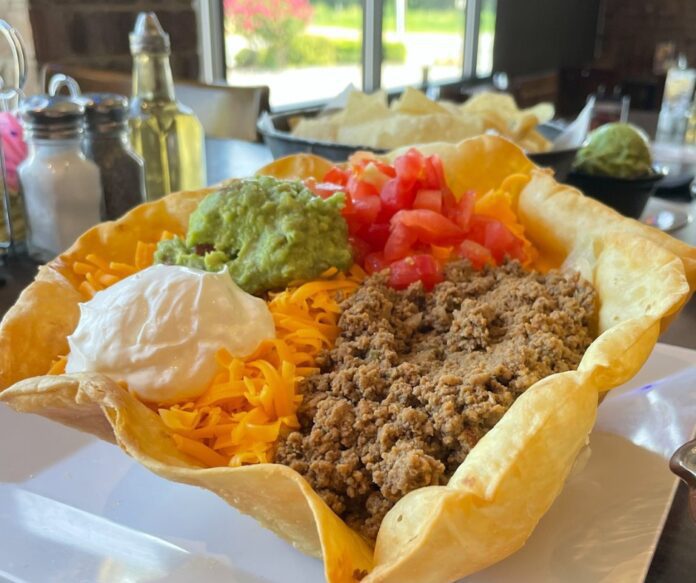
If you’re in Lawton and on the hunt for downright delicious Mexican food, look no further: Salas Urban Cantina has enough offerings to appease everyone in your party. From boozy libations and tasty appetizers to American fare and classic Mexican combos, Salas is the place to be.
To start your meal off right, Salas offers appetizers such as fresh guacamole, loaded queso chorizo, fried pickles, fajita nachos and fried mushrooms. Popular entrées include the stuffed avocado dinner – breaded and deep fried avocado with a chicken and cheese stuffing, served with a beef enchilada, rice and beans – and the Acapulco, a beef enchilada and beef taco served with rice and beans.
American fare includes a barbecue brisket sandwich, chicken fried steak and a personal-sized pizza. Along with a variety of margaritas, including the cucumber jalapeño, Corona-rita and blueberry mint, Salas offers craft cocktails like the spiked cherry limeade, Moscow mule and peach sangria, along with draft and bottled beers.
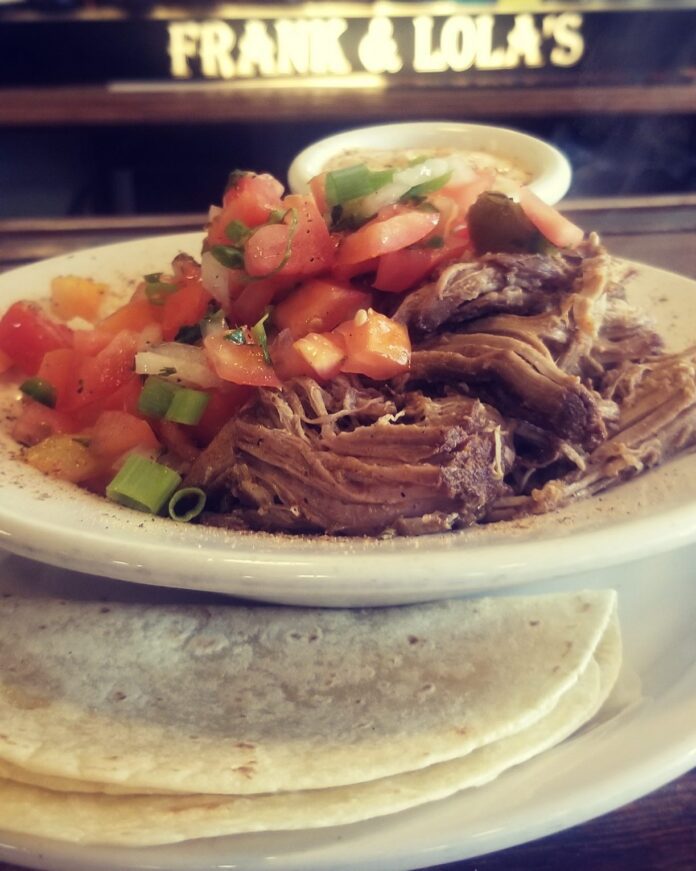
Located in a 110-year-old building in Bartlesville, Frank and Lola’s offers crafted, upscale American fare in a whimsical brick-walled bistro. The stacked menu offers appetizers like the loaded cheese fries – fresh cut fries topped with melted cheddar, bacon and green onions with a side of ranch for dipping, as well as calamari, drizzled in sweet Thai chili sauce and served on a bed of Asian slaw with a side of wasabi aioli.
Main dishes include penne pasta, drowning in a pesto cream sauce and served with sun-dried tomatoes and chicken; slow-roasted pulled pork, served with jasmine rice, red chili garlic aioli, pico and warm flour tortillas; and pan-roasted salmon, glazed with sweet Thai chili served atop jasmine rice, Asian slaw and a red curry cream sauce.
Other delectable offerings include the fried catfish sandwich, BLT, pork green chili stew and the cashew quinoa salad. For dessert, try the bread pudding or chocolate espresso brownie … or both.
With the upcoming holiday season, there are a wide selection of events to get you in the festive mood.
The Broken Arrow Ice Rink opens for the winter/holiday season on Nov. 10 and runs through the first week of January. A holiday classic, Rhema Bible Church lights up the night sky with over three million lights starting on Nov. 22 until New Year’s Day. On Nov. 23, head to Utica Square for the annual Lights On ceremony.
One of the largest model train shows in the region, the Oklahoma City Train Show returns to the Oklahoma State Fair Park from Nov. 4-5. Beginning Nov. 4 and running through Jan. 15th, the Edmond Ice Rink is pure winter fun for the whole family. Both on the 10th, Crest On Ice in Norman and the Devon Ice Rink open to the public.
Around the state, the Guthrie Ghost Walk hosts two weekends of tours Nov. 3-4 and 10-11 at Guthrie’s Apothecary Garden. Nov. 9-11 is the 25th annual Beavers Bend Folk Festival and Craft Show at Beavers Bend State Park. On Nov. 11, The OK Wine, Brew and BBQ festival and competition takes place at the Canadian County Expo and Event Center. On Nov. 13, the Christmas classic Home Alone plays at Central Park in Ardmore. On Nov. 18, be sure to head out to Chickasha for the Chickasha Festival of Light – one of the top holiday light shows in the nation – running through Dec. 31.
With the arrival of November, the award-seeking films are coming out in droves. There’s a large list this month, so let’s get to it!
Opening with another strange A24 picture, we have Dream Scenario. The story follows a schlubby professor, played by Nicolas Cage, looking like your best friend’s oddball dad. He suddenly begins appearing in millions of people’s dreams, causing massive distress as he gains newfound celebrity status. The cast also includes Michael Cera (Scott Pilgrim vs. the World), Julianne Nicholson (Mare of Easttown), and Tim Meadows (Saturday Night Live). A24 always finds the best nonconformist films to make and this looks like it’ll be a weird one when it releases on Nov. 10.
Next, a neo-noir thriller titled The Killer. Starring Michael Fassbender and directed by David Fincher, the plot focuses on an assassin who, after a fateful near miss, battles his employers on an international manhunt. Based on a French graphic novel series of the same name, the trailer looks to have Fincher’s definitive quiet style and skill, with an intriguing story to boot. With music by Trent Reznor and Atticus Ross (who won an Academy Award for their score of The Social Network), this picture is sure to be a killer in its own right when it releases to Netflix on Nov. 10.
For a wildly different ride with the same actor, check out Next Goal Wins. Based on a true story, the film sees Dutch-American football (soccer) coach Thomas Rongen (again, Fassbender) become involved with helping turn the American Samoa national team, considered one of the weakest in the world, into an elite squad. Directed by Taika Waititi (Jojo Rabbit), this has all the bones of a great sports comedy-drama. Make it your own personal goal to see it when it hits theaters on Nov. 17.
For your holiday horror flick, don’t miss Thanksgiving. Based on a mock trailer from 2007’s Grindhouse, director Eli Roth has finally brought his idea to life. A mysterious serial killer known as John Carver comes to Plymouth, Mass., with horrible intentions of carving the town to bits. The trailer starts out like a family friendly holiday tale, but quickly shows some gruesome kills juxtaposed with a cheery voiceover. Make your Thanksgiving plans for when this drops on Nov. 17.
If you’re looking for an epic historical drama, look no further than Napoleon. Directed by Ridley Scott (Alien), the film will depict Napoleon Bonaparte (Joaquin Phoenix) and his rise to power, along with his tumultuous relationship with Empress Josephine (Vanessa Kirby – The Crown). Insanely big in scope and length, the movie looks to be another tour de force for Phoenix and sight to behold visually. It releases Nov. 22.
Lastly, another biopic with grand acting aspirations, check out Maestro. Directed by and starring Bradley Cooper as Leonard Bernstein, an American conductor and composer of great renown, the plot follows his life and marriage to Felicia Montealegre, an actress and social activist, played by Carey Mulligan (Promising Young Woman). With portions in black and white and the aspect ratio appearing to be in 4:3, the film looks to be gunning hard for awards when it hits theaters on Nov. 22.
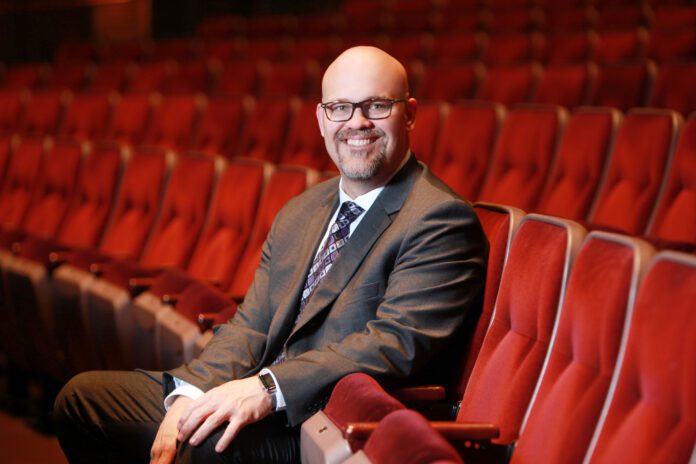
CEO of the Tulsa Performing Arts Center, Mark Frie has a broad background in performance, directing and theatrical management. He’s played a variety of roles in musicals, operas and concerts, and made his solo debut at Carnegie Hall in 2006.
In his position, Frie works with national tours, headline acts and local arts companies to bring a variety of showcases to the stage. He also chairs the Tulsa Office of Film, Music, Arts and Culture, which helps filmmakers, musicians, writers, artists and designers find the resources they need to bring their creations to life.
Before the TPAC, Frie has worked at Radio City Music Hall, Dallas Theatre Center and the Broken Arrow Performing Arts Center.
We caught up with Frie and got his thoughts on …
… what encouraged him to enter a leadership role in the arts.
I love the idea of being able to use the arts to impact a community, and I am so glad I get to do that in my hometown. As a performer, I have a connection and shared experience with the audience in the room. As a leader of a PAC, my ability to connect and share is broadened exponentially.
… his day-to-day.
No day is ever the same in my job, and I love it. My days range from managing my incredible staff to communicating with patrons and community partners, meeting with city officials and board members, speaking with booking agents across the country and making sure the facility is ready to host our events.
… his goals for the future of the TPAC.
We must continue to diversify and reach younger audiences. That is done through creative programming that speaks to a wide range of demographics. I would also like to see us book more headline concert acts and comedy acts.
… how the TPAC plans its seasons.
We look at our calendar at least three years ahead of time, sometimes four. We work with community partners and promoters in addition to presenting and producing ourselves. The first step is always calendar availability, then we look at titles, technical requirements, load-in and load-out timelines and artist requirements. A single event sends multiple employees and contractors into a flurry of activity.
… the best part of his job.
The people! I love my staff. They are all so talented and passionate about the arts. I have found that people who work in the arts and support the arts are typically creative, collaborative and accepting. Who doesn’t want that?
… why performing arts matter.
The arts have the power to unify people and inspire the hearts of an entire community. Also, the arts have a huge economic impact on a city. The TPAC has an estimated impact of $100 million annually when you factor in ticket sales, hotel stays, restaurant visits, gas for vehicles and more.
… the next 5-10 years for the TPAC.
Well, we have a major, $79.7 million renovation project ahead of us. That won’t start for about four years, but when we it’s completed, it will put the Tulsa Performing Arts Center back among the best venues in our region. It’s greatly needed.
… his favorite shows and memories.
I have two different answers. As a performer, it was the first time I had a singing role on Chapman Music Hall stage with Tulsa Opera and then years later when I played the role of Jean Valjean in Les Misérables with Theatre Tulsa. As the CEO, my best memory is the first time Hamilton played in Tulsa. It was magical.
… his time outside work.
You can often find me on the golf course. After a long week at work, there is nothing more soothing to me than to walk 18 holes as the sun sets. It’s my quiet place and refuge.
Looking for some entertainment this season? Across the state, there are a variety of performances for the entire family to enjoy.
At the Tulsa PAC, Don Quixote, presented by Tulsa Ballet, runs Nov. 2-5. Chamber Music Tulsa brings the Castilian String Quartet, who will surely dazzle its audience on Nov. 19. For those still holding onto the last bit of the spooky season, Celebrity Attractions presents Beetlejuice, the hauntingly fun musical based on the movie of the same name, from Nov. 21-26.
In Oklahoma City, Oklahoma Shakespeare presents Born With Teeth, the quick-witted tragic comedy at Oklahoma Shakespeare on the Paseo, running Nov. 9-19. For those interested in getting a head start on the holiday season, Civic Center Music Hall presents Elf, a live concert coinciding with the classic Christmas movie, on Nov. 17. Likewise, A Christmas Carol, presented by Lyric Theatre, runs from Nov. 24- Dec. 24 at Lyric on the Plaza.
Around the state, Postmodern Jukebox is bringing the Life in the Past Lane tour to Stillwater’s McKnight Center on Nov. 3. Performed with the Tulsa Symphony, How the Grinch Stole Christmas – a live music and movie showing – comes to the McKnight Center on Nov. 30. Finally, Join the American Midwest Ballet, presented by Davis-Waldorf Performing Arts Series, as they showcase a diverse and expressive selection of short ballets at Te Ata Memorial Auditorium in Chickasha on Nov. 30.
At Grey Sweater, chef Andrew Black presents an ever-changing menu; he says some dishes take months to invent and perfect. Photo by Brent Fuchs
You come expecting magic; Grey Sweater doesn’t disappoint.
Seats are arranged as in a theater. On a spotlit stage, James Beard Award-winning chef Andrew Black and his sous chef Dylan Morgan. They work in silence – though you sometimes hear a crackle, sizzle, hiss.
There’s no a la carte menu. In fact, there’s no menu at all. Instead, here come the courses in a slow and stately procession, each one a surprise, a mix of unexpected, dazzling flavors. You might find a single oyster, garnished with mango pearls and a snow made with liquid nitrogen seconds before serving. (That’s the hiss you heard.) You may find a scallop topped with sevruga caviar, served in a rich sauce made of sea urchins (uni). Or maybe it’s peeled, stewed tomatoes (tomato concassé) with a dashi sauce, trimmed with Japanese seaweed and snail eggs. Perhaps that’s followed by roast squab, a flavor-packed sauce, and a tiny, beautifully made pastry tart filled with all sorts of vegetable treats, including black truffles from Burgundy.
One can’t say for sure, because the menu is ever-changing. And that’s a tremendous task for the chef. Some of the sauces, says Black, “take months to develop and days to prepare. People think it’s easy for me to come up with a new dish. It’s not. Sometimes it takes three or four months to talk about the dish, play with concepts. For me as an artist, the menu is a story I’m telling; it’s a journey I’m taking you on.”
But the one with the most exciting story is Andrew Black himself. He learned as a child the values of food, family and meals that would bring both together. He didn’t learn that in cooking school; he grew up on an isolated farmstead in Jamaica.
“Everything we ate,” he recalls, “we grew, raised or foraged.” His grandmother was the head of the household. Her ancestors had come from India many years before.
“So,” he says, “I grew up with a lot of spices. I’d eat a lot of coconut chutney, curried goat and puri. I remember as a child helping make the puri – and I can still smell those flavors, it hasn’t left me at all.”
Black continues: “The only thing I know is food, and I realized at an early age I wanted to be a chef.”
At 15, he got a job at a resort. Each day, in exchange for room and board, he’d have to clean out 18 refrigerators and juice 3,000 oranges.
“Those were good days,” he says. From there, his horizons expanded, first to cook for a famous Viennese chef in Memphis, then to college in Ohio. Then it was on to France, where he cooked at some of the finest restaurants, including the Ritz Paris. And then, surprisingly, many years later, he accepted an offer to cook at the Skirvin Hotel in Oklahoma City.
Before Black left for Oklahoma, he asked people what crops grew there. Nothing, they told him; everyone eats meat and potatoes. Black was determined to prove them wrong. He toured the back roads of Oklahoma, visiting every farm he could. He found that he had a lot in common with the farmers.
“We both go with the seasons, we both never get a day off,” he says, “and I could relate because I grew up on a farm.”
A few years down the road from that, Black opened Grey Sweater. And to him, it’s still a work in progress.
“You can never rest on your laurels,” he says. “How we cooked last year isn’t how we cook this year. My motto ever day is: ‘Be open, know nothing, allow yourself to rediscover the magical world of possibilities.’” (This motto, by the way, summarizes in one sentence the Zen Buddhist concept of shoshin, or ‘beginner’s mind.’)
But how can Black manage to do all that work every day?
“I’ve never worked a day in my life,” he replies with a smile. “Cooking is play time. It’s what I love to do.”
The Chickasha Festival of Light will have four million bulbs this year. Photo by Dean Images
As if the breathtaking glow of Chickasha’s annual holiday Festival of Light wasn’t enough to attract visitors to the city of just over 16,000, another holiday-related enticement is causing a stir.
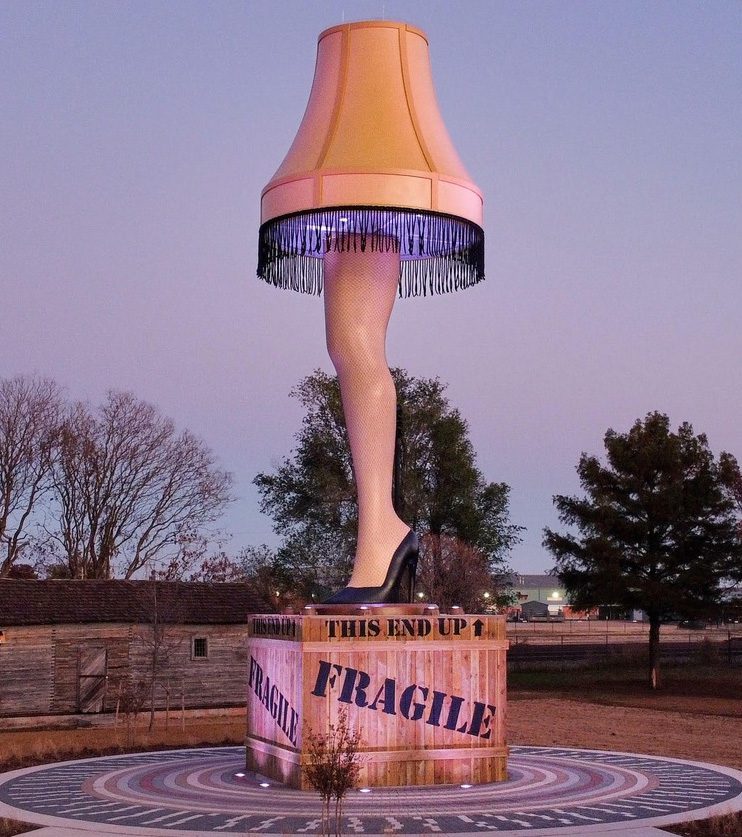
A 50-foot-tall fiberglass recreation of the iconic leg lamp made famous in the 1983 movie A Christmas Story – complete with a black high heel and fringed lampshade – now adorns Chickasha’s historic downtown.
Installed just over a year ago in the Train Depot Park, the lamp sits atop a 10-foot crate marked “FRAGILE.”
Together, the festival and this new tourist attraction have spurred a boom in overall interest in the Grady County city.
“It’s been crazy,” says Logan Lassley, the Festival of Light director and Chickasha’s tourism director.
Cassie Poole, Chamber of Commerce marketing director, echoes the sentiment: “Reaction to the leg lamp has been fantastic,” she says.
One family, she says, even drove in from North Dakota to see the lamp last year and to have their family’s Christmas portrait made in front of it.
“They were all wearing bunny suits,” she says, referring to the scene in A Christmas Story in which the main character’s kid brother is coerced into donning something similiar. “It was so interesting.”
The leg lamp’s connection to Chickasha started with the late University of Oklahoma visual arts professor Noland James, who hailed from the city and owned a farm nearby. Pat Cunningham, curator of the Grady County Museum, explains that James designed a lamp featuring two women’s legs for his office at OU. Published reports held that James always thought his lamp was the prototype for the movie version because a visitor to his office, who later became involved in movie production in Hollywood, had seen James’s lamp and dreamed up the movie iteration. James’s original two-legged lamp is on display inside the Grady County Museum.
Meanwhile, preparations have been going on for several months for this year’s Festival of Light, the 31st annual extravaganza. The walk-and drive-through display opens Nov. 18th and runs nightly through Dec. 31st in Shannon Springs Park.
Lassley says lights started going up in October, while planning began early in the year with a focus on creating “the next great thing.” Lights added to this year’s display will bring the total number to more than 4 million. Lassley says the overall Festival of Light mission is to allow people to see Christmas “through the eyes of a child.”
The festival also includes carriage rides, a Santa Shuttle, ice skating, a Ferris wheel and carousel, photos with Santa and a food truck park.
Volunteers who string lights, operate the gift shop and perform other tasks number in the hundreds.
“My job may be director, but really, it’s the community that puts on the Festival of Light,” says Lassley. “I just organize it.”
Did You Know?
An homage to A Christmas Story, a 50-foot-tall, fiberglass leg lamp sits in Chickasha’s historic downtown. Photos by Dean Images
Chickasha is home to the University of Science and Arts of Oklahoma, the state’s only public liberal arts college, with an array of cultural and athletic events for the public. USAO is nationally ranked for both its quality and value and is an inovator in interdisciplinary studies. It was founded in 1908, was once a women’s college, but became coeducational in 1965.
Volunteering for a worthy cause is a great way to gain a sense of purpose and belonging, all while giving back to those in need. Many nonprofit and charitable organizations rely on an active volunteer base to support their missions, especially during the holiday season. With Veterans Day and Thanksgiving right around the corner – on Nov. 11 and 23, respectively – there are plenty of ways to make an impact in your community.
Honoring Veterans Today and Every Day
There are approximately 290,000 veterans living in Oklahoma, according to the Oklahoma Department of Veteran Affairs (ODVA). Veterans Day is dedicated to recognizing the personal sacrifices that they have made while serving in the U.S. military. Upon returning to civilian life, veterans are at risk for mental health issues, social isolation, homelessness and suicide.
ODVA is at the forefront of providing much-needed assistance and resources to Oklahoma’s veterans all year round.
“We believe it’s so important for our veterans … to be honored and respected,” says Jeannene Wade, State Veterans Homes Outreach Coordinator at ODVA.
In addition to improving GI Bill accessibility and providing employment and crisis resources, ODVA has established seven long-term care facilities known as ‘veterans homes’, which house up to 300 people per location. ODVA offers a wide range of activities and field trips to its residents, helping enhance their quality of living. To make these programs possible, ODVA relies on the time and attention of volunteers.
“Being able to communicate with the outside world and the public gives veterans a sense of pride,” says Wade. Along with fostering connections, ODVA and its volunteer base work diligently to preserve the veteran home residents’ life stories and accomplishments through veteran military panels and Veterans Readers Theater.
“We tell their stories, that way their peers can respect them and get to know more about them,” says Wade.
From helping organize game day parties, garden groups and fundraisers, there are dozens of ways to get involved at ODVA and make a difference for veterans during the holidays. Wade encourages people to get in touch with the organization to learn more.
Providing Nutritional Meals on Thanksgiving
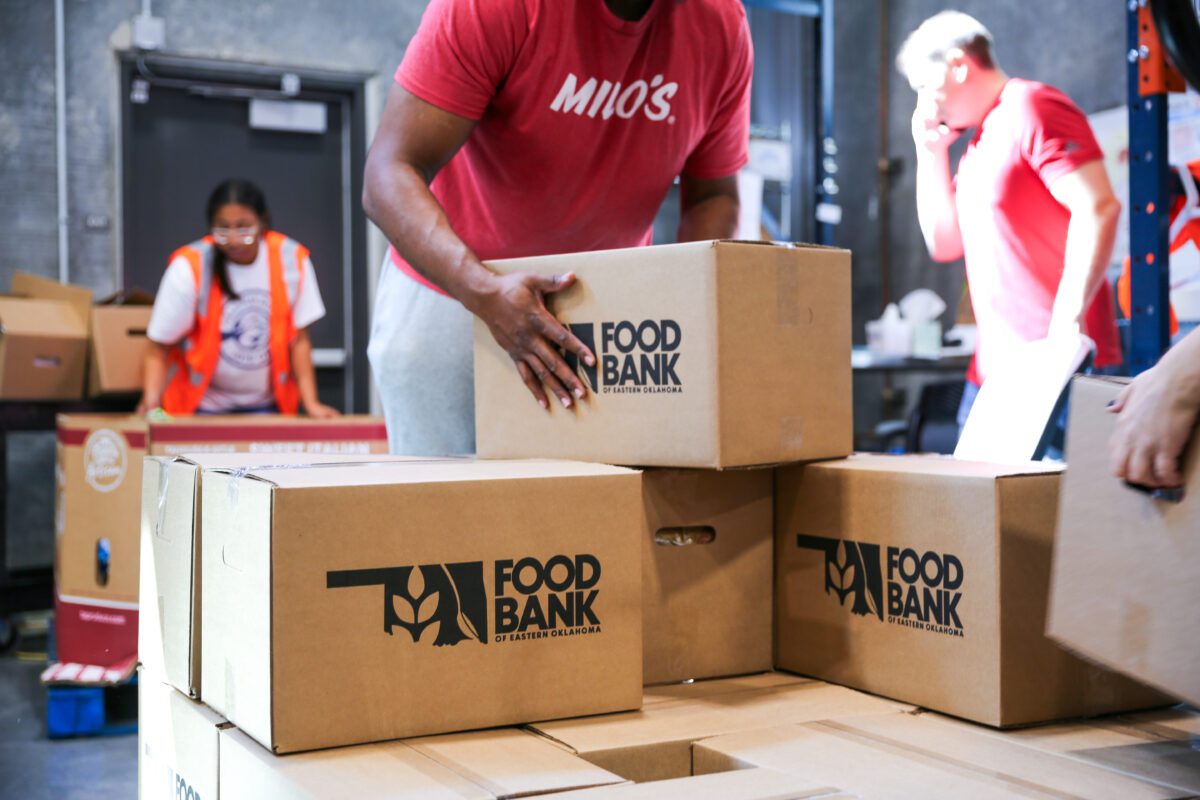
Thanksgiving is often associated with an abundant home cooked meal. However, more people are finding it difficult to make ends meet with rising inflation. This reality is especially true in Oklahoma. According to the Food Bank of Eastern Oklahoma, the state has a food insecurity rate of 16.1%.
On a mission to solve hunger, the Food Bank of Eastern Oklahoma serves 24 state counties, distributing up to 26 million pounds of food to more than 700 partner agencies annually.
“Volunteers are really crucial,” says Calvin Moore, the organization’s CEO. “We have volunteers who come in, handle food and repackage it in a way that our partners can easily handle and distribute.”
The Food Bank of Eastern Oklahoma serves 24 state counties. Photo courtesy FBEO
For Thanksgiving, volunteers can help cook and deliver Thanksgiving meals and turkeys to those in need.
“We distributed more than 6,000 turkeys and other proteins during our Thanksgiving celebration last year,” says Moore. “It was a phenomenal success.”
The nonprofit also has several programs geared toward feeding veterans.
“One in five veterans suffers from food insecurity in the state of Oklahoma. That’s one of the highest rates for veterans in the nation,” says Moore. Every year, the organization and its volunteers travel to the Veterans Center in Claremore to bag lunches and participate in the Veterans Day parade.
“We’re one community,” says Moore. “We believe everyone has the right to access low-cost, high-quality food that will give them the opportunity to thrive and live their best lives.”
Those interested in volunteering with the food bank can get started by visiting okfoodbank.org/volunteer.
Reducing Hunger During the Holidays
The Oklahoma Regional Food Bank is on a mission to reduce food insecurity and hunger across 53 counties.
“We see an uptick in need, especially around the holidays,” says Stacy Dykstra, Ph.D., CEO of the nonprofit.
Volunteers can organize and package food at the Volunteer Center, assist shoppers at its Food and Resource Center in Moore, or get involved in its production kitchen – Hope’s Kitchen.
“It’s so fun to share this collective work with other people and make a difference,” says Dykstra. “We want our community and state to come together… to take care of each other. It’s incredibly powerful to be a part of that [vision].”
Groups can also support the food bank by organizing a food drive to collect non-perishable food items. Starting Nov. 15, the Regional Food Bank rings in the season with its Holiday Match in partnership with KOCO 5 News. In 2023, the organization raised $3.7 million during its Holiday Match, which provided 14 million meals to Oklahomans in need.
Regardless of the time of year, Dykstra encourages others to volunteer. The Oklahoma Regional Food Bank’s volunteer base helps the organization save over $1.7 million in labor costs and distribute food to 1,300 partner agencies and schools. To get involved, go to regionalfoodbank.org/volunteer.
“Volunteers are the heartbeat of our mission,” says Dykstra. “There is no way we could distribute the amount of food that we do without them. They help us get [food] into the community, where it can be in the hands of folks who need it most.”
Thanksgiving & Veterans Day Events
Volunteers at ORFB’s Hope’s Kitchen serve up holiday meals.
Photo courtesy ORFB
An end-of-year financial checklist will look a little different for everyone. This can be a great time to look at your overall financial health, goals and planning. But keeping an eye toward reducing your tax responsibilities is a major theme that should weave throughout your end-of-year review.
“Year-end is your last chance to get several financial tasks wrapped up in order for them to be included in the 2023 tax year,” says Treana Lankard, vice president and branch leader at Fidelity Investments in Oklahoma City.
Lankard mentions items such as Roth IRA (individual retirement account) conversions, required minimum distributions, tax-loss harvesting and charitable donations; these have a deadline of Dec. 31 for tax purposes. But there are several other exercises you may want to perform at the close of the year in an effort to keep your financial life tidy.
The backbone of most financial plans is the goals each individual or family has set. End-of-year is the time to review these goals and discuss where you want to end up next year – and what vision you and your family have for your finances.
From there, it’s important to take a look at your budget from last year and use it to plan for the next. Understand what worked and what didn’t, what you want to change and what adjustments should be made. Review your debt and any repayment plans, take a look at your credit reports and check for any errors, as these can be costly if not corrected.
If you are still working, be sure to reassess your employee benefits during the open enrollment timeframe, which is often this time of year. It’s also a good time to look over any employer-sponsored retirement accounts and any other investment accounts you have.
Check your insurance policies and ensure that you still have the most beneficial amounts of insurance for your current situation. And finally, this is the moment to begin gathering paperwork and information you will need for preparation of your tax return.
Your Tax Review
Likely the most important aspect of planning at the end of the year should revolve around a tax review. If you prepare ahead of time, you’ll ensure you won’t have any surprises when you finalize that return in the spring.
“If we’re looking at how to be tax efficient at the end of the year, are you putting away money into those certain places that create tax advantages for you?” asks Jessica Jones, vice president and senior financial advisor with Bank of Oklahoma Financial Advisors. “I think it’s good to go through that checklist.”
And what sorts of things are on that checklist? Jones mentions ensuring that you have fully funded any employer-sponsored retirement accounts, as well as any IRAs you may have. The funding limits on these are different and change from year to year, so be sure to check into the details of the specific plan you have.
“[These retirement accounts] are the easiest, quickest way to reduce taxable income for the year, so that you’re keeping more in your pocket and not giving it to Uncle Sam,” says Jones.
Another aspect of planning that comes into play for anyone over the age of 72 is ensuring that any and all required minimum distributions have been taken. These are distributions from either employer-sponsored plans (where you no longer work) or an IRA, both of which are required to be taken by Dec. 31 to avoid a penalty, says Jones. But be sure to check your particular plans or with a financial advisor as these rules can change from plan to plan, too.
Dec. 31 also brings the end to using funds in many flexible spending accounts, or FSA’s, and sometimes unused funds are lost.
“You got the tax advantage of having [the funds] deducted from your payroll, but you don’t get the advantage of getting to spend that money tax free,” says Jones. “So, if you need some new glasses, if you need that year-end check up, if you need to order some contacts, whatever it is, you want to make sure you use those funds before the end of the calendar year.”
Charitable Giving
Another deadline to watch out for at the end of the year involves charitable giving. And while you may think considering your taxes while making decisions about giving may seem counterintuitive, Lankard points out how they can work together.
“Not only does giving to charitable causes make a difference in the world,” she says, “but your generosity could also qualify you for a tax break.”
Per IRS rules, taxpayers can deduct charitable donations to qualified organizations up to 60% of their adjusted gross income for cash donations if they itemize their taxes, says Lankard. There are ways to donate long-term appreciated securities, such as stocks and bonds, tax-efficiently as well, and some may want to consider donor-advised funds to keep your contribution options open. Be sure to check with a tax professional to ensure your giving is executed properly.
Avoiding Scams
Unfortunately, while many of us are considering charitable donations and other ways of giving back at the end of the year, there are unsavory elements at work as well. Just as with the rest of the year, it’s important to protect your financial assets at this time of year; it can be a season of increased attempts to scam. Many times this happens through phone calls asking for donations.
“Just be cautious, be aware, be careful,” says Jones. “If you’re not familiar with something, it’s OK to say, ‘No thank you.’”
Jones also sees clients who get emails or voicemails – purportedly from the IRS – stating they are doing some type of review, and the recipient of the call needs to submit a check. In those cases, it’s important to call, confirm, check and double check, she says.
Lankard recommends basic preventative measures such as two-factor authentication on devices and doing research on organizations before doing business with them.
“Before reacting to any unsolicited emails, phone calls or messages, always pause and look for red flags, even if it appears to be from someone you trust,” she says.
Additional Resources
If you are looking for more information as you consider your year-end financial planning, it can help to go back to the basics.
Jones recommends clients check out the IRS (irs.gov) and Social Security (ssa.gov) websites for up-to-date, reputable information.
Many employer-sponsored retirement plans also have websites and mobile applications that provide insight. But it is always important to check with a tax or other financial professional before making any major financial decisions.
She also recommends checking with your local bank if you’d like to start the conversation about year-end financial planning with an expert. These services are often free (at least for initial consultations) and can help you in finding out what you need to focus on to make next year your best financial year yet.