


















Home Blog Page 45

More Than Cookies and Camping

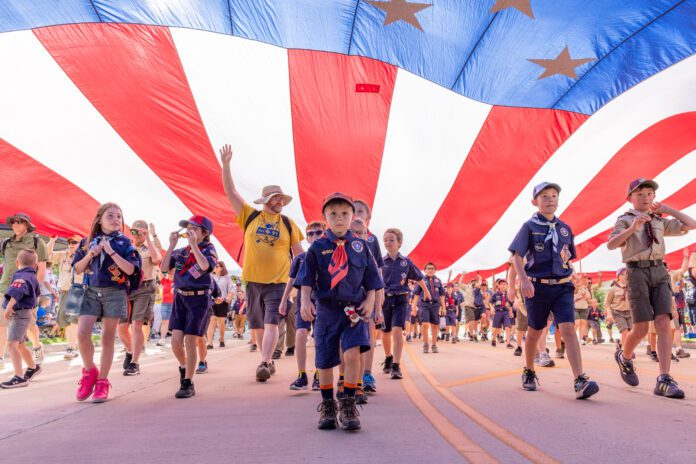
From community service projects to random acts of kindness, Boy Scouts with OKC’s Last Frontier Council are learning valuable life skills. Above and bottom right facing page photos courtesy the Last Frontier Council

Scouting, in its many forms, has a long-standing presence in Oklahoma. In fact, the first Boy Scout troop in the country – Troop #1 – was organized in Pawhuska in 1909. Since then, tens of thousands of children across the state have joined Scouting America and the Girl Scouts of the U.S.A. 

Although they may be known for cookie-selling and camping, these youth programs accomplish much more. Studies show that kids involved in Scouting programs are more likely to exhibit leadership qualities, form healthy relationships and feel more confident than their non-Scouting counterparts.  

Creating Leaders

Some people may be natural-born leaders. But for most, leadership skills are developed over time. Kids in Scouting America and the Girl Scouts get the advantage of learning about leadership and team work early in their lives – and in a supportive environment. 

All troops are also self-governed. 

“It’s a different learning model,” says Bill Hensley, Scoutmaster of Troop 15 at the Last Frontier Council in Oklahoma City. “Most of the leadership and teaching is done by older Boy Scouts. The adults are there to keep things safe.” 

The Scouts ultimately decide which activities to organize and which badges to earn. 
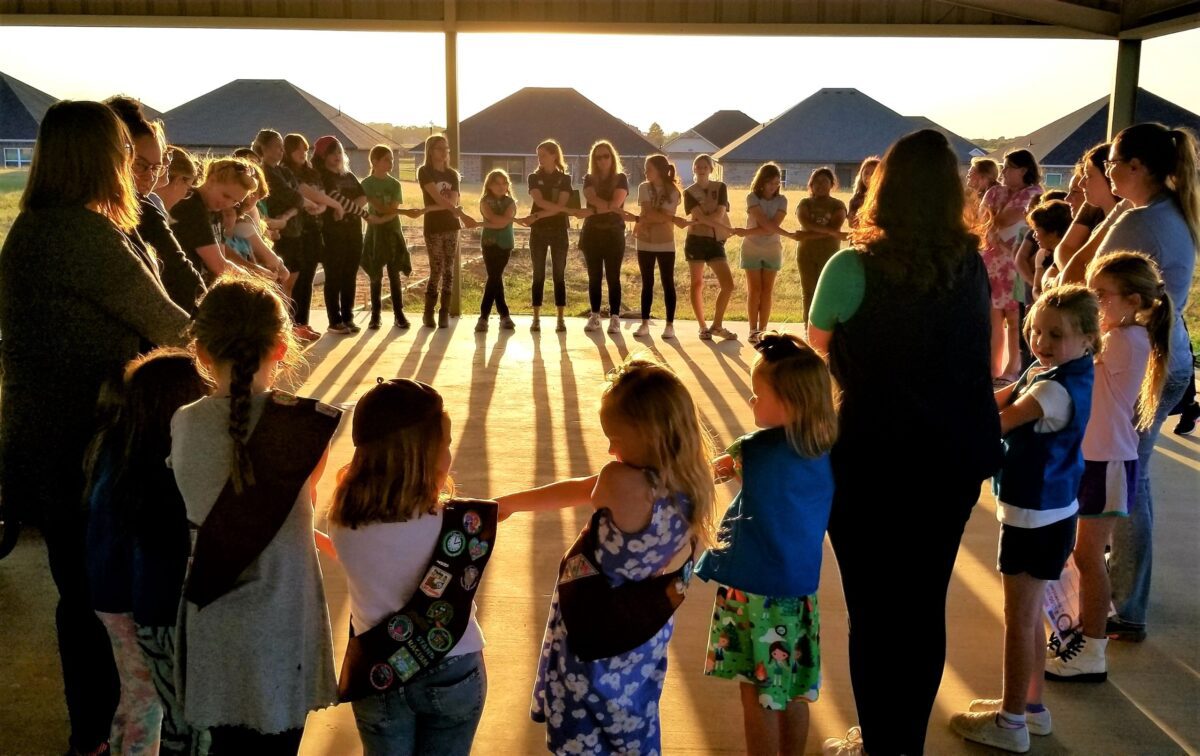
Civic responsibility is integral to earning the highest distinction in Girl Scouts: the Gold Award. Photo courtesy GSEOK

Similarly, Girl Scouts are girl-led, giving young women the opportunity to see themselves as true leaders. 

“I love helping empower girls,” says Melissa Bogle, interim CEO at Girl Scouts of Eastern Oklahoma (GSEOK). “I have had some amazing women in my life that helped pave the way for me and my career, and I feel a huge responsibility to do that for the next generations.”  

GSEOK takes this goal a step further with its STEM initiative, which aims to prepare young women for careers in underrepresented fields. Girls can experiment with robotics and join competitive Lego Leagues at the STEM Lab in Tulsa’s Hardesty Leadership Center. 

“They do everything from building machines to coding… and compete at different events across the country,” says Joey White, GSEOK’s chief mission officer. 

Helping Others
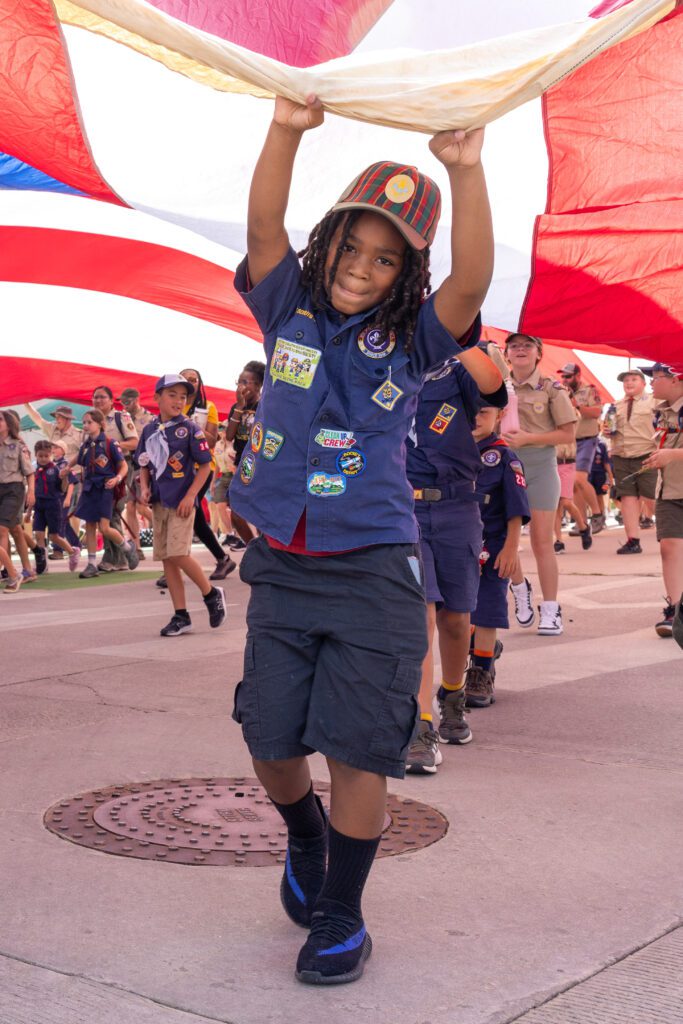
From community service projects to random acts of kindness, Boy Scouts with OKC’s Last Frontier Council are learning valuable life skills. Featured and above photos courtesy the Last Frontier Council

Beyond learning practical skills, both organizations place an emphasis on community service. Scouting America and the Girl Scouts organize annual programs that help address food insecurity, clean up neighborhoods and provide support to seniors and veterans. 

As a part of the Scouting for Food annual program, the Last Frontier Council collected 65,000 pounds of food to donate to the Regional Food Bank of Oklahoma in 2021. The council continues to collect thousands of pounds of food year after year. 

The Scouts also perform smaller acts of service, such as mowing lawns for their neighbors or cooking breakfast for local churches. 

“What really makes me proud is that I’ve never once had one of the boys complain about doing something for other people,” says Hensley.

This year, Scouting America has introduced a new program, Scouting for Clean Waterways, which will encourage Scouts to preserve local water sources and promote sustainability in their communities. 

“We’re not just picking up trash, we’re learning about how it affects our drinking water… and how we can prevent it in the future,” says Maryann Edgington, Deputy Scout Executive and COO at the Indian Nations Council in Tulsa. 

Troops with GSEOK are also focused on giving back. The Girl Scouts cook meals at Ronald McDonald House Charities of Tulsa, craft Christmas cards to send to senior centers and hand out thank you notes on Veterans Day. 

Another important program that GSEOK offers is Girl Scouts Beyond Bars, which enables Girl Scouts to visit their incarcerated parents safely. Over 116 girls have enrolled in the program. 

“In the 22 years that the program has been going on, none of the girls who have been in the program have been incarcerated themselves,” says White. “It’s a really effective program.” 

Making a Difference

Civic responsibility is integral to earning the highest distinctions – the Eagle Scout Award and Gold Award – with Scouting America and the Girl Scouts, respectively. 

Both awards require the youth to obtain leadership positions in their troops and propose a community service project of their own. If their proposal is approved, they must lead the project, collaborating with their peers, community organizers and institutions.

To earn the Eagle Scout Award, one Scout constructed picnic tables for Sister BJ’s Food Pantry in Oklahoma City and another built flag poles and installed signage at Veterans Park in Owasso. 

Hensley says that learning to serve others is one of the most important parts of joining the Scouts. 

“We wrap that fundamentally into our program,” he explains. “It’s just as much a part of learning to grow as learning how to tie a knot or build a fire.” 

The Girl Scouts with GSEOK have spearheaded several projects. One Scout collaborated with her school to develop a comprehensive safety plan, which included conducting regular emergency drills and creating a training manual for students and faculty. 

Another Scout developed a Greenwood Rising patch program, which encourages girls to learn about the Historic Greenwood District in Tulsa and cultivate a deeper understanding of racial injustices. 

“Being able to see the girls grow, gain confidence and give back to their communities is wonderful,” says White. “It’s very rewarding.”


Spring Break Getaways

Beavers Bend State Park is a must-visit vacation spot in southeastern Oklahoma. Photo courtesy Oklahoma Tourism

Beavers Bend State Park

Beavers Bend State Park is located in the mountainous region of southeast Oklahoma along the shores of Broken Bow Lake and the Mountain Fork River. 

“There are so many things to do here for spring breakers that I don’t think I can list them all,” says Kaitlyn Rivas, a communications specialist and researcher for Beavers Bend State Park. “Inside the park, we offer hiking, fishing, camping and swimming. We also have a restaurant; mini-golf course; canoe, kayak and paddle board rentals; canoe float trips; a miniature train ride; a horseback riding stable; a zipline; a museum; and a gift shop.”

She continues: “Our park is divided into two types of areas, our river area and our lake access area,” says Rivas.  

In the river area, the park offers rental cabins, RV and tent camping. In the lake access area, the park provides lodging with the 40-room Beavers Bend Lodge, as well as RV and tent camping options.  

Little Sahara State Park is one of Oklahoma’s most unique destinations. Photo by Lori Duckworth/Oklahoma Tourism

Little Sahara State Park

Little Sahara State Park is a prime example of Oklahoma’s diverse terrain. It boasts over 1,600 acres of sand dunes, ranging in height from 25 to 75 feet. Located south of Waynoka in northwest Oklahoma, the park offers RV sites with water, electric and sewer hookups, tent sites, picnic areas and comfort stations. 

The main attraction at Little Sahara State Park is dune buggy and ATV riding across the sand dunes. Visitors can either bring their own ATV or rent one off-site by a private vendor. 

Oklahoma City Adventure District

Located in northeast Oklahoma City at the crossroads of I-35 and I-44, the Adventure District is home to some of the most outstanding tourist attractions in the state, according to the Oklahoma Tourism and Recreation Department. 

Experience the excitement at Remington Park Racing and Casino, or make memories with the family at the USA Softball Hall of Fame Complex. Take a journey through the exciting world of the Oklahoma City Zoo, learn about the old west at the National Cowboy and Western Heritage Museum, or step into the amazing and fun world of science at Science Museum Oklahoma. The sky’s the limit.

Mount Scott/Wichita Mountains Wildlife Refuge

Worn by time and nature, the Wichita Mountains loom large above the prairie in southwest Oklahoma and are a lasting refuge for wildlife. Situated just outside the Lawton/Fort Sill area, the Wichita Mountains Wildlife Refuge preserves approximately 60,000 acres of mixed grass prairie, ancient granite mountains and freshwater lakes and streams. 

It’s best known for roaming herds of bison, longhorn and Rocky Mountain elk, and the Wichita Mountains also offer quality opportunities for recreation, including fishing, bird watching, wildlife photography, hiking, camping and kayaking.

Alabaster Caverns State Park

Enter one of the largest natural gypsum caves in the world at Alabaster Caverns State Park. Located in Freedom, this rare cave is open to the public, and is the only gypsum show cave in the United States. 

Daily guided tours leave promptly on the hour from 9 a.m.-4 p.m. Alabaster Caverns State Park also features reservable RV and tent sites. Enjoy hiking trails, picnic areas, group shelters with electricity, grills, water access and a volleyball court.

Boiling Springs State Park

An oasis on the plains, Boiling Springs State Park captures some of the finest elements of nature. The park is one of seven original state parks built in the 1930s by the Civilian Conservation Corps. Named after a natural “boiling” spring that still flows, visitors can view the park’s namesake attraction in a natural wooden shelter and interpretive center. 

All RV, cabins and tent campsites within the 820-acre park can be reserved online. There are more than 150 picnic tables and grills throughout the park. Enjoy swimming in the pool or fishing in the 7-acre spring-fed Shaul Lake. The Boiling Springs State Park Trail System includes five hiking and mountain trails of various lengths that are perfect for beginners. 

Featured image cutline: Beavers Bend State Park is a must-visit vacation spot in southeastern Oklahoma. Photo courtesy Oklahoma Tourism

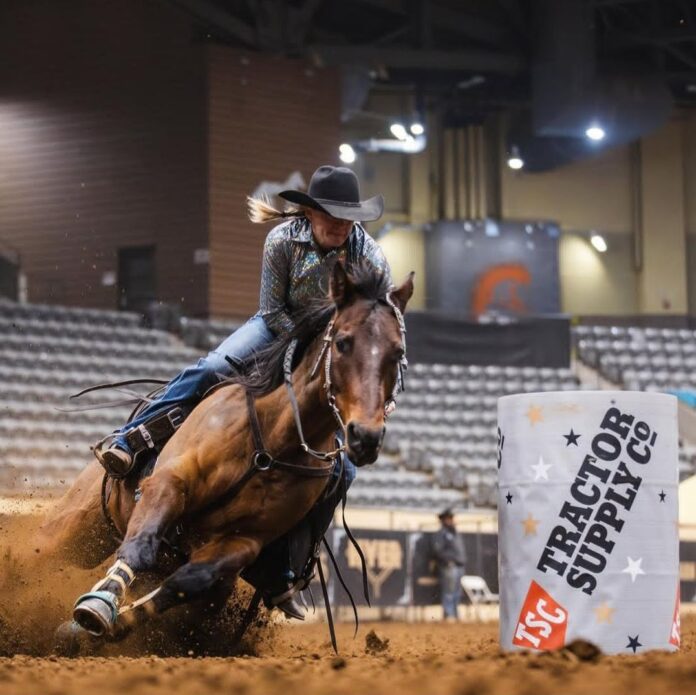
Barreling Down the Competition

The Better Barrel Races World Finals come to OKC this April. Photos courtesy the Better Barrel Races

Dirt flies as barrel racer Lindsay Emerson takes off into the arena, heart racing, wind in her hair and a sparkle on her lucky earrings – as well as her eye.

“I’ve been barrel racing basically all my life,” Emerson, 41, of Tecumseh says. “I grew up around horses and we went to rodeos all the time. I’ve been riding competitively since I was nine or 10.”

Barrel racing is a heart-pounding trial against the clock, where riders follow a course of three barrels in a cloverleaf pattern, according to the National Quarter Horse Association. Riders choose to circle either the right or left barrel first, race to the opposite barrel and complete the course after circling the third barrel and racing down the center to stop the timer. Knocking over a barrel carries a five-second penalty.

“It encompasses so much,” says Ross Wright, founder of Better Barrel Races (BBR) an association that produces top-paying competitions that draw riders from all over the world. “There’s speed, there’s really nice horses, athletic ability and just being part of that western lifestyle, which has really been embraced lately.”

It’s a life that is a family tradition for many. 

“My mom ran barrels before I was ever born,” Wright says, “so I was pretty much born into the sport. I’ve been barrel racing my whole life.”

Emerson, who placed in the BBR Top 10 a few years ago, brought her daughter Delaney, 11, into the sport as well.

The Better Barrel Races World Finals come to OKC this April. Photos courtesy the Better Barrel Races

“I started when I was six,” says Delaney Emerson, who, along with her horse, Blackjack, has already picked up a few buckles in her career. “I like riding horses because I kind of grew up around them, and I like riding them because I think they’re fun. The only times I get nervous are when I’m warming up, and then once I’m in there, I’m just relaxed.”

Certain qualities mark a successful barrel racer, Wright says, beyond just having a great horse.

“You definitely have to have perseverance and determination,” she says. “And the self-motivation to go out every day and ride.”

Camaraderie is one of the reasons riders love – and stick with – the sport.

“You develop a lot of great relationships that are pretty everlasting,” says Wright. “You make a lot of friends from all over the country, and sometimes all over the world. You meet people and get to find out different things about different places that you might not otherwise. There’s a lot of opportunity.” 

Emerson mentions that anyone can become a fan of barrel racing. 

“The majority of barrel races, with the exception of rodeos, are free to watch,” she says. “So find a barrel race in your community and go watch. It’s fun and exciting to pick your favorite horse and your favorite rider and cheer them on.”

The Better Barrel Races World Finals competition comes to OKC’s Oklahoma State Fair Park for action-packed days in the arena beginning on April 21.

An Economic Powerhouse

The American Airlines Base Maintenance Facility, also known as Tech Ops-Tulsa, has an estimated annual economic impact of $3.3 million. Photos courtesy American Airlines

The numbers are huge. 

More than 5,000 people are employed by the American Airlines Base Maintenance Facility, also known as Tech Ops – Tulsa, for an estimated annual economic impact of $3.3 billion. 

Upgrades currently underway at the base are budgeted at $400 million. And jobs added in 2023 and announced in late 2024 will total 621, thanks in part to a $22 million Business Expansion Incentive Program grant from the State of Oklahoma.

The capital project “really helps solidify American’s investment in the Tulsa region,” says Brien Thorstenberg, vice president for economic development for the Tulsa Regional Chamber of Commerce. “If those jobs were to leave, it would be very difficult to get those jobs back in the community. These are very high-quality jobs. These are fantastic jobs, and a fantastic employer.”

Ed Sangricco, managing director of base maintenance, says that $400 million worth of improvement projects adds up to a hefty list: new roofs, boilers, chillers and cooling towers alone will total $81 million. All the water and sewer lines are being replaced, and employee spaces such as restrooms and breakrooms will be re-done. New IT infrastructure calls for switching to fiber optics, and the plating shop is being modernized, too.

“It’s all being painted, with new signage,” says Sangricco. “It’s really making a big difference. When they are finished, you won’t recognize the place.”

Most of the infrastructure work will be completed in the next one to two years, and more projects are on the horizon. 

“We are also considering building a new hangar,” says Sangricco. 

The American Airlines Base Maintenance Facility, also known as Tech Ops-Tulsa, has an estimated annual economic impact of $3.3 million. Photos courtesy American Airlines

And all those upgrades are putting even more Oklahomans to work. “There are a lot of contractors on this base every single day,” he mentions. 

The 246-acre base opened at Tulsa International Airport in 1946, having been moved from LaGuardia in New York.

“The hangars were already here; there was a big military presence here,” Sangricco says. “It was the perfect location.”

In addition to heavy maintenance work on about 400 aircraft every year, functions at the six-hangar base include engine overhauls, work on landing gear and components, a brake and wheel center and a large supply center.

“I’m incredibly proud of this operation,” Sangricco says. “I think the secret to our success and the reason we are growing is the people. Last year, we signed a formal agreement with Tulsa Tech that guaranteed their top performers the chance to interview here.”

The facility recruits nationwide, but the Oklahoma hires are the people most likely to stay, Sangricco says.

“The Tulsa base is very generational,” he says. “We have fathers and sons, even grandfathers and sons and grandsons. Everybody knows everybody. And with an average pay rate in the $58 to $60 an hour range, it’s a pretty big economic powerhouse.”

The facility is very connected to the community, Sangricco says, with employee groups doing volunteer work at sites such as food banks, Habitat for Humanity and veterans’ hospitals.

All told, between the direct and indirect economic boon and what the employees contribute to the quality of life of the area through their volunteerism, “it’s just really a comprehensive impact to the Tulsa region,” Thorstenberg says. 

Feeling Green – In a Good Way

Above and below photos courtesy Myriad Botanical Gardens

St. Patrick’s Day is just around the corner, meaning it’s time for delicious food, great drinks and entertainment aplenty. As usual, Oklahoma has a plethora of options for the Irish holiday, so make sure to plan accordingly. We present just a few of the many offerings.

McNellie’s St. Patrick’s Day Celebration

The well-known Tulsa-based bar and restaurant is back with another memorable, multi-day event. 

“All three McNellie’s locations – downtown, south city and OKC – are pulling out all the stops,” says Dru Jackson, manager and digital creator at McNellie’s Group. 

The celebrations run March 15-17 with live music, DJs, drinks and beloved bar fare. Additionally, downtown Tulsa and OKC’s locations will host street parties on March 15.

“Enjoy festive drinks, delicious food and an electric atmosphere as we turn the streets into the ultimate Irish party zone,” says Jackson. Details are being finalized as of this writing, so make sure to check social media channels and the group’s website – mcnelliesgroup.com – for a full line-up.

ShamROCK the Gardens

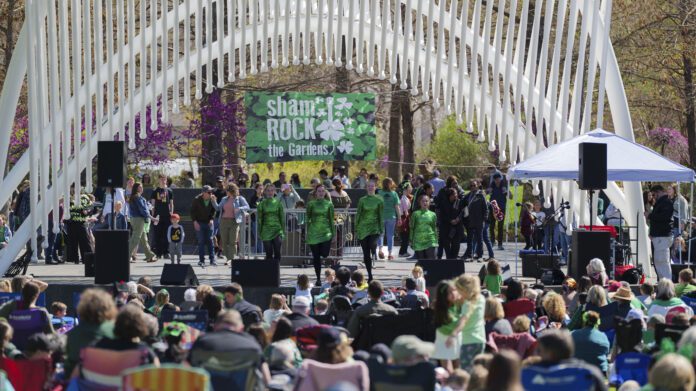
Running March 17 from 11 a.m. to 2 p.m., ShamROCK the Gardens at OKC’s Myriad Botanical Gardens features a bevy of family friendly events, as well as performances from three Irish acts: Ravens Three, Flowers of Edinburgh, and McTeggart Dance.

“ShamROCK the Gardens is a favorite holiday tradition in downtown Oklahoma City,” says Stacey Aldridge, chief marketing officer for Myriad and Scissortail Park. “Not only is it a great day to celebrate Irish music and dance, it is a great precursor to spring.” 

Face painters, crafts and other free activities will occur on the Devon Lawn, alongside plenty of food, drink and merchandise sales. 

“And be sure to come back to the Gardens on March 29-30 for our annual Tulip Festival,” adds Aldridge. 

Along with a herd of longhorns, the Stockyards City St. Patrick’s Day parade offers balloon art, face painting and games. Photo courtesy Stockyards City

Stockyards City St. Patrick’s Day Parade

Starting at 10 a.m. on March 15 in OKC’s Stockyards City district, the Stockyards City St. Patrick’s Day parade encourages you to bring the entire family out to watch the epic parade and celebrate Oklahoma’s Irish heritage and history. 

“The parade will be led by Slash-O-Ranch Longhorns,” a herd of longhorn cattle from Woodward, says Debbie Harrison, executive director of Stockyards City. “You can see St. Patrick, marching bands, bagpipes, Irish dancers, the Shriners, cool cars, community groups, pageant royalty, equestrian entries and so much more.” 

The parade begins at Exchange and Pennsylvania Aves., and is followed by activities for kids including balloon art, face painting and games.

“We will be having a cowboy leprechaun art contest,” says Harrisson. “Admission to the event is free. It will be fun for the whole family.” 

At Myriad Botanical Gardens, ShamROCK the Gardens presents three Irish musical acts alongside family-friendly entertainment. This and main image courtesy Myriad Botanical Gardens

ShamRock the Rose

Now in its eleventh year, Broken Arrow proudly presents another vibrant St. Patrick’s Day celebration on March 15th from 5-10 p.m. Along with live music, food and drinks, the event also offers the Soldier’s Wish ceremony that aims to make a meaningful impact on the life of veterans. 

On top of that, there’s a craft beer garden, a VIP area and a kid’s zone, ensuring the entire family feels welcome. General admission is free, with additional costs for the beer garden and VIP areas.

Celebrating Eicher Wednesdays

Fiddler Shelby Eicher is pictured here with his wife, cabaret star Janet Rutland. Eicher began the musical tradition of 'Eicher Wednesdays' in 2015. Photos courtesy Eicher Wednesdays

The long-running series of Tulsa musical events collectively known as Eicher Wednesdays provides, among other things, a pretty nice example of the old saw (often attributed to Alexander Graham Bell) about how when one door shuts, another one opens. 

Here’s the origin story: One evening back in October of 2015 at the Oklahoma Jazz Hall of Fame, after vocalist Annie Ellicott, guitarist Mark Bruner and fiddler Shelby Eicher had finished the latest in an impressive run of Wednesday evening shows around town, one of the trio decided it was time for a change. That’s according to Eicher, who remembers that Bruner simply said, at the end of their performance, that he thought he wanted to start doing something different on Wednesdays.

“I don’t know if he wanted to teach or look at another opportunity to play with another band or something,” Eicher muses. “But I said, ‘Oh. Okay,’ and at the same time I was thinking, ‘Gosh, what am I going to do on Wednesdays?’ I wanted to keep that regular Wednesday night gig.

“Then I thought, ‘It’d be fun to do something with Nathan.’”

Nathan is Nathan Eicher, son of Shelby Eicher and his wife, Janet Rutland, the Oklahoma-based stage and cabaret star. As you might imagine, it’s a musical family, and Nathan’s instrument is the bass – a perfect complement to his dad’s fiddle, mandolin and guitar.

The idea of a regular Shelby-Nathan team-up was quickly greenlit by Jazz Hall management, and on October 28, 2015, the first Eicher Wednesday concert took place. Joining the two Eichers were Annie Ellicott and West Coast guitarist Pat Kelley, a Tulsa native, who happened to be visiting his hometown that week.

“So that was our first concert, and we thought, ‘Why don’t we just try to have different featured guests every week?’” says Nathan. “Both of us have had long careers as sidemen, in addition to being bandleaders, and what you learn about being a sideman is that it’s a little bit like being a chameleon, or an actor. With everybody you play with, you play a character. But it’s always you that you bring to the stage, or a version of yourself. And with every person, you bring something different.”

“I grew up playing bluegrass, which isn’t something a lot of jazz players are going to say,” adds Shelby with a chuckle. “But that’s a community with a lot of jam sessions – not unlike jazz. So there’s some real crossover to me. Even though the styles of music are so different, there are similarities in the culture of the music.” 

At this writing, in early 2025, the Eicher Wednesday lineup has featured more than 100 different performers, in addition to Nathan and his dad. They include such names as the New York-based Brazilian guitarist Richard Miller, the aforementioned Kelley, and Bruce Forman, the West Coast jazz guitarist who created the Western-swing group Cow Bop.

Of course, many of the other featured guests are from the Tulsa area, including regular vocalist Rutland and guitarist Tommy Crook, one of the first wave of Tulsa rock ‘n’ rollers. 

“Tommy came out of retirement to play Eicher Wednesdays, and he has been a real staple over the years,” Shelby says. “We’ve just had a lot of great artists. Sometimes, they’re not jazz artists, but they’re artists that our people like, and there’s a jazz element to them. Like Jacob Tovar. He does more like old country swing.”

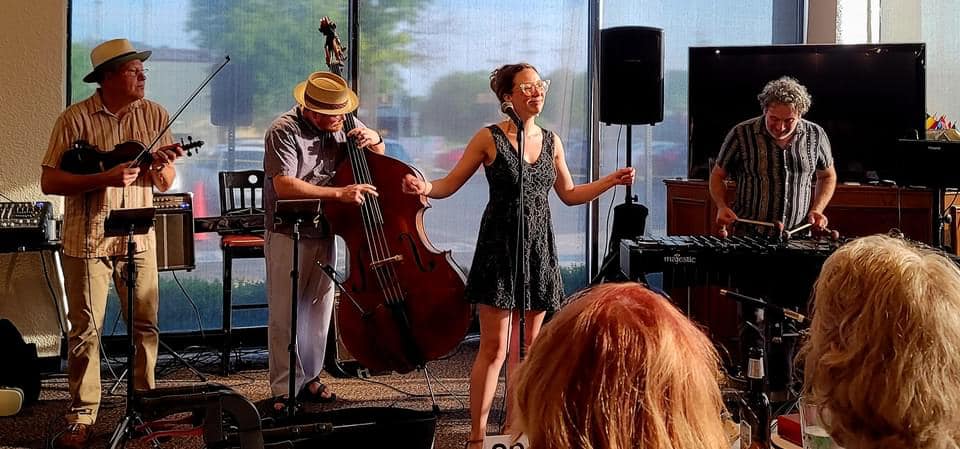
Started in 2015, Eicher Wednesdays welcome talented musicians to Baxter’s Interurban Grill in Tulsa.

Nathan continues: “That’s a good example, his style of music. If you were going to put it in a genre, a category, it’s a lot different than the other guests we have. But there’s an approach to making music that allows us to find some kind of magic there.

“We’ve been fortunate to have so many wonderfully talented guests. Jacob is one of ‘em. Richard was one of ‘em. We both have such an appreciation for people who have excellently honed their craft and have something exciting they want to bring to the table. It’s fun to share that with them and see what we can do together.”

The weekly shows were staged at the Oklahoma Jazz Hall of Fame through February of 2022, when that building was closed for renovations. The Eichers moved to the Greenwood Cultural Center for a few weeks, and then found their current venue: Baxter’s Interurban Grill at 717 S. Houston Ave., in Tulsa.

“It’s very centrally located, and there’s a nice room, like a meeting room, which is great,” notes Shelby. “All the restaurant stuff happens on the other side. They’ve got a bar, and they bring the food over, and parking is easy. It’s just a really great environment for playing music.”

It’s not an expensive one, either. The Eichers encourage their Wednesday evening patrons to make the same donation they did when the event began at the Jazz Hall of Fame, nearly a decade ago.  

“You don’t have to pay us, but we would love to suggest that you donate ten dollars,” says Shelby. “That way, we can bring in the [other] artists, and explore having new people in.” 

Although guest performers have always been a part of Eicher Wednesdays, Nathan and Shelby dealt with the exigencies of the pandemic by initially doing some two-man virtual performances from the Jazz Hall. Even then, however, they found ways to add other artists – figuring, as Nathan says, “We could spread out, put six feet between us, mask up, and do shows with them.” 

Those challenging concerts will always stick in their minds. But there are other Eicher Wednesdays they’ll especially remember. For instance, one that featured, in Nathan’s words, “dueling vibraphones,” played by Howard Potter and Nick Mancini. 

“We’ve had both of them as guests multiple times,” he adds, “but this one time, we got both of them in a room together. We opened with a Chick Corea song that I’d never played – or, I think, even heard, ‘Sea Journey.’ So we started playing it, and it was just this very magical sound. I remember being so excited. And when we got done, it was like, ‘What? What was that?’

“And then, another one. I grew up as a huge fan of the music of [the innovative bluegrass, folk, and jazz mandolinist] David Grisman. His music is such a niche thing that I thought I’d never get the opportunity to play it. And then, we did a tribute to the David Grisman Quintet, the only difference being that we had two acoustic guitars instead of two acoustic mandolins. We had both my brothers in the band, and [bluegrass artist] Kentucky White. And, again, it was electric – although it was an acoustic event.” 

He laughs.

“The crowd loved the energy at both those events, and I don’t think they fully knew what to expect. I don’t think we knew what to expect,” he adds. “We knew the music of David Grisman. But the experience of playing it in an ensemble like that and bringing it to life – that was a real high point for me.” 

So is being able to play shows on a regular basis with members of his gifted musical family.

“That’s a nice thing – they all get to be guests,” he says. “My mom we have very frequently, not just because, you know, we love her, but because she’s a wonderful artist. We can do a jazz tune, an old country thing, or maybe some kind of pop tune re-imagined with her; she has so much flexibility as an artist.

“There’s also definitely a father-son dynamic that makes this very special,” he concludes. “And my dad is such a fabulous musician, who plays at a very high level, that it makes me a better player when I play with him. That is definitely a high point, every week. I come away inspired, and driven to do what I do better.”

The First Taste is for Pachamama

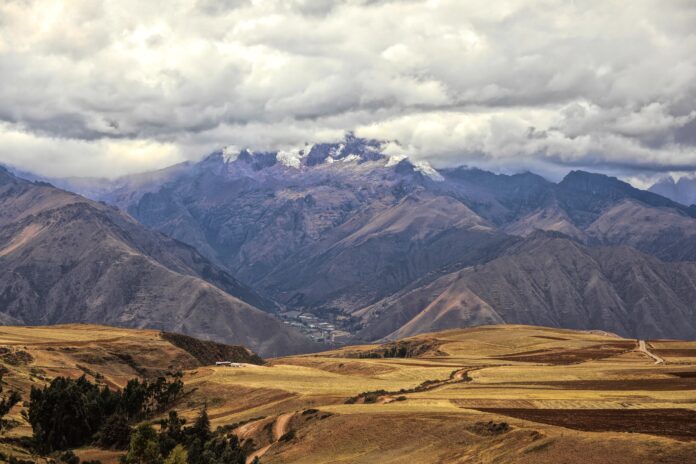
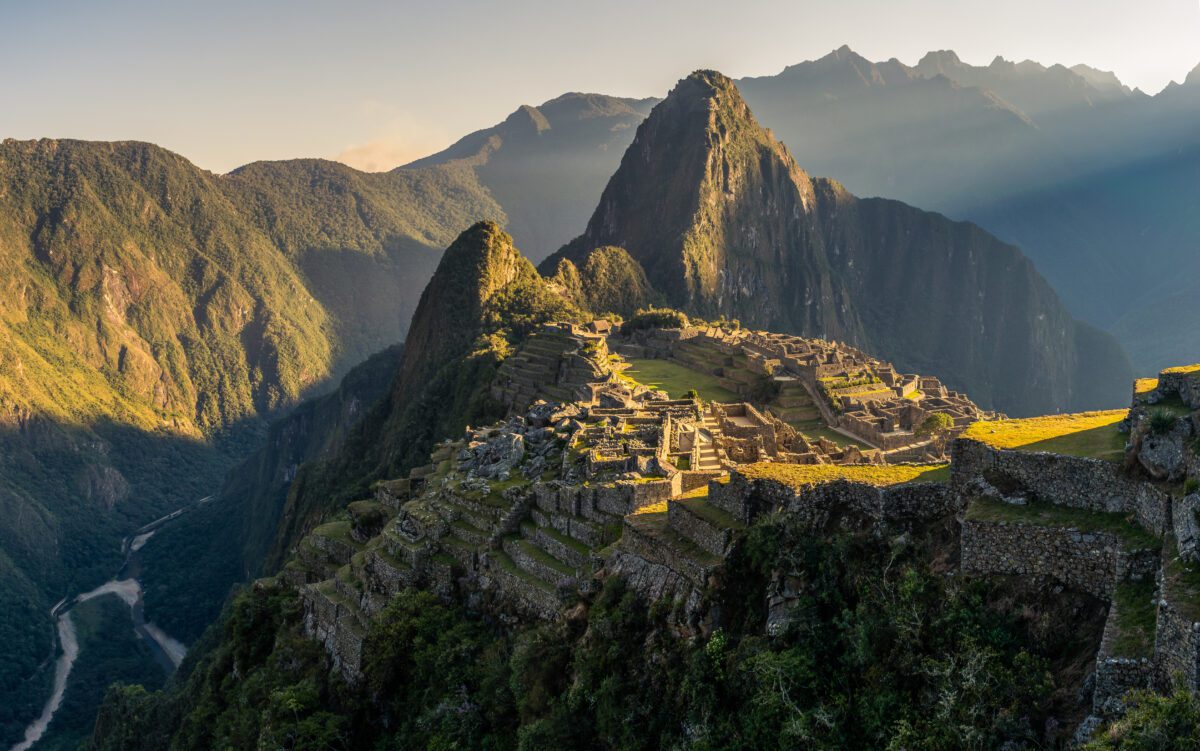
The Andes Mountain range provides a beautiful backdrop for South American adventures. Photo by Gina Michalopulos Kinglsey

If you travel to South America, prepare to be enlightened by the concept of Pachamama. Also known as Mother Earth, Pachamama is celebrated in various rituals that honor environmental and cosmological principles. In the Andes Mountains regions, Pachamama originated as a goddess of fertility, planting and harvesting with a focus on sustaining life on Earth. Reportedly, people believe Pachamama is the origin of water, earth, sun and moon. Although she is mostly viewed as benevolent, Pachamama has a feisty side to her – as it’s believed that if people take too much from the Earth, she’ll respond with earthquakes. 

After the exploration and settlements of South America occurred, religious syncretism adapted Pachamama to be more of an association to the Virgin Mary, the good mother, and the Virgin of Candelaria. The common thread was that the concept of Pachamama was to remind people to respect the environment – believing that problems occur when people take from nature without giving back. 

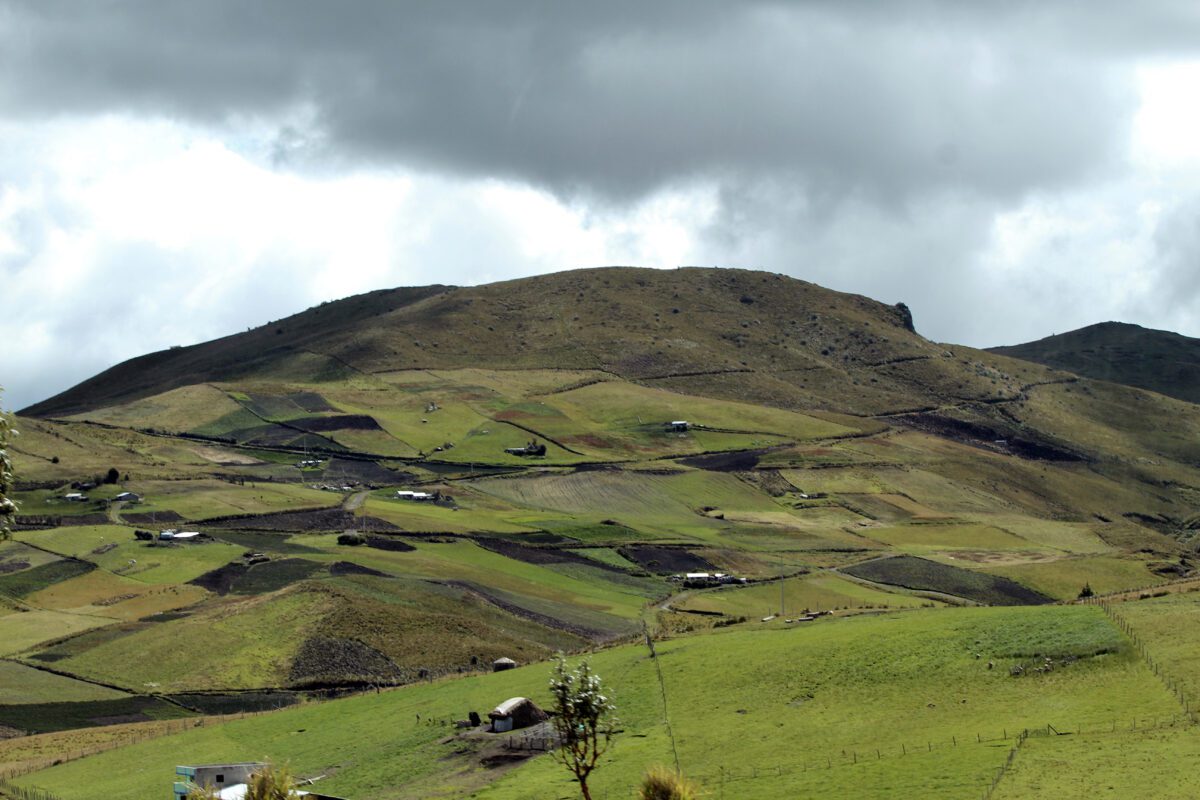
While it’s prevalent throughout many South American countries, the practice of Pachamama in Peru and Ecuador, specifically, is present in tourism activities. Driving through the sprawling landscapes, one can see signs and symbols of Pachamama rituals. Protruding from earthen dwellings or lodgings, sticks with red sacks tied in a balloon-shaped fashion identify a practice occurring there.

On backyard patios amidst fluttering chickens and vining florals, cauldrons can be found containing a fermenting concoction extracted from corn and yeast. It’s a beer called chicha, and the residents sell cups of it to tourists and tour guides. Raise your cups in the air for salutations and anticipate that your tour guide may pour a trickle of the golden chicha beer onto the ground proclaiming, “And the first taste for Pachamama!” Pooling and absorbing into the fertile ground, the chicha beer becomes part of the ritual of honoring the Earth first and giving back before you indulge in the Earth’s pleasures. 

Historically, priests or shamans sacrificed offerings of llamas and cuy (guinea pigs) to Pachamama. People buried food and burned incense, plants or wood in gratitude for good crops and harvests. Some families cooked all night in preparation for honoring Pachamama on a particular day of significance, Aug. 1, the beginning of the sowing season. On this day of gathering, the guests don’t eat the meal until the host first presents a plate of food to Pachamama. In fact, reserved food is poured onto the ground (like the chicha beer) in dedication to the earth mother. 

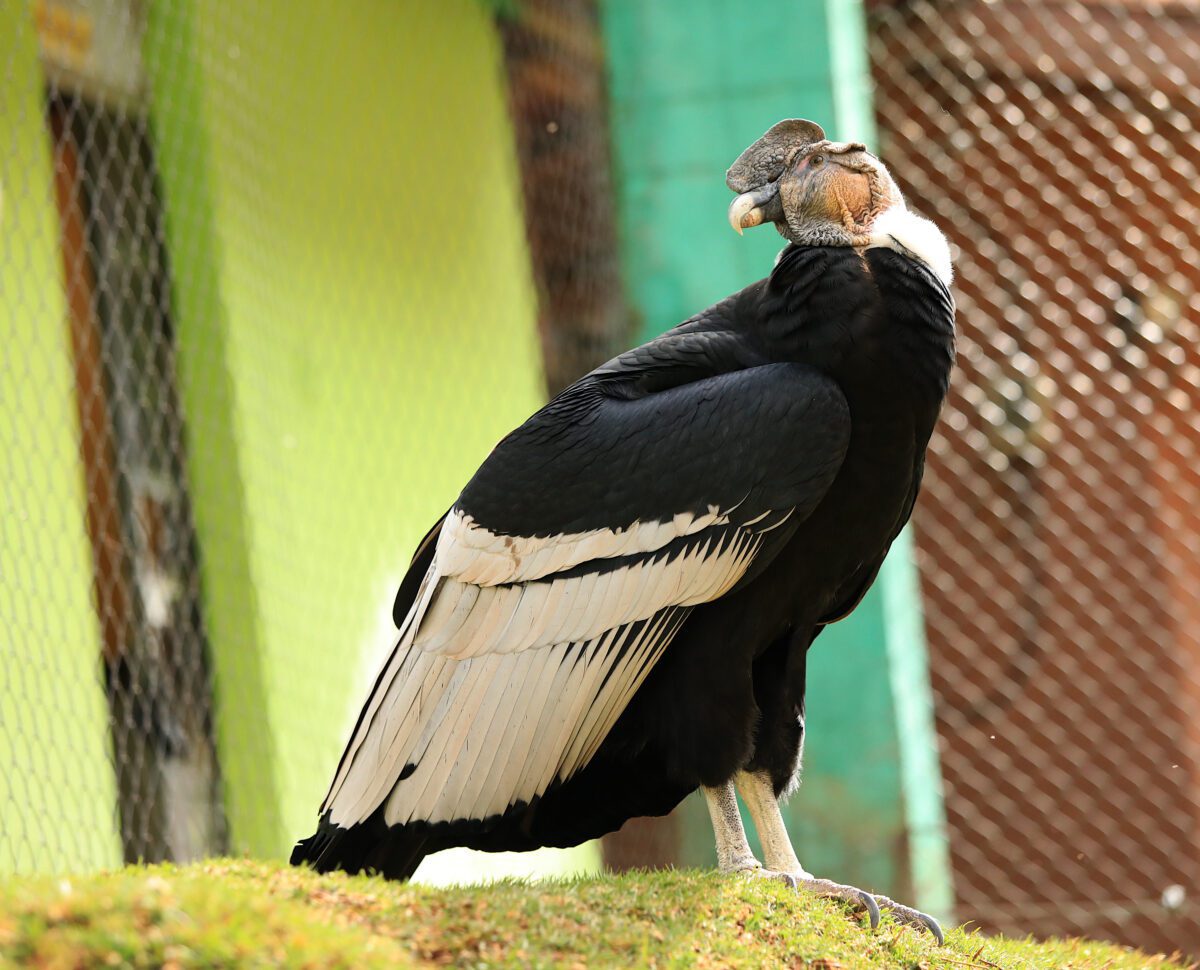
Certain travel agencies are incorporating new age practices of Pachamama into their excursions and itineraries. There are retreats focused on the principles of it, as well as tours visiting the sites of Machu Picchu and Cusco offering opportunities to participate in the rituals. Some ceremonies involve wool, flowers, herbs and condor feathers assembled into the shape of a heart. Coca leaves and instrumental music have also been involved in some ceremonies, as people focus their intentions as they connect with nature, condors and other animals. (Since the condor is the emblematic bird of South America, how appropriate that it’s part of the process!) 

Winding your way through the Andes Mountain regions, you are constantly confronted with verdant beauty and pristine nature. The fields are punctuated by saw-toothed agave plants and succulents. The luminosity of a terra cotta burnish fills the landscape. Descending into the Urubamba Valley, a rushing river sparkles and roars between peaks. 

Perhaps it’s the respect for Pachamama that is evident there. Pachamama promotes and protects the sanctuary of our land, Mother Earth. Observe and appreciate the cultural nuances and remember: “The first taste is for Pachamama!”

Featured image cutline: The Andes Mountain range provides a beautiful backdrop for South American adventures. Photo by Gina Michalopulos Kinglsey

Understanding Endometriosis

Approximately six and a half million American women have endometriosis, according to the Office on Women’s Health, and many suffer with chronic pelvic pain, severe menstrual cramps and the physical and emotional toll of infertility.

“Endometriosis is a condition where tissue similar to the lining of the uterus grows outside of the uterus, typically located on the walls of the pelvis and/or the ovaries and tubes,” says Jessica Putman, M.D., a minimally invasive gynecologic surgeon with OU Health in Oklahoma City.  “It can sometimes affect other organs in the abdomen. There are certain symptoms that can raise suspicion for endometriosis, but definitive diagnosis is surgical with visualization of the lesions and pathological confirmation.”

While there’s no known cause for endometriosis, Putman says the most common theory is retrograde menstruation, where menstrual blood flows back through the fallopian tubes and into the pelvis. 

“The blood may contain endometrial cells from the uterine lining that can then stick to the pelvic walls or organs,” she says. “Estrogen stimulates the growth and spread of endometriosis. Family history, particularly in mom or a sister, is a major risk factor. The majority of patients are diagnosed after the age of 25, however, most patients develop symptoms long before that. It can take months up to 10 years to get a diagnosis depending on symptoms and discussions with your doctor.”

The difficulty in diagnosing endometriosis often stems from symptoms being so similar to other conditions, and the varying degrees of severity and presentation of symptoms among individuals. Endometriosis symptoms can mimic conditions such as pelvic inflammatory disease, irritable bowel syndrome and uterine fibroids.

“The most common symptoms are painful periods, pelvic pain, pain with sex, pain with bowel movements or urination, heavy periods, bloating and infertility,” says Putman. “Most of the symptoms can be managed with appropriate treatment, but patients will often experience ‘flares’ where symptoms are worse for a period of time.”

She says up to half of patients with endometriosis will struggle with infertility, however, many with mild to moderate disease can still conceive. 

“Some patients, particularly those with more advanced disease, may need reproductive assistance,” she says. “Any patients with known endometriosis who are trying to conceive should reach out to their doctor for further workup if unable to achieve pregnancy within six months.”

Regarding treatment for endometriosis, Putman says symptoms are often managed with hormonal suppression medications. 

“This not only improves symptoms but also decreases the risk of progression or recurrence of disease,” she says. “When medical management does not control symptoms, then surgical management may be needed. This can be anywhere from a surgery for removal of endometriosis lesions up to hysterectomy. It is important to know that endometriosis is a chronic condition and there is no cure, although patients typically have significant improvement in symptoms after menopause due to the drop in estrogen.”

For women navigating the journey of endometriosis, there are several organizations that offer resources and support groups, such as SpeakEndo.com, the Endometriosis Coalition Patient Support Group, the Endometriosis Foundation and a variety of apps that can help women track symptoms, medications and gain more knowledge about their condition. 

A Friendly Face Next Door

Whether you live in a community where your neighbors are in close proximity or an area where the nearest residence is a great distance away, being a “good neighbor” may look a little different for everyone. However, a few tenants apply to all.

According to Myron Mayberry, executive director of the Neighborhood Alliance of Central Oklahoma (NACOK), a good neighbor is someone who is friendly, helpful, trusting and respectful. 

“Good neighbors know the names and pertinent contact information of their neighbors,” says Mayberry. “My perspective has always been built on the principle to love your neighbor as yourself. It is a simple, yet complicated first step to build great communities.”

Mayberry goes on to say that “friendly neighbors are kind to current neighbors and welcoming to new ones.” He also notes there may be quiet and unassuming folks who wish to be involved in the community but may not want to be social friends. His advice? Give space and respect their wishes.

Another good idea to protect your neighborhood is to organize or join a group that is specifically composed of individuals living in your area.

According to their website, Tulsa Crime Stoppers is a program of the Crime Prevention Network, Inc. and is Tulsa’s only nonprofit dedicated solely to public safety. Part of this group’s crime prevention suggestions is forming an alliance such as Alert Neighbors, a program provided to engage neighborhoods in discussions about crime and public safety. 

The program instills effective collaboration and communication within neighborhoods to prevent crime and help fulfill a neighborhood’s needs for security, and decreased incidents of crime are frequently reported in neighborhoods which participate in such alert programs. The website further states the sense of community formed by this kind of program often serves as a catalyst for neighborhoods to thrive and curate cohesiveness.

An Alert Neighbors program helps inform residents regarding how to secure their homes, how to be safer in their residences and while out among their neighbors, and how to recognize and report suspicious activity. The Alert Neighbors program results in effective communication between neighbors and fosters improved relations between the community and local law enforcement officials.

Treating others with respect – an effort we should all strive for – includes honoring personal boundaries, but is especially necessary with the individuals with whom we share physical space.

“Being respectful involves maintaining tidiness, understanding limitations and adhering to community rules,” explains Mayberry. “Trusting neighbors have their neighbors’ best interests at heart. They also keep their word and follow through when asked to do something.”

One last piece of advice from
Mayberry?

“Providing your neighbor with your information is a great way to keep in touch and start the foundation of a strong relationship,” Mayberry says.

Good Neighbor Tips:

• Pay attention to how much noise you make.

• Join in with efforts to keep the neighborhood clean.

• Have pets? Be responsible, keep them secured and clean up their messes. 

• Curb appeal is important to everyone. Take pride in your home’s appearance.

• Employ tact while discussing issues.

Perry Good

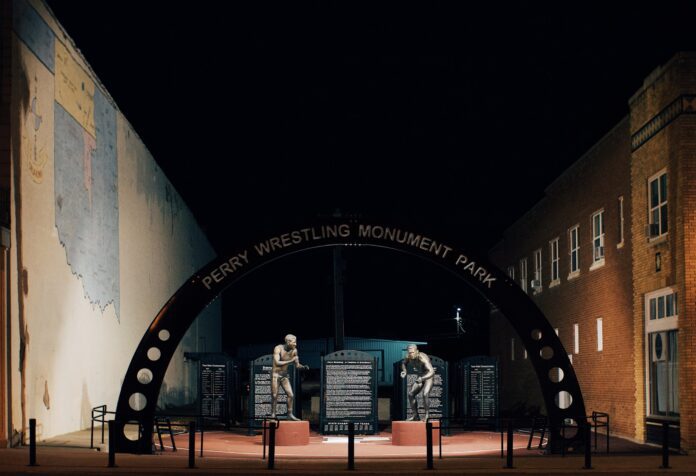
One of Perry’s most unique and celebrated attractions is Perry Wrestling Monument Park. Photo courtesy Perry Wrestling Park

A small yet historically significant city, Perry is best known for its deep connections to the Land Run of 1893 and its remarkable wrestling tradition. Located along Interstate 35, Perry is the seat of Noble County and offers visitors a unique blend of history, culture and good old community pride.  

Perry’s Beginnings

Perry’s origins date back to the Cherokee Outlet Land Run; on September 16, 1893, a pistol shot rang around noon and one of the largest land runs in U.S. history began. This event saw tens of thousands of settlers race to claim land in what was previously Cherokee Nation territory. Perry was established almost overnight and named after J.A. Perry, a government official overseeing the land run.  

“The significance of this race is that it not only was the largest and last land run of the unassigned lands, but brought thousands of immigrants and cultures to America,” says Maddy Flores, executive director of the Cherokee Strip Museum and Rose Hill School. 

The town quickly became a bustling hub, with businesses, homes and civic institutions.

Preserving Perry’s Pioneering Past

For those interested in exploring Perry’s pioneer history, the Cherokee Strip Museum and Rose Hill School are essential stops, Flores says. The museum provides a comprehensive look at the history of the Cherokee Strip, the Land Run of 1893, and the development of Perry and surrounding areas. Exhibits include artifacts from early settlers, historic photographs and interactive displays that bring Oklahoma’s frontier past to life.  

“Presently, so many of the last names you see around town are the same last names of settlers that came to settle the strip in 1893,” Flores says. “I am one  of those people who can date my family back to the land run! They established their roots north of Perry in 1893 and we bought the land back ten years ago that they established.”

Adjacent to the museum, Rose Hill School offers a glimpse into early Oklahoma education. The restored one-room schoolhouse provides visitors with an immersive experience of what schooling was like for children in the early 20th century. The site hosts educational programs that allow guests to step back in time and experience a typical school day from the past.  

A Tribute to a Legacy of Champions

One of Perry’s most unique and celebrated attractions is Perry Wrestling Monument Park. Wrestling is a deeply ingrained part of the city’s culture, with Perry High School boasting one of the most successful wrestling programs in the country. With 43 state championships to date, a national record, and a reputation for producing elite athletes, Perry has rightfully earned the nickname of the Wrestling Capital of the World.

“Wrestling is a way of life in Perry,” says Roger Tetik, president of the Perry Wrestling Foundation. “People come to the Perry Wrestling Monument Park to find names etched in granite of their father, brother, uncle or someone they know that wrestled for Perry.”

The park stands as a tribute to the town’s rich wrestling history and features statues of Danny Hodge and Jack VanBebber, Perry natives that not only went on to have collegiate success at Oklahoma University and Oklahoma A&M, respectively, but also as Olympic champions. 

“The Perry Wrestling Foundation wanted to honor Danny Hodge, and [the establishment of the museum] grew to where we wanted to recognize both of our Olympians and the Perry Wrestling program and all its accomplishments,” says Tetik. “We wanted to recognize all the state championship teams and the individuals and coaches that made up those teams that helped us win our 43 state championship titles.”