

We all love it when the menu changes and diners are treated to a cavalcade of creative new dishes. But few of us realize just how much work this takes.
“I’m constantly taking notes on future menus,” says Terra Rubio, the executive chef at Amelia’s in downtown Tulsa, “thinking of new flavors, ingredients that go together. It took me at least two weeks to assemble all of these into the new spring menu, let cooks make suggestions, plate and try every dish again and again until it’s perfect.”
This was her first menu for Amelia’s, but she’s been doing it (or trying to) ever since she was a child.
“I was always in the kitchen,” she recalls. “I’d follow Grandma around and try to change her recipes. Being a chef was a career I’ve always wanted to do.”
After Arts and Sciences High School and a degree at TU, Rubio went to the OSUIT culinary school at Okmulgee, then cooking school in Calabria. That’s the toe of Italy’s boot, almost touching Sicily. She learned about the food of different regions of Italy, but while there and while traveling around Europe, she learned something more.
“‘Piano piano!’ everyone said. That means take it easy, slow down. Prioritize food and take the time to enjoy it,” she shares. “I saw so many places where crops were grown, processed, cooked and enjoyed in the same place. We try to highlight local ingredients here at Amelia’s when we can. We make our own yogurt, our quail’s eggs are local and I have forager friends who will find me chanterelles and morels.”
There’s a restaurant in Brooklyn – Roberta’s – that has been a hotbed of culinary creation for the past twenty years. It started as a pizza shop built in an abandoned factory in a neighborhood that could be charitably called ‘rundown.’ That’s about when Rubio started working there. By the time she left eight years later, it was world-famous, had branches in Williamsburg, the Hamptons and Los Angeles, and served a menu of innovative dishes so good that its tasting menu earned two Michelin stars.
Yes, they had killer pizza, but they also offered a dish featuring kohlrabi from a local farm (hard to find in NYC) made four ways (juiced, pickled, roasted, made into chips). Rubio started slinging takeout pizza and her talent grew as fast as the restaurant. By the end of her time there, she was creating some of those famous dishes and a lot more besides.
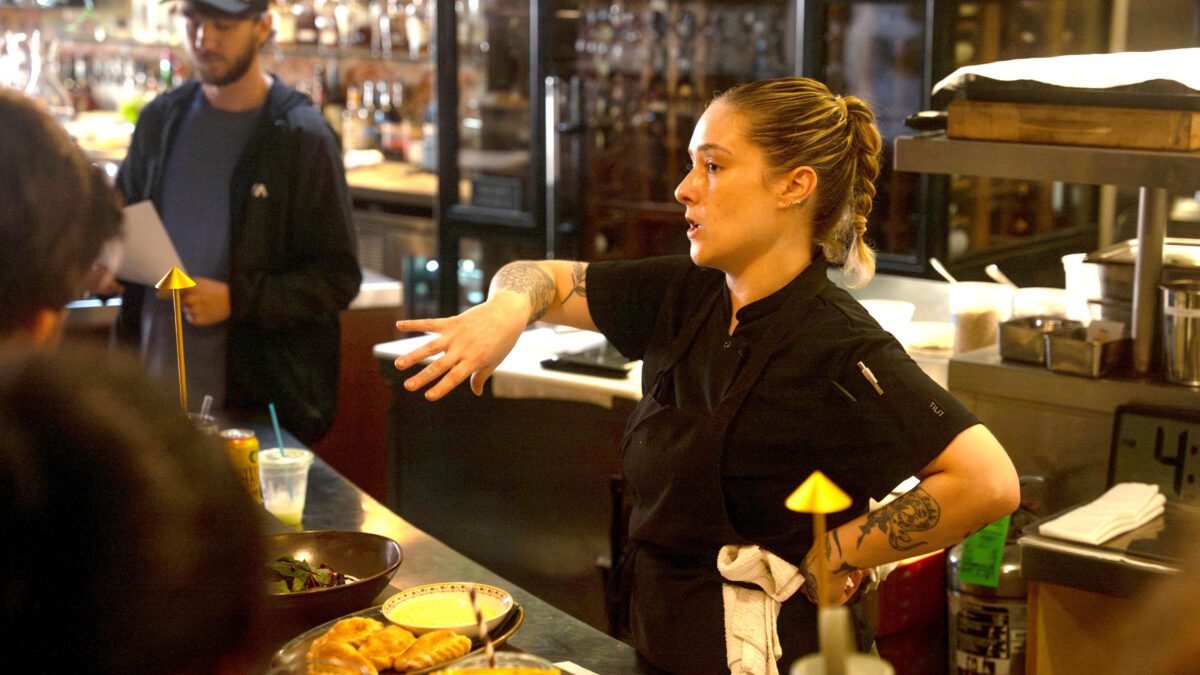
“I learned to be a manager,” she recalls. “I had to schedule 30 people, and I was in charge of several branches. I’d use Uber to go from one branch to the next. And I loved it! Life at Roberta’s was so exciting. I’d get to travel to pop-ups and food festivals all over the country.”
And now here she is at Amelia’s, excited and planning the months ahead.
“The summer crops come in waves,” she says, “and I’m already planning dishes that we’ll use in peak season, when the wave of summer fruit comes in. And I’m planning for the months after harvest ends. I’ve already started pickling ramp bulbs, thinking of preservation. I hope to build an area somewhere where we can do fermentation. But most important is investing time in my cooks, training them to master new kitchen stations, empowering them. There’s so much going on and that’s one of the things I love about being a chef. I thrive under pressure, I thrive with a little bit of chaos.”
“What do you hate about being a chef?” I ask her. She goes silent and ponders for a long time – but she just can’t think of anything at all.