


















Across Oklahoma, tribal nations are expanding economic opportunity, preserving cultural traditions and investing in future generations. From advanced aviation and healthcare initiatives to environmental stewardship and youth leadership, Native nations are reshaping our communities for the better.
An Expanding Business Portfolio
As with many of the tribes based in Oklahoma, the Choctaw Nation’s economic development activities extend well beyond the gaming industry, says Tammye Gwin, the nation’s senior executive officer for strategic development.
“While gaming remains an important economic engine, we have intentionally expanded into hospitality, retail, commercial leasing, agriculture, healthcare, housing, print services and emerging aviation technologies,” Gwin says. “Today, the Nation operates more than 145 businesses and programs that support economic growth, long-term sustainability and greater economic independence for tribal members.”
In 2023, the Choctaw Nation generated more than $4.1 billion in economic impact, supported over 20,000 Oklahoma jobs and contributed more than $1 billion in wages and benefits, Gwin says.
“Over the past four years alone, we have created more than 3,000 new jobs through investments in healthcare, education, housing, infrastructure, tourism and business development,” she continues.
A key part of Choctaw Nation’s diversification strategy is investing in its people.
“Since 2019, we have built more than 1,500 homes and invested over $153 million in housing. We invest more than $70 million annually in education, workforce development, scholarships, internships and career training programs. Our healthcare system serves more than 1 million patient encounters annually, ensuring access to quality care while creating thousands of jobs across the region.”
Choctaw Nation is one of the largest employers in southeastern Oklahoma, Gwin says, with businesses and operations spanning a wide range of industries.
“The impact extends far beyond our own workforce,” Gwin says. “Every time the Nation develops a new business, constructs a new facility or makes a strategic investment, it creates a ripple effect throughout the regional economy. We purchase goods and services from local vendors, partner with regional contractors and suppliers and create opportunities for small businesses to grow alongside us.”
Looking ahead, several industries are positioned to become major drivers of future growth for the Choctaw Nation, Gwin says. One of those is Advanced Aviation and Unmanned Aircraft Systems (UAS).
“Choctaw Nation has positioned itself as a leader in drone testing, research and emerging aviation technologies,” Gwin says. “This sector has the potential to attract new businesses, create high-skilled jobs and establish southeastern Oklahoma as a hub for aviation innovation.”
Another is technology and innovation.
“Investments in broadband infrastructure, artificial intelligence, cybersecurity, data analytics and digital technologies are creating new opportunities for business growth, workforce development and economic expansion.”
Initiatives such as the Choctaw Beef Program, Choctaw Country Market and AgPreneur programs are strengthening local food systems, supporting Choctaw farmers and ranchers and enhancing food security throughout the reservation. And as demand for healthcare services continues to grow, healthcare remains one of the Choctaw Nation’s most important industries.
“Continued investments in facilities, technology and services will improve access to care while creating career opportunities across the region,” Gwin says.
Throughout all its business and development efforts, “cultural preservation remains central to who we are,” Gwin says. “Investments such as the Choctaw Cultural Center, Choctaw Country Tourism, cultural programming and support for Choctaw artisans ensure that our history, language and traditions remain vibrant for future generations.”
Remaining Stewards of the Earth
The Cherokee Nation’s environmental stewardship efforts are expansive, says Christina Justice, secretary of natural resources.
“Historically, Cherokees are very connected to wildlife. It’s culturally inherent to want to protect our natural resources,” she says.
Justice oversees a large department that has 11 sub-departments. The natural resources department is dedicated to preserving and protecting the tribe’s air, water, land, wildlife and cultural resources.
Tribal stewardship efforts cover wildland fire management, land management, wildlife conservation, parks and recreation, waste management, energy conservation and ethnobiology, among others.

Principal Chief Chuck Hoskin Jr. recently signed the Cherokee Nation Energy and Sustainability Act of 2026.
“We are one of the largest employers in Oklahoma,” Justice says, and the tribe has reservation-wide goals in connection with its buildings and enterprises such as reducing litter, expanding recycling efforts, reducing water and energy consumption and reducing light pollution.”
Tribal counsellor Lisa Hall continues: “Our relationship with the land, the water and the air is not just a policy position – it is who we are. Our ancestors understood something so very profound, that every decision made today ripples forward across the future generations. They planted trees whose shade they would never sit beneath, trusting that their grandchildren and great-grandchildren would one day rest there.”
The ethnobiology department oversees the Cherokee Nation Heirloom Garden and Native Plant Site and manages the Cherokee Nation Seed Bank.

“We are teaching people how to utilize our cultural plants,” Justice says, which are used for crafts, food and medicine. The seed bank distributes 10,000 packets of seeds annually including corn, beans, squash, gourds and tobacco.
With four air monitoring sites located within tribal jurisdictional boundaries, the Clean Air Program operates one of the largest tribal air monitoring networks in the United States. Pollutants monitored include ozone, carbon monoxide, sulphur dioxide and particulate matter.

“We are all concerned about sustainable clean air and clean water,” says Justice, who has worked for the tribe for more than two decades. “It’s really upon us to be good stewards and make sure we are setting the standard.”
Investing in Tradition
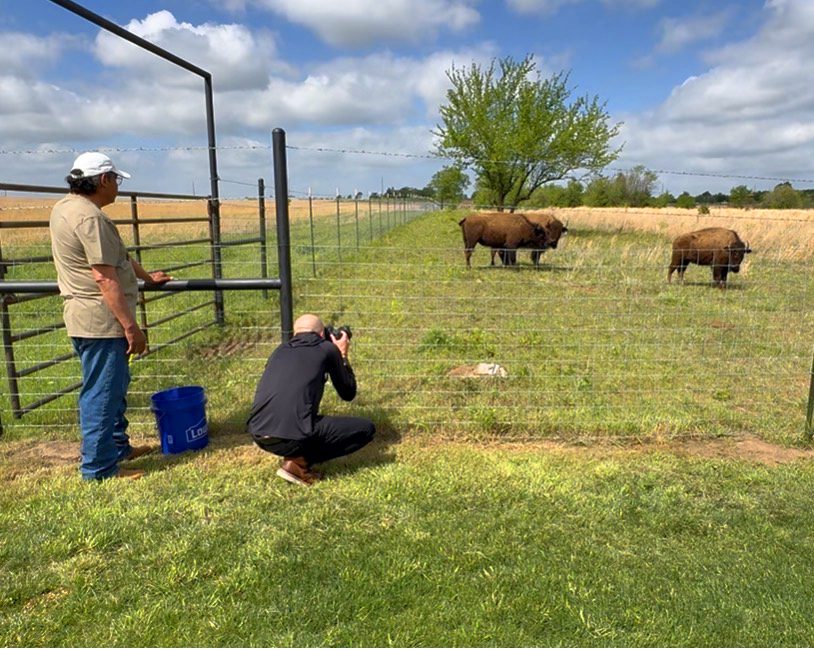
When 4:30 p.m. rolls around, it’s feeding time for the three bison who live near the Choctaw Cultural Center. Usually, their caretaker Skyler Robinson says, they’re waiting near the main gate. If not, he jumps on the Gator (his utility task vehicle) and goes in search of the year-old animals.
“I holler ‘girls!’ and they chase me back to the pen, ready to eat.”
Robinson christened two of the bison as 181 and 182, the numbers on their ear tags. The third, which came from a different ranch and was not immediately welcomed by her pen mates, he named Lonely.
Robinson, who grew up working with cattle and horses, is a project manager for the Choctaw Nation’s historical preservation department. He was thrilled when invited to take care of the bison, which were purchased at an auction in Oklahoma City and arrived on Feb. 14.
“I feel really lucky to do this,” he says. “They are beautiful animals.”
The bison currently roam 16 acres near the Cultural Center and can often be spotted by visitors.
“It’s part of our culture,” Robinson says of the tribe’s decision to start a buffalo herd. “The buffalo roamed the area many years ago. This is one of the best prairies in this area. It’s the same grass they would have eaten.”
Robinson, 66, says he talks to the animals and observes their distinct personalities.

“They know me,” he says. “We’ve gotten used to each other.”
But they are nonetheless wild animals, and if he gets inside the fence with them, he’s usually on the Gator. Walking tours can be arranged through the Cultural Center, which is in Calera near Durant, but visitors stay outside the enclosure, which is protected by a fence that’s more than 6 feet tall.
“If you catch them at the right time, you can see them swim across the pond,” Robinson says. “They love water.”
Being with the bison, Robinson says, “is meditation for us. Bison do have ties to spirituality for our tribal citizens.”
Honoring Ancestors
Nine days in, Adrian Gaches could discern that the Remember the Removal Bike Ride would launch her future with the tribe.
“It’s already changed me,” says the 20-year-old Stilwell native and student at Northeastern State University in Tahlequah. “I’ve grown so much as a Cherokee person, as a Cherokee woman.”
Her goals, Gaches says, now include “advocating for this program and all the Cherokee programs
out there.”
The Remember the Removal Bike Ride was started in 1984 for Cherokee youth to retrace the Trail of Tears and get a glimpse of the hardships their ancestors faced when they made the same trek on foot. This year, 18 bicycle riders trained for six months before leaving from Georgia on June 1 and completing the journey on
June 19.
Gaches says she is majoring in health and human performance and hopes to use her skills after she graduates as a tribal employee.
“I feel like that’s a long-term goal for a lot of us,” Gaches says of her fellow cyclists.
Jaden Carroll, 24, of Tahlequah, says his experiences with the program “make me want to be more socially aware of others. It’s made me want to be more of an example to others that struggle.”
As he pedals up steep hills, often facing a bracing wind, “it’s just awesome to respect the sacrifice that they made for us,” Carroll says of his ancestors.
Gaches mentions that she was a high school softball player who has continued to work out while in college.
“I’ve stayed pretty strong, but you can’t really do that without your teammates,” she says. As the cyclists talk together in the evenings, “we are always looking at what we can do to improve as a team.”
KenLea Keys, social media and communications manager for Cherokee Nation Communications, was 23 when she completed the ride.
“It changed me completely,” Keys said. “I wanted to give back to my tribe and learn more and always keep the history of my ancestors alive. The bike ride really instilled in me that I could be a leader.”
Keys says she continued as a volunteer for the next few years and now serves on the Remember the Removal Bike Ride committee.
“I am out here with Cherokee Nation Communications, but on a volunteer basis,” Keys said during a rest day in Missouri.
Carroll says the leadership program, which now has 175 alumni, “has to do with bringing together a group of young individuals and showing them what it is to be Cherokee.”

Intertribal Collaboration
The quarterly meeting of the Inter-Tribal Council of the Five Civilized Tribes “is one of the coolest events that I regularly get to take part in,” says Zechariah Harjo, Muscogee Nation secretary of the nation. “We compare notes and track progress.”
The Muscogee Nation hosted the most recent quarterly meeting at River Spirit Casino Resort in Tulsa. Leaders from the Cherokee, Choctaw, Chickasaw and Seminole nations joined the Muscogee for the meeting.
Committees and subcommittees discussed important topics including public safety, public health, education, social services, veterans’ affairs, nutrition services, housing, commerce and natural resources.
And in addition to the collaboration among the five sister tribes on the eastern side of the state, “we do a lot of partnerships with all tribes in Oklahoma,” Harjo says.
One of those is the Oklahoma Indian Child Welfare Association, a Shawnee-based nonprofit representing the interests of Indian Child Welfare programs across the state.
The Muscogee Nation also works jointly with the Cherokee and Osage Nations to fund infrastructure and other projects in Tulsa, as many citizens of the three tribes live within the jurisdictional boundaries that converge in the area, Harjo says.
Featured photo credit: The Choctaw Nation’s growing bison herd reflects a broader commitment to preserving cultural traditions while investing in education and tourism for future generations. Photo courtesy Choctaw Nation