

















Home Blog Page 37

An Economic Powerhouse

The American Airlines Base Maintenance Facility, also known as Tech Ops-Tulsa, has an estimated annual economic impact of $3.3 million. Photos courtesy American Airlines

The numbers are huge. 

More than 5,000 people are employed by the American Airlines Base Maintenance Facility, also known as Tech Ops – Tulsa, for an estimated annual economic impact of $3.3 billion. 

Upgrades currently underway at the base are budgeted at $400 million. And jobs added in 2023 and announced in late 2024 will total 621, thanks in part to a $22 million Business Expansion Incentive Program grant from the State of Oklahoma.

The capital project “really helps solidify American’s investment in the Tulsa region,” says Brien Thorstenberg, vice president for economic development for the Tulsa Regional Chamber of Commerce. “If those jobs were to leave, it would be very difficult to get those jobs back in the community. These are very high-quality jobs. These are fantastic jobs, and a fantastic employer.”

Ed Sangricco, managing director of base maintenance, says that $400 million worth of improvement projects adds up to a hefty list: new roofs, boilers, chillers and cooling towers alone will total $81 million. All the water and sewer lines are being replaced, and employee spaces such as restrooms and breakrooms will be re-done. New IT infrastructure calls for switching to fiber optics, and the plating shop is being modernized, too.

“It’s all being painted, with new signage,” says Sangricco. “It’s really making a big difference. When they are finished, you won’t recognize the place.”

Most of the infrastructure work will be completed in the next one to two years, and more projects are on the horizon. 

“We are also considering building a new hangar,” says Sangricco. 

The American Airlines Base Maintenance Facility, also known as Tech Ops-Tulsa, has an estimated annual economic impact of $3.3 million. Photos courtesy American Airlines

And all those upgrades are putting even more Oklahomans to work. “There are a lot of contractors on this base every single day,” he mentions. 

The 246-acre base opened at Tulsa International Airport in 1946, having been moved from LaGuardia in New York.

“The hangars were already here; there was a big military presence here,” Sangricco says. “It was the perfect location.”

In addition to heavy maintenance work on about 400 aircraft every year, functions at the six-hangar base include engine overhauls, work on landing gear and components, a brake and wheel center and a large supply center.

“I’m incredibly proud of this operation,” Sangricco says. “I think the secret to our success and the reason we are growing is the people. Last year, we signed a formal agreement with Tulsa Tech that guaranteed their top performers the chance to interview here.”

The facility recruits nationwide, but the Oklahoma hires are the people most likely to stay, Sangricco says.

“The Tulsa base is very generational,” he says. “We have fathers and sons, even grandfathers and sons and grandsons. Everybody knows everybody. And with an average pay rate in the $58 to $60 an hour range, it’s a pretty big economic powerhouse.”

The facility is very connected to the community, Sangricco says, with employee groups doing volunteer work at sites such as food banks, Habitat for Humanity and veterans’ hospitals.

All told, between the direct and indirect economic boon and what the employees contribute to the quality of life of the area through their volunteerism, “it’s just really a comprehensive impact to the Tulsa region,” Thorstenberg says. 

Feeling Green – In a Good Way

Above and below photos courtesy Myriad Botanical Gardens

St. Patrick’s Day is just around the corner, meaning it’s time for delicious food, great drinks and entertainment aplenty. As usual, Oklahoma has a plethora of options for the Irish holiday, so make sure to plan accordingly. We present just a few of the many offerings.

McNellie’s St. Patrick’s Day Celebration

The well-known Tulsa-based bar and restaurant is back with another memorable, multi-day event. 

“All three McNellie’s locations – downtown, south city and OKC – are pulling out all the stops,” says Dru Jackson, manager and digital creator at McNellie’s Group. 

The celebrations run March 15-17 with live music, DJs, drinks and beloved bar fare. Additionally, downtown Tulsa and OKC’s locations will host street parties on March 15.

“Enjoy festive drinks, delicious food and an electric atmosphere as we turn the streets into the ultimate Irish party zone,” says Jackson. Details are being finalized as of this writing, so make sure to check social media channels and the group’s website – mcnelliesgroup.com – for a full line-up.

ShamROCK the Gardens

Running March 17 from 11 a.m. to 2 p.m., ShamROCK the Gardens at OKC’s Myriad Botanical Gardens features a bevy of family friendly events, as well as performances from three Irish acts: Ravens Three, Flowers of Edinburgh, and McTeggart Dance.

“ShamROCK the Gardens is a favorite holiday tradition in downtown Oklahoma City,” says Stacey Aldridge, chief marketing officer for Myriad and Scissortail Park. “Not only is it a great day to celebrate Irish music and dance, it is a great precursor to spring.” 

Face painters, crafts and other free activities will occur on the Devon Lawn, alongside plenty of food, drink and merchandise sales. 

“And be sure to come back to the Gardens on March 29-30 for our annual Tulip Festival,” adds Aldridge. 

Along with a herd of longhorns, the Stockyards City St. Patrick’s Day parade offers balloon art, face painting and games. Photo courtesy Stockyards City

Stockyards City St. Patrick’s Day Parade

Starting at 10 a.m. on March 15 in OKC’s Stockyards City district, the Stockyards City St. Patrick’s Day parade encourages you to bring the entire family out to watch the epic parade and celebrate Oklahoma’s Irish heritage and history. 

“The parade will be led by Slash-O-Ranch Longhorns,” a herd of longhorn cattle from Woodward, says Debbie Harrison, executive director of Stockyards City. “You can see St. Patrick, marching bands, bagpipes, Irish dancers, the Shriners, cool cars, community groups, pageant royalty, equestrian entries and so much more.” 

The parade begins at Exchange and Pennsylvania Aves., and is followed by activities for kids including balloon art, face painting and games.

“We will be having a cowboy leprechaun art contest,” says Harrisson. “Admission to the event is free. It will be fun for the whole family.” 

At Myriad Botanical Gardens, ShamROCK the Gardens presents three Irish musical acts alongside family-friendly entertainment. This and main image courtesy Myriad Botanical Gardens

ShamRock the Rose

Now in its eleventh year, Broken Arrow proudly presents another vibrant St. Patrick’s Day celebration on March 15th from 5-10 p.m. Along with live music, food and drinks, the event also offers the Soldier’s Wish ceremony that aims to make a meaningful impact on the life of veterans. 

On top of that, there’s a craft beer garden, a VIP area and a kid’s zone, ensuring the entire family feels welcome. General admission is free, with additional costs for the beer garden and VIP areas.

Celebrating Eicher Wednesdays

Fiddler Shelby Eicher is pictured here with his wife, cabaret star Janet Rutland. Eicher began the musical tradition of 'Eicher Wednesdays' in 2015. Photos courtesy Eicher Wednesdays

The long-running series of Tulsa musical events collectively known as Eicher Wednesdays provides, among other things, a pretty nice example of the old saw (often attributed to Alexander Graham Bell) about how when one door shuts, another one opens. 

Here’s the origin story: One evening back in October of 2015 at the Oklahoma Jazz Hall of Fame, after vocalist Annie Ellicott, guitarist Mark Bruner and fiddler Shelby Eicher had finished the latest in an impressive run of Wednesday evening shows around town, one of the trio decided it was time for a change. That’s according to Eicher, who remembers that Bruner simply said, at the end of their performance, that he thought he wanted to start doing something different on Wednesdays.

“I don’t know if he wanted to teach or look at another opportunity to play with another band or something,” Eicher muses. “But I said, ‘Oh. Okay,’ and at the same time I was thinking, ‘Gosh, what am I going to do on Wednesdays?’ I wanted to keep that regular Wednesday night gig.

“Then I thought, ‘It’d be fun to do something with Nathan.’”

Nathan is Nathan Eicher, son of Shelby Eicher and his wife, Janet Rutland, the Oklahoma-based stage and cabaret star. As you might imagine, it’s a musical family, and Nathan’s instrument is the bass – a perfect complement to his dad’s fiddle, mandolin and guitar.

The idea of a regular Shelby-Nathan team-up was quickly greenlit by Jazz Hall management, and on October 28, 2015, the first Eicher Wednesday concert took place. Joining the two Eichers were Annie Ellicott and West Coast guitarist Pat Kelley, a Tulsa native, who happened to be visiting his hometown that week.

“So that was our first concert, and we thought, ‘Why don’t we just try to have different featured guests every week?’” says Nathan. “Both of us have had long careers as sidemen, in addition to being bandleaders, and what you learn about being a sideman is that it’s a little bit like being a chameleon, or an actor. With everybody you play with, you play a character. But it’s always you that you bring to the stage, or a version of yourself. And with every person, you bring something different.”

“I grew up playing bluegrass, which isn’t something a lot of jazz players are going to say,” adds Shelby with a chuckle. “But that’s a community with a lot of jam sessions – not unlike jazz. So there’s some real crossover to me. Even though the styles of music are so different, there are similarities in the culture of the music.” 

At this writing, in early 2025, the Eicher Wednesday lineup has featured more than 100 different performers, in addition to Nathan and his dad. They include such names as the New York-based Brazilian guitarist Richard Miller, the aforementioned Kelley, and Bruce Forman, the West Coast jazz guitarist who created the Western-swing group Cow Bop.

Of course, many of the other featured guests are from the Tulsa area, including regular vocalist Rutland and guitarist Tommy Crook, one of the first wave of Tulsa rock ‘n’ rollers. 

“Tommy came out of retirement to play Eicher Wednesdays, and he has been a real staple over the years,” Shelby says. “We’ve just had a lot of great artists. Sometimes, they’re not jazz artists, but they’re artists that our people like, and there’s a jazz element to them. Like Jacob Tovar. He does more like old country swing.”

Started in 2015, Eicher Wednesdays welcome talented musicians to Baxter’s Interurban Grill in Tulsa.

Nathan continues: “That’s a good example, his style of music. If you were going to put it in a genre, a category, it’s a lot different than the other guests we have. But there’s an approach to making music that allows us to find some kind of magic there.

“We’ve been fortunate to have so many wonderfully talented guests. Jacob is one of ‘em. Richard was one of ‘em. We both have such an appreciation for people who have excellently honed their craft and have something exciting they want to bring to the table. It’s fun to share that with them and see what we can do together.”

The weekly shows were staged at the Oklahoma Jazz Hall of Fame through February of 2022, when that building was closed for renovations. The Eichers moved to the Greenwood Cultural Center for a few weeks, and then found their current venue: Baxter’s Interurban Grill at 717 S. Houston Ave., in Tulsa.

“It’s very centrally located, and there’s a nice room, like a meeting room, which is great,” notes Shelby. “All the restaurant stuff happens on the other side. They’ve got a bar, and they bring the food over, and parking is easy. It’s just a really great environment for playing music.”

It’s not an expensive one, either. The Eichers encourage their Wednesday evening patrons to make the same donation they did when the event began at the Jazz Hall of Fame, nearly a decade ago.  

“You don’t have to pay us, but we would love to suggest that you donate ten dollars,” says Shelby. “That way, we can bring in the [other] artists, and explore having new people in.” 

Although guest performers have always been a part of Eicher Wednesdays, Nathan and Shelby dealt with the exigencies of the pandemic by initially doing some two-man virtual performances from the Jazz Hall. Even then, however, they found ways to add other artists – figuring, as Nathan says, “We could spread out, put six feet between us, mask up, and do shows with them.” 

Those challenging concerts will always stick in their minds. But there are other Eicher Wednesdays they’ll especially remember. For instance, one that featured, in Nathan’s words, “dueling vibraphones,” played by Howard Potter and Nick Mancini. 

“We’ve had both of them as guests multiple times,” he adds, “but this one time, we got both of them in a room together. We opened with a Chick Corea song that I’d never played – or, I think, even heard, ‘Sea Journey.’ So we started playing it, and it was just this very magical sound. I remember being so excited. And when we got done, it was like, ‘What? What was that?’

“And then, another one. I grew up as a huge fan of the music of [the innovative bluegrass, folk, and jazz mandolinist] David Grisman. His music is such a niche thing that I thought I’d never get the opportunity to play it. And then, we did a tribute to the David Grisman Quintet, the only difference being that we had two acoustic guitars instead of two acoustic mandolins. We had both my brothers in the band, and [bluegrass artist] Kentucky White. And, again, it was electric – although it was an acoustic event.” 

He laughs.

“The crowd loved the energy at both those events, and I don’t think they fully knew what to expect. I don’t think we knew what to expect,” he adds. “We knew the music of David Grisman. But the experience of playing it in an ensemble like that and bringing it to life – that was a real high point for me.” 

So is being able to play shows on a regular basis with members of his gifted musical family.

“That’s a nice thing – they all get to be guests,” he says. “My mom we have very frequently, not just because, you know, we love her, but because she’s a wonderful artist. We can do a jazz tune, an old country thing, or maybe some kind of pop tune re-imagined with her; she has so much flexibility as an artist.

“There’s also definitely a father-son dynamic that makes this very special,” he concludes. “And my dad is such a fabulous musician, who plays at a very high level, that it makes me a better player when I play with him. That is definitely a high point, every week. I come away inspired, and driven to do what I do better.”

The First Taste is for Pachamama

The Andes Mountain range provides a beautiful backdrop for South American adventures. Photo by Gina Michalopulos Kinglsey

If you travel to South America, prepare to be enlightened by the concept of Pachamama. Also known as Mother Earth, Pachamama is celebrated in various rituals that honor environmental and cosmological principles. In the Andes Mountains regions, Pachamama originated as a goddess of fertility, planting and harvesting with a focus on sustaining life on Earth. Reportedly, people believe Pachamama is the origin of water, earth, sun and moon. Although she is mostly viewed as benevolent, Pachamama has a feisty side to her – as it’s believed that if people take too much from the Earth, she’ll respond with earthquakes. 

After the exploration and settlements of South America occurred, religious syncretism adapted Pachamama to be more of an association to the Virgin Mary, the good mother, and the Virgin of Candelaria. The common thread was that the concept of Pachamama was to remind people to respect the environment – believing that problems occur when people take from nature without giving back. 

While it’s prevalent throughout many South American countries, the practice of Pachamama in Peru and Ecuador, specifically, is present in tourism activities. Driving through the sprawling landscapes, one can see signs and symbols of Pachamama rituals. Protruding from earthen dwellings or lodgings, sticks with red sacks tied in a balloon-shaped fashion identify a practice occurring there.

On backyard patios amidst fluttering chickens and vining florals, cauldrons can be found containing a fermenting concoction extracted from corn and yeast. It’s a beer called chicha, and the residents sell cups of it to tourists and tour guides. Raise your cups in the air for salutations and anticipate that your tour guide may pour a trickle of the golden chicha beer onto the ground proclaiming, “And the first taste for Pachamama!” Pooling and absorbing into the fertile ground, the chicha beer becomes part of the ritual of honoring the Earth first and giving back before you indulge in the Earth’s pleasures. 

Historically, priests or shamans sacrificed offerings of llamas and cuy (guinea pigs) to Pachamama. People buried food and burned incense, plants or wood in gratitude for good crops and harvests. Some families cooked all night in preparation for honoring Pachamama on a particular day of significance, Aug. 1, the beginning of the sowing season. On this day of gathering, the guests don’t eat the meal until the host first presents a plate of food to Pachamama. In fact, reserved food is poured onto the ground (like the chicha beer) in dedication to the earth mother. 

Certain travel agencies are incorporating new age practices of Pachamama into their excursions and itineraries. There are retreats focused on the principles of it, as well as tours visiting the sites of Machu Picchu and Cusco offering opportunities to participate in the rituals. Some ceremonies involve wool, flowers, herbs and condor feathers assembled into the shape of a heart. Coca leaves and instrumental music have also been involved in some ceremonies, as people focus their intentions as they connect with nature, condors and other animals. (Since the condor is the emblematic bird of South America, how appropriate that it’s part of the process!) 

Winding your way through the Andes Mountain regions, you are constantly confronted with verdant beauty and pristine nature. The fields are punctuated by saw-toothed agave plants and succulents. The luminosity of a terra cotta burnish fills the landscape. Descending into the Urubamba Valley, a rushing river sparkles and roars between peaks. 

Perhaps it’s the respect for Pachamama that is evident there. Pachamama promotes and protects the sanctuary of our land, Mother Earth. Observe and appreciate the cultural nuances and remember: “The first taste is for Pachamama!”

Featured image cutline: The Andes Mountain range provides a beautiful backdrop for South American adventures. Photo by Gina Michalopulos Kinglsey

Understanding Endometriosis

Approximately six and a half million American women have endometriosis, according to the Office on Women’s Health, and many suffer with chronic pelvic pain, severe menstrual cramps and the physical and emotional toll of infertility.

“Endometriosis is a condition where tissue similar to the lining of the uterus grows outside of the uterus, typically located on the walls of the pelvis and/or the ovaries and tubes,” says Jessica Putman, M.D., a minimally invasive gynecologic surgeon with OU Health in Oklahoma City.  “It can sometimes affect other organs in the abdomen. There are certain symptoms that can raise suspicion for endometriosis, but definitive diagnosis is surgical with visualization of the lesions and pathological confirmation.”

While there’s no known cause for endometriosis, Putman says the most common theory is retrograde menstruation, where menstrual blood flows back through the fallopian tubes and into the pelvis. 

“The blood may contain endometrial cells from the uterine lining that can then stick to the pelvic walls or organs,” she says. “Estrogen stimulates the growth and spread of endometriosis. Family history, particularly in mom or a sister, is a major risk factor. The majority of patients are diagnosed after the age of 25, however, most patients develop symptoms long before that. It can take months up to 10 years to get a diagnosis depending on symptoms and discussions with your doctor.”

The difficulty in diagnosing endometriosis often stems from symptoms being so similar to other conditions, and the varying degrees of severity and presentation of symptoms among individuals. Endometriosis symptoms can mimic conditions such as pelvic inflammatory disease, irritable bowel syndrome and uterine fibroids.

“The most common symptoms are painful periods, pelvic pain, pain with sex, pain with bowel movements or urination, heavy periods, bloating and infertility,” says Putman. “Most of the symptoms can be managed with appropriate treatment, but patients will often experience ‘flares’ where symptoms are worse for a period of time.”

She says up to half of patients with endometriosis will struggle with infertility, however, many with mild to moderate disease can still conceive. 

“Some patients, particularly those with more advanced disease, may need reproductive assistance,” she says. “Any patients with known endometriosis who are trying to conceive should reach out to their doctor for further workup if unable to achieve pregnancy within six months.”

Regarding treatment for endometriosis, Putman says symptoms are often managed with hormonal suppression medications. 

“This not only improves symptoms but also decreases the risk of progression or recurrence of disease,” she says. “When medical management does not control symptoms, then surgical management may be needed. This can be anywhere from a surgery for removal of endometriosis lesions up to hysterectomy. It is important to know that endometriosis is a chronic condition and there is no cure, although patients typically have significant improvement in symptoms after menopause due to the drop in estrogen.”

For women navigating the journey of endometriosis, there are several organizations that offer resources and support groups, such as SpeakEndo.com, the Endometriosis Coalition Patient Support Group, the Endometriosis Foundation and a variety of apps that can help women track symptoms, medications and gain more knowledge about their condition. 

A Friendly Face Next Door

Whether you live in a community where your neighbors are in close proximity or an area where the nearest residence is a great distance away, being a “good neighbor” may look a little different for everyone. However, a few tenants apply to all.

According to Myron Mayberry, executive director of the Neighborhood Alliance of Central Oklahoma (NACOK), a good neighbor is someone who is friendly, helpful, trusting and respectful. 

“Good neighbors know the names and pertinent contact information of their neighbors,” says Mayberry. “My perspective has always been built on the principle to love your neighbor as yourself. It is a simple, yet complicated first step to build great communities.”

Mayberry goes on to say that “friendly neighbors are kind to current neighbors and welcoming to new ones.” He also notes there may be quiet and unassuming folks who wish to be involved in the community but may not want to be social friends. His advice? Give space and respect their wishes.

Another good idea to protect your neighborhood is to organize or join a group that is specifically composed of individuals living in your area.

According to their website, Tulsa Crime Stoppers is a program of the Crime Prevention Network, Inc. and is Tulsa’s only nonprofit dedicated solely to public safety. Part of this group’s crime prevention suggestions is forming an alliance such as Alert Neighbors, a program provided to engage neighborhoods in discussions about crime and public safety. 

The program instills effective collaboration and communication within neighborhoods to prevent crime and help fulfill a neighborhood’s needs for security, and decreased incidents of crime are frequently reported in neighborhoods which participate in such alert programs. The website further states the sense of community formed by this kind of program often serves as a catalyst for neighborhoods to thrive and curate cohesiveness.

An Alert Neighbors program helps inform residents regarding how to secure their homes, how to be safer in their residences and while out among their neighbors, and how to recognize and report suspicious activity. The Alert Neighbors program results in effective communication between neighbors and fosters improved relations between the community and local law enforcement officials.

Treating others with respect – an effort we should all strive for – includes honoring personal boundaries, but is especially necessary with the individuals with whom we share physical space.

“Being respectful involves maintaining tidiness, understanding limitations and adhering to community rules,” explains Mayberry. “Trusting neighbors have their neighbors’ best interests at heart. They also keep their word and follow through when asked to do something.”

One last piece of advice from
Mayberry?

“Providing your neighbor with your information is a great way to keep in touch and start the foundation of a strong relationship,” Mayberry says.

Good Neighbor Tips:

• Pay attention to how much noise you make.

• Join in with efforts to keep the neighborhood clean.

• Have pets? Be responsible, keep them secured and clean up their messes. 

• Curb appeal is important to everyone. Take pride in your home’s appearance.

• Employ tact while discussing issues.

Perry Good

One of Perry’s most unique and celebrated attractions is Perry Wrestling Monument Park. Photo courtesy Perry Wrestling Park

A small yet historically significant city, Perry is best known for its deep connections to the Land Run of 1893 and its remarkable wrestling tradition. Located along Interstate 35, Perry is the seat of Noble County and offers visitors a unique blend of history, culture and good old community pride.  

Perry’s Beginnings

Perry’s origins date back to the Cherokee Outlet Land Run; on September 16, 1893, a pistol shot rang around noon and one of the largest land runs in U.S. history began. This event saw tens of thousands of settlers race to claim land in what was previously Cherokee Nation territory. Perry was established almost overnight and named after J.A. Perry, a government official overseeing the land run.  

“The significance of this race is that it not only was the largest and last land run of the unassigned lands, but brought thousands of immigrants and cultures to America,” says Maddy Flores, executive director of the Cherokee Strip Museum and Rose Hill School. 

The town quickly became a bustling hub, with businesses, homes and civic institutions.

Preserving Perry’s Pioneering Past

For those interested in exploring Perry’s pioneer history, the Cherokee Strip Museum and Rose Hill School are essential stops, Flores says. The museum provides a comprehensive look at the history of the Cherokee Strip, the Land Run of 1893, and the development of Perry and surrounding areas. Exhibits include artifacts from early settlers, historic photographs and interactive displays that bring Oklahoma’s frontier past to life.  

“Presently, so many of the last names you see around town are the same last names of settlers that came to settle the strip in 1893,” Flores says. “I am one  of those people who can date my family back to the land run! They established their roots north of Perry in 1893 and we bought the land back ten years ago that they established.”

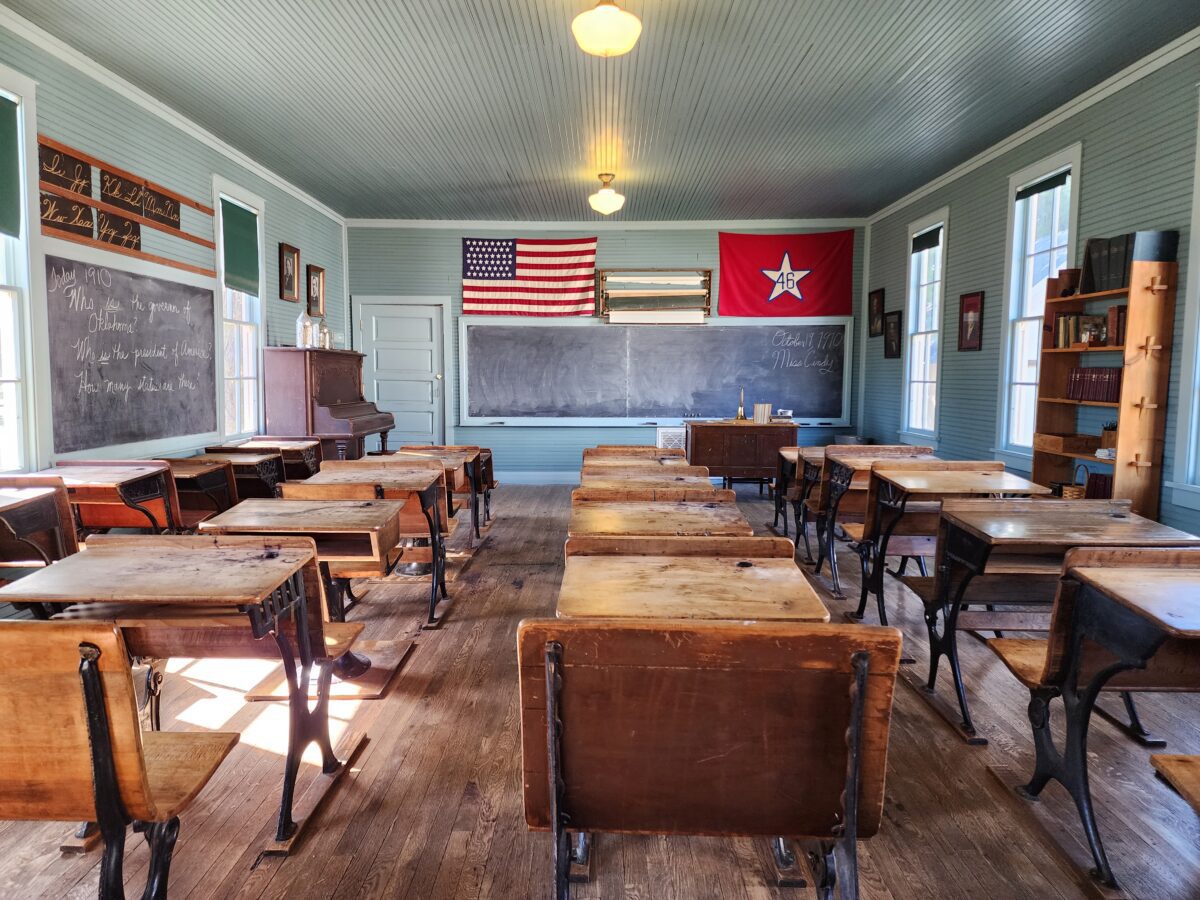
Adjacent to the museum, Rose Hill School offers a glimpse into early Oklahoma education. The restored one-room schoolhouse provides visitors with an immersive experience of what schooling was like for children in the early 20th century. The site hosts educational programs that allow guests to step back in time and experience a typical school day from the past.  

A Tribute to a Legacy of Champions

One of Perry’s most unique and celebrated attractions is Perry Wrestling Monument Park. Wrestling is a deeply ingrained part of the city’s culture, with Perry High School boasting one of the most successful wrestling programs in the country. With 43 state championships to date, a national record, and a reputation for producing elite athletes, Perry has rightfully earned the nickname of the Wrestling Capital of the World.

“Wrestling is a way of life in Perry,” says Roger Tetik, president of the Perry Wrestling Foundation. “People come to the Perry Wrestling Monument Park to find names etched in granite of their father, brother, uncle or someone they know that wrestled for Perry.”

The park stands as a tribute to the town’s rich wrestling history and features statues of Danny Hodge and Jack VanBebber, Perry natives that not only went on to have collegiate success at Oklahoma University and Oklahoma A&M, respectively, but also as Olympic champions. 

“The Perry Wrestling Foundation wanted to honor Danny Hodge, and [the establishment of the museum] grew to where we wanted to recognize both of our Olympians and the Perry Wrestling program and all its accomplishments,” says Tetik. “We wanted to recognize all the state championship teams and the individuals and coaches that made up those teams that helped us win our 43 state championship titles.” 

The Boys from Oklahoma

Award-winning Red Dirt group the Great Divide, led by Mike McClure, returns to its original stomping grounds, Stillwater, for a 4-day concert series this April. Photo courtesy RPR Media

It might indeed be, as Mike McClure laughingly calls it, a signal that “the Red Dirt apocalypse is coming.”

For sure, it’s something that continues to amaze Cody Canada – who, like his good friend McClure, is one of its major participants. 

“I honestly thought, ‘If we do this, we’re going to have a good crowd,” says Canada. “But I had no idea.” 

What both musicians are talking about here is a massive event dubbed The Boys from Oklahoma, set to take place over four days, April 10-13, at Oklahoma State University’s Boone Pickens Stadium in Stillwater. All four shows at the venue, which has an official capacity of 53,855, have been sold out for months. And both Canada and McClure are part of the reasons for the sellout, with Canada sitting atop the multi-band lineup with his former, now reunited, group, Cross Canadian Ragweed, and McClure appearing with his own reassembled aggregation, the Great Divide. Other top-billed acts include the Turnpike Troubadours, Stoney LaRue, and Jason Boland and the Stragglers. 

To find an antecedent for this level of concert success in Oklahoma, you’d have to go back to Tulsa a decade ago, when Garth Brooks sold out seven shows at the 19,199-seat BOK Center. 

It may not be entirely coincidental that Brooks – like all but the Tahlequah-based Turnpike Troubadours on the Boone Pickens Stadium shows – not only came out of Stillwater, but was also deeply involved in that town’s unique music scene sometime in the late ‘80s-early ‘90s time frame, when what would become known as Red Dirt music had begun percolating around Oklahoma State. In fact, a case could be made that Garth Brooks was the first Red Dirt act to hit it big.

The Turnpike Troubadours, originally from Tahlequah, take the stage in Stillwater this April. Photo courtesy RPR Media

So, what is Red Dirt? Like a lot of our other musical genres and subgenres – the Tulsa Sound comes immediately to mind – it resists pinning down, no matter how hard many of us have tried to do just that over the years. Often placed under the country banner, it’s certainly music that’s lyric-based and close to the earth, more rural than urban, deeply sincere, often emotional without being maudlin, and carrying with it the kind of self-effacing sense of humor that’s deeply ingrained in the Oklahoma character. 

After decades of trying to come up with the perfect Red Dirt definition, the closest I can come is to evoke the names of two more great Oklahoma music figures: First, Western-swing popularizer Bob Wills, whose love of musical experimentation is shared by the Red Dirt acts, as is his determination to help his listeners escape their worries, if only for a while. The other is Woody Guthrie, a musical populist, whose socially conscious lyrics were more often than not aimed toward pointing out social inequities and improving the lives of common people.

Those two giants are the sources of the musical rivers that flow through Garth and beyond, into every one of the acts on the Boone Pickens Stadium roster. And each of them is a major torch-bearer for the genre. 

That includes the top-billed Cross Canadian Ragweed, which has gotten back together for the shows after disbanding in 2010, when Canada left to form a new unit, Cody Canada and the Departed.

“I figured that people would go nuts [for the Stillwater event] because Ragweed was going to come back together, on top of Turnpike being there,” says McClure, whose impressive list of musical achievements include producing tracks for Cross Canadian Ragweed and other acts. “Turnpike could come close to filling the stadium on its own, and you couple the magnitude Turnpike has reached with the excitement of Cross Canadian coming back – there’s so much nostalgia with that. A lot of people don’t remember how big they were, but they were really, really big, and then they called it quits and walked away. Now, you’ve not only got all those people they affected but also all their kids, who grew up listening to Ragweed in the background. The same goes for Great Divide.” 

The Great Divide is another groundbreaking Red Dirt act. Coming up, like Ragweed, in the mid- to late-’90s, the Divide was the first in the genre to put songs on Billboard magazine’s national country-music charts (1998’s “Never Could” and “Pour Me A Vacation”). With McClure as singer, guitarist, and primary songwriter, the band continued until 2003, when he left to start his own group, the Mike McClure Band. 

Then, in 2011, the members reunited, and they continue recording and touring to this day. Their second-time-around success, in fact, helped inspire Cody Canada to do some of his own fence-mending. 

“Mike has always led me, from the minute we met,” he notes. “Everybody knows how much I respect and love the guy. When I met him, I was looking for something I didn’t know how to find. I was just playing Garth Brooks songs and stuff, trying to find my footing.”

Some thirty years after that initial meeting, in 2022, Canada once again went to his friend for advice. A few months earlier, he’d done a Rolling Stone interview in which he’d said, referring to a Cross Canadian Ragweed reunion, “Man, that’s never gonna happen.” 

“Then I read that interview, and I thought, ‘How negative is that?’” he recalls. “I started waking up a little bit and realizing, ‘You know, I think I’m the one holding us back. Let’s go for it.’ I called Mike then, and I said, ‘Dude, I think I need to make a move, but it has to be right.’

“He said, ‘I’m so proud of you. You were bitter for so long. We both were.’  And now I’m so ready not to be bitter. And really, it wasn’t even anything toward any person. When everybody [in Ragweed] started talking, and it was all happy, I said, ‘You know, we can’t talk about the past, because if we talk about the past we can’t move forward.’ Everybody was real excited about that.” He laughs. “So Mike had a gigantic influence on this – he and my kids and my wife.”

Cody Canada will headline the Stillwater event with his reunited band, Cross Canadian Ragweed. Photo courtesy RPR Media

“With the [reuniting of the] Great Divide, man, it was just so healing for me,” adds McClure. “And I know Cody saw that, and saw what it means to people who love the music and how important that is.”

Since getting back together, the Great Divide has continued to tour, with a notable recent appearance on the Grand Ole Opry in Nashville (thanks to an invitation from country star Wyatt Flores, a Stillwater musician with ties to the band) and record, with 2022’s Providence its latest record. In addition to the original members – brothers Scotte and J.J. Lester on, respectively, guitar and drums and bassist Kelley Green – keyboardist Bryce Conway is now a part of the band, playing a Hammond B-3 organ. 

“Having a B-3 onstage is just incredible,” says McClure. “A lot of the Great Divide records were heavy with B-3; a guy named Riley Osbourn, out of Austin, played all those parts. And man, it’s just that glue that holds everything together. And it frees me up, too. When I go solo [on guitar], there’s a rhythm guitar and that B-3 underneath. I can experiment and stretch out a little bit more.

“Bryce has always been a huge Great Divide fan, so he’s just excited up there, and that rubs off on us. And, man, it just makes it sound so much better.”

 McClure is also busy writing songs for the group, which he feels is important to the band’s continued resurgence. 

“Back in 2011, we came out and had a really big reunion show, and then we kind of fizzled out a little bit, mainly because we hadn’t put out anything new,” he reflects. “All the Great Divide songs I wrote in my twenties and thirties. And now, to be able to come from a 53-year-old brain – I’ve been through a lot more than I had when I wrote that stuff. I’ve also gotten better as a writer, and singer, and player. We set the bar really low when we were young,” he adds with another laugh. 

His musical compadre Cody Canada, however, and fellow Cross Canadian Ragweed musicians Grady Cross (guitar), Jeremy Plato (bass), and Randy Ragsdale (drums) are taking a different tack – at least for the time being. In addition to not playing any jobs together before the four-day blowout at Boone Pickens Stadium, the members of Ragweed are going to stick to songs from their original repertoire.

“The first question I get is, ‘Are you going to tour?’” says Canada. “And then it’s, ‘Are you going to do new music [at the Stillwater shows]?’ I’ve said, ‘we’ll see what happens,’ to the first question, and ‘no’ to the second.

Stoney LaRue joins the legions of Red Dirt legends at the four-day event. Photo courtesy RPR Media

“I remember going on tour with [Lynyrd] Skynyrd, 35 shows, and every time they’d play a new song everyone would go to the bathroom,” he adds. “And I thought, ‘What a blessing and a curse it is to have so many songs.’

“So I said, ‘Let’s just play the songs that people know, get some shows under our belt, and see what happens. Let’s not get in a rush. Let’s have some fun with this.’”

And, as he reflects on the tens of thousands of ticket sales these shows have generated, he admits that the response “still amazes me.”

“I thought we would do 20,000 tickets,” he says. “I really thought that’s what it would be. I’ve been trying to talk about it without sounding cocky, but I really didn’t realize we had that far of a reach, and I’m extremely grateful. 

“My favorite part,” he concludes, “is talking to the guys again, and everybody being friends and hanging out together. It’s all sunny. It’s all nice. It’s good for the soul.”

A Prolific Fountain

For most of the Boys from Oklahoma, their residency at Boone Pickens Stadium is a return to their roots – even if those roots first dug down into the red dirt a few miles outside of Stillwater, around a funky old yellow house jutting up out of the countryside. The place was dubbed the Farm, and for several years, from the late 1980s to around the end of the 20th century, it was a magnet for music and musicians. Singer-songwriter Bob Childers, known as the godfather of Red Dirt music, lived in a trailer on the premises. The members of the Red Dirt Rangers and Medicine Show, the two Red Dirt acts that carried the genre into the ‘90s, hung out there as well. 

And so did a young OSU student named Jason Boland, who, with his band the Stragglers, would go on to become a leading light in the genre. 

“It was something,” he recalls. “We were kind of toward the end of the Farm era, but luckily we got enough of it to drastically change the way we looked at music forever. The first time, you know, you sat around that campfire, and the song torch went around and got to you, you’d be like, ‘Oh, I thought I had some songs. But I need to go home,’” he adds with a laugh.

“Childers referred to it [the Farm] as a spring, or a well, that always drew people back to it. There really was something happening there. Who knows if it was something metaphysical or something tied to the earth? But it happened.” 

It’s been a quarter of a century since Boland left the Farm and began touring and recording in earnest. And he admits with a chuckle that it’s “bewildering, flattering and embarrassing” to be coming back to Stillwater to play a series of stadium shows. 

“You don’t realize what’s happening until you’re years into it,” he muses. “You’ve just got your head down and you’re making music. But I do think most people from the Red Dirt scene are first and foremost music fans, and they always want to service the song and service their style – the way they put out their music.” 

As a student at OSU, Jason Boland often spent time at ‘The Farm ‘ – a home just outside Stillwater where talented musicians would converge. Photo by Will Von Bolton

To find the antecedents for all of that, he points to another Stillwater-spawned act on the Boys from Oklahoma show, the Great Divide. 

“They were influences on every other band on this bill,” Boland says. “We’re looking at a time when Top 40 country was just this monolithic thing, and nothing could exist outside of it. They were the first ones to say, ‘Oh yeah it can. It can be from right here. And it can be completely do-it-yourself.’

“The friendship with Mike [McClure] and those guys was just really a pedagogical relationship,” he adds. They were teachers. I think Cody and Ragweed felt that way, too. And Stoney [LaRue] was in the same vein. It was about learning the artistic way of doing things. We were evolving at a time when you could take it out to the market. And we were trying to play both sides of the fence: Don’t compromise your music, but take it to as many people as you can.

“And then, here came the Troubadours to reset the bar on what was possible with taking it to the people. It was all just a healthy evolution of the sound, and everybody did a good job of getting it to a lot of people and, at the same time, keeping it true to the spirit of Red Dirt.”

It’s one spirit, he concludes, but many different styles, and he promises that those who attend one of the stadium shows will see and hear what he means: “Five wildly different bands – but all from the same fountain.” 

Featured photo: Award-winning Red Dirt group the Great Divide, led by Mike McClure, returns to its original stomping grounds, Stillwater, for a 4-day concert series this April. Photo courtesy RPR Media 

A Spring Awakening

Photo courtesy Caviness Landscape Design

The Great Indoors

From lighting and color to space and lifestyle compatibility, interior design is about making bold statements in 2025. Ross See, principal of Sees Design in Oklahoma City, says lighting continues to be the jewelry of the home.

“Expect sculptural, oversized fixtures that double as art pieces, incorporating mixed metals, hand-blown glass and plaster fixtures,” he says. 

Concealed kitchens are gaining popularity as they blend seamlessly into living areas with hidden appliances and sleek cabinetry. 

“There’s also a growing appreciation for sculleries and butler pantries,” he mentions. “These functional spaces allow homeowners to keep the main kitchen clean and uncluttered while showcasing timeless details like exposed hinges or custom millwork.”

Bold colors are making a comeback, after years of neutrals dominating the design palette. 

“Moody colors of dark blues, deep greens and warm hues like terracotta and mustard yellow infuse spaces with personality,” See says.

Incorporating greenery and bringing nature indoors is a major design trend for 2025. Kitchen by Edmond Kitchen Bath Home, photo by Emily Hart Photography

Biophilic design – a concept that connects people to nature through built designs – is a trend that’s only growing.

“Bringing nature indoors is more than a trend, it’s a lifestyle,” Sees says. “Incorporating greenery alongside plaster finishes, natural stone and wood elements creates an inviting atmosphere that nurtures well-being.” 

Saturating a room with a singular color in order to create a mood is called color drenching, and it’s rising in popularity this year, too. 

“Using a single color across walls, ceilings and even furniture is becoming a bold statement,” Sees says. “This technique works beautifully with rich, moody tones or soft pastels.”

Arches and curves in home design, See says, can bring a calming effect to a room or entire home. 

“Organic shapes are softening interiors,” he says. “Arched doorways, groin-vaulted and barrel ceilings, and curved furniture bring a sense of comfort and timeless elegance to spaces.” 

Combining antiques and textured walls with plaster finishes, like lime wash or Venetian plaster, are some of See’s current fancies, along with designing fun powder baths. 

“Dramatic wallpaper, bold paint colors or an exciting tile pattern,” he adds. “We love treating it as the ‘jewel box’ of the home.”

Sustainable Choices

Sustainability, the practice of building and maintaining homes to reduce their environmental impact, continues to be a key consideration for people looking to build or remodel. Kent Hoffman of the Hoffman Group in Oklahoma City shares some of the ways he works to achieve greater sustainability. 

“Energy efficiency is what we think of when we talk about sustainability,” he says. “How can we reduce the energy requirement of the home? And that has a lot to do with how well insulated the home is.” 

Foam insulation is a system used to create a tight seal to improve efficiency. 

“It is like a blanket for the home, so that during these extreme summers and winters, the [heating and air conditioning] systems don’t have to run nearly as often as they used to run,” Hoffman says. 

When it comes to heating and cooling, Hoffman suggests going geothermal. Geothermal heat pumps take advantage of the constant temperature of the shallow Earth to efficiently exchange temperatures. A few feet below the Earth’s surface, the ground remains at a relatively constant temperature year-round; GHPs take advantage of the constant subsurface temperatures by exchanging heat with the Earth through a ground heat exchanger. “Geothermal heating and air is a way to take the earth’s temperatures and transfer it into your own home,” says Hoffman, “so that you aren’t using as much electrical or you don’t need natural gas because you’re getting that off the heat of the earth.” 

Low voltage lighting, like LED, requires less electricity and less power to operate more lights, Hoffman adds. The use of natural stones that don’t require exterior painting, as well as synthetic roofs made of recycled plastic and rubber, are other ways to add sustainability to a home. 

“It’s about having a well-balanced home where the energy footprint has been greatly diminished,” Hoffman says. 

Technology to Watch

All roads lead to artificial intelligence (AI), and that is certainly the case when it comes to home security and technology. 

“I think everybody is getting accustomed to AI,” says Austin Hannah, vice president of Kazar Security in Tulsa. “If you’re buying something and you go to a company’s website, there’s probably an AI assistant ready to help you. Similarly, your video cameras these days have a lot of AI technologies that can identify faces and vehicles. So as far as trailblazing new technology, that’s where security is heading.” 

Hannah says people can just start with the basics. 

“For home security, doorbell cameras, basic alarm systems and driveway cameras are a necessity,” he says. “You can get that kind of technology relatively inexpensively and in a lot of different ways. 

Keyless locks are replacing metal keys, allowing homeowners and visitors alike to enter a code or be let in remotely. Automated shades are another upgrade Hannah says are more in demand than ever. 

“It’s all about how much you want to embrace technology,” he says. 

All Things Outdoors

In a departure from more structured gardens, Kathy Caviness of Caviness Landscape Design believes Oklahoma gardens are going back to their roots. 

“Depending on the size of your yard, the existing plant material and style of architecture, there are opportunities to incorporate softer designs, or what we like to call ‘organized chaos,’” she says. “Utilizing different colors, leaf structures, heights and mass groupings help to create a more nature-inspired design, and can attract more bees, butterflies and birds, which help pollinate.” 

With the preservation of nature in mind, David Hillock, senior extension specialist in consumer horticulture at Oklahoma State University, says there are several ways to be intentional. A low water landscape, for instance, incorporates plants that require less water and mulching to conserve soil moisture.

Making a pool as maintenance-free as possible is a top tip of Kent Hoffman. “Think about how the pool can not become a burden,” he says. “Bigger isn’t better – so make it something that works for you.” Photo courtesy Hoffman Group

“Water is becoming more and more of a precious resource and we need to be better stewards and managers of that resource,” Hillock says. “One way we can do that is by choosing more plants that require less water. That doesn’t mean you can’t put plants in the ground that still require moisture, but you could reduce the percentage of your landscape devoted to those high water use plants.” 

Hillock says the concept of ‘fire-wise landscaping’ can reduce the risk of fire damage by keeping an area clear of yard debris, creating fire breaks with nonflammable materials and choosing fire-resistant plants. 

“The more soft tissue a plant has, the more water is in it, and it’s going to be less flammable than evergreen plants,” Hillock says. “So succulents like cacti are full of moisture. A lot of ground covers, like the sedums or stone crops, ice plant, are going to be less flammable. Deciduous trees in general would be less flammable, too.”

Pool 101:What to Know Before Taking the Leap

One way to transform a home into an oasis is by adding a pool, but the definition of ‘oasis’ means different things to different people, Hoffman says. 

“Some people look at a pool as a kind of a visual asset,” he says. “Some people use the pool as big time recreation and exercise. We have done some pools that are the lap-type pools or they’ll have sun decks with them. Or they might have a hot tub feature.” 

When someone is ready to put in a pool, the first things to research are the property easements, any drainage issues, and the need for any retaining walls depending on the topography of the yard, Caviness says. 

“Those are the foundations needed for any good design,” she mentions. “The next to consider is a list of features in order, a realistic budget that can include as many of the features you want, and a good working relationship with the landscaper and pool designer.” 

Making a pool as maintenance-free as possible is one of  Hoffman’s top tips. 

“Think about how this pool can not become a burden,” he says. “There are self-cleaning systems that you can have built in that keep the pool quite clean. Bigger isn’t better with a pool. Bigger is more expensive and requires more upkeep. So make it something that works for you.”

Oklahoma Plants: What Works Best?

Native plants and flowers are always solid choices for an Oklahoma garden, since they are naturally suited to the climate. 

“When we talk about ‘native,’ we’re usually talking about the general area or region, or North America,” says Hillock. “A lot of our landscape plants are non-natives, but many of them have been chosen from a very similar climate, so they do really well here because they are adapted to our local conditions in terms of temperatures, soil types and moisture.” 

That’s important in supporting native pollinators and beneficial insects. 

“We’ve seen the decline in some of our beneficial insects, and that’s one of the reasons why there’s been a push towards going native . We know that in general, those native plants are going to support our local beneficial insects.” 

Some of Hillocks favorite natives are brightly colored sneezeweed; rattlesnake flower, native to the prairies; and Oklahoma’s state wildflower, the Indian Blanket.  

“Rattlesnake flower is a fun perennial and very drought tolerant,” he adds. “It doesn’t look like a rattlesnake, but they say that they would use the juices from the plants to treat snake bites.” 

Brazilian verbena, fan flowers, firecracker flowers and Mexican zinnia are recommended for Oklahoma gardens, Hillock says. 

Kelly Caviness, CEO of Caviness Landscape Design, adds that canarti junipers, multiple types of ornamental grasses, deciduous trees and smaller ornamental trees seem to still do well here. They thrive even with the late freezes Oklahoma has had in recent years. 

New cultivars of deodar cedars, Kelly says, seem to do much better than in the past, when people were just planting the seedlings that came up naturally and were balled and shipped from Oregon.

Photo by Mitchell Alcala, OSU Agriculture

Growing Your Own Food

For budding gardeners who love the idea of growing their own food, Hillock says to start small – “even if it’s just a container or two,” he says. “Or if you have some space in the garden, keep it small so that you can get used to it. A lot of people like to start big, and then they get overwhelmed and quit.”

Choose only the plants you know you’d like to eat. 

“If you don’t like it, or nobody in your family likes it, then there’s probably no reason to grow it,” he mentions. 

Growing fruits and vegetables that are specifically suited to Oklahoma’s climate, and generally easier to grow, will give gardeners an advantage.

“Peppers do really well in Oklahoma,” Hillock says. “They love the heat of the summer. Everybody loves tomatoes, but they are more of a challenge as they can be prone to disease.”

The experts agree: When growing your own food, start small – even if it’s just a container or two. Photo by Mitchell Alcala, OSU Agriculture

Bringing the Indoors Outside

Creating a Year-Round Patio

A patio that can be enjoyed year round yields a good return on investment – if it’s done right. And, says Hoffman, “it’s big on the wish list of today’s customer. We almost don’t build a home without one, and they are generally an extension of the home.” 

Temperature control, no matter the season, is the foundation for making a patio enjoyable all year long. 

“Fireplaces, fire pits or integrated heating systems extend the patio’s use in colder months,” Sees says, “while fans or misting systems provide relief during summer.” 

Layered lighting is a design technique that incorporates different light sources, like ambient, task and accent lighting, to create a functional and appealing space. 

“Combine overhead lights, lanterns and uplighting to give a versatile ambiance,” See says. “Smart lighting systems that adjust brightness and color temperature are particularly effective.” 

High quality furniture covers and smart furniture choices can make entertaining both stylish and comfortable. 

“Furniture covers and flow-through cushions made from outdoor-friendly fabrics,” are a must, See says. “For longevity, opt for materials like teak, powder-coated aluminum or weather-resistant wicker.” 

Screens and curtains can make the outdoors feel like its own room of the house, and “adding retractable screens or outdoor curtains to shield against the elements” can enhance privacy and style,” See says.

Hoffman agrees. 

“You can have screens that keep the bugs out or that keep the heat in,” he says. “As they let light in, they filter the light coming into the house. You can roll from the inside of the house to the outside on pretty spring days and nice fall days. And your home grows significantly, because you now have outdoor entertainment that’s all-weather.” 

See adds that installing mosquito misters or other natural plants like citronella can keep the patio comfortable and bug-free throughout the year. 

Featured photo courtesy Caviness Landscape Design   

Real Estate Rundown

Raising Your Home’s Value


You may have made your house a home since purchasing it. But when it comes time to sell, you’ll need to look at it critically in order to raise that asking price. 

“Do your very best to see your house through someone else’s eyes,” advises Blake Loveless, co-owner of and real estate agent at Walter and Associates in Tulsa. 

Most sellers need to do some repairs and staging before putting a home on the market. However, it’s important to be deliberate in the changes you make; personalized amenities and fixtures may ward off buyers instead of increasing the value of your home as anticipated. 

Repainting your home in neutral colors and replacing dated carpeting can help brighten the space and make it feel move-in ready. 

“A simple approach to decorating and setting up for showings is usually beneficial,” explains Taylor Chinowth, vice president at Chinowth & Cohen Realtors. “It’s much easier for buyers to see their own furniture and decorations in the space and not get distracted by what the seller has there.” 

First impressions matter – so focus your efforts on your home’s curb appeal and entrance. 

“Statistically, buyers make an emotional decision if they want a house within 30 seconds of walking into the front door,” says Leland Chinowth, president at Chinowth & Cohen. “They spend the rest of the showing trying to justify that gut feeling.” 

The data agrees. According to the 2024 Cost vs. Value Report from the Journal of Light Construction, the two home projects that deliver the highest returns are garage door and entry door replacements. Both improvements recoup nearly 200% of the job costs.

If your house doesn’t need significant repairs, upgrading commonly used spaces, such as the kitchen and bathrooms, is another good strategy. And the changes don’t have to be drastic – small finishing touches, such as updating the light fixtures, repainting cabinets and replacing fixtures can have a transformative effect. 

For the last couple of years, buyers have been at a disadvantage, with historically low inventory and elevated mortgage rates. Younger generations are finding it difficult to become homeowners, and older generations are staying put rather than downsizing. 

The lack of housing options can be attributed to multiple factors. First, developers face red tape with restrictive zoning laws, and smaller houses are usually not profitable enough to justify building. 

Second, large corporations and investors have been acquiring single family homes more aggressively. In fact, investors purchased over 26% of affordable homes that were sold in the U.S. in the fourth quarter of 2023, a record high.

“When that happens, those properties rarely go back on the market,” explains Susan Beach, principal broker at Keller Williams Advantage in Tulsa. “It would take 20 years for new construction to make up the loss of inventory that we have suffered since 2008. That’s just the reality.” 

Despite these factors, the real estate market is expected to gradually shift this coming year. Home sales are expected to rise as buyers become more acclimated to 6-7% mortgage rates. 

“It’s a baseline that we’ve had for many years through the 2000s,” says Leland Chinowth. “Historically, what we’re at now is a really good rate for buyers.” 

Home prices are projected to climb a percentage point above inflation rates through 2029, giving homeowners peace of mind in maintaining the value of their home. Further, Oklahoma home values tend to remain more stable compared to home values in coastal cities. 

“While the rapid growth between 2020 and 2022 may make the current market feel slower and interest rates seem higher, this is actually a balanced, healthy market,” says Lindsey Schlomann, executive vice president and Oklahoma principal broker at McGraw Realtors.  “It is a great time to buy or sell real estate.”

Cutting Down on the Chaos

For most people, their home is their biggest financial investment. Stress can be expected whether you’re buying or selling, and unexpected challenges are bound to happen. However, there are common mistakes you can avoid. 

For buyers, the most important thing to do is to get pre-approved for a loan before shopping for homes. 

“A lot of times, people will get too far down the road and then find there’s some surprise with their finances,” says Loveless. “That causes more stress than anything.”  

Making a house wish list can also help you narrow your search. Determine exactly what you need versus what you want. 

“A common mistake for both buyers and sellers is the inability to compromise, often stemming from unrealistic expectations,” explains Schlomann. “Challenges will arise, and it’s important for both parties to approach the process with a clear, level-headed mindset.” 

Sellers can benefit from hiring a real estate listing consultant, especially if they need to sell their house by a certain date. A listing consultant helps price your home competitively and prepare it for showings. 

Most buyers will set up a home inspection after making an offer. To avoid surprises, consider getting an inspection before listing your home. 

For sellers, the bottom line of an offer takes priority – but consider who the buyers are. 

“I put a lot of weight in the solidity of the buyer,” says Loveless. “[Having] a good, honest relationship between everyone is very calming.”  

Closing Table Terms

Closing is the final step, when home ownership is legally transferred between parties. Here are a few terms that you’ll probably hear in this leg of the process.

Closing disclosure: A document that includes all the details of the home loan, including fees, closing costs, the interest rate and projected monthly payments.

Cash to close: The total amount of money that the buyer must bring to the closing table to finalize the sale.

Escrow agreement: A legally binding agreement that determines how assets, which are held in an escrow account, will be managed by a third-party agent. 

Underwriting: The process of researching a buyer’s finances, creditworthiness and employment history to determine if they can repay a home loan. 

Contingencies: Conditions made by the buyer that must be met before finalizing the sale. 

• Annual percentage rate (APR): The yearly cost of the loan, including interest, origination fees and closing costs.

Inspection: An evaluation of the home’s condition that generally happens after an offer.

Tips & Knowledge from the Pros

Choose your real estate agent wisely.

“You need to be able to trust your agent and communicate with them… You want an agent that tells you the truth, not just what you want to hear,” advises Loveless. 

Taylor Chinowth continues: “One thing that can differentiate one Realtor from another is their local knowledge. Find someone that knows your local area, your market and the school districts nearby,” he says.

Borrow from alocal lender.

“I’ve seen people regret just taking the bottom-dollar on rates, because it can end up causing problems later if the lender doesn’t know the market or understand Oklahoma laws,” shares Loveless.

Beach echoes this sentiment. “You want to be with a local, reputable lender – no faceless organizations. You want to choose people who have reputations, and you’ve got to be comfortable with them.”

Owning a home in Oklahoma comes with advantages.

“Oklahoma homes aren’t just budget-friendly; they’re designed with space and comfort in mind. Many properties feature large lots or expansive parcels of land, perfect for growing families or those seeking room to spread out,” says Schlomann. 

Leland Chinowth adds: “You can buy a house here and safely rely on it gradually increasing in value over time. By the time you’re ready to sell, it’s worth more than you bought it for.” 

The Costs of Selling a House

According to U.S. News and World Report, sellers typically pay 10-15% of their home’s sales price in selling costs. Keep the following costs in mind for your budget. 

• Real estate agent commissions tend to be the biggest expense for sellers. According to data collected from Clever, an online real estate education resource, the average commission rate for Oklahoma realtors is 5.68%. 

• The principal balance on your home loan may not be the same as the mortgage payoff amount, which includes interest fees and prepayment penalties. You can request the payoff amount from your lender. 

• Getting your home professionally staged will cost extra. The average staging costs in 2025 ranged between $837-$2,924 based on data from HomeAdvisor.  

• If your home value has appreciated, you may need to pay capital gains tax on profits from the sale, which is taxed the same as income. Some homeowners are exempt from this tax under the Taxpayer Relief Act of 1997.

• Sellers are responsible for closing costs, too. Average closing costs for sellers are 8-10% of the home’s sales price, according to Zillow. 

• Moving costs and home repairs aren’t always avoidable. Factor both costs in your bottom line when considering offers. 

The Costs of Buying a House

Most buyers are aware that they’ll need to save up for a down payment when purchasing a home, but there are more expenses beyond that. Know exactly what you need to save to secure your dream home.

• The amount you’ll need on a down payment for a home will depend on the home’s sales price, the type of loan you select, and your credit score. Conventional loans require at least 3% of the sales price. 

• In the past, sellers were responsible for paying commission to their agent and the buyers. However, buyers may be responsible for negotiating and paying their agent fees now, following a settlement related to commissions in 2024.

• Closing costs include origination fees, title fees, underwriting fees, prepaid interest, mortgage insurance and other expenses. On average, buyers pay between 3-5% of the loan in closing costs.

• Appraisal and home inspection fees can vary but generally cost several hundred dollars each. 

• Earnest money helps a buyer secure a home by showing their interest to the seller. These funds are deposited into an escrow account until the home sale is finalized. A typical earnest payment ranges from 1-10% of the sales price, and the funds are applied to the down deposit at closing.