Send the Tulsa FC off in style during their last soccer matches of the season, Oct. 5, 12, 19 and 26 at ONEOK Field. Then, venture to H.A. Chapman Stadium to cheer on the University of Tulsa’s Golden Hurricane as they take on regular season football foes Oct. 5 and 26. At the BOK Center, the Tulsa Oilers take the ice Oct. 19-26, and you can also enjoy the highly anticipated Arabian and Half Arabian U.S. Nationals on Oct. 18-26 at Expo Square. If you want to get in on the action or just be an enthusiastic spectator, the Tulsa Run takes place Oct. 26 in downtown Tulsa.
The OKC Fairgrounds host two equine events this month: the Grand National and World Championship Morgan Horse Show, Oct. 5-12, and the OPHA Fall Color Classic, Oct. 18-20. Get ready to get back into the swing of the NBA season with the OKC Thunder; the team plays both pre- and regular-season games this month at Paycom Center, Oct. 9, 17, 27 and 30. (You can also see them Oct. 10 at the BOK Center versus the New Zealand Breakers.)
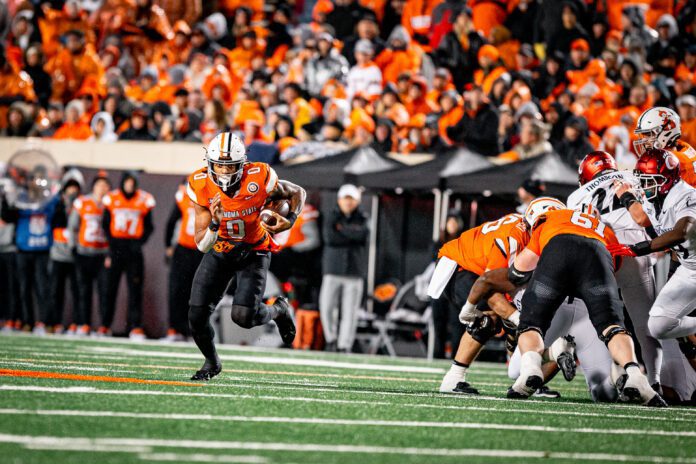
And football season is also upon us for the OU Sooners and the OSU Cowboys. See the former at Norman’s Gaylord Family Oklahoma Memorial Stadium on Oct. 19 and the latter at Stillwater’s Boone Pickens Stadium on Oct. 5.
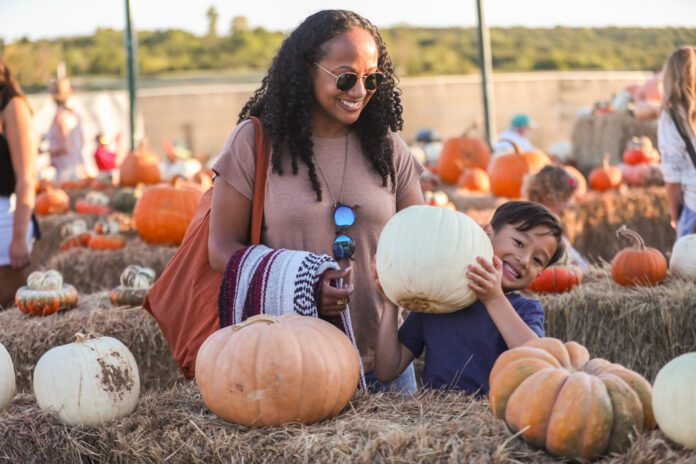
In Tulsa, one of the most anticipated events of the year returns: Tulsa Oktoberfest. Running Oct.17-20, the festival offers carnival rides, refreshing beverages, authentic cuisine, rousing competitions, live music and so much more at River West Festival Park. The same weekend, visit the Kendall Whittier Art Festival for some extra outdoor fun. Get ready to “come on down” at The Price is Right Live at the BOK Center on Oct. 27, or enjoy the Pumpkin Festival at Shepherd’s Cross in Claremore through Nov. 9. Closer to home, Autumn in the Botanic Garden runs through Halloween at Tulsa Botanic, replete with games, pumpkins, live music and more.
In OKC, get ready to cheer at the Oklahoma Regatta Festival, Oct. 4-6 in the Boathouse District. Myriad Gardens hosts Pumpkinville Oct. 4-20, or you can visit the OKC Fairgrounds for the LEGO Brick Convention Oct. 5-6. Take the kiddos to Hot Wheels Monster Trucks Live Glow Party, Oct. 12 at Paycom Center, and don’t forget to commemorate Indigenous Peoples Day, Oct. 14, with events at the First Americans Museum.
Across the state, enjoy the Pelican Festival, Oct. 3-6 at Wolf Creek Park in Grove; the Hennessey Wine and Chocolate Festival, Oct. 5 at Memorial Park in Hennessey; the Adult Elephant Expedition, Oct. 7 at Hugo’s Endangered Ark Foundation; the International Bluegrass Festival, Oct. 10-12 at Guthrie’s Cottonwood Flats Recreation Area; and the Poteau BalloonFest, Oct. 18-19 at the LeFlore County Fairgrounds.
October, the month of spooky times and delicious candy, has arrived. Although I’ve sadly got no horror flicks for you this month, there are plenty of other excellent choices to get you out of the house and into a theater.
First up is Joker: Folie a Deux. Pretentious name aside, this is the follow up to 2019’s wildly successful Joker, an original background story for the famous Batman villain. The sequel takes place two years later, with Arthur Fleck (Joaquin Phoenix) now residing in Arkham State Hospital – where he meets Harleen Quinzel (Lady Gaga) and a romance begins. Todd Phillips returns to the director’s chair, with this film being part musical, part psychological drama. We’ll see if a sequel really needed to happen when it hits theaters on Oct. 4.
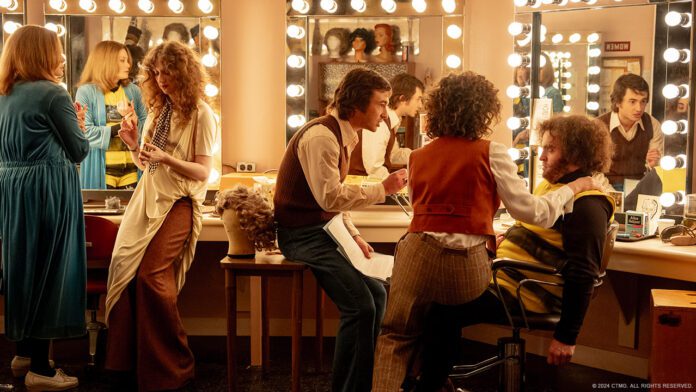
For your biographical comedy, don’t miss out on Saturday Night. Set in 1975, the film follows the original cast of Saturday Night Live as they prepare for their premiere episode – and all the shenanigans that come with it. Directed by Jason Reitman (Juno), the trailer seems to capture the chaos that was SNL in the early days with Lorne Michaels (Gabriel Labelle, The Fabelmans), Chevy Chase (Cory Michael Smith, Gotham), Gilda Radner (Ella Hunt, Dickinson), Dan Aykroyd (Dylan O’Brien, The Maze Runner), Garrett Morris (Lamorne Morris, New Girl) Rosie Shuster (Rachel Sennott, Shiva Baby) and John Belushi (Matt Wood, Difficult People). Hopefully it proves to be an interesting look back at how the TV staple began when it releases on Oct. 11.
If you’re into single location films, look no further than Flight Risk. Directed by Mel Gibson, his first since 2016’s Hacksaw Ridge, the film follows FBI agent Madelyn Harris (Michelle Dockery, Downton Abbey) as she transports an informant played by Topher Grace (That ’70s Show) via plane. The pilot, played by Mark Wahlberg, turns out to be a hitman hired to kill them. The confined space, along with Wahlberg’s bizarre appearance, look to lend this odd story some interesting weight, but time will tell if this movie lands smoothly or crashes when it comes out on Oct. 18.
If a documentary is more your speed, Black Box Diaries should do the trick. The film tells the story of Shiori Ito, a Japanese journalist and filmmaker who was sexually assaulted by prominent Japanese TV journalist Noriyuki Yamaguchi. The film is directed by Ito, telling her own story about the event and the investigation that took place in the years following the assault. Likely a tough but important watch, it releases Oct. 25.
For your historical drama, take a look at Nickel Boys. Based on the 2019 novel of the same name by Colson Whitehead, the film takes place in a reform school in the 1960s which is notorious for its abusive treatment of students. We follow Elwood and Turner, two friends who form a bond while trying to navigate the waters of the corrupt institution. The book won a Pulitzer Prize, and the film seems to be gunning for similar awards during Oscar season. It releases Oct. 25.
Main photo: Saturday Night; photo courtesy Sony Pictures/CTMG
The Bob Dylan Center, located in downtown Tulsa, showcases the life and works of the prolific American singer-songwriter. The museum opened in May 2022 following the purchase of Dylan’s archive to the George Kaiser Family Foundation and the University of Tulsa.
Steven Jenkins, the museum’s director, spent extensive time in the San Francisco Bay area before taking on this role, serving in leadership positions at the University of California Press, the San Francisco Film Society, the Film Arts Foundation and the Ansel Adams Center for Photography. He is also an arts journalist, contributing articles to publications including New York Magazine, Out, and Publishers Weekly. We caught up with Jenkins and got his thoughts on …
… what motivated him to move from San Francisco for the job.
I’ve been a devoted, often obsessed, Bob Dylan fan since I was quite young, having discovered his first Greatest Hits album in my mom’s record collection (she had great taste) as a precocious six-year-old, already heavily into The Beatles and The Beach Boys. I didn’t understand the songs back then, but I was captivated by Dylan’s voice and by the colorful and iconic Milton Glaser poster that was included with the album, which my encouraging dad tacked up on my bedroom wall. Dylan looked down at me and infiltrated my dreams, and his music has been lodged in my consciousness and influenced my worldview ever since.
When the George Kaiser Family Foundation acquired the Bob Dylan Archive in 2016, I knew that I would visit as soon as the materials were made available to the public, but at the time had no clue that I’d end up joining the team. Some five years later, I learned of the imminent opening of the Bob Dylan Center (in May 2022), met the amazing folks behind the project and was offered the job of a lifetime, one which combines all of my personal interests and professional experience as an avid listener and veteran of the nonprofit arts field. Joined by my husband Jorge and our dog Rocco, I bid farewell to San Francisco after nearly four decades and drove out to Tulsa, mythical stomping grounds of Ponyboy and Motorcycle Boy – S.E. Hinton also had much to do with my adolescent dreaming – and now our friendly new home.
… his proudest accomplishments to date.
I hope that we’re doing full justice to Dylan’s multiplicity by presenting his life’s work within the sociopolitical contexts that have informed his songs and that he, in turn, has shaped. I’m pleased that we focus on Dylan’s creative process, asking how this one extraordinary artist does what he does to such a high degree of skill, beauty, fierceness and cultural impact. By considering Dylan as an exemplar of fearless creativity, we’ve made room for the art and music of kindred spirits such as Elvis Costello, Shane MacGowan, Patti Smith and Mavis Staples. I also like to see students visit the Center and witness their sparks of inspiration and recognition as they start to “get” Dylan as an iconoclast and tap into their own creative instincts.
… his favorite elements of the Center.
We have a letter written by Johnny Cash to Dylan that is filled with wordplay and an obvious mutual admiration, and a film of Dylan and his band performing “Cold Irons Bound” that I can’t get enough of.
… what he wants people to know about the Center.
You don’t have to be a lifelong fan or even a casual follower to enjoy the Center; there’s so much here that speaks not only to the specifics of Dylan’s career but also to the creative process in a much larger sense. Also, Dylan’s very funny!
…upcoming developments.
We’re planning some very special events for 2025, including a multi-artist concert celebrating the fiftieth anniversary of Dylan’s masterpiece Blood on the Tracks and a tribute to the Oklahoma-born musician Jesse Ed Davis. We’re also looking forward to the release of the Complete Unknown biopic with Timothée Chalamet, which should serve to introduce Dylan to new generations of fans who hopefully will be inspired to make the pilgrimage out here.
… what makes Dylan such a special artist to him.
There’s a line in his song “Thunder on the Mountain” that I love: “Look into my heart and you will sort of understand.” It’s the “sort of” – the ambiguity, the fundamental unknowingness, the wide open space for interpretation, emotion and expression – that brings me back to the music and the artist every day.
… where he’ll find him in his off hours.
Lunching at Chimera in the Arts District, strolling through the galleries and gardens at the Philbrook Museum, seeing films at Circle Cinema, up front for concerts at Cain’s Ballroom, and living on Tulsa time in our midtown backyard.
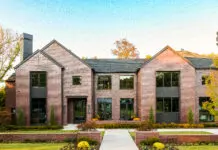
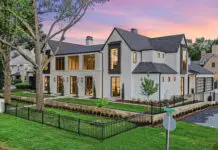
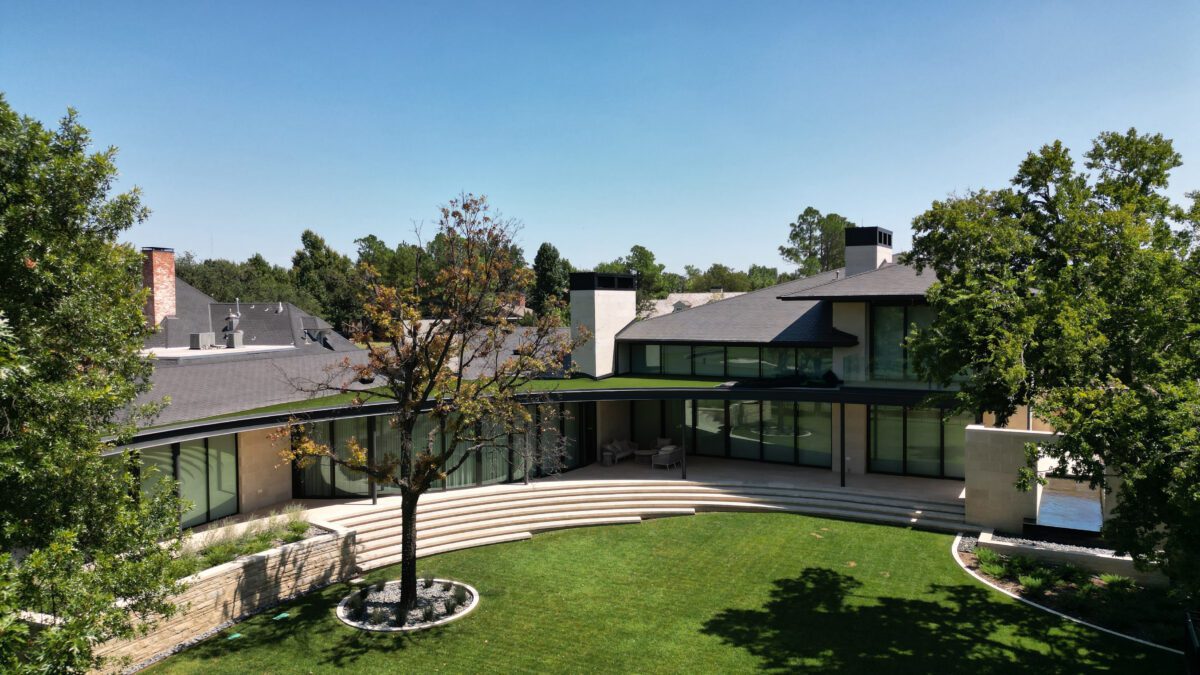
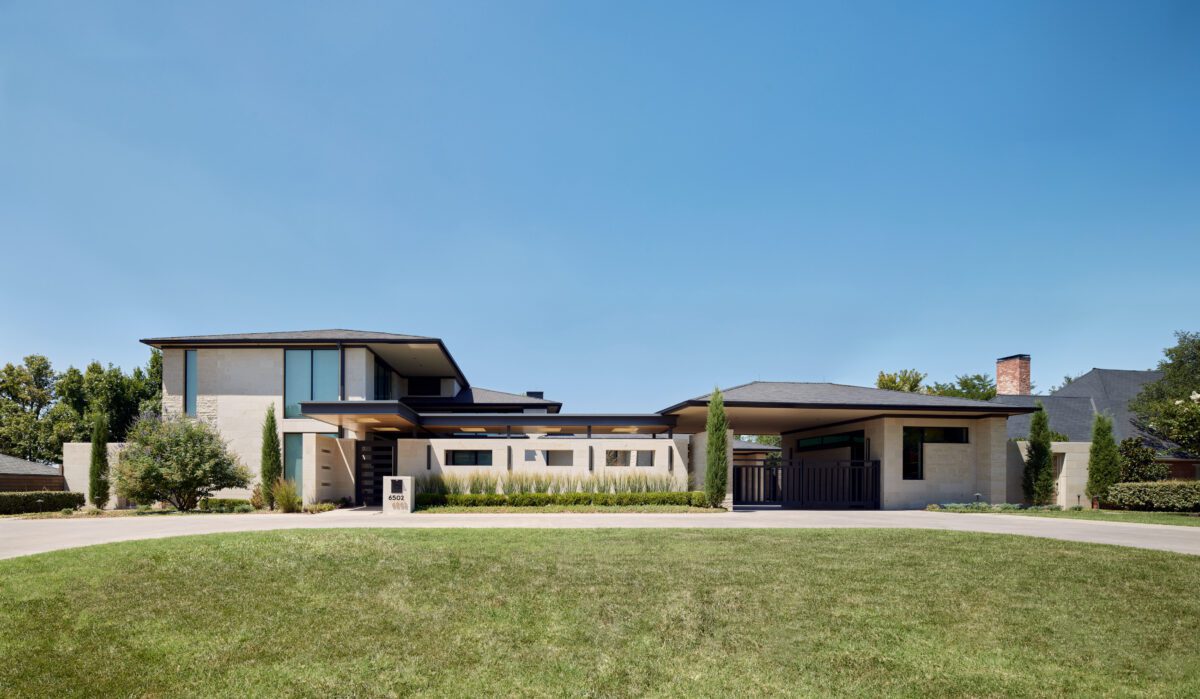
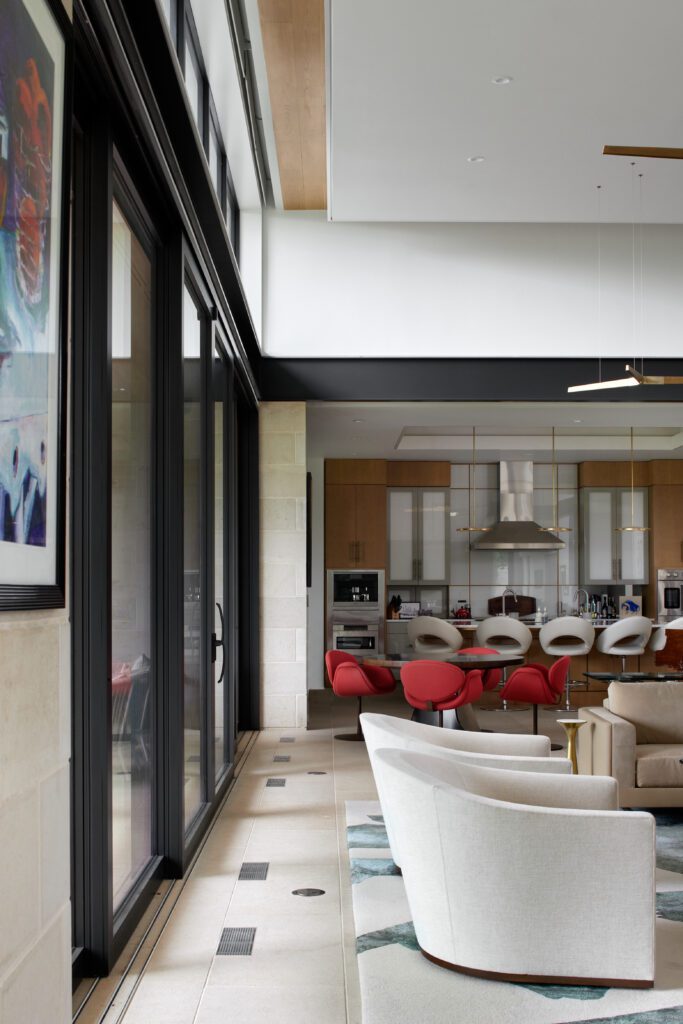
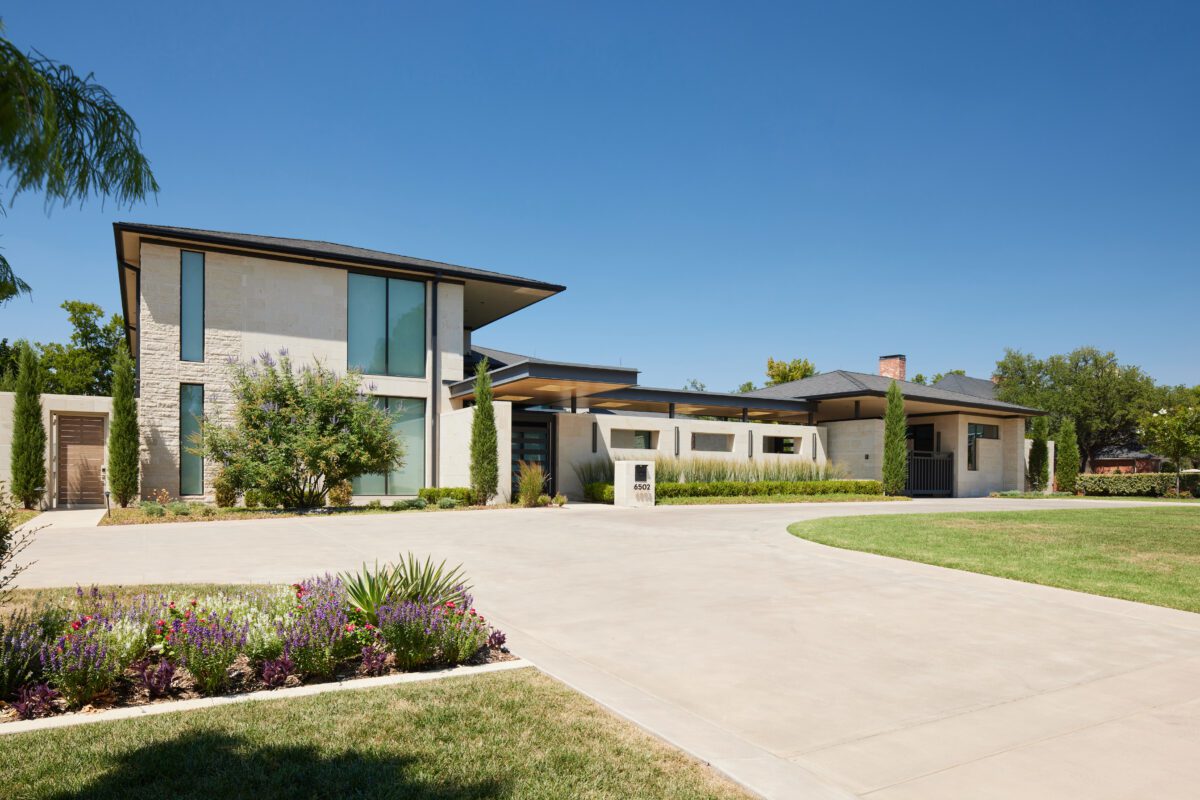
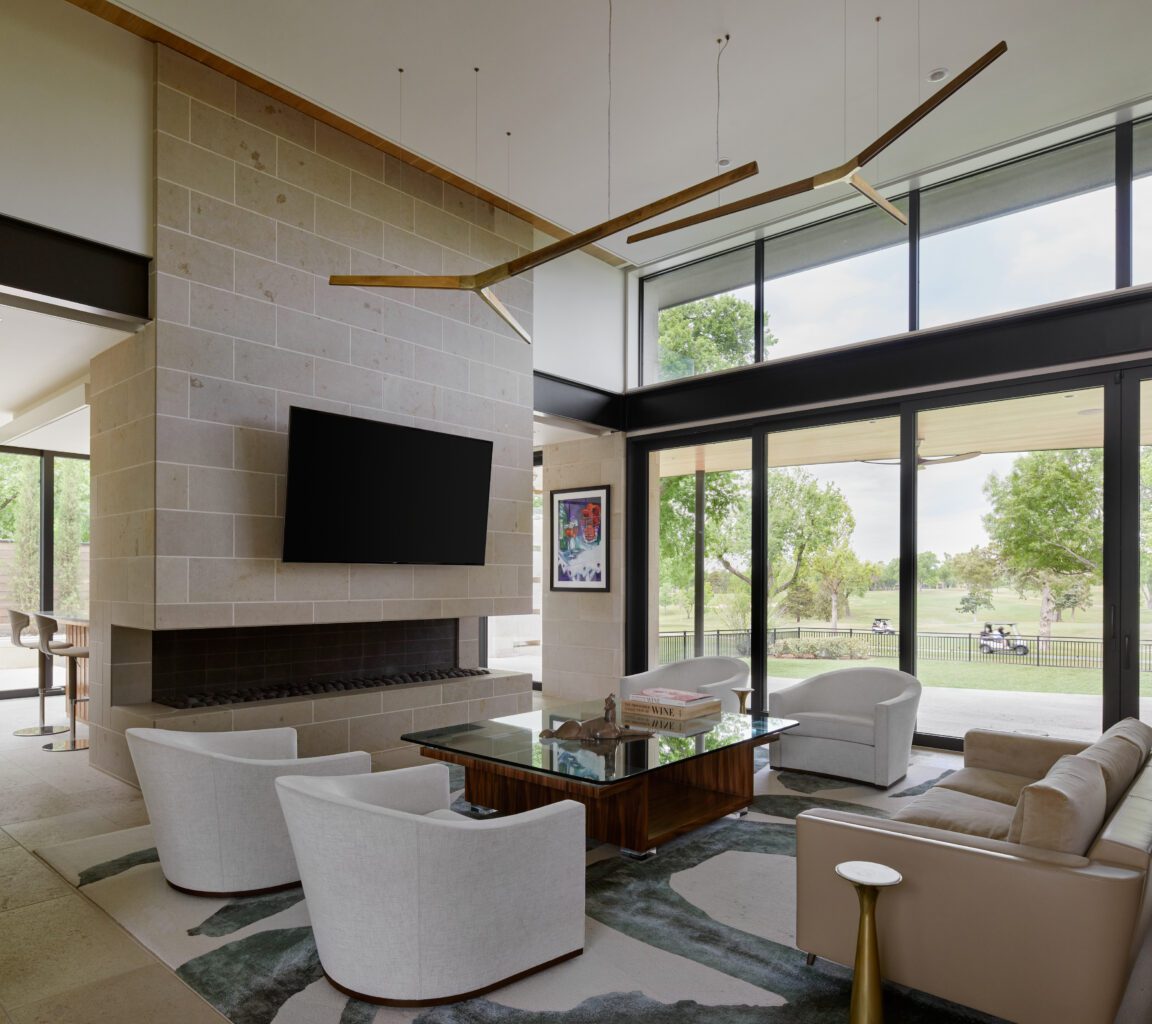
Built from the ground up, this luxury residence took 30 months to construct. The home, located in Oklahoma City, features an expansive floor plan of four bedrooms, four full baths, two powder rooms, two courtyards and a wine cellar that, in true Oklahoma fashion, doubles as an F5-rated storm shelter.
The project was a true team effort, with major players including Bruce Bockus – chairman and architect at Bockus Payne Architecture, Sharon Stewart Buchanan – designer and owner of Sharon Stewart Designs, Inc., and Kent Hoffman – owner of luxury home builder company Hoffman Group.
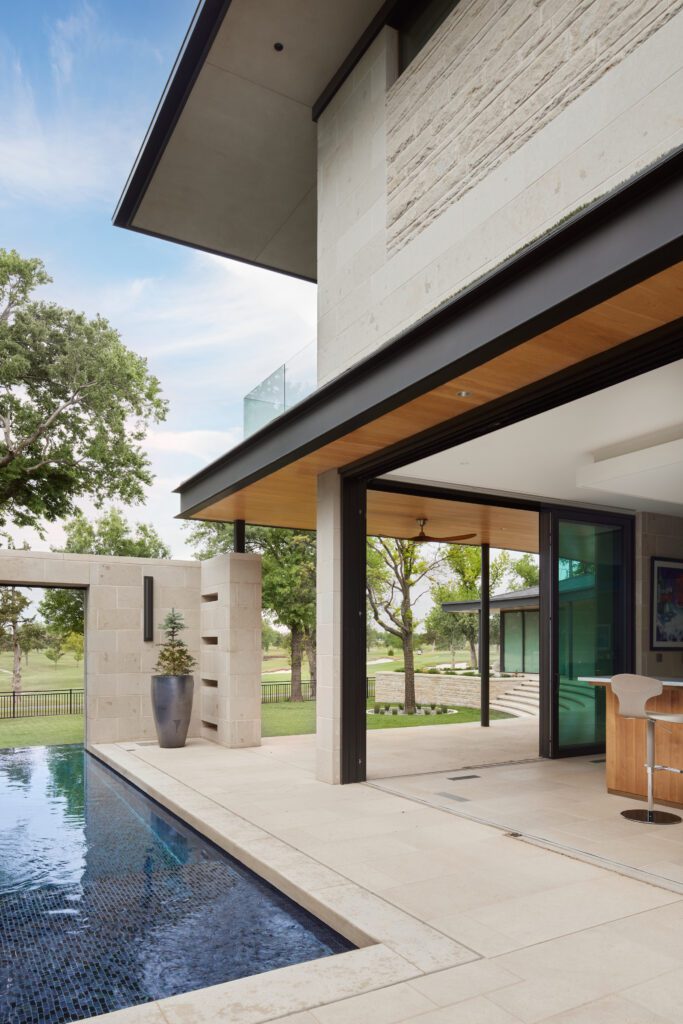
Two shaded courtyards allow for comfort and privacy during outdoor entertaining. Photos by Justin Miers Photography
The three, alongside a handful of other integral members, collaborated closely with the homeowners to create a space that would lend itself to outdoor living and entertainment.
“I enjoy formulating a dream, watching it come to fruition and seeing how my clients can live better by good design,” says Bockus.
The Vision
After Bockus partnered up with the homeowners, Hoffman and Stewart followed closely behind to bring the vision to life.
“I was called in on the project after the overall architectural plan was near completion,” says Stewart. “At the outset, we looked at everything together as a team – communicating about all design elements in order to ensure we all understood the combined visions, which was key to a beautiful end result.”
Hoffman seconds this team effort mentality: “Prior to construction, there were many design and material selection meetings which we attended as part of the architectural, designer, and builder team.”
From the jump, the homeowners requested for the dwelling to blend modern design with its traditional surroundings.
For example, the homeowners had a flat-top roof in mind; however, they opted for a classic-pitch roof instead, helping in the mission to coalesce the modern with the classic.
A classic pitch roof helps this contemporary home fit in with its traditional environment.
“Everything I do, I want to best reflect the clients and their wishes,” says Stewart. “I try to make sure people are not surprised by how it all comes together.”
Designed in an L-shape, the layout of the home capitalizes on the lush views of the country club golf course toward the west.
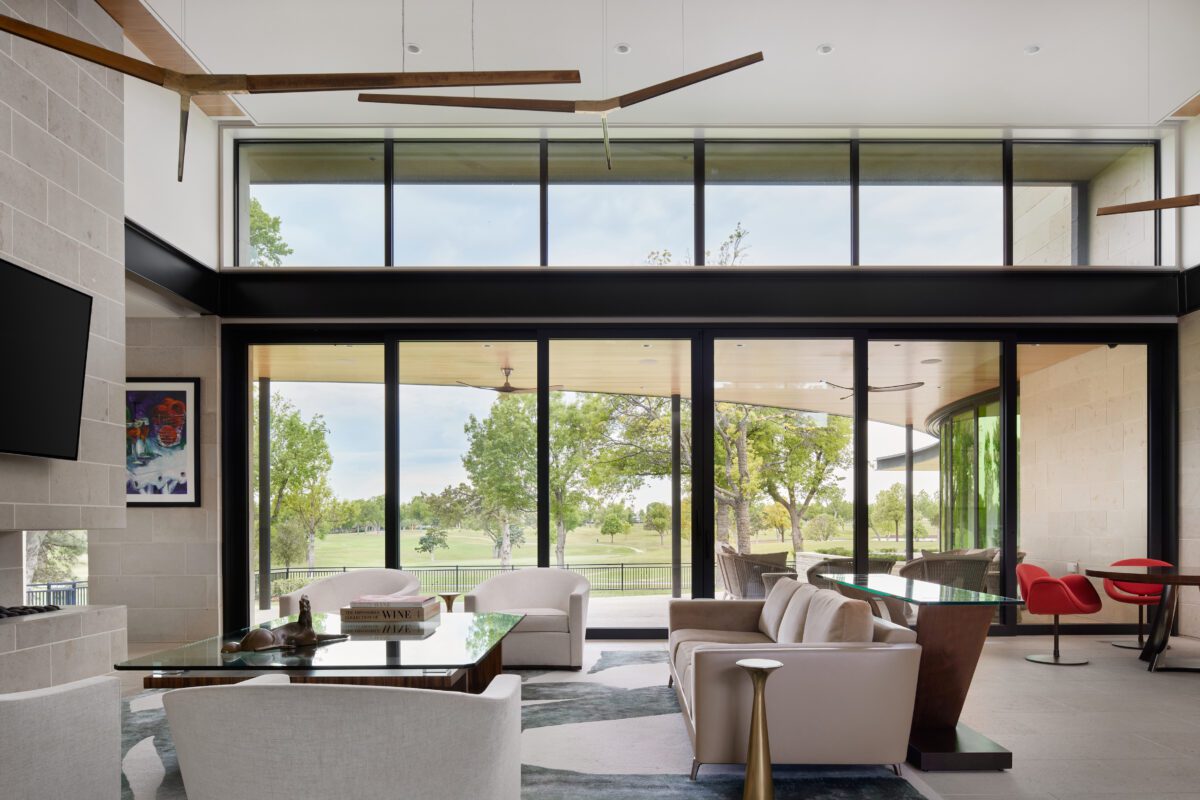
“By far, the most important thing to the owners was to have a view from every room,” says Bockus. To bring the beauty of the outdoors inside, the west side of the home is lined with floor-to-ceiling windows.
“My favorite aspect of the home is the way the outside is brought into the inside because of the large glass openings,” says Hoffman.
Natural entertainers, the owners also wanted to accommodate large gatherings, with a special request to allow for comfortable overflow during gatherings. Working alongside the team, the settled on an open-concept floor plan that melds the living room, kitchen and dining room together.
Convertible Windows & Walls
During the design process, the owners asked to enclose the outdoor living space. The idea was to create a “convertible home.” The team saw this request as an opportunity to do something a little out of the ordinary.
“I drew a curved line across their outdoor living space, and I said that we ought to do a retractable, curved glass wall,” says Bockus.
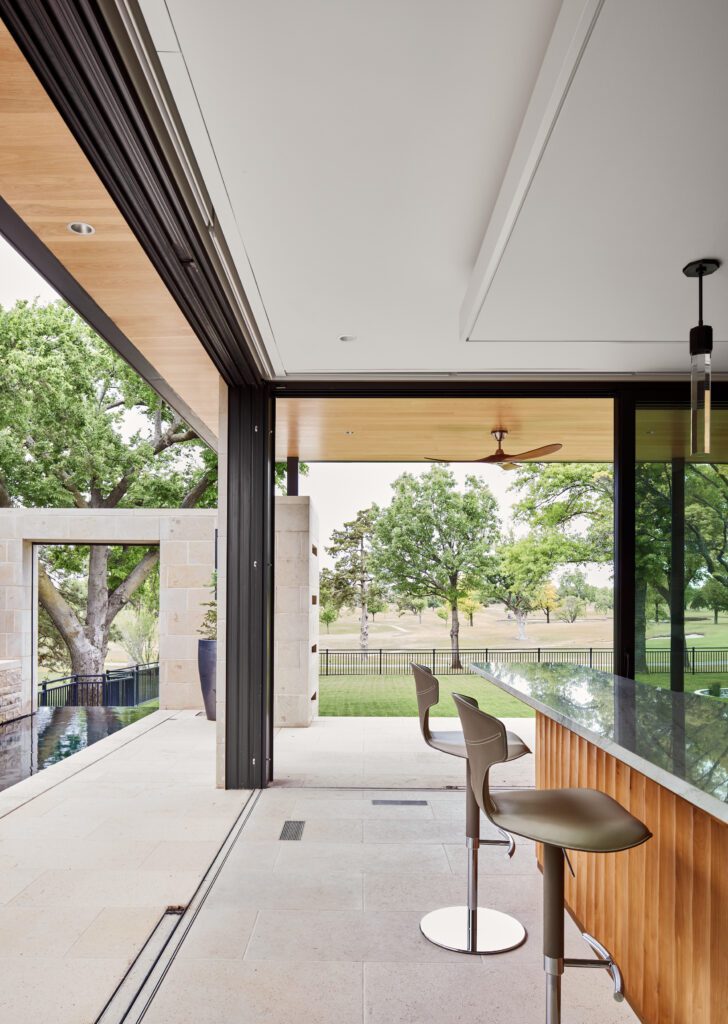
A major undertaking in this project was installing a retractable curved glass wall to blend indoor and outdoor entertaining.
“There is one 55 foot long, 10 feet tall, curved sliding glass door system,” Hoffman supplies. “The owners were very excited about this feature. Much of the home is framed in steel to structurally accommodate these large systems.”
It was an elaborate undertaking that ultimately paid off. Comprising 12 glass panels, the curved glass wall glides along a rolling track, allowing the owners to fold the windows into the walls of the home as desired. From there, the team added five more retractable walls that border the home’s perimeter.
“There’s a total flow between the inside and outside,” says Bockus.
High-End Features
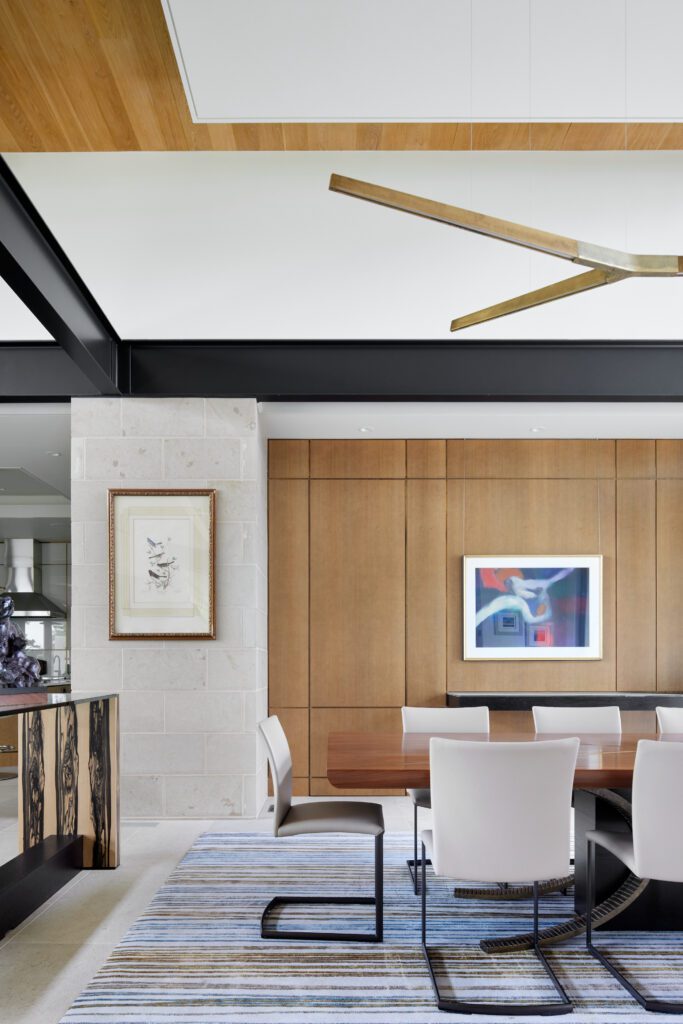
Limestone walls and steel accents appear on the exterior of the home. Inside, you can find plenty of the same materials and design motifs, along with ample wood elements.
“Exploring the beauty of steel and juxtaposing it with wood was very interesting,” says Bockus.
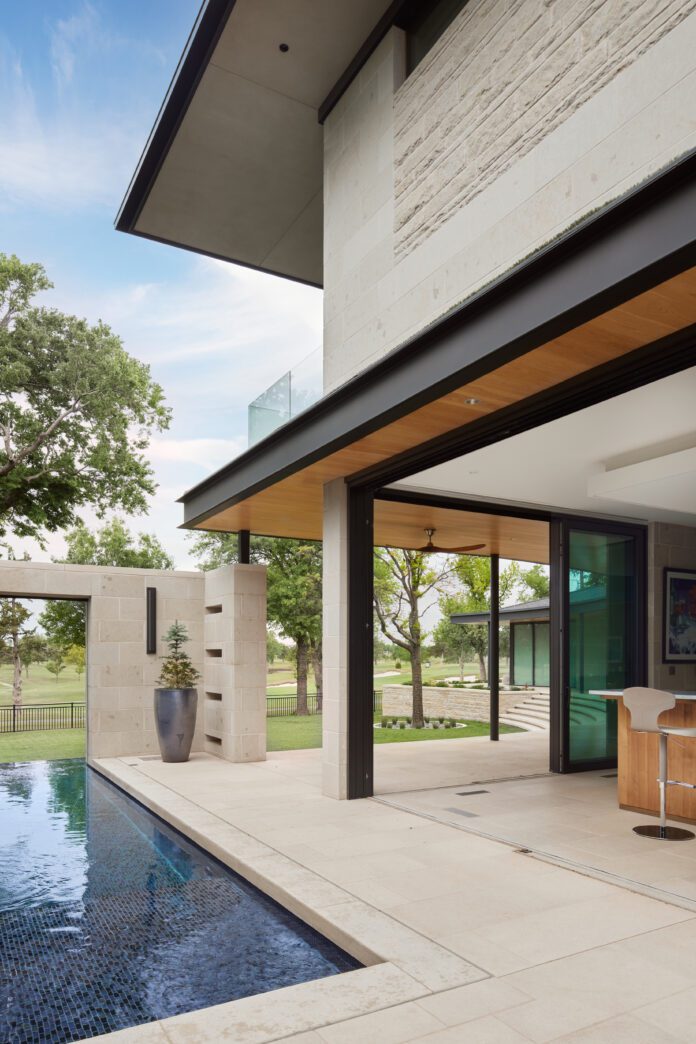
To cultivate a sense of privacy, the entrance of the home is obscured behind a gated courtyard. A large white oak overhang further encapsulates the space, providing shade during the day. A second courtyard, located on the side of the home, features a water fountain and luxurious dipping pool.
“The home is an architectural beauty, and the patios, pool, waterfall and landscaping are an integral part of the home,” says Hoffman. “I also love the limestone floor throughout which runs outside onto the patios.”
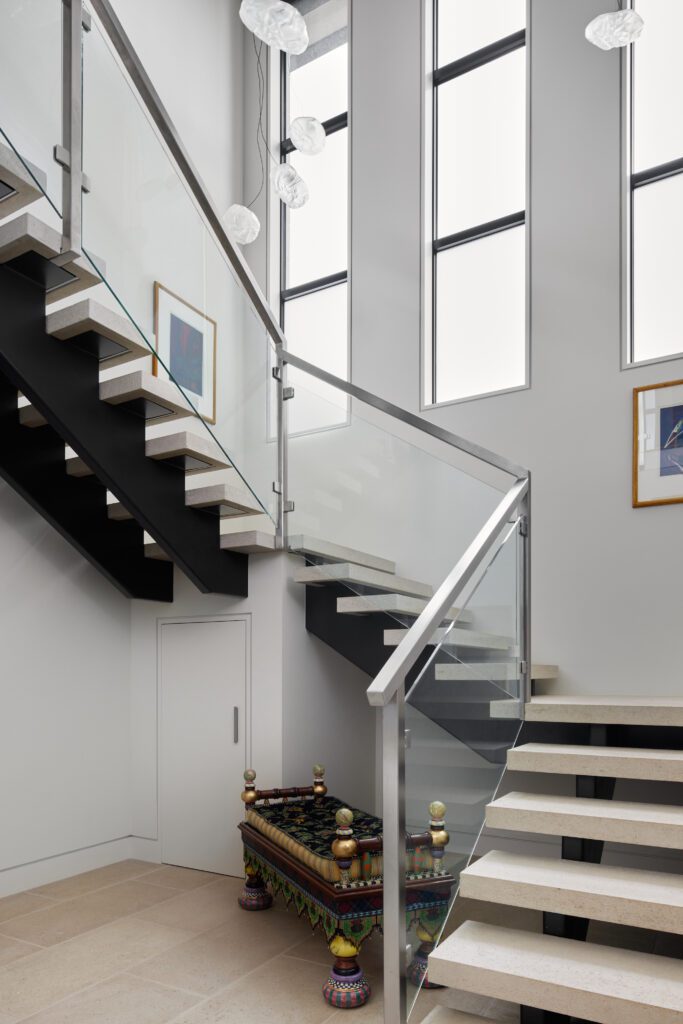
A major ask for these clients was that every room of the home had a view of the outdoors. The design of the home mixes steel, limestone and wood elements. An eye-catching floating staircase welcomes guests to the home’s second floor, which has two guest bedrooms and an additional living space.A luxurious dipping pool is just one draw of this expansive OKC home.
Inside the home, a central fireplace serves as a focal point between the living space and the bar. A floating staircase leads to the second floor, which houses an additional living space and two guest bedrooms.
Attached to one of the guest suites is an elevated balcony, providing a vantage point of the scenic landscape surrounding the home.
A Bevy of Customizations
Stewart mentions that virtually everything inside the home was custom designed. Most of the interior design started with her initial sketches, which led to perspective drawings, and then finally, the unfoldment of all the engineering, product development and costs.
“When it is time to build my custom furniture and cabinetry, I partner up with John Chapline, owner of First Circle in OKC. Their talented team helped bring the artistry of my custom furniture to realization. They also produced a part of the highly customized kitchen and elaborately detailed paneling used in the entry, dining room and kitchen. To promote ease and love of entertaining, design elements hid a pantry door and access to the common wall butler service behind the kitchen.
“It was a team effort to bring continuity to the open living spaces by using the same paneling on the outer kitchen cabinets and on one wall that wrapped around the refrigerator. Then, for a needed lift, I designed lacquered cabinets with glass insets that matched large painted glass tile panels for the backsplash. This added light to that end of the space and a custom paneled island buttoned it all up.”
She continues: “My task in this project took into play almost every space, from the main living areas to the bedrooms and bathrooms. Whether it was custom furniture, paneling, special cabinetry, upholstery, area rugs or lighting … it all started with the merging of the architecture, indoor/outdoor harmony, the light, the relationships of shapes and forms, along with the dance of the furniture. And of course, everything truly begins with the clients, their home, and the inspired sketch.”
Meticulously crafted and stunning in design, this home is a fruitful team effort.
“We love to build difficult homes with a great team,” says Hoffman. “In this case we had a superb architect and a tremendously talented designer.”
Stewart seconds this: “It really takes a team. And what a wonderful team it was.”
The design and construction of this OKC residence was a true team effort.Near a golf course, this home showcases stunning outdoor views.This home is sleek, stylish and tailored to perfection.
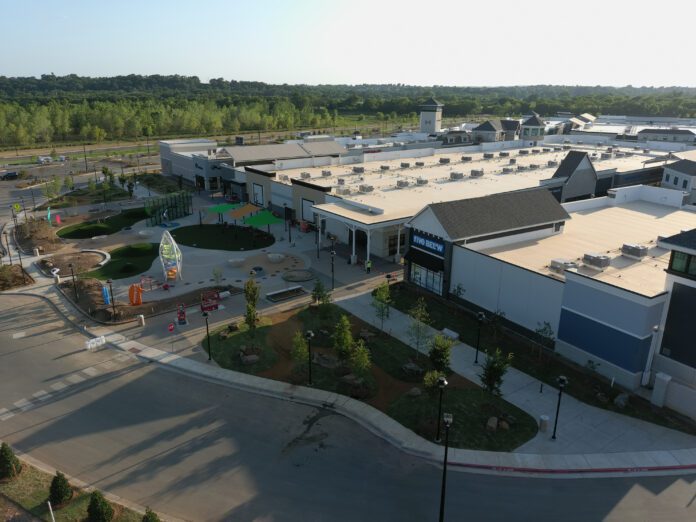
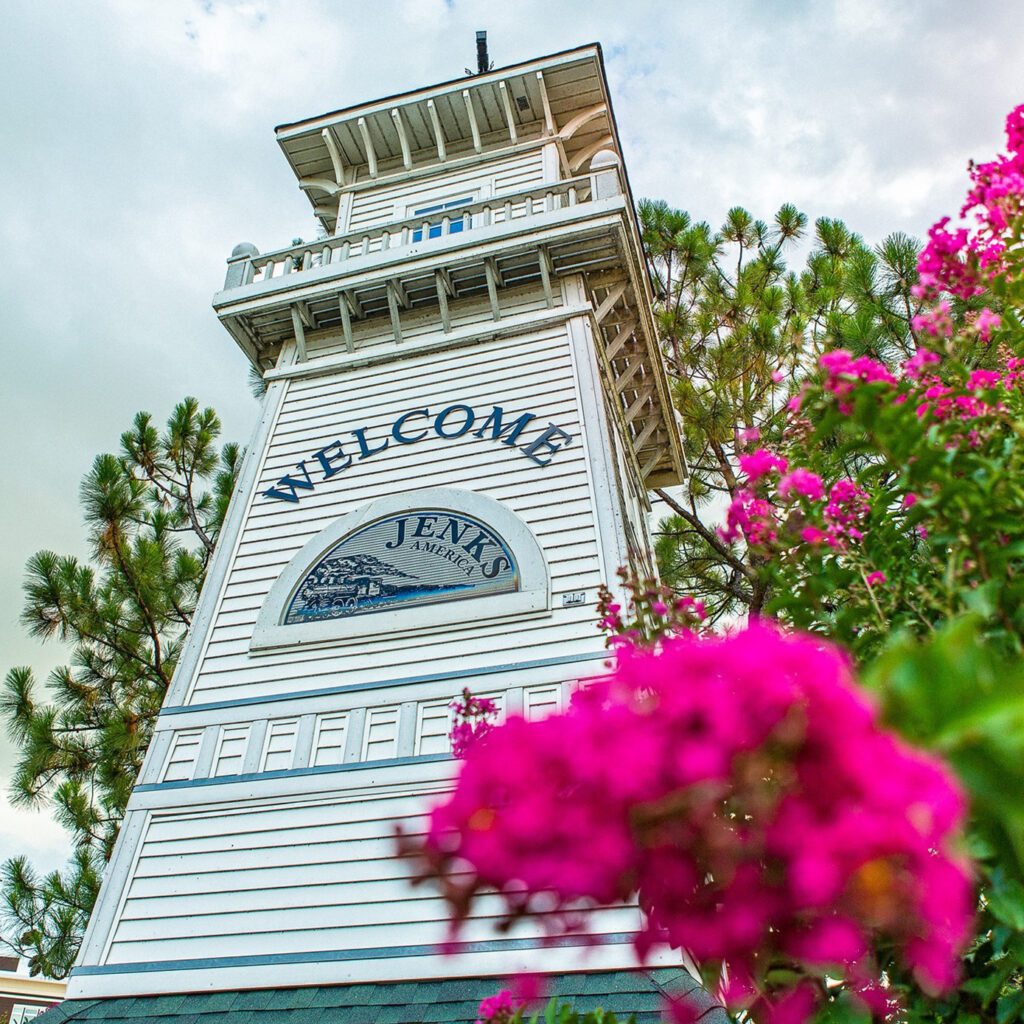
The Simon Outlet Mall, a project ten years in the making, opened in August with retail stores, a children's park and restaurant. Photos courtesy the City of Jenks
As one of Oklahoma’s fastest-growing suburbs, Jenks has been the site of many exciting developments. These projects aim to improve the quality of life for residents and position Jenks as a recreational destination.
Tulsa Premium Outlets, also known as the Simon Outlet Mall, which opened in August, has been one of the most highly anticipated developments in the city, costing an estimated $100 million. The open-air shopping center consists of more than 80 premium brands, offering patrons discounted prices of up to 65%.
A 10-Year Project
Although it may seem like the outlet mall cropped up overnight, the project has been in development for a decade. Simon Property Group first announced its plans to develop the space in Jenks in 2015.
“The Simon Outlet Mall will provide much needed shopping to our residents,” says Christopher Shrout, the city manager for Jenks. “Many residents live here but work in Tulsa because we haven’t always had the amenities related to entertainment and shopping.”
Another reason for Jenks’ selection is its close proximity to highway U.S. 75 and the Creek Turnpike.
“You can get anywhere in the Tulsa metro from Jenks within 15 minutes. It’s also an enviable location for visitors from Arkansas, southern Missouri and Kansas,” explains Shrout.
Simon planned to open the mall in 2017. However, the company faced setbacks along the way. Construction, which eventually broke ground in 2020, was put on hold due to supply chain issues. The project resumed in 2023, and negotiations for retail leases began in the fall of that year.
Community Impact
At the time of the development’s announcement, there were two other proposals for outlet malls in the Tulsa area, which ultimately did not pan out. Most notably, Simon planned to open an outlet mall on the west side of Turkey Mountain – a project that was opposed by the Tulsa Urban Wilderness Coalition.
Jenks, however, has been a different story. Local business owners have welcomed the outlet mall with open arms. City officials estimate that it will attract 7 million visitors annually and create over 800 jobs.
“The economic impact that this will have on Jenks is going to be in the hundreds of millions of dollars,” says Shrout. “Not just from the sales at the mall, but from ancillary sales at other restaurants and stores in Jenks.”
Recognizing the opportunity the outlet mall would bring, the city revamped its tax increment financing districts to support the project. The additional funding has gone not only to the mall, but to other ongoing projects near the Oklahoma Aquarium and Jenks Riverwalk.
Camp Pickle, a 1940s-inspired restaurant and bar, will feature ten pickleball courts. It’s set to open in 2025 next to the Oklahoma Aquarium.
A Premium Shopping Experience
Tulsa Premium Outlets brings a variety of classic brands to the greater Tulsa market. Some of the tenants include Tory Burch, Vineyard Vines and Polo Ralph Lauren.
Designed as an open-air concept, the 340,000-square-foot space features a two-acre children’s park and playground, a restaurant and a large decorative fountain. More than 1,000 construction workers and contractors contributed to the project.
Simon, the company behind the development, owns over 250 retail properties, including the Woodland Hills Mall in Tulsa.
“We’ve been working with Simon for a while, and they’ve been a great community partner,” says Shrout.
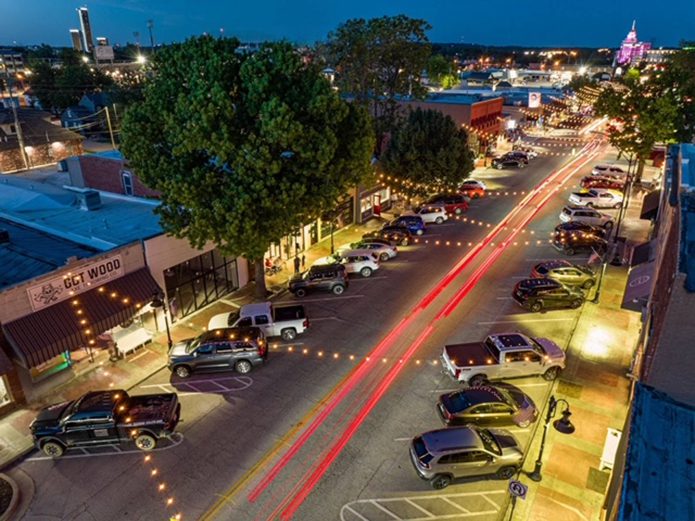
Reviving Main Street is a priority for Jenks’ government.
Infrastructure Expansion
Given the projected number of visitors, Jenks has been expanding its infrastructure to accommodate increased traffic flow and pedestrian activity. Developers intentionally designed a one-way traffic circle that leads up to the mall in an effort to eliminate traffic jams. The outlet mall also features 2,000 public parking spaces.
The city has focused on improving the roads near the attraction, too.
“We’ve widened Main Street from two to four lanes for about two miles, from Highway 75 to Elm,” says Shrout. The City of Jenks also added a new interchange near the Turnpike on Elm Street.
To improve the city’s walkability, government leaders have constructed walking and biking trails that provide access to the mall. The city will continue expanding its infrastructure, with plans to widen Elm Street from three to five lanes.
Small town charm and big city amenities can be found in Jenks.
More in Store
Tulsa Premium Outlets is just one of many new projects that will transform the Jenks landscape. Reviving Main Street, for example, has been a big focus for several years.
“The city council has prioritized incentivizing new businesses and supporting existing businesses,” says Shrout. “We’ve been working hard to ensure that – although we have a huge retail destination with the outlet mall – we maintain our small-town charm with our Main Street.”
New office spaces and restaurants are in the works, including a concept from the McNellie’s Group: City Hall Steak & Cocktail. A full-service hospital, operated by Ascension St. John, is slated to open south of Main Street as well.
The area surrounding the Oklahoma Aquarium is also a hot spot for development. Opening in 2025, Camp Pickle will be a 1940s-inspired restaurant and bar that features 10 pickleball courts. High 5, a multi-story family entertainment venue, is another up-and-coming project.
“We’re going to see even more visitors coming to the mall, the aquarium and everything else that there is to do in Jenks,” says Shrout. “We have a lot going on … and I don’t see it slowing down anytime soon.”
Photo credit: The Simon Outlet Mall/Tulsa Premium Outlets, a project ten years in the making, opened in August with retail stores, a children’s park and restaurant. Photos courtesy the City of Jenks
The Pioneer Woman
Photo courtesy the Oklahoma Historical Society
While you may think you have to pay admission to view some of Oklahoma’s most iconic pieces of art, the truth is many of them are free and visible in the great outdoors. We explore just a few of the public monuments, statues and sculptures that depict Oklahoma history.
The Pioneer Woman
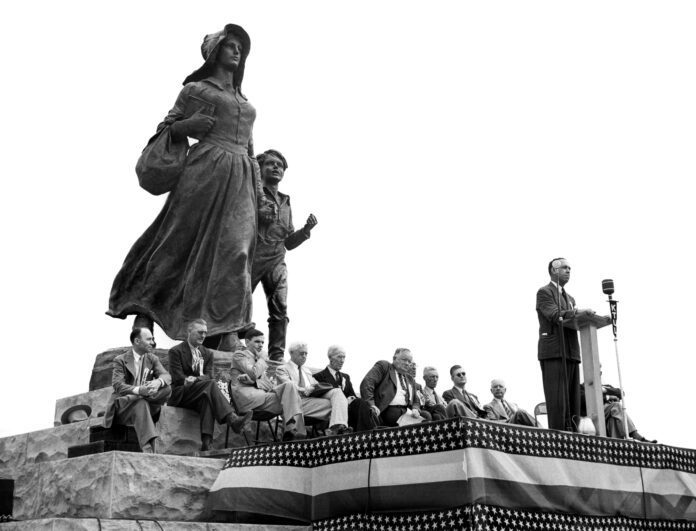
The Pioneer Woman statue is a 17-foot, 12,000-pound bronze sculpture in Ponca City, designed by Bryant Baker and dedicated on April 22, 1930. The statue depicts a sun-bonneted woman leading a child by the hand. The statue, according to the Oklahoma Historical Society, is meant to depict the legacy of women of all races, creeds and nationalities who contributed to the development of Oklahoma.
The piece was donated to the state of Oklahoma by millionaire oilman E. W. Marland. He commissioned models from twelve well-known sculptors and financed a nationwide tour to get feedback from art critics and the general public in order to decide which model to use for the final form.
The bronze statue is seated upon a pyramidal-stepped base of granite blocks which brings the total height of the monument to 40 feet. It resides outside the Pioneer Woman Museum.
Spirit of the American Doughboy
Photo courtesy the Henryetta Public Library
Spirit of the American Doughboy
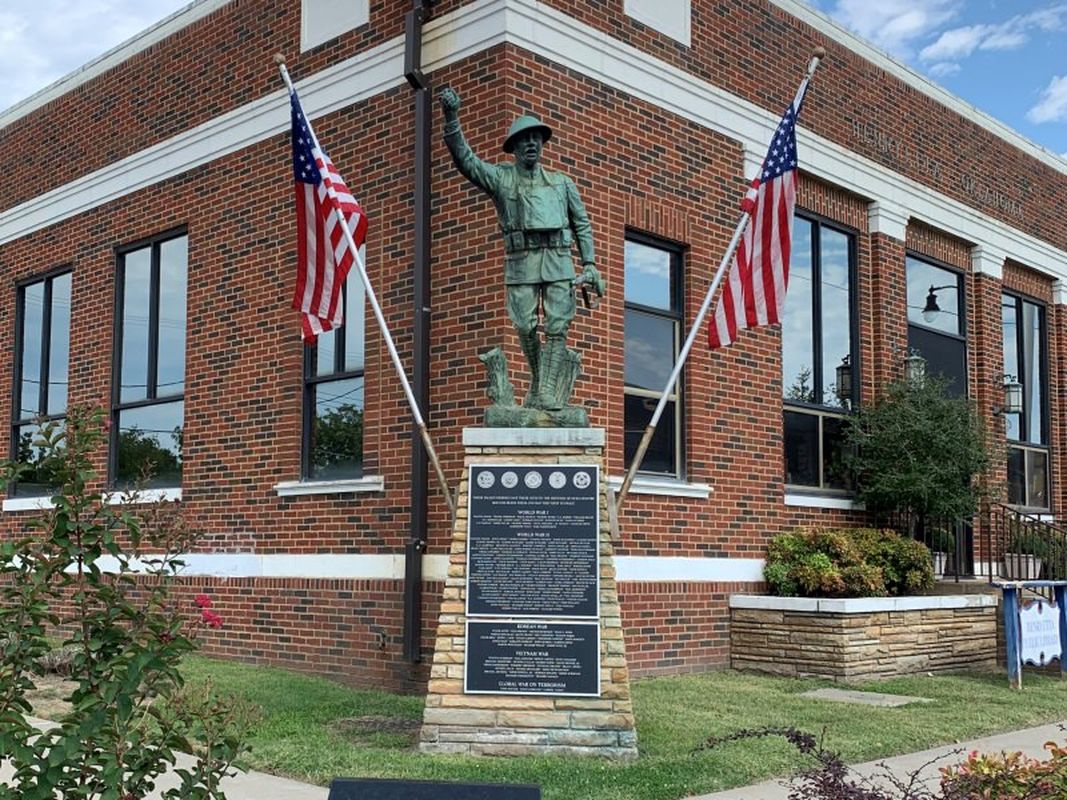
The Spirit of the American Doughboy monument represents the quintessential American soldier during World War I. The statue depicts said soldier charging over the top of a hill towards the enemy line, carrying full field equipment. The statue was erected as a memorial to war veterans and arrived in Henryetta in November of 1923. The memorial still sits in front of the Henryetta Public Library today.
The memorial plate bears this inscription: “To the memory of all in this area who paid the supreme sacrifice in all wars.” It was cast “By the people, the year of 1991.”
Inscribed on the memorial surrounding the statue are the names of local soldiers who lost their lives in WWI, WWII, the Korean War and the Vietnam War.
Centennial Land Run Monument. Photo courtesy Visit OKC
Centennial Land Run Monument
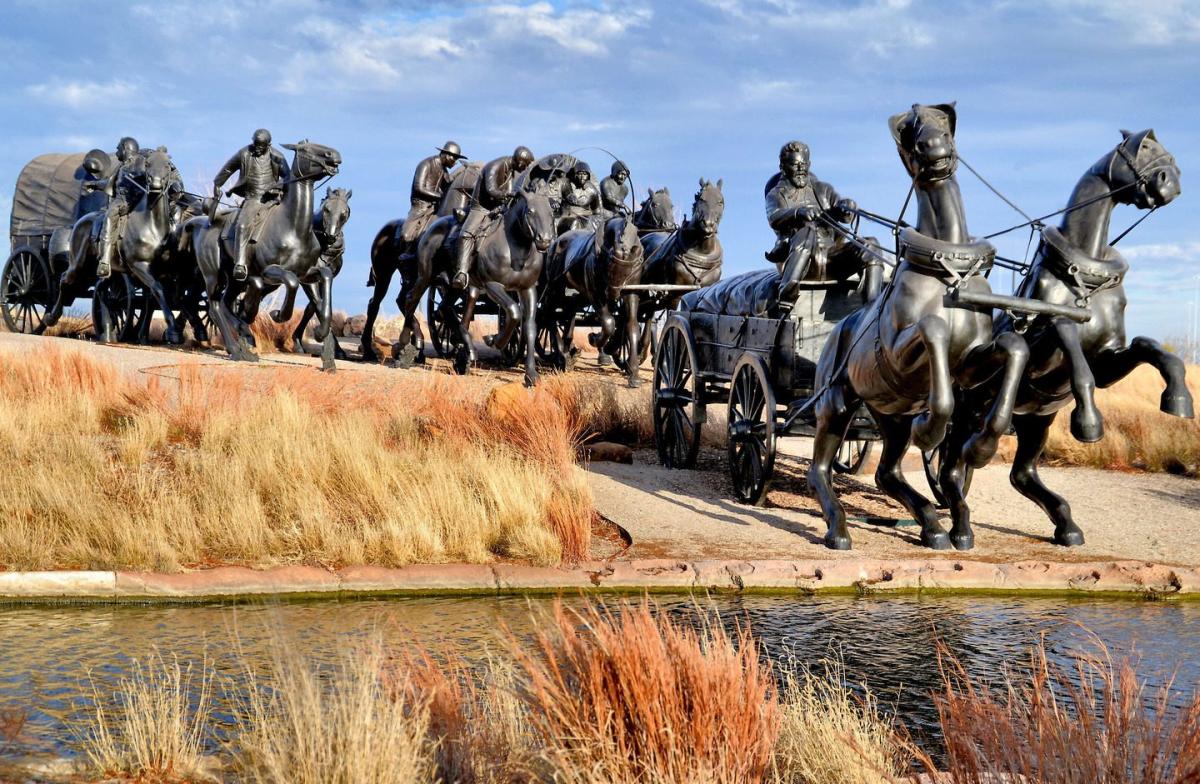
The Centennial Land Run Monument, an art installation by Paul Moore dedicated in 2011, is located in the Oklahoma City Bricktown District.
In all, there are 38 people portrayed, plus 34 horses, three wagons, a cannon, a dog and a frightened jackrabbit – all racing to claim new homesteads.
All figures are cast in dark bronze, at one-and-a-half life size, meaning a standing human in the sculpture would be almost 9 feet tall, and a horse and rider over 12 feet. The sculptor, from Norman, is a fifth generation Oklahoman whose great-grandfather participated in the 1889 Land Run.
In spite of the controversy of the 1889 Land Run, several more events of its kind were held in later years in other parts of Oklahoma territory. Millions of Oklahomans have been able to trace their ancestry back to an original participant.
Oklahoma City National Memorial. Photo courtesy the OKC National Memorial and Museum
Oklahoma City National Memorial
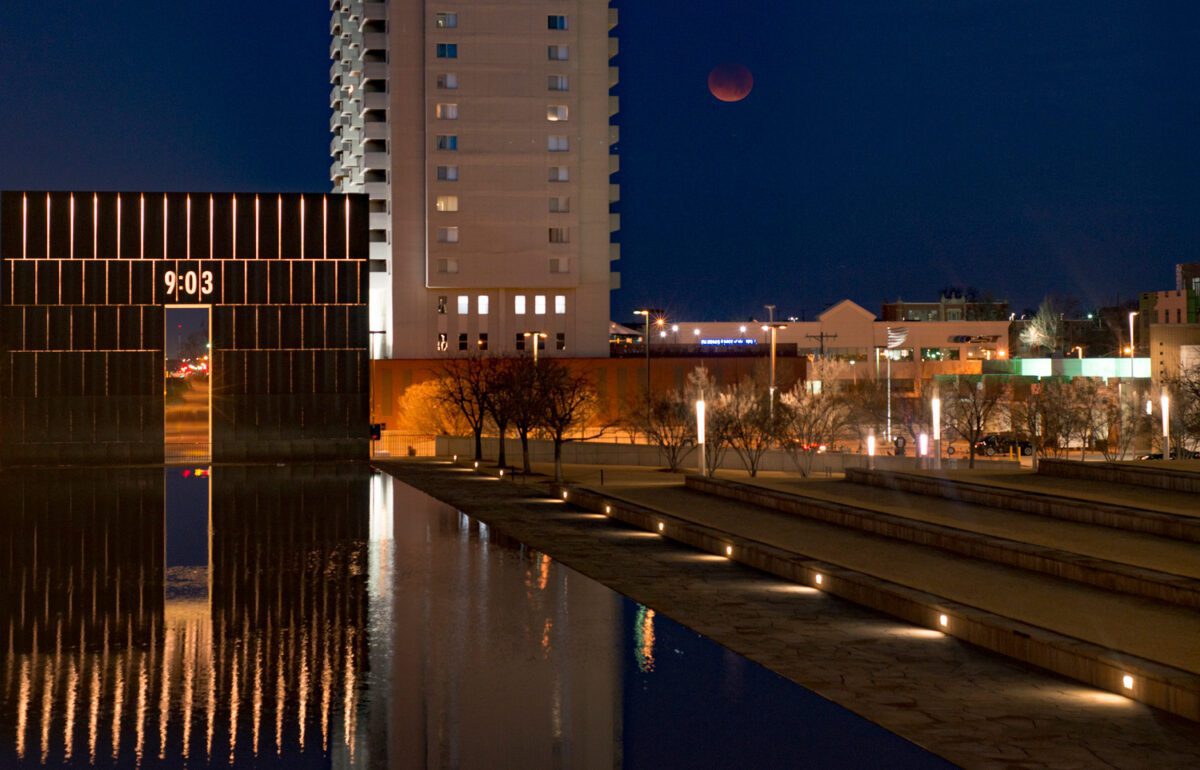
The Oklahoma City National Memorial honors the victims, survivors, first responders and all who were affected by the Oklahoma City bombing on April 19, 1995.
It shines a well-deserved spotlight on all those affected on that fateful day. The monument encompasses the now-sacred soil where the Murrah Building once stood, as well as the surrounding areas devastated by the attack. The outdoor memorial contains several elements, including the Reflecting Pool, Gates of Time, Field of Empty Chairs, Survivor Tree, Survivor Wall and Rescuer’s Orchard. All outdoor elements are available to view for free.
“It is centered in the middle of downtown, and connects the mission of the memorial to our everyday lives,” says Kari Watkins, president and CEO of the museum.
Healing Hands
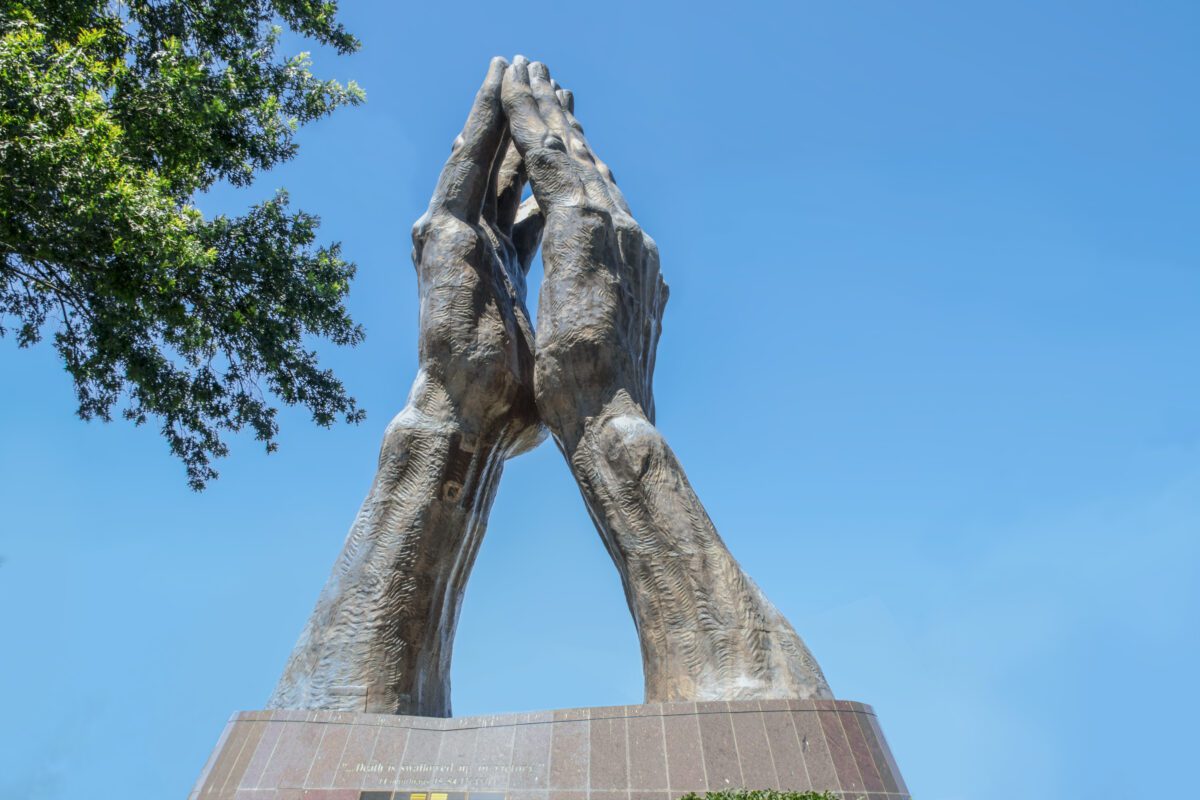
The Healing Hands statue – often called by its misnomer ‘The Praying Hands’ – is a common sight anytime one flies over Tulsa. Known as the world’s largest praying hands, the 60-foot-tall sculpture was created by artist Leonard McMurray. The hands were cast in Juarez, Mexico, in 1980 and stood in front of CityPlex Towers until they moved to the front of Tulsa’s Oral Roberts University campus in 1991.
“A 10-man crew worked for three months to assemble and weld 450 pieces together on site,” says Charles Scott, Ed.D., vice president of external affairs at ORU. “The sculpture depicts the joining together of medicine and faith: one hand representing the healing power of medicine, the other symbolizing the power of faith.”
The Fort Gibson historic site in northeastern Oklahoma sits at the crossroads of three rivers, and offers the opportunity to be transported to Oklahoma’s past – a past that includes a wide variety of stories. This spring marked 200 years since the establishment of the fort and a chance to examine the lessons learned from a varied, but not always positive, history.
The Oklahoma Historical Society commemorated the Fort Gibson Historic Site’s bicentennial with educational activities and community events. Photos courtesy OHS
“The fort and its establishment are sort of the doorway to the West, and as such, is able to show a hugely diverse hub of people, cultures and social, political, physical geographies,” says Jennifer Frazee, site director at Fort Gibson.
The fort, in its original form, was part of a regiment moved from Fort Smith, Ark. in 1824. It was named after U.S. Army Commissary General George Gibson and was the first military settlement in what would become Indian territory.
“Located farther west than any other existing U.S. post, [Fort Gibson] was built to protect the nation’s southwestern border and to maintain peace on the frontier,” according to Brad Agnew in The Encyclopedia of Oklahoma History and Culture.
The ‘peace’ referred to working with the Native tribes in the area, as well as managing relations as more tribes were forcibly removed to Indian territory. During this Native removal period, the fort was occupied and played an important role as a launching place for expeditions further westward. This continued until the 1850s when the fort was briefly decommissioned and given to the Cherokee Nation.
Just a few years later, Fort Gibson was reactivated due to the invasion of Indian Territory during the Civil War. The fort would continue to play a role during this time in securing the area for the Union army.
“Troops from Fort Gibson marched south in July 1863 to win the engagement at Honey Springs, the war’s largest and most important engagement in Indian Territory,” writes Agnew. After the Civil War, the fort remained active for a time, but was largely abandoned by 1890. It did play a role near the turn of the 20th century by housing the Dawes Commission and their work with Cherokee Freedmen.
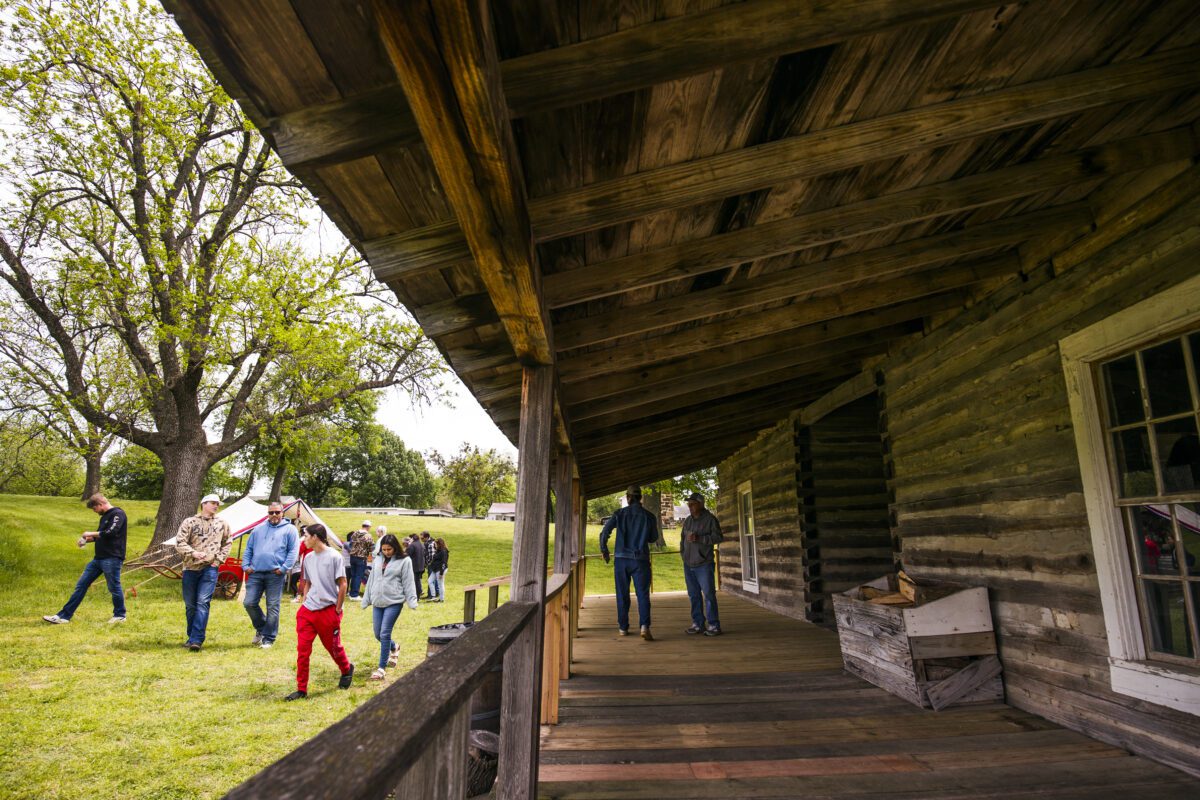
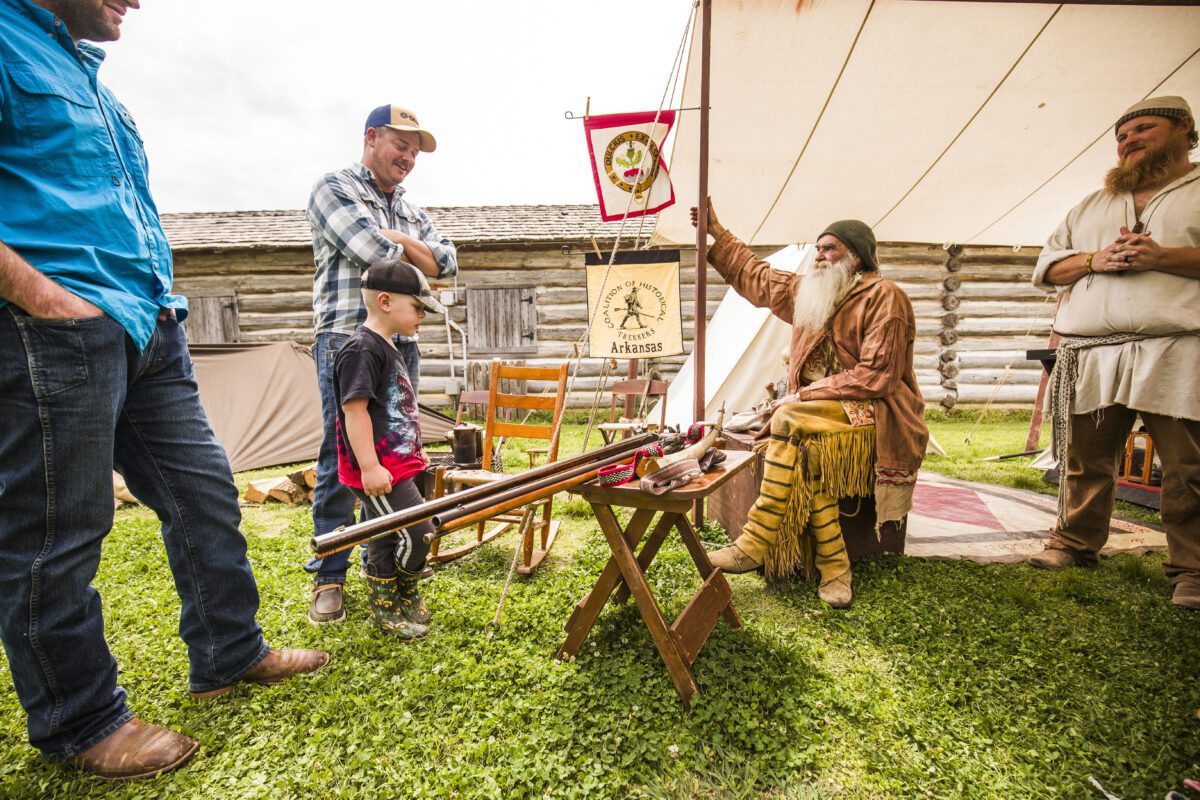
While the original fort barracks are gone, a replica palisade was built by the Works Progress Administration in the 1930s, where visitors can see living history demonstrations, including showcases of period attire. This historic site also includes a visitors center in the original commissary; the bakery, where period baking demonstrations are held; and a historic hospital currently in a full rehabilitation effort.
The 200th Anniversary
For this bicentennial year at Fort Gibson, planned activities have taken the opportunity to commemorate the occasion, but also recognize the difficult history. In April, the Oklahoma Historical Society marked the anniversary with an education day for students, and another day open to the public, which included speakers and presentations from members of Native tribes impacted by removal policies in the 19th century.
There are many more entertaining and educational events coming up for the historic site in this special year. Visit okhistory.org/sites/fortgibson to keep up with the calendar.
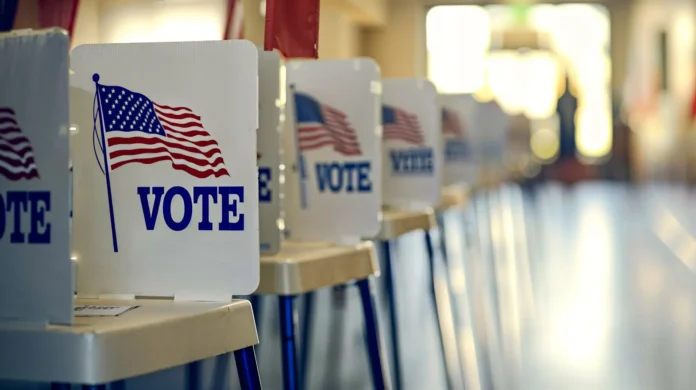
In a time when digital misinformation is the norm, it can be challenging to get the right facts on political matters – even including where, how and when to vote.
To verify your polling place and to get unbiased information about candidates and state questions, Oklahoma State Election Board (OSEB) public information officer Misha Mohr says to contact your county election board, or visit websites such as vote411.org, justfacts.org, votesmart.org or ballotpedia.org. Local media outlets and newspapers are also helpful places to find this information, as well as the State Election Board’s OK Voter Portal at oklahoma.gov/elections/ovp.html. This last site is also recommended by Gwen Freeman, secretary of the Tulsa County Election Board.
“You can not only find your polling place and early voting information, but you can view a sample ballot as well as register to vote, request an absentee ballot and a new voter ID card,” she says. “If you don’t have a sample ballot, then more than likely you are not able to vote in that election. But just to be sure, you can always call our election board at 918-596-5780.”
What You Need
Remember that voting requires certain identification items – so don’t show up to your polling place empty-handed.
“Oklahoma’s proof of identity law, or the ‘voter ID’ law, requires every voter who votes in person at the precinct polling place or during early voting to show proof of identity before receiving a ballot,” says Freeman. “You must bring a valid photo ID issued by the State, the federal government or a federally recognized tribal government. These would include a driver’s license, a passport, U.S. military ID or an OK I.D. card. Voters may also use the free voter identification card they received by mail from the County Election Board when they registered to vote – the law does allow for use of the voter identification card even though it does not include a photograph. And don’t forget, to vote in the November general election, you must be registered by October 11.”
Know Your Rights
Finding time to vote during a work day is assisted by legislative decree.
“By law, your employer must give you two hours to vote, either on election day or during early voting,” says Freeman. “There are a few provisions involved, though. I would suggest voters consult the State Election Board website for the details.”
Early Voting Done Right
Freeman also encourages early voting.
“That takes place starting October 30 and goes through November 2. Plenty of time to cast a ballot. Or you can vote by absentee. Oklahoma is a no excuse state, meaning you don’t have to state a reason to vote absentee. Once you are a registered voter, you can apply for a mail-in ballot by accessing the Voter Portal. When you receive your ballot, you’ll follow the directions on the enclosed affidavits.”
However, there are a few extra steps you’ll need to take.
“If you are filling out a Standard Absentee Ballot, you will have to have it notarized,” she says. “You can find a local notary on the American Association of Notaries website, and you can check to make sure they are commissioned by going to the Oklahoma Secretary of State website. I do like to remind people to carefully read and follow the directions that are mailed along with the ballot so we can make sure your vote is counted. To request an absentee ballot for the November election, you must do so by October 21.”
A Positive Change
“In late 2023, we started a big recruitment effort to find enough poll workers for the numerous elections this year,” says Freeman. “For a large election, we fully staff 251 polling locations. That means an inspector, a judge and a clerk must be assigned to each location. That effort has really started to pay off. The community heard the call and applied in large numbers.”
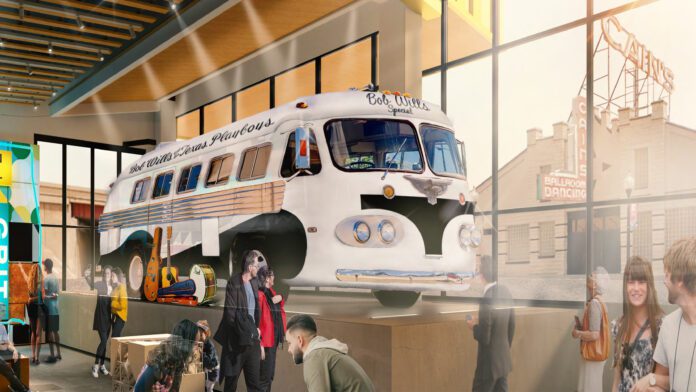
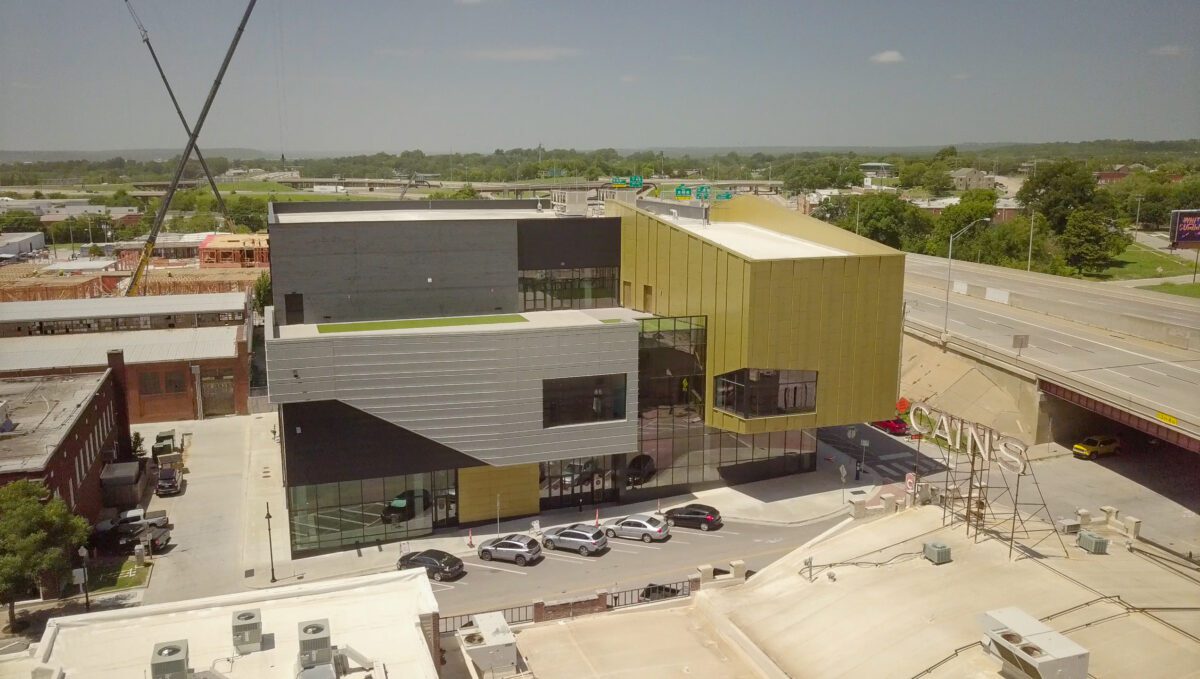
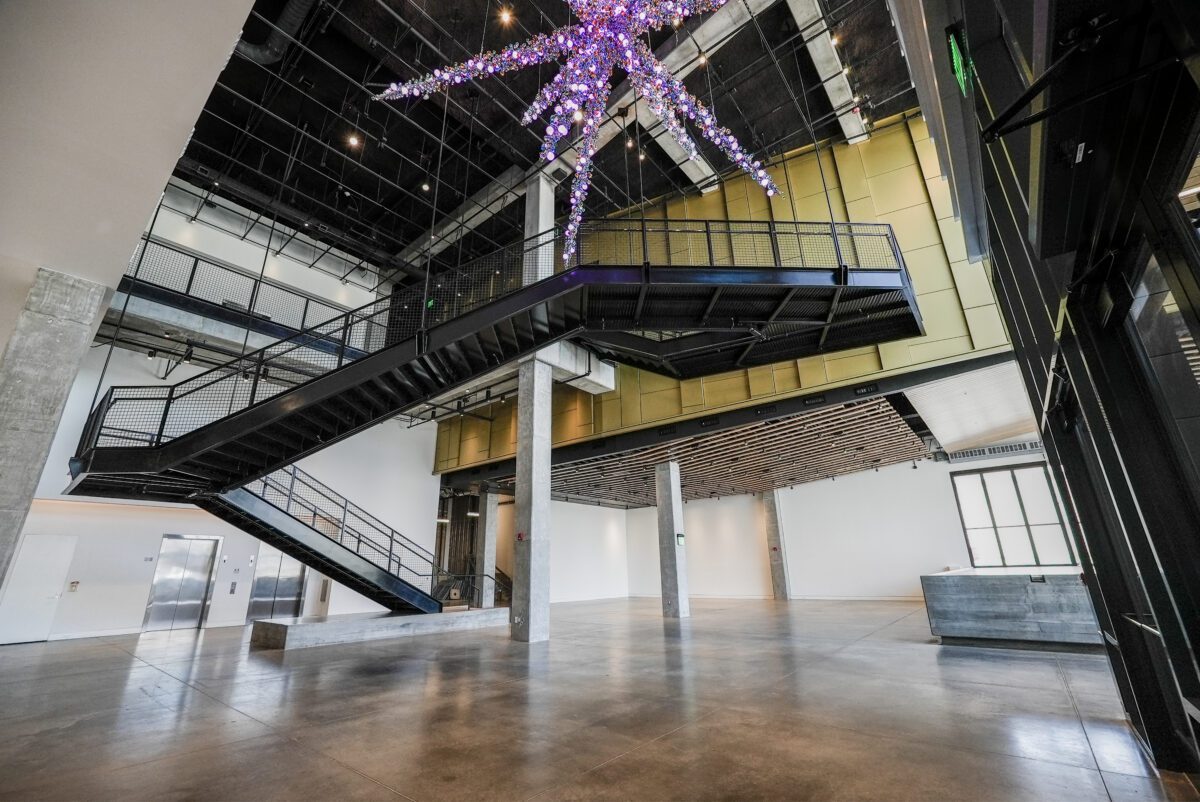
Once funding has been secured for the interior build-out, the OKPOP Museum will offer myriad exhibitions celebrating notable Oklahomans in the entertainment industry. Photos courtesy OKPOP Museum
The Oklahoma Museum of Popular Culture (OKPOP) is anticipated to be a place of celebration, inspiration and appreciation – as well as a major tourist draw to downtown Tulsa.
Development of the museum is ongoing, despite several funding challenges along the way. But officials say public support and excitement for the museum will result in a project that will highlight the achievements of Oklahomans in the arts, seek to influence new talent and attract visitors to the state.
“We have already gathered thousands of interviews with and artifacts from Oklahoma creatives that will be used to tell stories about their cultural impact and lasting legacies,” says Jake Krumwiede, the museum’s executive director. “We are excited to surround these stories and artifacts in an unforgettable experience that will inspire pride in Oklahoma and inspire a new generation of Oklahoma creatives.”
Once funding has been secured for the interior build-out, the OKPOP Museum will offer myriad exhibitions celebrating notable Oklahomans in the entertainment industry. Photos courtesy OKPOP Museum
The museum, located in the Tulsa Arts District across from the historic Cain’s Ballroom, is under the direction of the Oklahoma Historical Society. The establishment plans to showcase stories of Oklahomans who have impacted the world of entertainment – from music and movies to television, radio, comics, animation, literature and more.
The Process Thus Far
In 2015, state lawmakers supported the project by providing $25 million in bonds to construct the museum. In 2019, the groundbreaking took place with an original expected open date in 2021. Officials say that the COVID-19 pandemic did impact the project, as did the rising costs of materials and construction services.
Fundraising is ongoing to complete the second phase of the building, “which includes the development and construction of our immersive exhibits and visitor experiences,” says Abby Kurin, managing director of the OKPOP Foundation – the museum’s nonprofit fundraising arm.
“We are raising $36 million to fully fund phase two, which includes exhibit design, build out and some funding for operations,” Kurin says.
She mentions a “a big win” for the project came during the recent legislative session, when lawmakers supported state matching support of $18 million through the passage of Senate Bill 1155. The next step is raising $18 million in private donations for the legislative match.
“We are grateful to Oklahoma elected officials for believing in the mission and economic impact of this museum. In addition to legislative support, we have been making progress securing the $18 million in matching private contributions,” Kurin says.
With those critical fundraising goals at the forefront, tough choices needed to be made. Krumwiede said in a statement this summer that officials made “the hard decision to temporarily reduce our staff until the museum build-out is fully funded. We are immensely grateful for all the incredible work our larger team has accomplished over the past two years in research, planning, operations, acquisitions, videography and design.”\
Looking Ahead
Krumwiede says he expects that it will take 18 to 24 months “to complete the interior build-out for phase two once the funding has been secured.”
He mentions that the excitement about the museum remains high, and he also believes the museum will be a major tourist draw.
“We believe now is the right time for this museum. Tourism in Oklahoma is a multi-billion-dollar industry, and OKPOP fits perfectly into the pop culture tourism that already exists in Tulsa – like the Woody Guthrie Center, Historic Route 66, the Bob Dylan Center, the Church Studio, Cain’s Ballroom and The Outsiders House Museum,” he says. “There is a lot of great synergy with our museums as we continue to make Oklahoma a tourism destination.”
When all is said and done, Krumwiede says he believes the museum will be a place of celebration and aspiration.
“At the core of our mission is to remember and inspire future Oklahoma creatives,” he says. “Public support – and public excitement – is crucial for a project like this. We hope Oklahomans will join us in celebrating these influential Oklahomans by supporting this project, sharing names of people they know who should be included in our archives and museum, and having pride in the creative spirit of Oklahoma.”