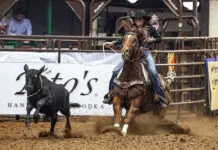
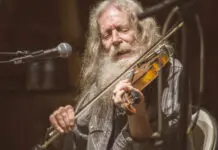
For 11 days, Expo Square will be held the hostage of festivities, curiosities and deep-fried goodness. We never said it went unwillingly. The Tulsa State Fair opens Thursday, Sept. 25, at 5 p.m. with carnival rides, concerts, fair food vendors and exhibits from heirloom vegetables to original artwork and crafts. The first weekend of the fair brings the Oklahoma State Sugar Art Show (Friday and Saturday), Disney On Ice (Thursday-Sunday), the Oklahoma State Picking & Fiddling Championships (Saturday-Sunday), the Miss Tulsa State Fair Pageant (Thursday) and concerts from rising acts All That Remains, Thomas Rhett and others. Look for culinary shows, petting zoos and other hallmark attractions throughout the fair, which concludes Oct. 5. General admission to the Tulsa State Fair is $6-$10, but some events require separate tickets for entry. Expo Square is located at 4145 E. 21st St., Tulsa. Go online to www.tulsastatefair.com for a complete roster of attractions and schedule of events.
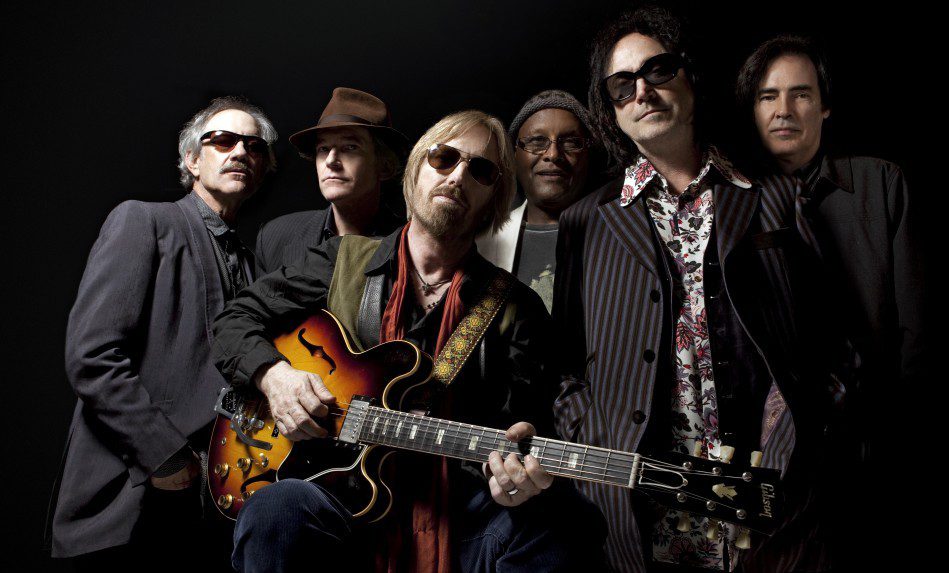
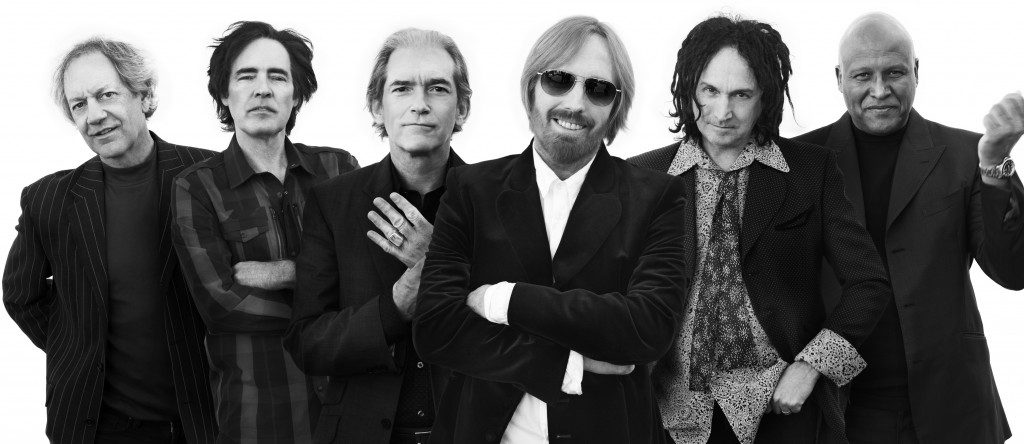
Tom Petty and The Heartbreakers will rock the BOK Center this weekend. Playing hits from throughout a legendary career, Petty and the band will also give fans new work from the latest album, Hypnotic Eye. Special guest Steve Winwood stops in for a night of rock that’s both timely and timeless. Show time is at 7:30 p.m. Sunday, Sept. 28, at 200 S. Denver Ave., Tulsa. Tickets, $42-$117, are available at the BOK Center box office and online at www.bokcenter.com.
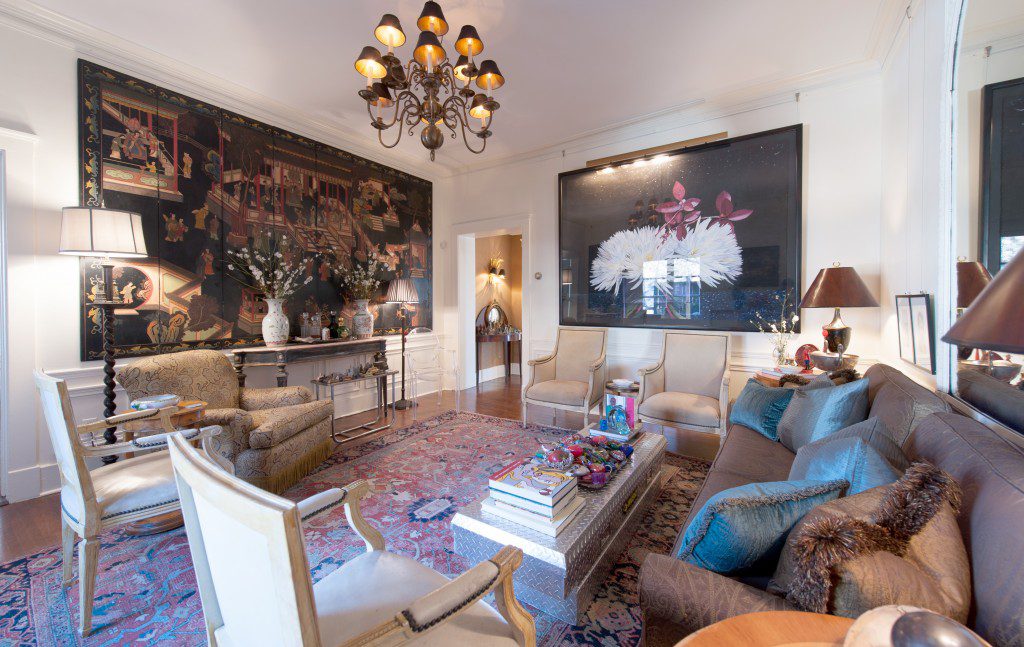
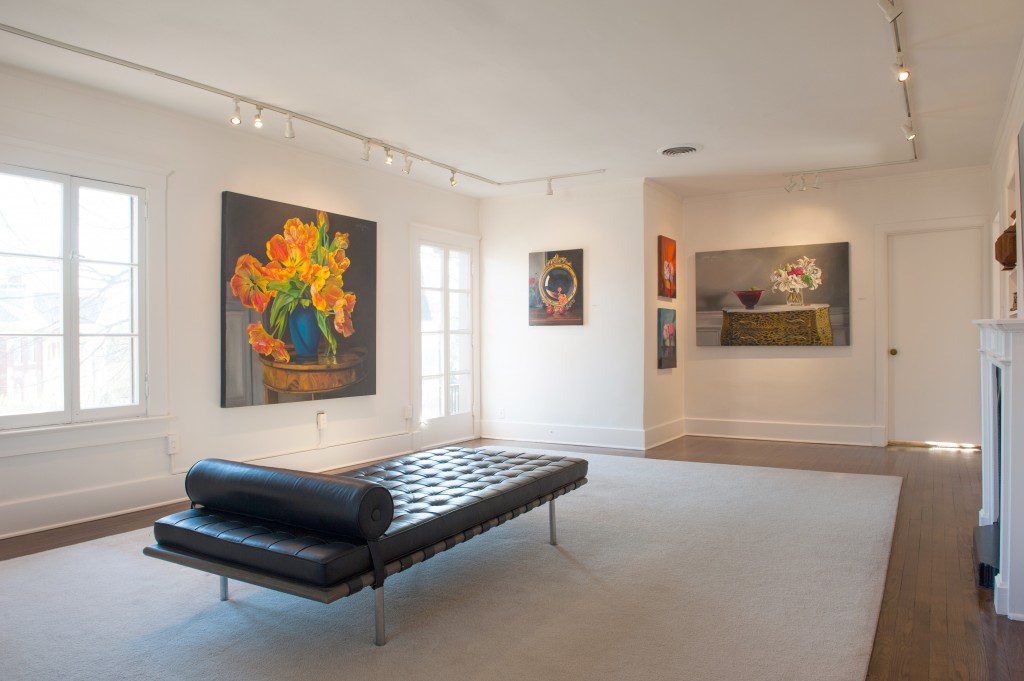
An eclectic mix of furnishings lend to the study of gordon’s works, on display in his living room.
An eclectic mix of furnishings lend to the study of gordon’s works, on display in his living room.
Artist Patrick Gordon has easily settled back into Tulsa life after almost a decade in New York City, where his career flourished.
Many Tulsans may remember him as P.S. Gordon, whose popular watercolors, drenched in vivid color with stunning detail of eclectic still lifes, gained the artist national attention by the time he graduated from the University of Tulsa with graduate work in watercolor.[pullquote]“I made wonderful friends in New York, and I miss them, but there is something about those 40-year-old friendships [in Tulsa] that I couldn’t duplicate there.”[/pullquote]
Gordon had his first show in a New York City gallery by the time he was 21. He created two Mayfest posters, including one for the 25th anniversary, had shows in major galleries and museums across the country and was regularly commissioned to paint portraits and custom pieces.
By 2003, Gordon was ready for a change. He relocated to New York City and transitioned from watercolors to large-scale oil on canvas, plus his signature changed from “P.S.” to “Patrick.”
However, after years of living in a 1,500-square-foot loft, and as he edged closer to a milestone birthday, Gordon was beginning to feel the tug of returning to Tulsa.
Elements, such as a wicker table from his childhood and dining chairs he customized, are both unique and personal for Gordon.
The master bedroom is the only room where Gordon displays work by other artists.
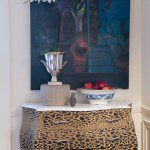
A french bombe commode covered in jaguar-pattern cut velvet graces the living room.
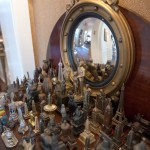
One of the collections the artist has amassed through his work and interests.
“I made wonderful friends in New York, and I miss them, but there is something about those 40-year-old friendships [in Tulsa] that I couldn’t duplicate there,” he adds.
A few months earlier, he’d received a brochure about a home for sale on 21st Street from a friend in real estate. He still wasn’t ready to make the change, but that house “stuck in my head,” he says.
The home lingered on the market for months, and when Gordon finally decided to relocate, he bought it.
The home, built in 1940, sits across from the Skelly Mansion – “What a view I have!” he exclaims – and itself has an interesting history. After World War II, it was converted into two apartments. And it was the first of many Tulsa houses owned by the late Charles Faudree. The renowned interior designer lived downstairs, and his sister, Francie, resided upstairs. While the house has changed owners, most of Faudree’s original design remained.
“The living room was dark, and the gold leaf ceiling had turned black,” says Gordon.
But the house and wood floors were in good shape, so the biggest transition was painting most of the rooms white. Gordon also removed the wall that split the house into two units; but as homage to Faudree, the original wallpaper and light fixture remain in the entry.
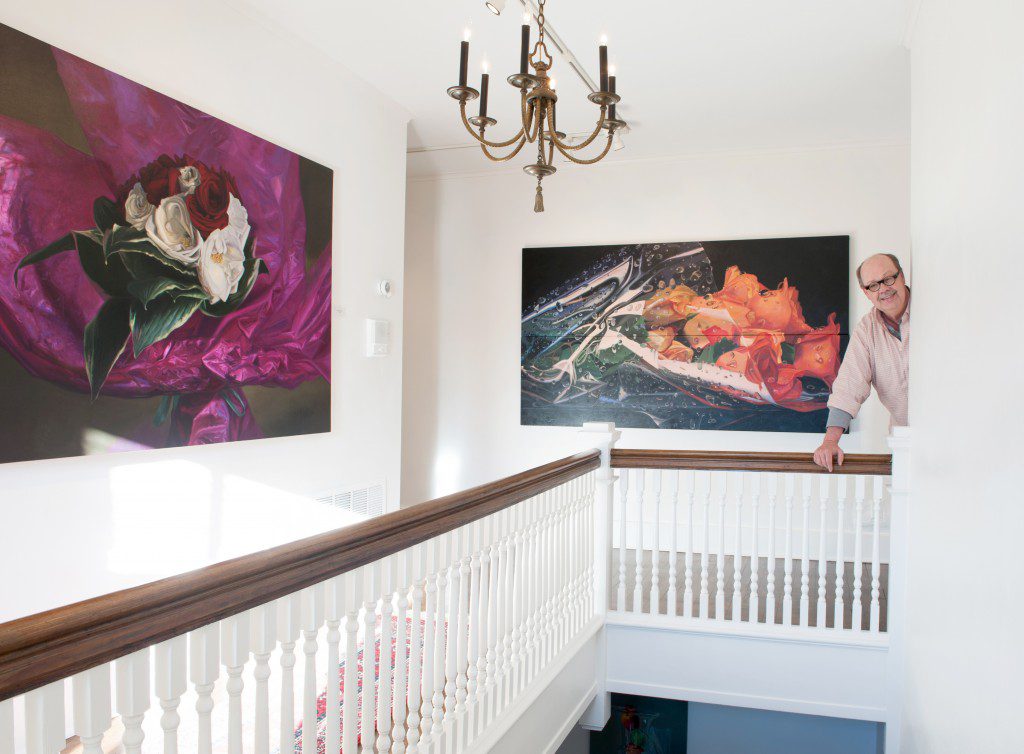
Gordon with two works displaying the vivid detail for which he is renowned.
“I’ll never change that,” says Gordon.
Because the house was to be Gordon’s working studio, he repurposed most of the rooms. The large living room serves as a studio where Gordon paints often 10 to 12 hours a day. The one exception is Friday, when Gordon and a friend spend a few hours perusing the area garage and estate sales, where he often finds unique items to add to his multiple theme collections.
The original library is now the dining room, where Gordon uses the wicker table from his childhood, painted gold, mixed with a set of Louis XVI chairs.
“I picked these up at a sale,” he says. Originally mahogany with yellow leather, he first painted the chairs white, then started experimenting with layers of color. When he liked the look, he added the nail head trim.
The chandelier over the table is one he’s had for more than 30 years, making the move to New York City and back. The library shelves hold items he’s used in past paintings.
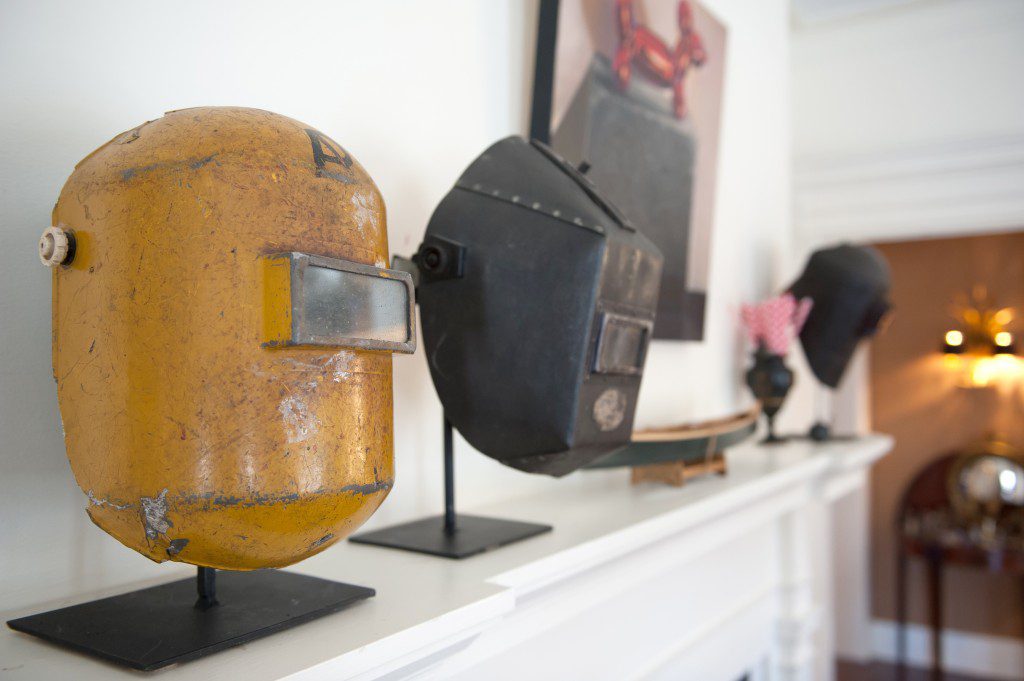
Functional welding masks make bold statements as art.
Gordon’s eclectic style is especially evident in the living room, originally an oversized dining room. There’s an acrylic chair at one end and a pair of French bombe commodes covered in a jaguar-pattern cut velvet at the other. Formal chairs flank a stainless steel cocktail table.
“From Home Depot,” he says, laughing. [pullquote]“[During] the month of May 2010, I stood at the same place every day looking out my apartment window and gave myself 10 minutes to paint the same view but from different perspectives.”[/pullquote]
Upon closer inspection, the “table” is a storage unit for a pick-up truck.
“In New York, every inch of space counts, and that was also my silver chest,” he says.
On top is his collection of hearts.
Gordon’s artwork is on display throughout the house. In his studio, portraits of his daughter made over the years adorn the walls. In the living room hangs his only still-life watercolor displayed in the home, the medium that launched his career. Using a centerpiece from a friend’s apartment in NYC, the painting is done on two pieces of watercolor paper to create the size. Only in his bedroom does he have other artists’ paintings.
Gordon’s home also serves as his studio and a by-appointment-only gallery for his work.
The kitchen update consisted of adding a mirrored backsplash and installing a new stove. The breakfast room is now a sitting area. Traditional furnishings are juxtaposed with a sculpture of a bale of hay used as a coffee table. Gordon explains the collage of paintings on the wall in the room.
“[During] the month of May 2010, I stood at the same place every day looking out my apartment window and gave myself 10 minutes to paint the same view but from different perspectives.”
Upstairs are two bedrooms – one for his grandchildren – plus Gordon’s office. The rest of the space has been transformed into his gallery.
Because of his extensive connections in Tulsa, he was reluctant to work exclusively with any gallery, so Gordon’s work can be viewed at the residence by appointment.
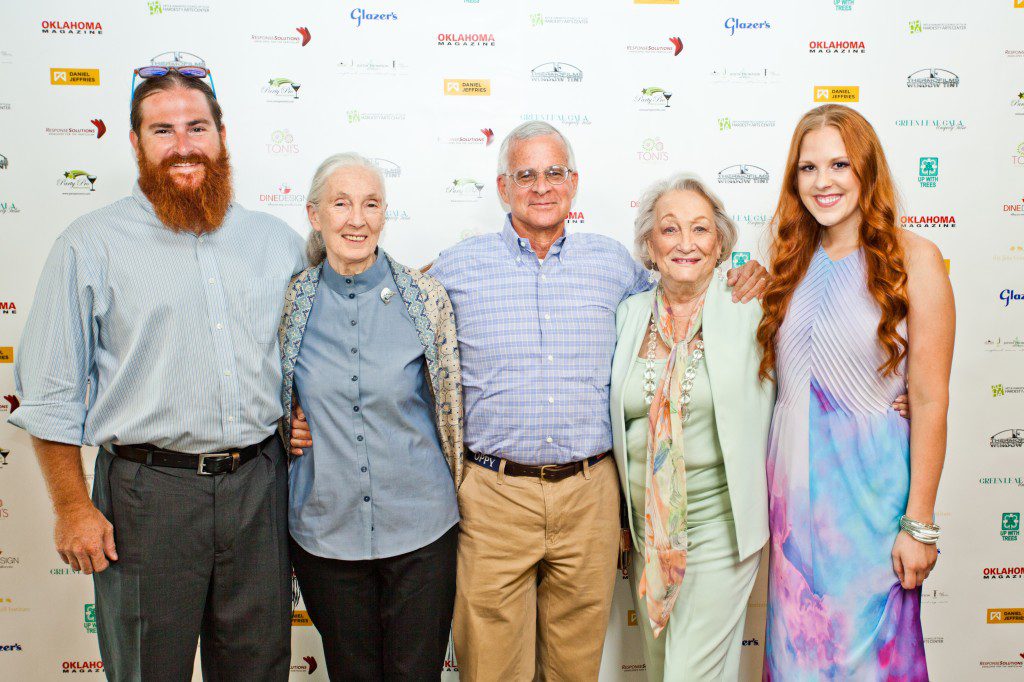
E.J. Oppenheimer, Jane Goodall, Reed Oppenheimer, Bonnie Klein and Laura Parrott enjoyed the patron party for the Green Leaf Gala, an annual fundraiser for Up With Trees.
Wendy and Gentner Drummond and Debbie Zinke were all smiles at this year’s Kaleidoscope Ball, benefiting Emergency Infant Services.
Jim Owens, Emily Cary, Raj Basu, Rebekah Tennis and Dan and Vida Schuman took part in this year’s Kaleidoscope Ball, a benefit for Emergency Infant Services.
Tom Taylor and Matthew Marble enjoyed Kaleidoscope Ball, an annual fundraiser for Emergency Infant Services.
Jen Dear-Mayo, Steven Karr, Kara Chapman, John Jameson, Robert Allee and Lexi Windsor had a boot-scootin’ good time at Aces High, a fundraiser for the National Cowboy and Western Heritage Museum.
Tom and Judy Kishner, Jack Gantos and Lynn Peacher attended the 2014 Anne V. Zarrow Award for Young Readers’ Literature, which was awarded to Gantos.
The Cattle Barons Ball recently held its patron party. Among those in attendance were barons Andy Kinslow, Leah Bowles, Rocky Goins, Diane Heaton and Don Smolen.
E.J. Oppenheimer, Jane Goodall, Reed Oppenheimer, Bonnie Klein and Laura Parrott enjoyed the patron party for the Green Leaf Gala, an annual fundraiser for Up With Trees.
Katia Anaya, John Gaberino III, Teresa and Dennis Caruso, Rose Washington and Richard Cranford are preparing for Spotlight on San Miguel: Dancing with the Tulsa Stars, which will be Nov. 1 at the Cox Business Center.
Michelle Holdgrafer, Vince Westbrook, Jeanette Kern and Lauren Landwerlin enjoyed the festivities of the Bruce G. Weber Tennis Classic.
Chairpersons Hal and Kathy Brown and honorary chairpersons Judy and Tom Love enjoyed the Renaissance Ball, benefiting the Oklahoma City Museum of Art.
Mary Kreider Vrooman, Wade Huntsman, Lori Walderich and Steve Sherrod participated in this year’s Wild Brew, benefiting Sutton Avian Research Center.
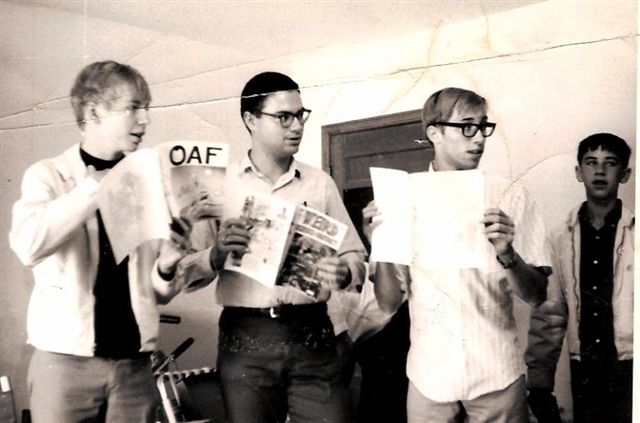
Oklahoma Alliance of Fans founders (from left) John Wooley, David Smith and Bart Bush.
Photo courtesy John Wooley.
Oklahoma Alliance of Fans founders (from left) John Wooley, David Smith and Bart Bush. Photo courtesy John Wooley.
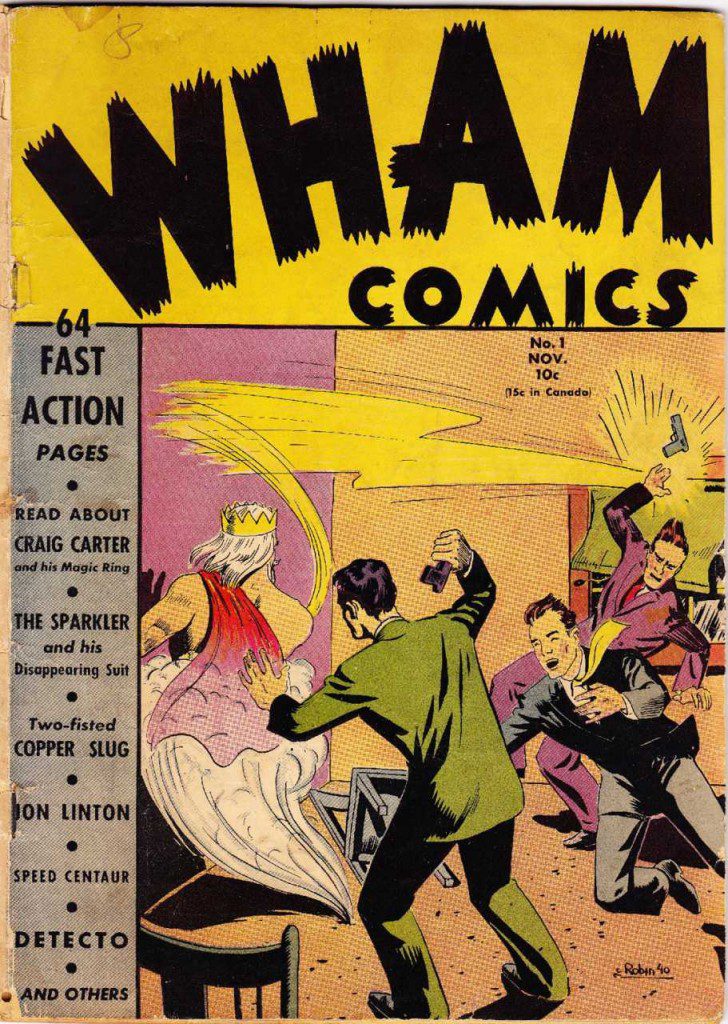
When I was 15 years old, my friend Paul McSpadden came to my house for a visit, bringing with him something rare and beautiful: the first issue of a publication from 1940 called Wham Comics No. 1. A comic-book crazed teen – as was Paul – I had never seen a single issue from 1940 before; it was as though he had parted time’s curtain, reached in and pulled out a treasure from a wondrously different time and place.[pullquote]When all the nostalgic entertainment you could ever want is available with a few keystrokes or clicks of the remote, finding what underground cartoonist R. Crumb called “the good old stuff” was not easy in the late ‘60s.[/pullquote]
The curtain of time wasn’t the only thing that parted on that summer day in 1964. A big stack of comics I’d bought off the stands during the preceding few years parted from me as well. I was so crazy to get Wham Comics No. 1 that I traded Paul just about all my prime Marvel superhero comics, including first issues of The Fantastic Four, The Amazing Spider-Man and The Incredible Hulk. I figured something from that long ago had to be worth a whole raft of comics I’d bought for a dime and 12 cents in the recent past.
Well, we now know how wrong I was. If I’d held onto those Marvels, I might be writing this column from a villa on the French Riviera. Although Paul didn’t hang onto them either – and I take some small solace in that fact – the comics I traded him are now worth umpteen hundreds of thousands of dollars. Meanwhile, the last time I looked, a pretty nice copy of Wham Comics No. 1 had sold online for $300.
The purpose of this anecdote, however, is not to moan or mourn; it’s to help emphasize something that’s come home to me. As a lover of nostalgia – that siren call of an idealized time from your past – I now realize that if you live long enough, nostalgia for a period of time before your birth slowly metamorphoses into nostalgia for yourself.
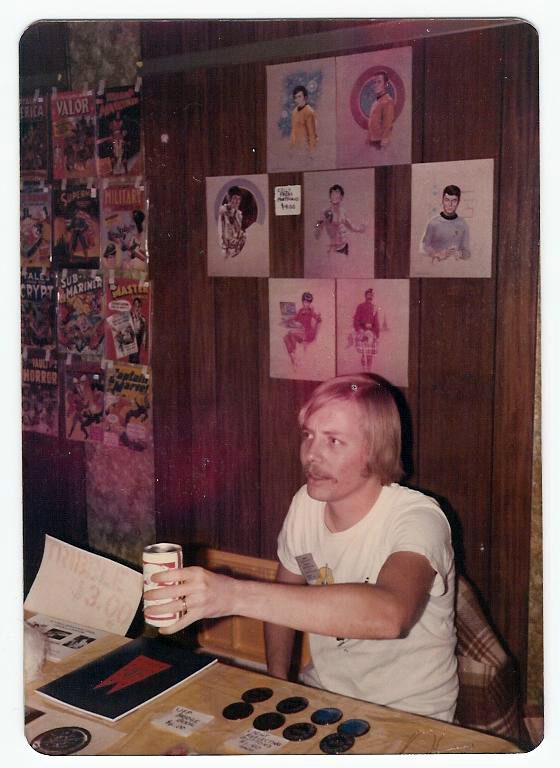
George Takei of Star Trek and social media fame visits with John Wooley in 1975. Photo courtesy John Wooley.
I don’t know how old I was when I first realized that I had a deep, mysterious love for a past in which I had not been a participant. I do remember that in high school and college I was a sucker for old movies, radio shows, 1940s comic books and the big bands of such long-ago names as Glenn Miller, Tommy & Jimmy Dorsey and my personal favorite, Hal McIntyre.
Although it’s hard to imagine these days, when all the nostalgic entertainment you could ever want is available with a few keystrokes or clicks of the remote, finding what underground cartoonist R. Crumb called “the good old stuff” was not easy in the late ‘60s. There were a few LPs you could buy of old big-band performances and radio dramas and comedies, if you knew where to look, but you were at the mercy of TV stations and, in bigger cities, the occasional revival-house movie theater when it came to watching vintage feature films. You took what they gave you, commercials and all. (A small number of old-time radio collectors did turn capitalist around that time and began selling copies of their shows on reel-to-reel tape, so a fan could at least build some kind of a personalized entertainment library.)
There was a bit of a fad for nostalgia during this time, even though the notion of a young adult collecting old comic books or vintage movie memorabilia was unusual enough to warrant newspaper coverage. It happened to many of my friends, and also to me, in the late ‘60s, when I was attending Oklahoma State University, and several of us banded together in a nostalgia lover’s club known as the Oklahoma Alliance of Fans, better known as OAF.
After all these decades, we OAFs still get together once a year, buying, selling, swapping and visiting – just as we’ve always done. But thanks to the relentless shoving of time, the stuff we’ve got to sell, trade or just show off now is just as likely to be from our lifetimes as not. When I traded Paul for Wham Comics No. 1, its date of publication was 24 years in the past, an era so different from my own that the book could’ve been drawn and colored by cavemen. Now, I think about what was happening 24 years ago in my life, and it seems like last week.
john Wooley in the early days of the oklahoma alliance of fans. Photo courtesy John Wooley.
I can remember when this whole idea of nostalgia for oneself first hit me, less than a decade after my acquisition of Wham Comics No. 1. I was in the Navy, stationed on a helicopter carrier that had just left Vietnam for Hawaii, where we were to pick up Skylab II. My friend and former roommate Bruce Shults – a fellow OAF – happened to be stationed at Pearl Harbor, and we had a great reunion. At some point, we decided to go to a local theater and take in the new film American Graffiti.
Of course, it was terrific. But as I sat there and watched it unfold, something began to bother me. It took a while to figure it out, but I finally realized that this movie about, essentially, the final loosening of high school bonds, was set in the same time frame as my own – and my growing-up years had suddenly become quaint. It was still nostalgia, but it was tempered for the first time with an almost shocking sense of loss.
The writer John O’Hara famously said that nostalgia was a kind of homesickness. Certainly, that describes nostalgia for yourself. Like homesickness, it’s an idealized vision of a place you loved, or think you did. What I try to remember now is that, like everyone who makes it through adolescence, I had my own problems and struggles during the teen and young-adult years, and one big reason nostalgia was so damned important to me was that I deeply craved it as an escape from some of the pressures of daily life. Everyone can use a little escapism, of course, but maybe your passion for it is directly proportional to your need for it.
john Wooley in the early days of the oklahoma alliance of fans. Photo courtesy John Wooley.
These days, I’ve come to terms with this changed face of nostalgia. I still love old movies – those made before my time as well as the first-run films from my youth – and, as I’ve written in the pages before, I’m delighted to see so many of them, along with television shows I remember fondly, offered again by free, over-the-air HD channels like MeTV and getTV. They play like TV movies did when I was a kid, interrupted by commercials every 15 minutes or so, and I’ve even gotten used to those ads, which reflect, sadly enough, their aim toward the demographic that now includes me. (One ubiquitous spot begins with the announcement, “People who use urinary catheters are smiling!”) It’s taken me a little longer to accept the fact that the only oldies radio station in town now plays Guns N’ Roses when I’m expecting Lesley Gore.
Peter De Vries, a novelist and writer for The New Yorker, is credited with the wry observation that nostalgia isn’t what it used to be – meaning, I think, that longing for the past in the past was better than longing for the past now, and nothing is as good as it once was. On the other hand, despite the long-ago hosing he gave me, Paul McSpadden and I have enjoyed a very good friendship for half a century, and without our shared love for nostalgia, we never would have met.
The two of us still go to old bookstores together. We even occasionally make a trade. But believe me, if he ever turns up another copy of Wham Comics No. 1, I’m running the other way.
Bartlesville native Joe Sears returns to community theater following a successful professional theater career.
Photo by Brandon Scott.
Each Saturday since 1953, without a break, a cast of characters has taken the stage at Tulsa’s Spotlight Theater to enact a performance of The Drunkard. The production is legendary, and rumor has it that the play is the longest continuously running production in America.
Such an illustrious performance calls for an equally celebrated leader. And now, the production and theater have one.
Bartlesville native Joe Sears returns to community theater following a successful professional theater career. Photo by Brandon Scott.
Renowned stage actor Joe Sears has returned to the Oklahoma small stage after retiring from a legendary career. Sears is best known for the Greater Tuna plays, a comedy series that he coauthored with Jaston Williams and in which they costarred to play a cast of characters in a small Texas town. The Tuna era began in 1981 as a simple party skit and grew into four wildly popular plays, a stand-up comedy routine, a cookbook and an avid fan following.
Sears’ performances in the Tuna series earned him a Tony Award nomination for Best Actor in a Play and the opportunity to perform at the White House twice.
He has fond memories of The Drunkard, a production he remembers watching as a teenager growing up in Bartlesville.
“The show stays the same, but the actors change,” explains Sears. “It’s the same show I saw back in the ‘60s.” [pullquote]“Every week there are different acts,” explains Sears. “Sometimes there are jugglers, dancers, musicians, comedians or a magic act.”[/pullquote]
In fact, The Drunkard dates back to the mid 1800s, and Tulsa’s tongue-in-cheek version has been ongoing since 1953. But, don’t be deceived by its longevity. Sears says the play is a fast-paced, laugh-filled event that brings smiles to the entire family.
“There are lots of fun things to keep the guest entertained,” says Sears. Before the evening’s main event, audiences enjoy The Olio and a sing-a-long. “Every week there are different acts,” explains Sears. “Sometimes there are jugglers, dancers, musicians, comedians or a magic act.”
The production’s home is the Spotlight Theater on Riverside Drive. It’s even older than Tulsa’s Drunkard. A capital improvements campaign is underway to pay for necessary renovations and repairs of the theater, designed by renowned architect Bruce Goff and built in 1928.
“The building needs to be restored for the generations of audiences and actors to come,” says Sears.
He hopes that the building can bring joy and inspiration to young actors, just as it inspired him when he was young. The Spotlight Theater has a popular children’s theater program.
“My family history is steeped in Oklahoma,” says Sears, who once again calls Oklahoma home. “I started in theater here. I would have been perfectly content to spend my life in community theater here.”
And, he’s returned to the small stage to encourage a new generation of actors.
“I wanted to come back to offer something to my state, to work with Oklahoma kids,” says Sears. “I like to work with kids who wouldn’t normally have the opportunity to be on stage. When you have learned a discipline, apply the director’s teaching and receive the audience’s applause, it is so uplifting.”
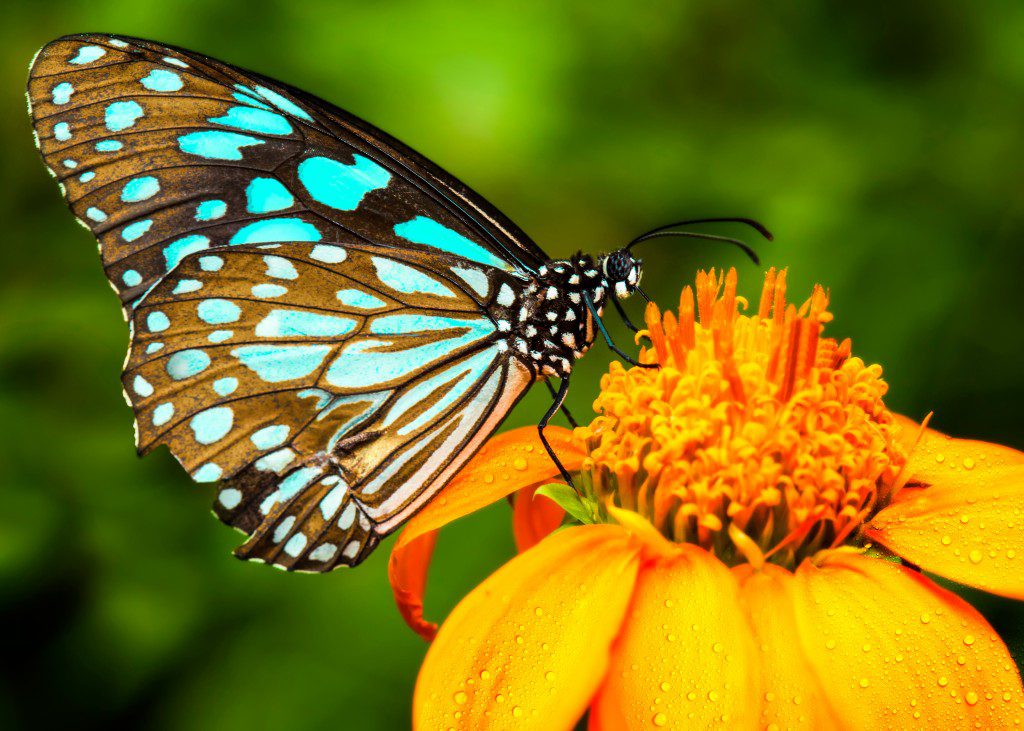
A nonprofit organization is providing job training and supplies to Thlopthlocco Tribal Town members interested in learning the trade of butterfly farming. Natives Raising Natives and its partner, the Euchee Butterfly Farm, are located in Leonard, Okla., and raise butterflies used in zoos and exhibits as well as at butterfly releases and special events. Funded by a $500,000 U.S. Department of Agriculture grant, Natives Raising Natives’ mission is to promote financial independence.
The project was inspired by similar programs in Costa Rica and other tropical countries offering a sustainable income to indigenous peoples and an alternative to logging endangered forests, says Jane Breckinridge, program executive director.
“Commercial butterfly farming is an exploding industry, with over $64 million in annual sales to butterfly exhibits at zoos and institutions, releases at weddings and funerals and educational caterpillar kits for schools,” Breckinridge says.
The high demand for butterflies can help the state.
“Oklahoma faces high unemployment rates in rural areas where jobs are scarce, Breckinridge says, “and the unemployment rate for Native Americans is significantly higher than average.”
More than 2,000 butterfly and moth species are native to Oklahoma. Of those, only a handful is suitable to raise in captivity. Butterfly habitats must include specific plants that the insect will need throughout its life cycle. The program will provide equipment necessary for individuals to become commercial butterfly farmers as well as the essential training and business skills.
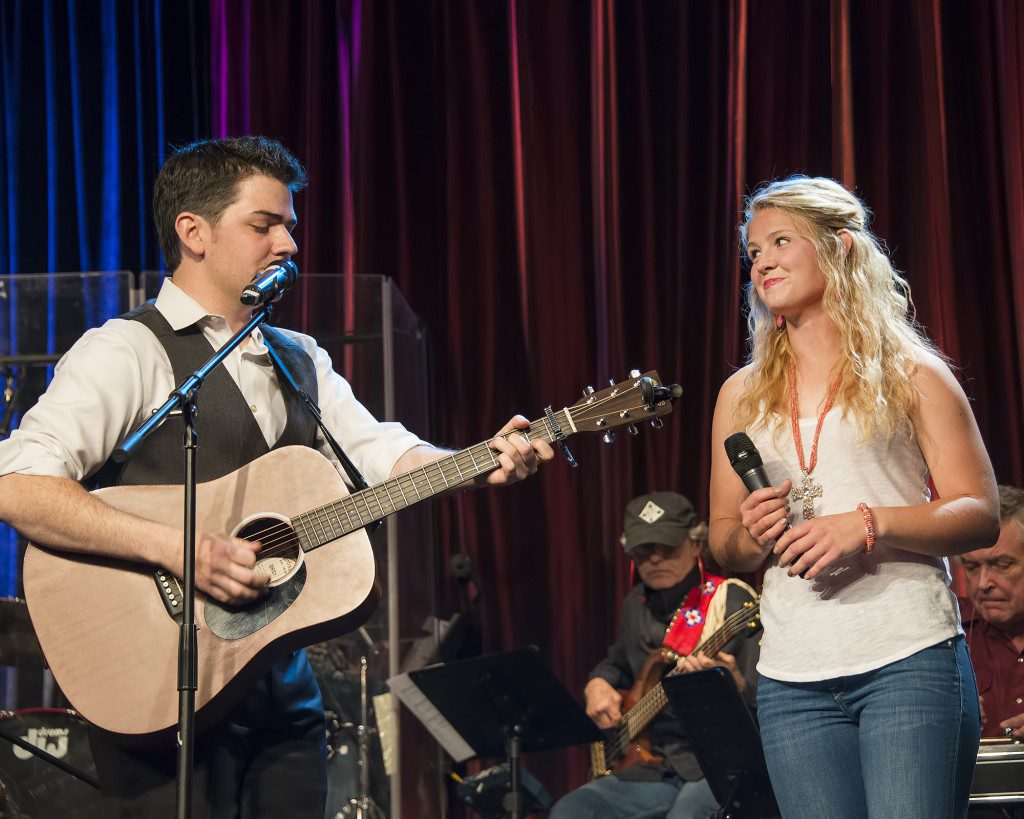
Undiscovered talent is in good supply at rodeo opry. Photo by Jack Corman.
Undiscovered talent is in good supply at rodeo opry. Photo by Jack Corman.
Granville “Grant” Leftwich’s passion for music helped him turn his backyard jam sessions with friends and family into a legacy for all to enjoy at the Rodeo Opry.
At 7:30 p.m. every Saturday, hundreds gather in Oklahoma City’s Stockyards City to witness Oklahoma’s official country music show.[pullquote]“I have the opry to thank for my start in the entertainment business, and for that, I am eternally grateful,” says Pickard. “For me, it’s home.”[/pullquote]
“If you are wondering what to expect when you come to a Saturday show, be prepared to hear one of the best house bands you have ever heard, backing different artists each week, and being entertained by a fun, family-friendly emcee while enjoying one of the opry’s famous root beer floats and snacks from the concession stand,” says executive director Cindy Scarberry. “It’s always a fun night of quality music and family entertainment.”
Previously known as the Oklahoma Opry, the name was changed when the show moved out of Knob Hill Theater in the Capitol Hill District.
“The Rodeo Opry is currently housed in what was known as the Rodeo Theater in the Stockyards of Oklahoma City,” says opry performer Owen Pickard.
The opry stage is a haven for undiscovered talent in Oklahoma. Grammy Award-winner Bryan White and Red Dirt music star Cody Canada both began their careers performing there.
“Grant (Leftwich) had always put everything he had back into the show and wanted to help promote, showcase and connect young entertainers with industry professionals while providing quality entertainment and education,” says Scarberry.
Pickard was just 14 when he began performing at Rodeo Opry.
“I have the opry to thank for my start in the entertainment business, and for that, I am eternally grateful,” says Pickard. “For me, it’s home.”
To continue this tradition, the nonprofit Opry Heritage Foundation of Oklahoma opened a music school in 2009. At the school, children from low-income households receive music lessons for 50 cents.
“So, while the Rodeo Opry is providing family-friendly shows every Saturday night, rest assured that your $15 ticket is going to great use,” says Scarberry.
“For the Rodeo Opry, it’s more than just showcasing the talented artists and musicians on our stage,” echoes Pickard. “This show is the foundation of the organization, and the school is the platform for the future of our community. Thirty-seven years later, we’re just getting started.”
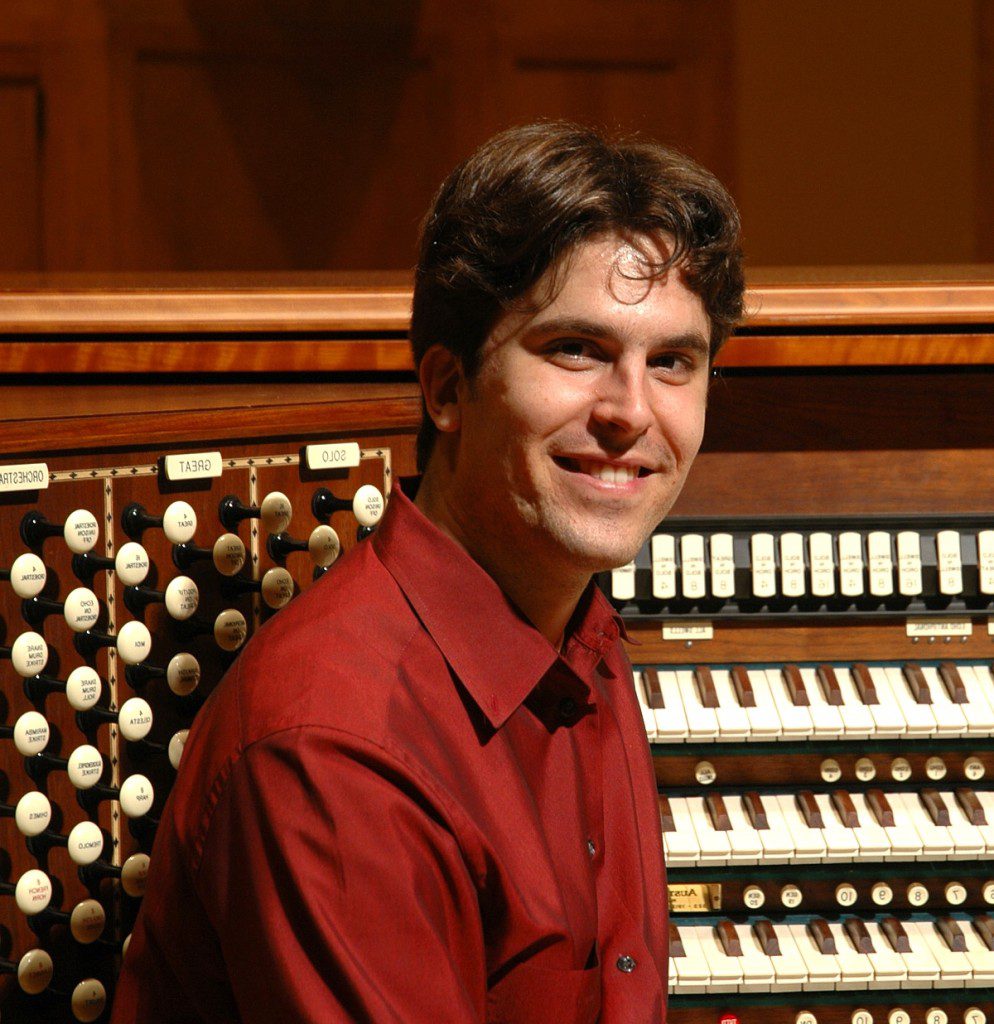
Trinity Episcopal Church, 501 S. Cincinnati Ave., in downtown Tulsa continues its Douglas A. Nelson Concert Series this weekend. Spanish organist Raul Prieto Ramirez performs a free recital on Sunday, Sept. 28, at 7 p.m. Serving as artistic director of the International Organ Festival in Barcelona, Spain, the organist will include in his Tulsa performance music by Bach, Widor, Lizst and Saint-Saens. A reception for the artist and guests will follow the recital. The concert is presented by the Tulsa Chapter of the American Guild of Organists. For more, visit www.trinitytulsa.org.
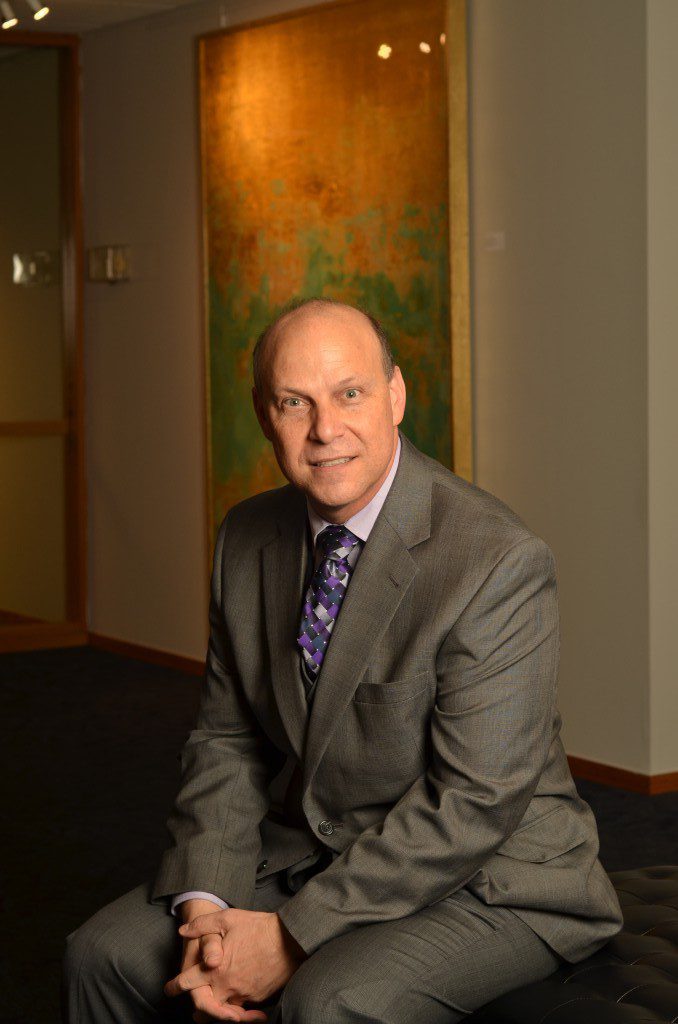
New Tulsa opera managing director greg weber seeks to make an impact on the arts and city.
Photo by Dan Morgan.
New Tulsa opera managing director greg weber seeks to make an impact on the arts and city. Photo by Dan Morgan.
Greg Weber brings nearly three decades of art management experience to Tulsa Opera this month. As the newly appointed managing director for the organization, Weber hopes to continue the growth that Tulsa Opera has experienced in recent years. Weber joins the organization after a three-year stint as the director of production at the San Francisco Opera.
Having worked with Houston Grand Opera, San Francisco Opera and other companies, what about Tulsa Opera caught your attention? Opera is a like a small town – everyone knows everybody and what each person is doing. I heard new board leadership in Tulsa had taken bold steps to grow the company, and any type of growth in the arts can be challenging and risky. My work has always focused on growth, and the competitor in me loves a challenge. After meeting members of the board, I felt such passion and conviction from them for the city and the art form that I was convinced I had to be a part of the blooming of Tulsa Opera.
As an educator (Weber is a former University of Missouri-Kansas City assistant professor), do you see a learning component to viewing opera? I see a learning component in every part of our lives – not just opera and music. Many of the most successful and brilliant among us are people who have studied music at some point in their lives. Some of the earliest human artifacts found have been musical instruments. Why? Music doesn’t keep our heads dry, it doesn’t feed our bodies, it doesn’t defend us against dangers. Music, I believe, has given us our greatest achievement – the ability to think creatively and abstractly. Without music we are less likely to discover innovative ways to keep dry, feed ourselves, grow as a generation.
What are your greatest concerns, not only for the organization, but for opera and the performing arts? There has always been conversation surrounding support and funding the arts. As we have watched opera companies fail over the past five to seven years, that fear about financial sustenance has loomed menacingly over each company. The arts have always relied on devoted benefactors to keep them alive, and that model hasn’t really changed. Mozart had Emperor Joseph II, and Verdi had Antonio Barezzi … We will have financial challenges, but I have already seen buds of strength sprouting throughout the company, and I am inspired by the devotion I see in the company’s benefactors. Seeing this positive financial front, my concern focuses on arts education and attention spans.
Do you have ideas for expanding the audience for Tulsa Opera? First and foremost, I want Tulsans to know that opera is touchable. I’m an example of that. I grew up on a small farm in the Midwest, the 11th of 12 children. At the age of 21, I saw my first opera, The Marriage of Figaro, and I was hooked. I didn’t understand the story, couldn’t quite follow it, but loved how the music elucidated it all for me. The best way to expand an audience is to be in the community and encourage people to give us a try.
How do you hope to most impact Tulsa Opera in the coming seasons? First and foremost, I intend to impact Tulsa and Oklahoma! This is a fantastic city and a magnificent state. As a newcomer, I will not only remind Tulsans of this, but the entire opera industry of what a fabulous place it is I now call home. My efforts will focus as much on growing Tulsa and Oklahoma as they will on growing Tulsa Opera. All three need each other to offer an outstanding place for our children.
As an arts leader, I am a pragmatic dreamer – I always have my head in the stars, but my eye on the path to reach them. This means I bring a strong commitment to artistic growth and fiscal responsibility. This type of stability has always been one of my playing cards, and it will become a staple at the opera.
I will not allow opera to be marginal or irrelevant. I will defend it. I will fight for it. For 400 years it has inspired lovers, dreamers and even cartoonists. Through opera we see humanity’s greatest and most grotesque characters – many times we see ourselves, our weaknesses and our strengths. Opera is as important to our humanity as kindness is to our soul. As an arts leader, my greatest impact is to feed humanity’s soul.














 Starts Thursday, Sept. 25