






















As sports tourism continues to grow across Oklahoma, athletic trainers remain a critical part of keeping athletes healthy, safe and performing at their peak. From college football Saturdays to youth tournaments that draw thousands of visitors into local communities, certified athletic trainers are often the first medical professionals on the scene when injuries occur.
According to Matthew O’Brien, Ph.D., director of clinical education in the School of Allied Health at Oklahoma State University, the profession has expanded significantly in recent decades, both in visibility and in responsibility.
O’Brien also mentions that athletic training is now recognized as a full healthcare profession by the American Medical Association. While many people associate athletic trainers strictly with sports teams, he explained that they also work in military settings, industrial workplaces, performing arts and public safety environments.
For students interested in entering the profession, the pathway has evolved substantially. Since 2020, all accredited athletic training programs in the United States have transitioned to master’s level education. Students must now graduate from an accredited master’s program before becoming eligible to sit for the Board of Certification exam.
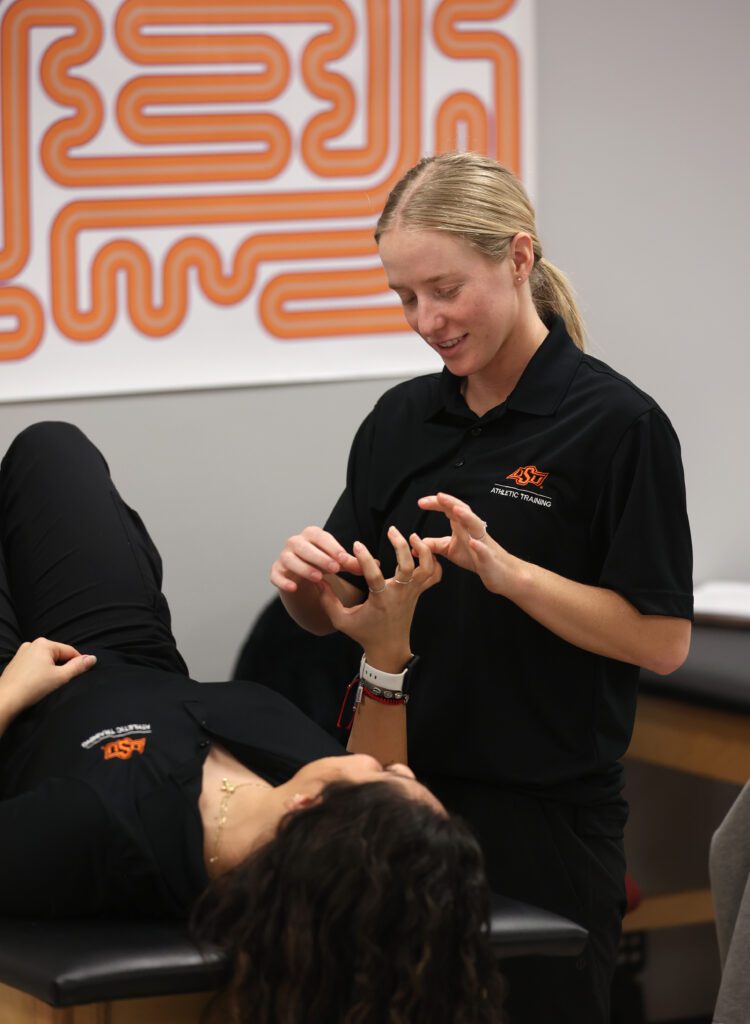
At OSU, students gain hands-on experience through immersive clinical rotations that place them with collegiate athletic programs and medical sites across the country. O’Brien says the structure allows students to experience the full day-to-day responsibilities of an athletic trainer while working alongside teams and healthcare professionals in real-world environments. Those rotations often lead directly to employment opportunities after graduation.
“We joke that the word ‘adapt’ doesn’t start with the letter ‘A’ and end with the letter ‘T’ by coincidence,” O’Brien says, while describing the qualities students need to succeed in the profession. “Athletic trainers adapt on the fly consistently, day in and day out.”
Time management, versatility and communication are among the most important skills students develop during clinical education.
Injury prevention is one of the profession’s primary responsibilities. Athletic trainers evaluate injury trends, identify physical weaknesses and create individualized prevention plans. Those plans may include flexibility work, strengthening exercises, taping, bracing and workload management designed to reduce the risk of injuries.
“[Injury prevention] is proactive,” O’Brien says. “I think some of the best injury prevention specialists out there are athletic trainers, and they identify where the underlying cause of injury is.”
When injuries do happen, athletic trainers oversee the recovery process from initial evaluation through rehabilitation and return-to-play progression. O’Brien explains that athletic trainers often coordinate with physicians, coaches and strength staff to balance an athlete’s immediate recovery with long-term health and safety.
Their importance becomes even more visible on game day. Athletic trainers prepare emergency action plans, monitor athlete health, apply protective equipment and respond immediately to injuries. O’Brien notes that many high schools, particularly in rural Oklahoma, still lack full-time athletic trainers, leaving coaches or administrators to manage medical situations without training.
“Regardless of your sport or age, you want to make sure you have the most well prepared, the most medically responsible individual to be able to be on site at the time an injury occurs,” O’Brien says. “Here in Oklahoma, we have less than 20 percent of secondary schools that have access to a full-time athletic trainer.”
As Oklahoma continues attracting athletes and sporting events from around the region, athletic trainers remain essential to both athlete safety and the overall success of sports tourism statewide.