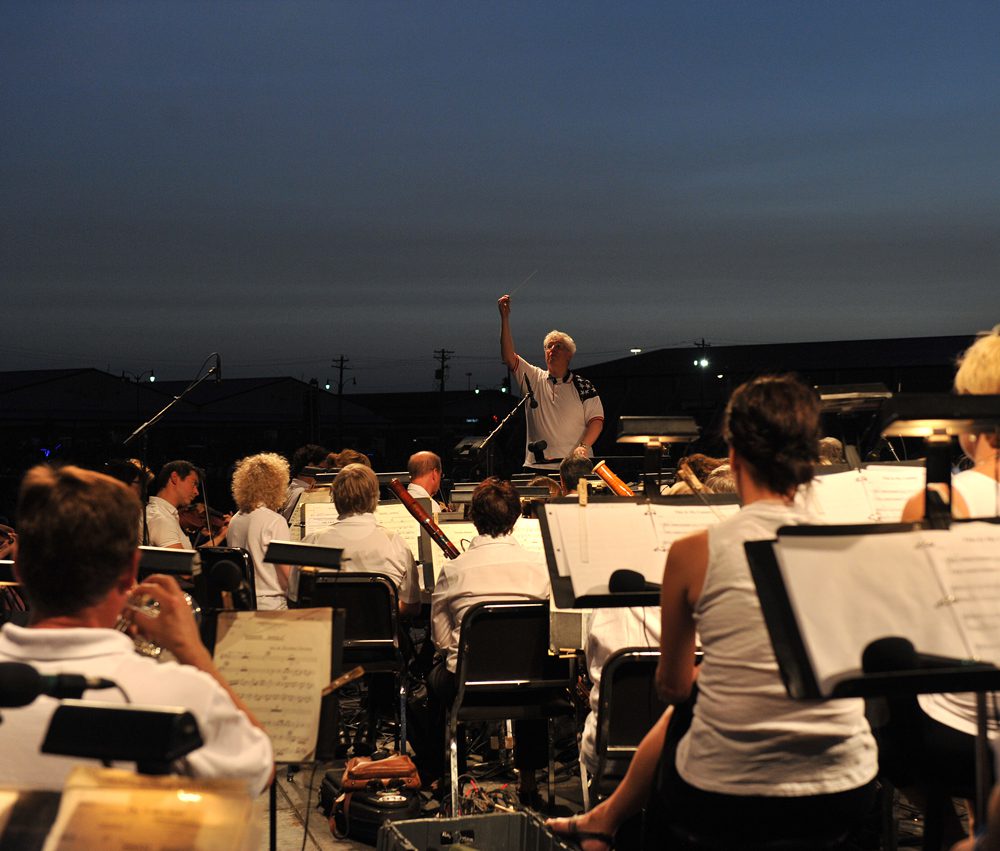
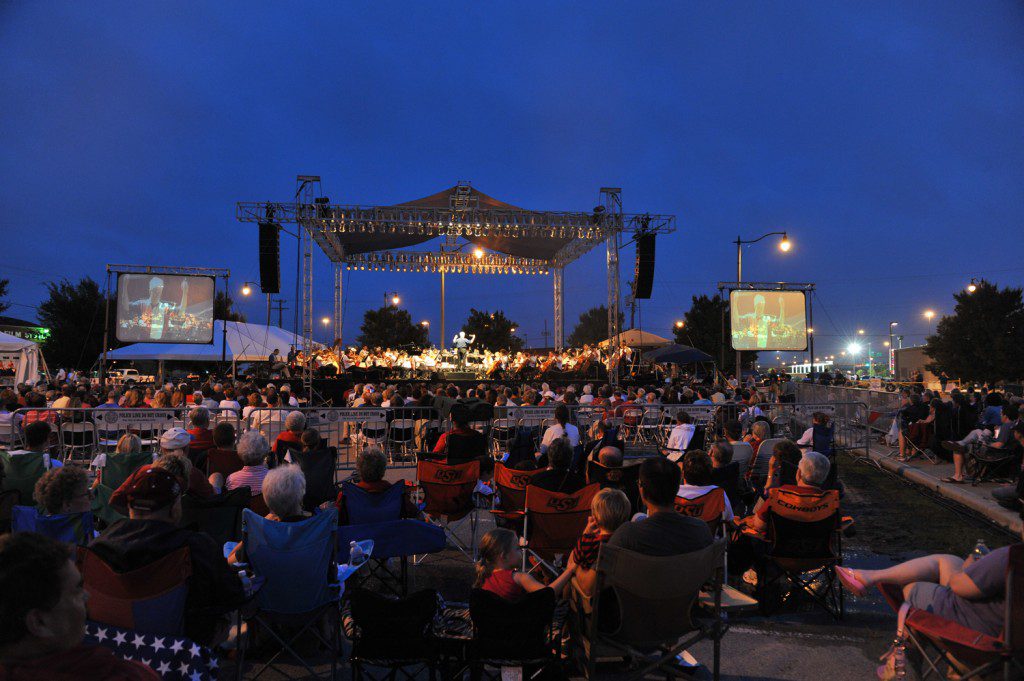
Photo by Wendy Mutz Photography, courtesy Oklahoma City Philharmonic.
“Red, White & Boom!” in Oklahoma City. Photo by Wendy Mutz Photography. Courtesy Oklahoma City Philharmonic.
Thursday, July 3
Want a little music for your Independence Day weekend? Tulsa Signature Symphony holds its 4th on the 3rd Patriotic Concert at 7:30 p.m. Thursday, July 3, at the VanTrease Performing Arts Center for Education at Tulsa Community College’s Southeast Campus, 81st Street South and U.S. 169. Tickets to this long-standing tradition are $6-$12 (www.tulsacc.edu). The Oklahoma City Philharmonic goes Red, White & Boom with patriotic favorites beginning at 8:30 p.m. Thursday. The outdoor show takes place at Oklahoma State Fair Park, 3001 General Pershing Blvd., in Oklahoma City and includes patriotic tunes, food vendors and fireworks. Bring your lawn chairs for the free event (www.okcphilharmonic.org).
"Ex-Patriot" by George Morrison (Chippewa), 1964. Image courtesy Philbrook Museum of Art.
“Ex-Patriot” by George Morrison (Chippewa), 1964. Image courtesy Philbrook Museum of Art.
Continuing
Philbrook Downtown continues its inaugural exhibitions Opening Abstraction and Identity & Inspiration as the Brady Arts District gallery heads long into its second year. Opening Abstraction focuses on the abstract art of the 20th century and the open context of interpretation best used to approach these works. Drawn mostly from Philbrook Museum of Art’s permanent collection, Opening Abstraction includes works by Leonardo Drew, Willem deKoonig, Robert Rauschenberg and Georgia O’Keeffe. Identity & Inspiration addresses both concepts in pieces by American Indian artists and crafters across generations. The collection highlights cultural arts such as basketry, beadwork, clothing and objects from ceremonial and daily life in addition to contemporary work by artists challenging boundaries through subject, materials and influence. Both exhibits are expected to continue into mid 2015. Philbrook Downtown is located at 116 E. Brady St., Tulsa. For hours and admission information, visit www.philbrook.org.
Storyteller Kirk Waller is this year’s guest of the Jeanne B. Goodwin Storytelling Workshop and Festival at Rudisill Library, 1520 N. Hartford Ave., Tulsa. The director of storytelling programs with the Stagebridge Senior Theater Company in Oakland, Calif., Waller is a 2010 recipient of the J.J. Reneaux Emerging Artist Grant presented by the
National Storytelling Network among other awards. He’s also known for his musical and movement-infused style of storytelling. The workshop and festival event is named in honor of the late Goodwin, a lifelong educator and advocate for literacy.
Waller will present a workshop from 6-7:30 p.m. Tuesday, July 8, at the library, where he’ll demonstrate spoken word techniques in rhythm and movement to accent the storytelling experience. It’s free and open to the public. The following day, Waller shares his craft with a young audience at Rudisill. The storytelling festival is at 10 a.m. Wednesday, July 9, and is free and open to the public. For more, visit www.tulsalibrary.org.
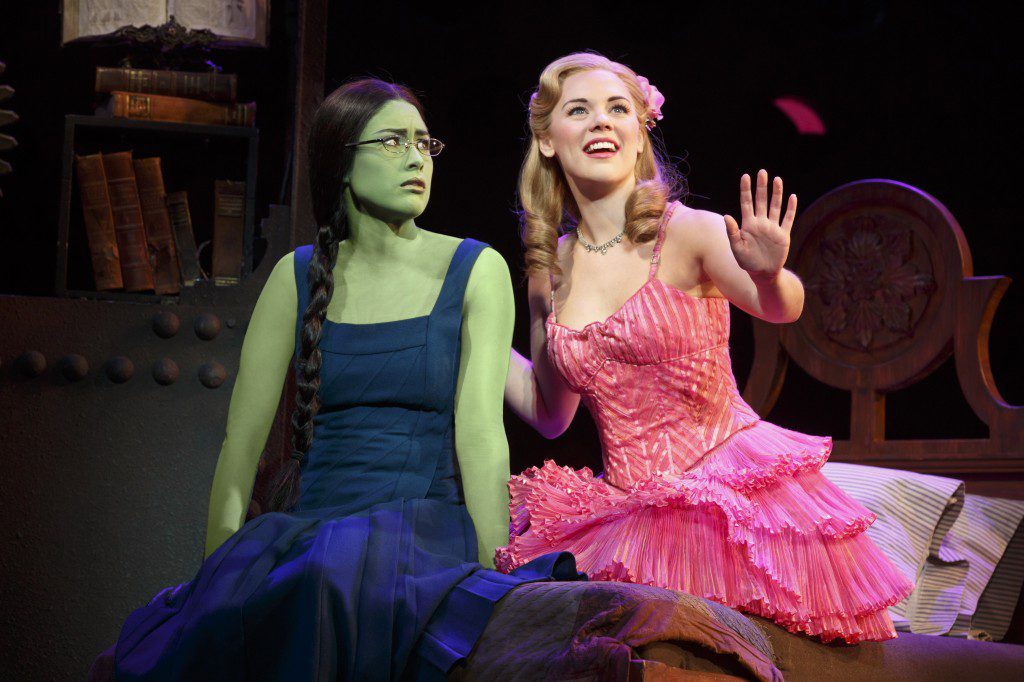
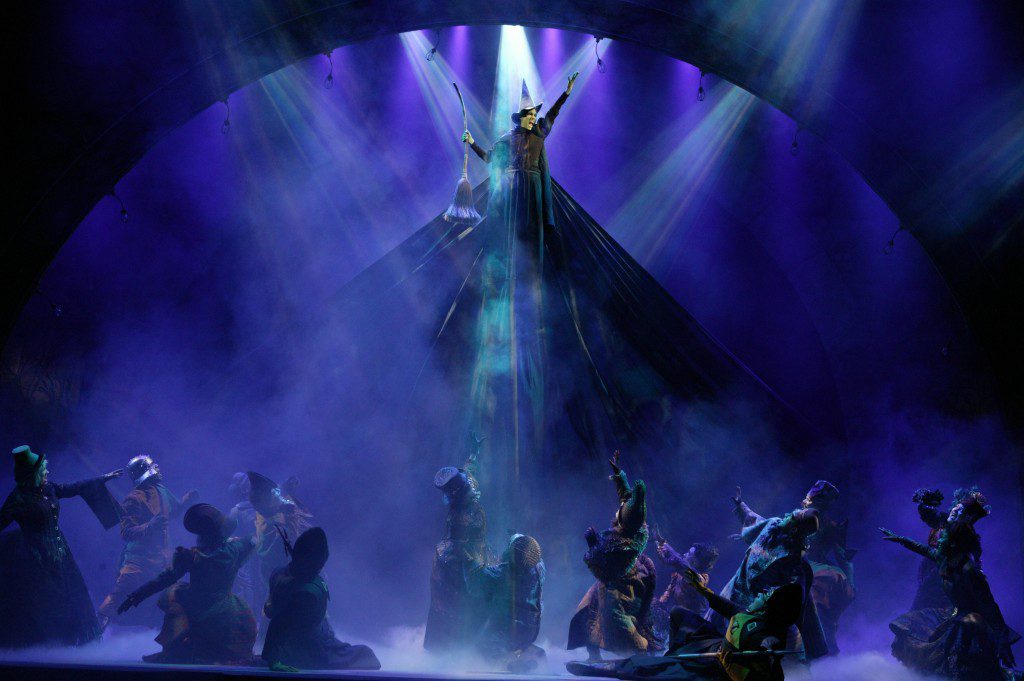
Photo by Joan Marcus, courtesy Celebrity Attractions.
Courtesy Celebrity Attractions.
Ends Sunday, July 6
All good things must come to an end, even when they’re Wicked. The hit Broadway musical has been parked at the Tulsa Performing Arts Center since mid June, but is about to hit the touring trail once more when it finishes its current run Sunday, July 6. The Tony Award-winning musical based on L. Frank Baum’s Oz witches – “Popular” Glinda the Good and the Wicked Witch of the West – continues with performances most nights along with matinees through Sunday in the PAC’s Chapman Music Hall, 101 E. Third St. Tickets for most shows starts at $60 with matinee prices varying. For tickets or more information about Celebrity Attractions’ 2014-15 season, visit www.celebrityattractions.com online.
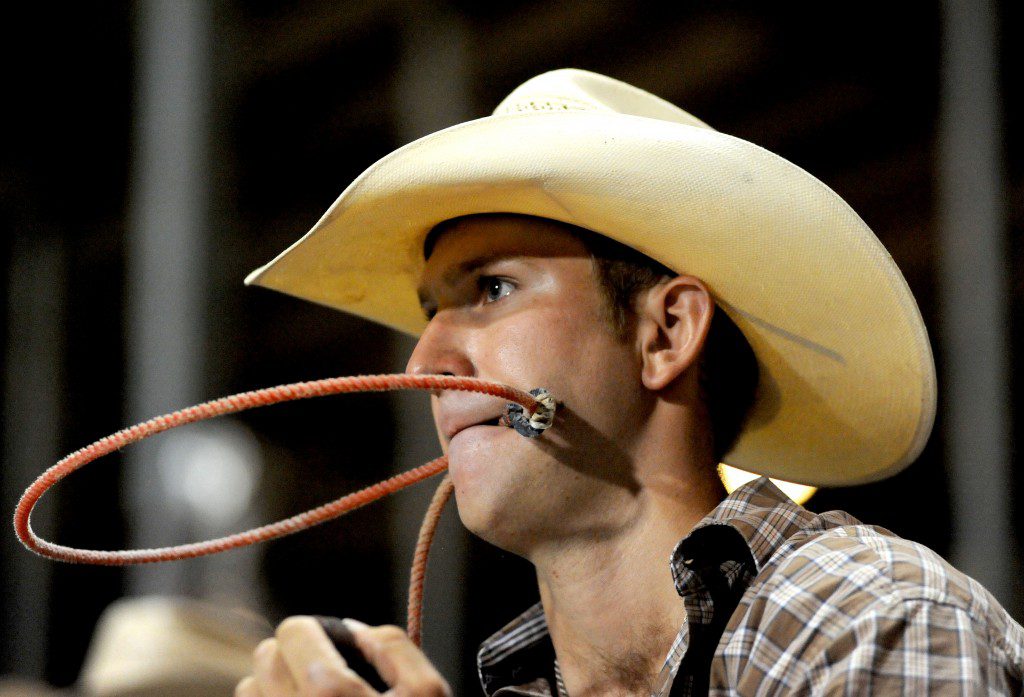
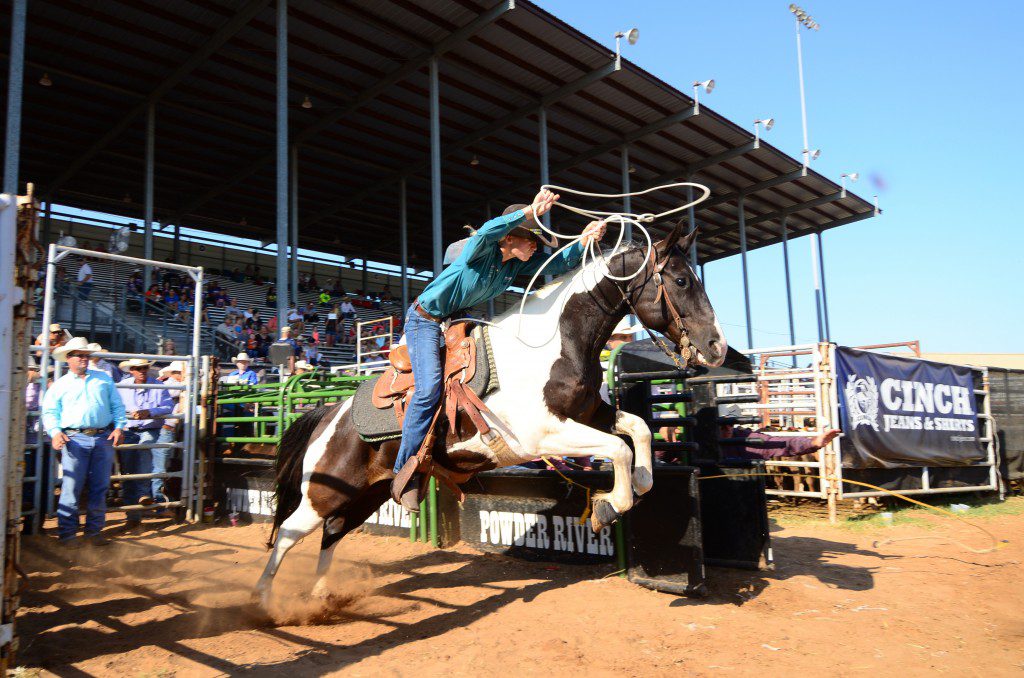
International Finals Youth Rodeo draws competitors from all over the world to Shawnee. Courtesy IFYR.
Sunday, July 6-Friday, July 11
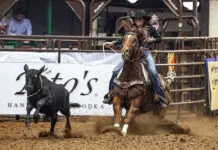
Tomorrow’s rodeo stars are set to compete at the International Finals Youth Rodeo in Shawnee. More than two decades in the making, the IFYR recognizes high school-age cowboys and cowgirls everywhere in competitions held annually at the Heart of Oklahoma Exposition Center, 1700 W. Independence St., in Shawnee. In the past, the rodeo has drawn participants from the U.S., Australia, Brazil and Canada to compete for championship titles and cash prizes in team roping, steer wresting, barrel racing, bull riding and other event categories. The rodeo opens at 8 p.m. Sunday, July 6, and continues through July 11 and the finals showdown. General admission is $10 for each session or $110 for all. Children ages 3-11 can attend all sessions for $55. For more, visit www.ifyr.com.
The Woody Guthrie Folk Festival in Okemah is just around the corner, but Tulsa will get a peak at some of its music and craft on Tuesday, July 8. The Woody Guthrie Folk Festival Preview is an afternoon of musicians and songwriters at the Woody Guthrie Center, 102 E. Brady St., Tulsa. Anthony da Costa opens the showcase at 1:30 p.m. Following him are Ronny Cox, John Wort Hannam, Larry Long, David Amram, Tim Easton and Annie Guthrie. The event is free with museum admission ($6-$8). For more about the preview and its guests, visit www.woodyguthriecenter.org.
The Woody Guthrie Folk Festival picks up July 9-13. Go to www.woodyguthrie.com to see who will be in Okemah and a schedule of speaking engagements and performances.
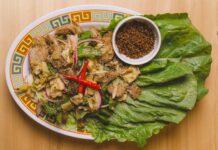
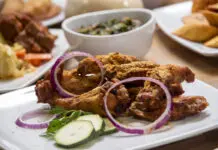
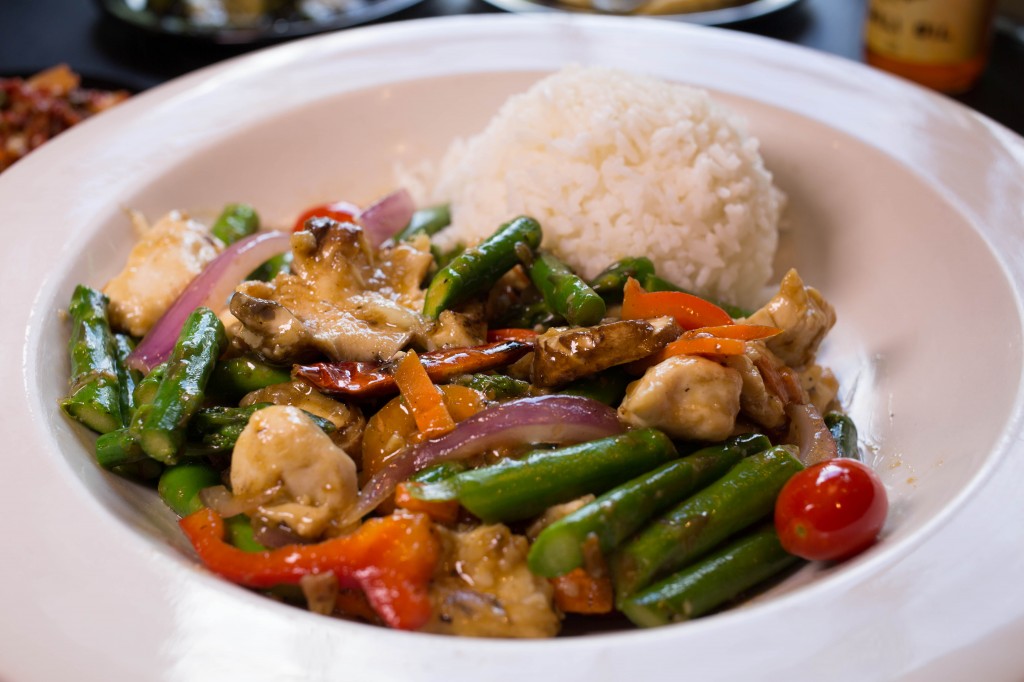
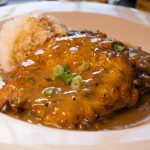
Spicy asparagus chicken at Mings Noodle Bar in Tulsa. Photo by Brandon Scott.
Spicy asparagus chicken at Mings Noodle Bar in Tulsa. Photo by Brandon Scott.
Fried cheese poofs at Mings Noodle Bar in Tulsa. Photo by Brandon Scott.
Mings Noodle Bar in Tulsa. Photo by Brandon Scott.
Mings Noodle Bar in Tulsa. Photo by Brandon Scott.
Mings Noodle Bar in Tulsa. Photo by Brandon Scott.
It seemed like half of Texas had gone crazy. A man walked in off the street, ordered 22 egg rolls, slowly ate them one by one and left without a word. A policeman sauntered in one day on lunch break and ordered pork fried rice. He returned at the same time every day, 7 days a week, month after month, rain or shine, and each time ordered the very same fried rice. That was 18 years ago at Ming’s Cafe, Fai Jow’s first restaurant, in Houston. And now, after running wildly successful restaurants in Houston and Austin, Mr. Jow – older, wiser and more experienced – has come home to Tulsa.
There was a time when all of America went wild over what used to pass as Chinese food: egg rolls, chow mein, egg foo young. Those dishes might seem like clichés today, but love, care and genius can transform a tired old recipe into a dish that will dazzle even the most jaded gourmet. For proof, stroll down Tulsa’s Brookside and head for Mings Noodle Bar. The egg foo young is a work of art. The gravy? It looks like the same old sauce of a thousand take-outs, but one taste sets off a string of flavor firecrackers in your mouth. Jow smokes fine, fatty brisket for six hours, gathers the drippings and throws it in the sauce.
“It’s my tribute to Oklahoma’s love of barbecue,” he says. “That Egg Foo Young is Oklahoma Chinese.”
What’s owner Fai Jow’s secret?
“We reduce the sauce,” he confides. “We don’t just throw in cornstarch to thicken it.”
That’s his French twist. “I use French tricks, Thai, Japanese, Korean, whatever works. It doesn’t matter where the recipe comes from, so long as you use proper technique…Today’s ‘super buffets’ have been the downfall of Chinese technique.”[pullquote]“These are the dishes that built a lot of family restaurants, and Chinese restaurants are always about family.”[/pullquote]
You probably won’t see Mr. Jow while you eat amidst the spare decor of the dining room: beige stone walls, black pillars hung with charmingly garish 1920’s advertising posters from Shanghai – “nostalgic modern,” Jow calls it. He’s working nonstop in the kitchen. But if you’re lucky, you might catch him taking a quick break in the tranquillity of the back garden, surrounded by bamboo, Japanese maple plants, and bonsai trees trimmed and cultivated by Jow himself.
You’ll be struck by his peculiarly boyish blend of shyness and enthusiasm. The greenery reminds him of his childhood, not that he grew up in China (he grew up in Tulsa, attending Edison Preparatory School and Cascia Hall). Jow grew up in Chinese restaurants. His grandparents opened the Mandarin, Tulsa’s first, sometime before 1930; and when he was a child his parents ran a place called, not by coincidence, Ming’s. At the restaurants, employees grew bean sprouts using old cans instead of flowerpots.
“Never waste, find use for everything. That’s what we were taught,” Jow says.
Among his earliest childhood memories is Jow dozing on huge burlap sacks of rice as his parents cooked. Shortly after that, he remembers cooking his own first dish: fried rice. That’s how Jow first came to love Chinese-American restaurant cooking; he grew up with it.
“I’m not too caught up in it, though. I’m planning to introduce a broad range of Asian dishes,” he adds.
There’s a vibrant homemade kimchi as good as any that you’ll find in Korea. Soon, diners will find shredded pork with preserved vegetables, a typical dish from China, on the Mings menu. They do their own pickling. And then there’s the ramen, that quintessentially Japanese dish, which, as Jow proudly points out, was invented by Chinese living in Tokyo. The Japanese used to call it “Chinese noodles,” and in Tokyo, ramen has reached the level of an art form. Mings’ noodles are from an artisan store in Brooklyn, and the stock has long-simmered chicken, pork bones and fish.
“I roast the bones before I boil them,” says Jow. “I’m trying to develop layers and layers of flavor.”
Dried seaweed and wok-seared, caramelized pork belly plus a big, fried egg all add a flavor punch.
“It’s all about the depth and the dish,” observes Bart Speegle, co-owner of Mings, who has known Jow since Edison.
Still, Jow’s love for dishes like egg foo young is undeniable.
“These are the dishes that built a lot of family restaurants, and Chinese restaurants are always about family,” he says.
When Mings first opened, Jow’s mother flew in from Houston for a week to help him cook.
“She still gives me advice,” he says.
Mings Noodle Bar, 3509 S. Peoria Ave., Tulsa. 918.878.7888
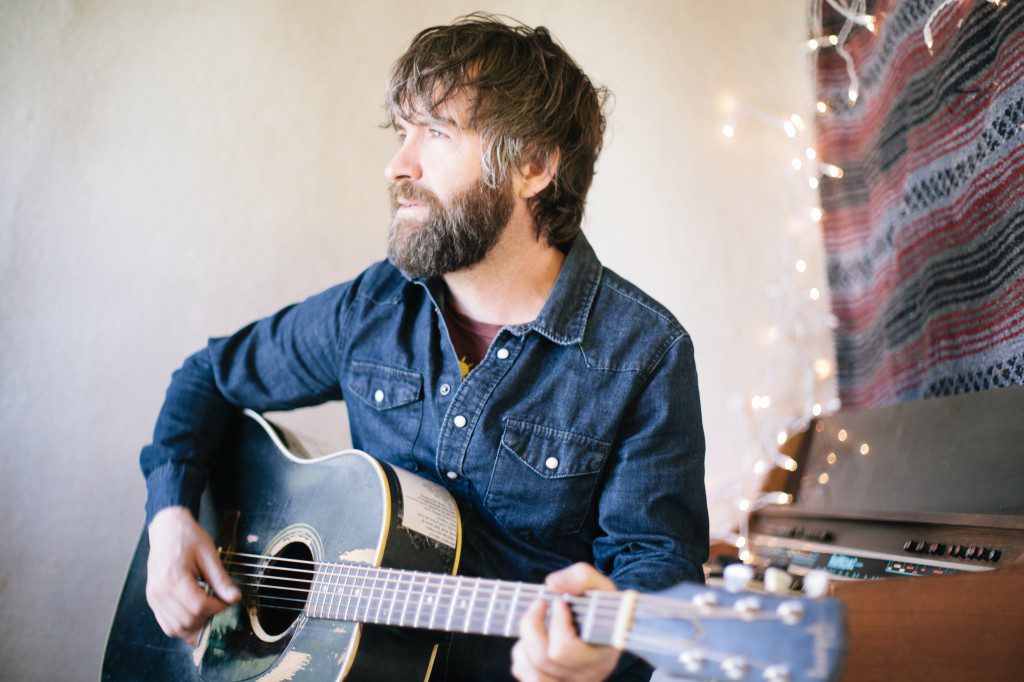
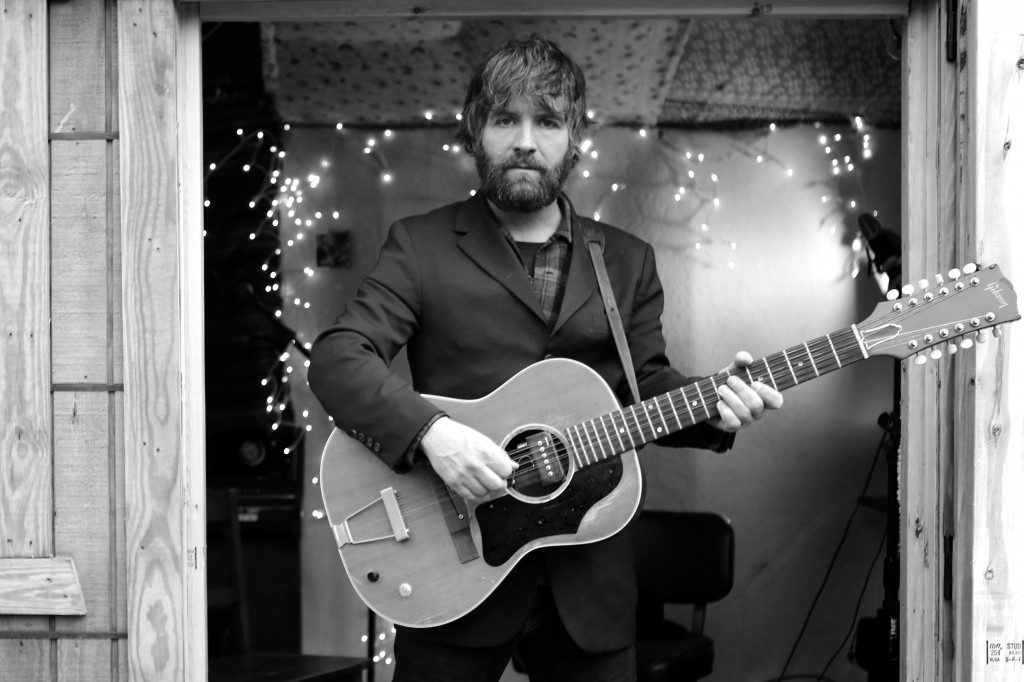
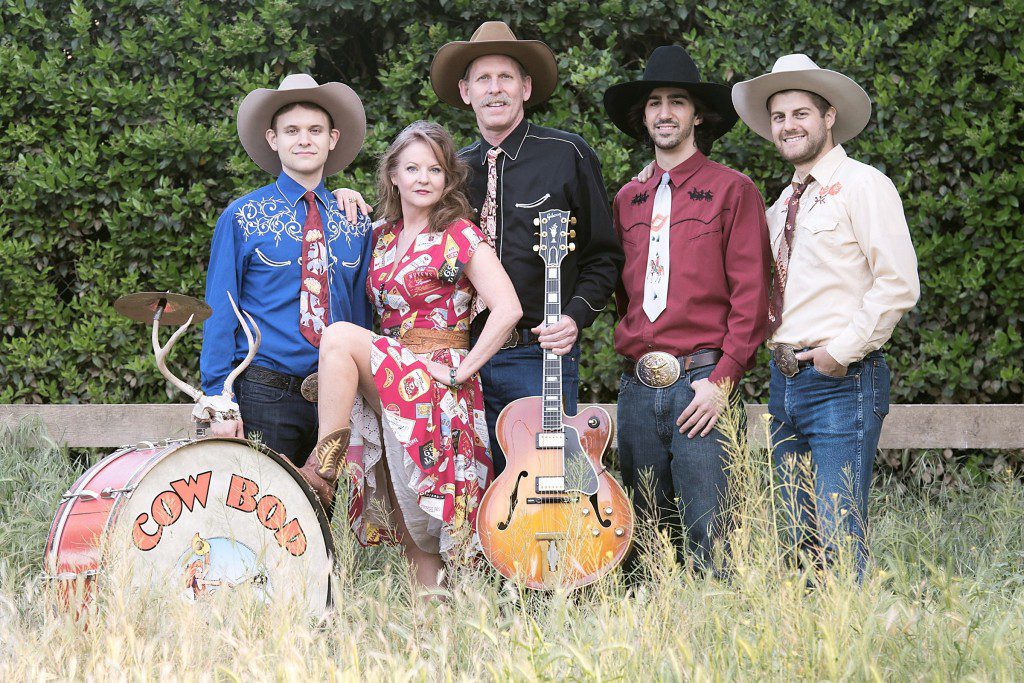
Bruce Forman, center, and Cow Bop will be part of the inaugural Rifftime on Route 66 Linear Music Festival. Photo courtesy Bruce Forman.
Bruce Forman, center, and Cow Bop will be part of the inaugural Rifftime on Route 66 Linear Music Festival. Photo courtesy Bruce Forman.
There’s a brand-new live-music experience rolling out this summer, and Oklahoma’s right in the big middle of it – both figuratively and literally.
“Rifftime Music is producing the industry’s first mobile, interactive music festival – the Rifftime on Route 66 Linear Music Festival. Bands will tour and perform along historic Route 66 from July 25 to Aug. 8, 2014,” according to the website route66.rifftime.com.[pullquote]“For every style of music, there’s a place where the music is big, where it came from. And for me, because of my love of western-swing music, to go to Tulsa and play there takes on a whole other level of importance for me and for my place in the continuity of the music.”[/pullquote]
The innovative nature of the fest has a lot to do with the adjective “linear,” as noted West Coast jazz guitarist, California-based Bruce Forman explains.
“You know how music festivals – like Woodstock or Coachella or Newport – originally started with people going to a place and hearing music,” says Forman, the music director of the event. “Then, as things evolved, there became what I call metro music festivals, where whole cities became festivals. The biggest one of those is South by Southwest, where the entire town of Austin becomes this music festival for a week.
“Well, my invention and dream was to create this linear festival, where all of Route 66 becomes a festival, including all the cities along the way, and what keeps it a centralized hub is that everybody is posting information online, and they’re also streaming concerts and stuff to a single place so that people all over can go out and convoy and get involved, or they can sit at their computers in remote places like Finland or Guatemala or Indonesia and still be a part of things,” Forman says.
To that end, he’s working with the new Internet company Rifftime, which is launching itself internationally with the event. As of press time, dozens of acts have already visited the website, signing up for some or all of the festival stops.
Among them are Tulsa native Pat Kelley – like Forman, a well-known West Coast jazz guitarist – the Tulsa-based string-jazz band Mischievous Swing, and Forman’s own cowboy-jazz outfit, Cow Bop.
“Rifftime is a new website that’s dedicated to the music community, to help musicians and bands utilize technology and social media to get their music out to the fans and create a big music community, where we can all sort of be there and stop being so fragmented,” he explains. “That’s the whole point of Rifftime. That’s their mission. And they love the idea of Route 66, which is my idea.”
It’s also his idea to make a big deal out of the Oklahoma part of the festival. To that end, he plans what he calls a Route 66 roadshow revue at the end of July, featuring Cow Bop and at least a couple of other acts, including the award-winning all-city jazz band, the Tulsa Jam’Bassadors.
“We’ve got an East Coast band, kind of a new version of [the 1920s and ‘30s act] the Boswell Sisters, coming in from New York. We’re coming from the West Coast, and then we’re hoping to have Mischievous Swing from Oklahoma,” he says. “We’re going to do it at the [Oklahoma] Jazz Hall of Fame [in Tulsa] for sure, and we’re hoping to do it in Miami, Okla., and Oklahoma City.
“It’ll just be a big show, and the focal point of the entire tour,” Forman adds. “Of course, you’ve got the departure [from Chicago] and the arrival [in Los Angeles]. But to me, Oklahoma is such a central aspect, since the whole idea of Route 66 was conceived in Oklahoma by Cyrus Avery, the man who made it all happen.”
Avery, as Mother Road fans know, was the Tulsa-based oilman and member of the Joint Board on Interstate Highways whose efforts earned him the title “Father of Route 66.”
Although this is the maiden voyage of the Rifftime on Route 66 Linear Music Festival, it’s not the first time Forman and Cow Bop have made the trip. In 2004, the band – which includes vocalist Pinto Pammy, Forman’s wife – embarked on something they called the Route 66 Challenge. Beginning in Chicago with exactly $100 and no gigs booked in advance, the group set out to traverse the entire 2,500 miles of the road, earning their way by playing as they went.
“We did it, too,” recalls Forman. “We played our way out to the Santa Monica Pier.”
One of the many Route 66 jobs they played was at the Oklahoma Jazz Hall of Fame, where they were joined by such local luminaries as fiddler Shelby Eicher and banjo player Rick Bentley. That show began a relationship between the band and Tulsa that continues to this day.
“You’ve got to understand that for me, not being a Tulsan, Tulsa has always been kind of hallowed ground,” he says. “For every style of music, there’s a place where the music is big, where it came from. And for me, because of my love of western-swing music, to go to Tulsa and play there takes on a whole other level of importance for me and for my place in the continuity of the music.”
The Route 66 Challenge that first brought Cow Bop through Tulsa 10 years ago, he adds, came about because he was afraid the road was in its death throes.
“I had been out at this old roadhouse outside of St. Louis,” he remembers. “It was a bar and restaurant, and it looked kind of like Bonnie & Clyde, but it was still operating. The motor court next to it, though, was completely dilapidated, with weeds growing up through the roofs and everything. And I said to myself, ‘I want to see this Route 66 before it all goes away.’
“I realize now, in hindsight, how cynical that statement was,” he adds. “Once I got out on the road, I met all these people who are committed to making it work,” he says. “They’ve been through hard times, and they’ve been through good times, but it’s a commitment to a life and a lifestyle, to family and home, that makes Route 66 endure.”
Then, he says, he realized what he found on Route 66 was a metaphor for the music community at large.
“Our parents tell us not to be musicians, that we’ll never make a living. We hear that there’s not going to be any live music anymore. We hear that you can’t sell records anymore. People are always saying that it’s going away, it’s going away,” he says. “Yet, I know, as a creative musician who teaches and mentors young musicians, that it’s not going away, that there’s this indelible American spirit to it all that’s a testament to our culture and our lives – just as there is on Route 66.”
So, says Forman, the Rifftime on Route 66 Linear Music Festival gives him, along with thousands of other musicians, music fans and music writers, a chance to “go out and celebrate American culture” on the nation’s Mother Road.
“Rifftime’s philosophy behind this is the asphalt highway meets the digital highway,” he notes. “And there’s another metaphor: The interstate freeway – the corporate model – is one way to get there. But there’s also the community model, which is Route 66. A lot of jazz music and swing music and Americana music generally deals in the Route 66 style, and it’s going to stay alive mostly because of its quality and integrity, but also because of the caring commitment of its people. It may be a lofty goal, but we want to bring these two communities, Route 66 and the music, together, so that they can celebrate and help each other.”
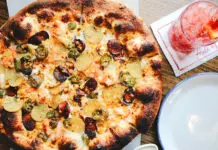
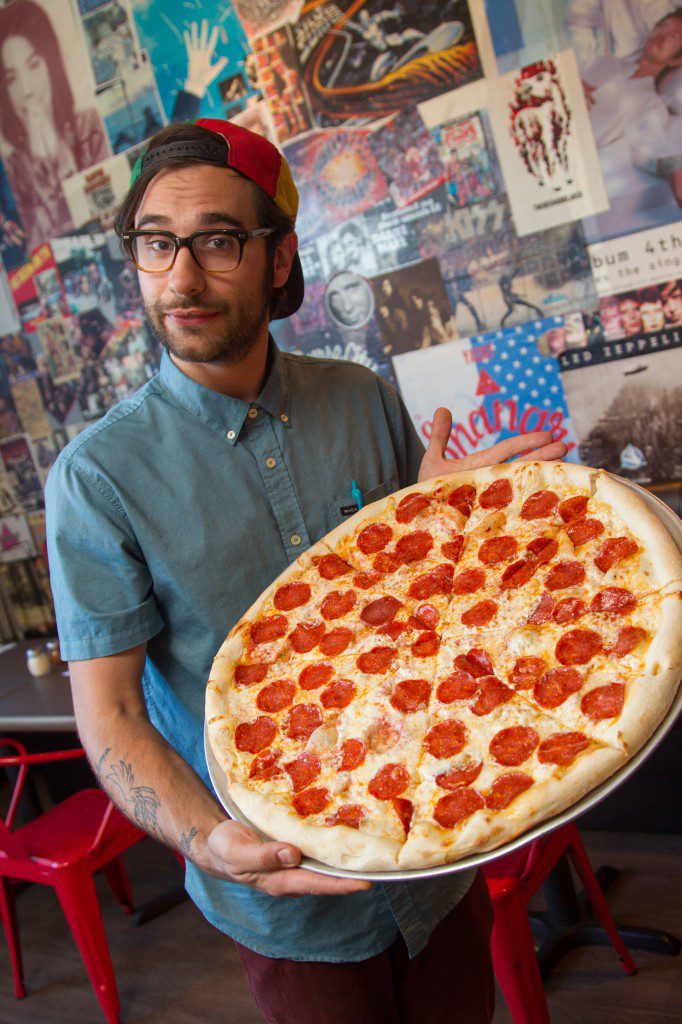
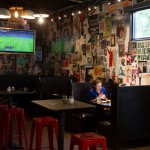
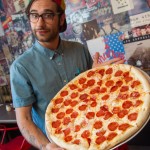
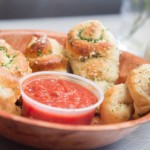
Words like “balsamic reduction” are not typical for the menus at most pizza joints. At Empire Slice House, it comes standard on the Rocksteady pie along with Gorgonzola, bacon and red onion. Whether you’re stopping in for a single slice or the whole pie, you won’t forget the names of some of Empire Slice House’s favorites. There’s the Notorious P.I.G. (five versions of pork), Fungus Among Us (topped with three kinds of mushrooms and truffle oil), the Evil Empire (four different peppers on top of spicy marinara) and the Foghorn Leghorn (a loud mouthful of flavors hot, sweet, savory and, uh, chicken-y). Grab a beer, choose your appetizers – the scrummy 16th St. Garlic Knots or Drunken Mushrooms – or order one of the house’s specialty salads, served up fresh, chunky and crisp. Enjoy it amidst fun touches of Gen-X-pop nostalgia, and you have the perfect addition to Oklahoma City’s funky Plaza District scene of art galleries, tattoo parlors and bars. 1734 N.W. 16th St., Oklahoma City. www.empireslicehouse.com