















For a little more than 23 years now, Tulsa NPR affiliate KWGS, 89.5 FM, has been the home of my Saturday evening radio program, Swing on This (which also live-streams at publicradiotulsa.org). Basically a Western-swing show, celebrating the genre Bob Wills launched from his Tulsa base back in the early ‘30s, its the playlists have grown over the years to encompass lots of other related music, including material recorded by Tulsa-based acts whose impact reaches far beyond the city’s borders.
Certainly, that definition applies to Walt Richmond and Casey Van Beek, two towering Oklahoma-music figures whose latest pair of discs have quickly become favorites of Swing on This listeners.
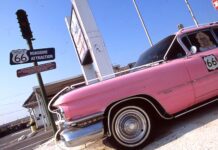
One, The Route 66 Sessions, came along just in time for the 100th anniversary of that iconic highway, officially celebrated this month. Executive-produced by the Church Studio’s Teresa Knox, it’s available at the Church’s gift shop or online at store.thechurchstudio.com.
The other, simply called Hymns by its creators, is, essentially, homeless, having not yet gotten an official release.
Both are credited to Casey Van Beek and the Tulsa Groove, with Richmond producing and playing piano. Several other first-rate Tulsa musicians appear on both discs.
So what, exactly, is a Tulsa groove?
To answer that, let’s go back to 1975, when T-town native Richmond and Van Beek, who was born in Holland but grew up in Southern California, met. Bassist-vocalist Van Beek was in town to work with his musical compadre Don Preston at Leon Russell’s Church Studio. Hitting the local club scene, Van Beek expected to find – as he told me in a 2020 interview – “some real country music and stuff.” Instead, he encountered a laid-back style of rock ‘n’ roll, featuring a different kind of presentation, a groove, that he hadn’t heard in the West Coast scene. It’s the kind of groove that many have in mind when they refer to the classic Tulsa Sound, and while its best-known practitioner was J.J. Cale, he wasn’t the only one. At the time, for instance, there was a popular band in town, Rockin’ Jimmy Byfield and the Brothers of the Night, offering its own unique twist on that Tulsa sound.
“To me,” Van Beek told me then, “Byfield exemplifies the Tulsa groove – that real low-key, cool-groove stuff.”
The Brothers of the Night’s keyboardist was Walt Richmond, and soon, Van Beek and Richmond were playing some engagements together. It was a golden age for Tulsa rock ‘n’ roll, with bona fide superstar Russell leading the charge, Cale hitting his stride as an artist (on Russell’s Shelter Records label), and any number of great players – like Richmond and Van Beek – regularly laying out memorable sounds in local nightspots.
Van Beek had come to Tulsa after a busy stretch out West that included work with a young Linda Ronstadt and future Eagles Don Henley and Glenn Frey along with a Nevada club circuit tour backing Righteous Brother Bill Medley. Richmond went on to become a linchpin in the bands of Rick Danko and Bonnie Raitt, doing regular work with Cale as well. Then, in the early ‘90s, Van Beek and Richmond reunited in the multiplatinum-selling Tulsa-based country-rock act, the Tractors. And for the past decade or two, they’ve been regularly recording at Richmond’s home studio.
The two new discs came out of those sessions. But neither is the first recording credited to Casey Van Beek and the Tulsa Groove. That distinction belongs to Heaven Forever, which came out via the Little Village Foundation in the spring
of 2020.
“We were just making – I don’t know if you’d call ‘em demos,” says Van Beek. “We were just making music, recording in the studio, and it got to sounding pretty good. Then somebody decided we ought to make a record.” He laughs. “It wasn’t me.”
Mike Kappus, J.J. Cale’s longtime manager, is the most likely suspect. As Van Beek recalls it, Kappus heard what became the disc’s title track – a wry Richmond-penned meditation on the afterlife – and “fell in love with it,” helping bring the subsequent album to the attention of the Little Village Foundation.
With that California-based music-industry nonprofit behind Heaven Forever, a big launch party was planned for late April 2020. And then, along came COVID-19. As was the case with a lot of projects, musical and otherwise, the pandemic never really allowed Heaven Forever to get out of the gate.
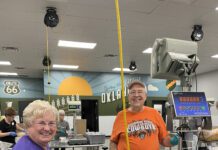
Still, the duo continued to record together in Richmond’s studio. And then, earlier this year, Richmond saw a story about the upcoming Route 66 Road Fest at Expo Square, a major summer event that ended up drawing thousands from all over the country. “I thought, ‘Oh, there’s going to be a bunch of people here in town. Let’s see if we can sell ‘em something,’” he recalls. “I already had tracks, boogie tracks, I’d cut.”
They, of course, needed lyrics. And a singer. So Richmond went to Van Beek.
“Walt said, ‘Yeah, we’ve got to have 10 songs in two weeks. Do you think you can do it?’ And I said, ‘No,’” remembers Van Beek with another laugh. “But darned if we didn’t get it done.”
Richmond wrote the music for the 10 tracks on The Route 66 Sessions, with Van Beek penning the lyrics for eight and Susan Webb for the other two. Jared Tyler, John Fullbright, Charles Tuberville and Paul Benjaman made musical contributions to the disc.
And, while The Route 66 Sessions CD is readily available for purchase, as noted before, there’s not yet a way to get the other Van Beek/Tulsa Groove disc, Hymns, commercially. That’s a shame, too, as it’s a great example of a true hybrid sound: classic hymns with a Tulsa groove.
Unlike The Route 66 Sessions, Hymns came about over a long period of time. In fact, you could trace it back to Richmond’s Southern Baptist upbringing, when he became familiar with the likes of “Just A Closer Walk with Thee,” “Church in the Wildwood” and “Rock of Ages.” He was a music-pro adult when he revisited them, arranging them in a Tulsa-groove style.
“I recorded a bunch of ‘em around ‘74. I sang ‘em – and I can’t sing,” Richmond says. “So I got Casey to sing ‘em. We cut some of those vocals [with Van Beek] 15 years ago.”
Like Richmond, Van Beek was no stranger to classic hymns, spending his formative years attending a Dutch Reformed Church in California.

“When I was a younger guy, we always went to church, Sunday school, daily vacation Bible school, all of that,” says Van Beek. “My aunt was the organist in this church, and my dad sang in the choir. I studied classical piano as a kid, and occasionally, I played a little piano there, just to show off.”
Both of their churched upbringings are reflected in Hymns, along with their musical roots in the ‘70s Tulsa Sound. It’s a combination that makes for fascinating listening – even if its creators don’t exactly know what to do with it.
“It’s a problem, because nobody wants a CD these days,” Richmond says. “Everyone just streams, and when you do that, you’re basically giving it away. Even Little Village doesn’t do CDs any more. They just stream.”
Richmond’s aversion to streaming is based on experience. He says that, in its first several months of release back in ‘94 and early ‘95, the Tractors hit “Baby Likes to Rock It” got something like 150,000 downloads on the streaming service Spotify. “I got four dollars out of that,” he notes with a smile. “That was my big check.”
Still, if it’s the only way to get Hymns out there, he says he may have to explore that possibility. After all, not long ago he brought Rockin’ Jimmy Byfield into to the studio to play guitar on the disc, along with dobroist Jared Tyler and steel-guitarist Steve Bagsby (Hymns is likely Bagsby’s final recorded work, as the noted Tulsa musician died a short time later), just so he could get the tracks finalized. Now, people need to hear them.
“Yeah. I don’t know,” Richmond says about the streaming option. “I put the piano down, and the drums, and had Casey sing ‘em – and then I let ‘em sit around for 15 years. I didn’t know what to do with ‘em. Still don’t. But I just felt like they had to be finished.”