




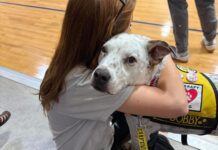

















Dogs have long been bred to work alongside humans, from rescuing avalanche victims to herding sheep. As society has progressed, so have these canines’ jobs. Today, dogs help track criminals, locate endangered wildlife, assist in conservation efforts and, increasingly, provide comfort to people in stressful situations.
One of a dog’s most valuable qualities is their sense of smell, but they also possess impressive levels of intuition. This ability to sense someone who may need extra care makes them uniquely qualified for one of their newest roles: therapy animal.
Unlike service dogs, which are trained to do extremely specific skills for one person, therapy dogs are trained to give attention and love to everyone.
Across Oklahoma, therapy dogs are becoming more common, largely due to the efforts of those at the nonprofit Human Animal Link of Oklahoma – or H.A.L.O. The organization works with certified dogs and their volunteer handlers to place teams in courthouses, nursing homes, airports, schools and other hectic or stressful environments.
Glenda Bitner, H.A.L.O.’s CEO and a canine evaluator, says the first requirement of a therapy dog is simple: “They have to like people,” she says. Therapy dogs must also be obedient, calm around other animals, and comfortable in busy environments.
For evaluations, Bitner takes dogs somewhere like a Lowe’s, where they encounter crowds, noise and plenty of distractions. A neutral dog is also present to ensure they can comfortably interact with other animals. Once approved, the dogs and handlers can begin volunteering throughout
the state.
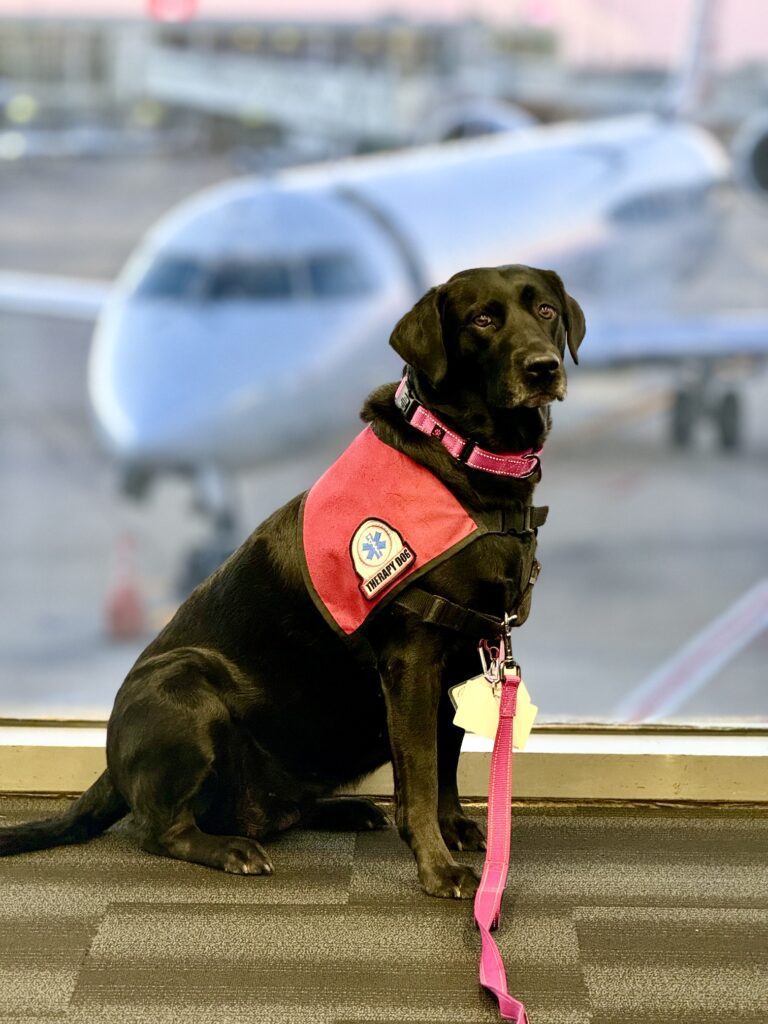
One of Oklahoma’s most visible therapy-dog programs is the “Welcome Waggin’” at Tulsa International Airport. The program began in 2019 and now has approximately 30 therapy teams volunteering regularly, according to Kim Kuehler, Communications Manager at the Tulsa Airports Improvement Trust. Kuehler says the dogs help travelers facing all kinds of circumstances, from the stress of navigating an airport as a young family to the difficulty of traveling to a funeral.
Kuehler has seen this firsthand. She recalls her therapy dog, Maggie, pulling her toward a woman at the airport. The woman was waiting on a flight to visit a dying family member.
Longtime Welcome Waggin’ volunteer Derek Young remembers a similar experience. After nearly two hours of visiting passengers, he and his dog, Guinness, made a final pass through the terminal. They noticed a young woman by herself and offered pets. Guinness simply placed his head in her lap, and she began crying. Turns out, she had spent the last week planning a funeral and had been unable to cry.
For Bitner, this demonstrates what makes dogs so effective: “They’re nonjudgmental … They’ll meet you right where you are.”
And the dogs, it seems, like the work just as much as the humans they help. Bitner says her therapy dog gets just as excited about her therapy vest as many dogs might get at the word “walk.”
For anyone whose pets love meeting people, H.A.L.O. is always looking for new volunteers. To learn more, visit yourhalofoundation.org to see how you can get your dog certified and join the team lifting everyone’s spirits.