





















With the official centennial observance of Route 66 winding down, Oklahoma’s chief historian looks back on the year-long series of events as an opportunity to tell a story of the road’s past success, and what he sees as its bright future – not only in Oklahoma, but in the other seven states the road bisects.
While official celebrations of the road’s actual day of christening (Nov. 11, 1926) have mostly come and gone, Trait Thompson, executive director of the Oklahoma Historical Society, thinks the venerable road’s best days may be ahead.
Thompson says that when the road was decertified as a federal highway in 1985, its future looked bleak.
“But thankfully, due to efforts of preservationists, the road is stronger than ever,” he says. “Today, people come from all over the world to travel Route 66. It’s a true Americana experience.”
Oklahoma’s portion of Route 66 is fully paved, with its approximately 400 driveable miles exceeding any other state’s. And Thompson says cities along the strand have taken advantage, with businesses and attractions continuing to pop up – inviting the traveling public.
When speaking to groups, Thompson says, “I always point out to people that you can drive it east to west [in Oklahoma], then six months later drive it again, and there are new things.”
As Route 66 was continually developed and improved, so was the nation itself. When people began traveling the highway, Thompson says, it wound up being a major boon to small businesses.
“You started seeing gas stations, diners, stores, restaurants. The impact on small business was incredible. Travelers are going to need a place to eat, and to stay,” he explains. “Any time you can increase the efficiency of moving people across the country, the economic impact is going to be substantial.”
And while that was happening, the road became incredibly valuable for moving manufactured goods across the country. Portions of what became Route 66 had already been built by 1926, Thompson says, but were not included in any organized system of highways. In fact, Oklahoma had only established its first state highway system two years earlier, in 1924.
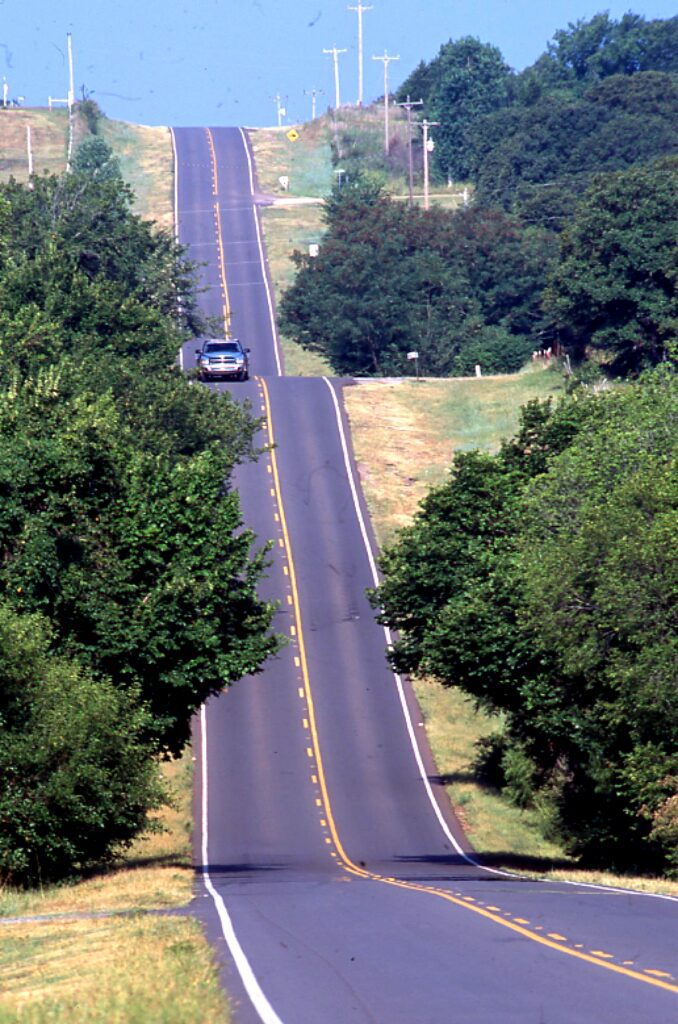
Oklahoma’s then-highway commissioner, Cyrus Avery, was a member of the American Association of Highway Officials, and had proposed designating a highway that would run between Chicago and Los Angeles. Thompson says Avery was influential in getting the government’s Bureau of Public Roads to sign off on the federal highway designation.
In Oklahoma, Route 66 wasn’t completed as a fully paved road from one side of the state to the other until 1937. Thompson says he isn’t aware of any formal observances that would have marked the milestone, which came at the height of the Great Depression.
Those Depression days are part of the reason for Route 66’s cliché-like nickname, the Mother Road, Thompson says. Novelist John Steinbeck called it “The Mother Road, the Road of Flight” in his famous novel The Grapes of Wrath, which tells the story of an Oklahoma family heading to California in search of a better life.
Other names for the roadway include The Main Street of America and the Will Rogers Highway.
Today, an ongoing, $6.6 million federal grant helps Oklahoma – and other states – keep the roadway at the forefront of attention, with cities eligible for grants for specific preservation projects.
In September, four Route 66 monuments were installed along the road’s original route through Oklahoma City, giving the capital city six Route 66 markers.
For More Information
Oklahoma Route 66 Association
405-258-0008
oklahomaroute66.com
Oklahoma Historical Society
405-521-2491
okhistory.org