








The Seychelles is the ultimate remote getaway. Emphasis on remote. The archipelago is, pardon the expression, in the middle of nowhere. It really is. The Seychelles (say-SHELLS) are a menagerie of 115 small islands 800 miles from Africa, the nearest continental landmass. And that’s exactly why people go there.
Because of the Seychelles’ remote location, the islands have ecologies found nowhere else on earth. Superlatives rule: largest and heaviest seeds, oldest land animals, largest living land arthropods, rarest birds.
The 115 islands come in two flavors: the inner 45 are smooth granite sculpted by the ocean and accented by low mountains. And the 70 outer islands are made entirely of stunning coral. Aldabra Atoll, one of the world’s largest raised coral atolls, consists of four coral islands encircling a tidal lagoon where thousands of half-ton, 100-year-old Aldabra tortoises frolic in the ever-changing tides.
Twenty-six of the islands are inhabited, but most of the country’s 100,000 population live on the principal island of Mahe (mah-HAY). Victoria, the capital, is hemmed by 3,000-foot ancient granite mountains, verdant rainforests and the Indian Ocean. Stop by local markets and fill your Seychellois braided bag with native-grown vanilla, cinnamon, curry, honey and Mahe mountain tea. Be sure to check out the black pearls, gold jewelry, batik fabric and Creole art.
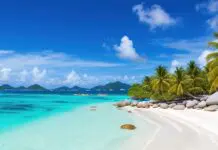
The beaches in the Seychelles are among the most beautiful in the world. Retro ’50s turquoise water fronted by white, fine sand and, on the granite islands, ancient buffed pink and gray boulders stand guard above crystal-clear lagoons.
On Mahe, the best beaches are across the island from Victoria (four miles away) at Beau Vallon, a long, lively, touristy ribbon of perfect sand and magical water – and vendors on hand to get you in or on it. The beach boasts magnificent sunsets to accompany your cocktail and slice of tuna and onion pizza.


It’s not all rock on the granitic islands. In fact, 60% of the Seychelles is dedicated to flora and fauna preservation. Well-maintained hiking trails on Mahe snake through virgin jungle pergolas of hardwoods and palms. All 72 acres of Cousins Island is an official Nature Reserve with an outcropping of mangroves, lush canopy and hundreds of species of birds, such as the scarce magpie robin and Seychelles Warbler.
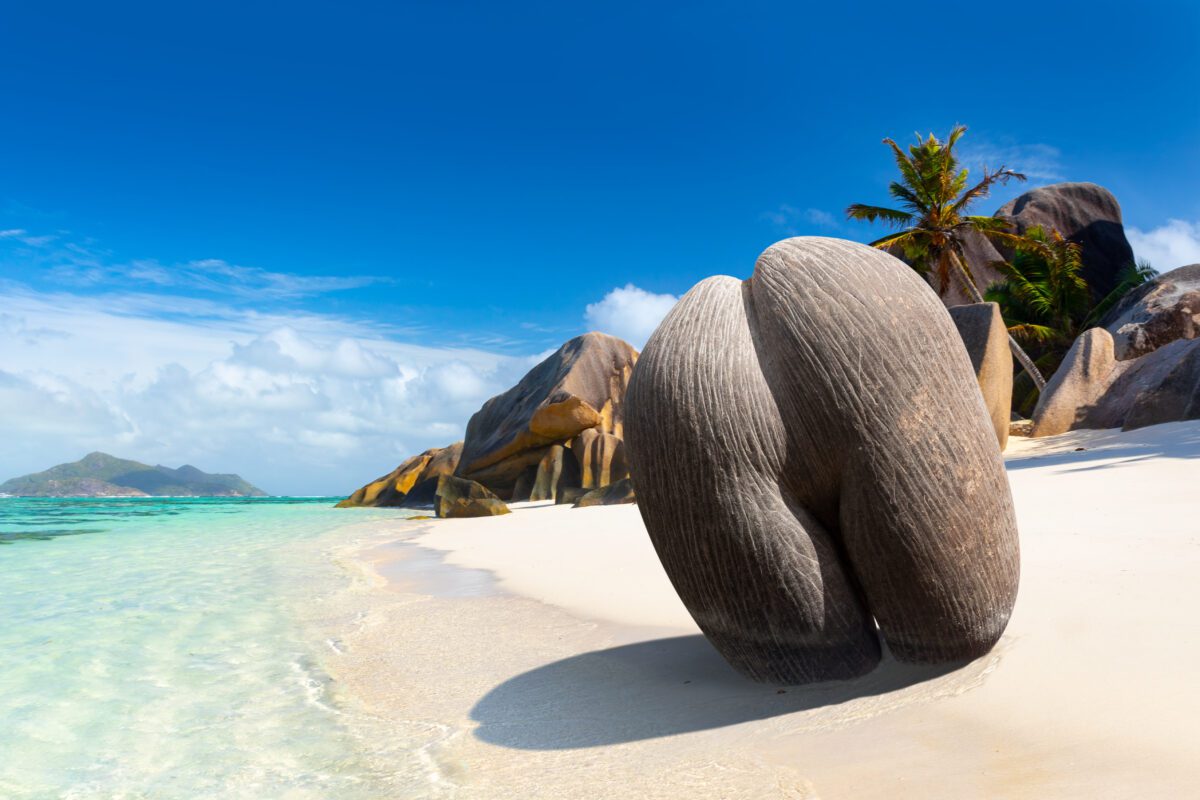
Two UNESCO World Heritage sites grace the Seychelles. You’ve met one of them, Aldabra Atoll, and the other is Vallée de Mai Nature Preserve, a primeval forest on Praslin Island, where not much has changed since the island was formed. Keep your eyes open for an animal you’ll find nowhere else on earth, the Seychelles black parrot. This Garden of Eden is also the home of the largest and heaviest seeds on the planet. The “double coconut” seeds of the endangered Coco de Mer palm tree can weigh as much as 66 pounds and measure 20 inches in diameter.
Named after France’s one-time finance minister Jean Moreau de Séchelles, the Seychelles became an independent republic in 1976. French and Creole are still widely spoken.
The islands’ marketing folks eschew mass tourism and instead focus on attracting a more discerning, higher-end clientele. Dozens of luxury resorts dot the isles. There are two Four Seasons resorts and the fabulous new Waldorf Astoria on Platte Island offers six restaurants surrounding distinctive low-slung waterside villas, each with its own pool.
By the way, the two superlatives not mentioned so far are oldest land animal: Jonathan, a Seychelles giant tortoise born in 1832 (yes, he’s 194 years old); and largest living land arthropod: that would be the coconut crab, weighing in at nine pounds with a leg span of three feet and capable of cracking open coconuts with its eight-inch claws.