










Last month, we left rock ‘n’ roll bassist Gary Gilmore in his hometown of Tulsa, where he’d been working a regular club gig with drummer Gary Sanders and a guitarist-vocalist named John Cale. (Because of the wide-open local nightclub scene at the time, even an underage musician like Gilmore – who’d just graduated from high school – was able to play those places.) After a few months, Cale got a call from another musical Tulsan who’d come up through the clubs. It was Leon Russell, who’d been making a name for himself, as well as some money, playing music on the West Coast. He’d just bought a house in the Hollywood Hills and was putting in a home studio – something unusual in 1964, the year all of this unfolded.
Russell wanted his friend Cale to move to L.A. and run the studio.
It was a job Cale couldn’t refuse. And a couple of weeks later, according to Gilmore, “Cale called me and Sanders up and said, ‘You guys wanna come on out? We can play some clubs, and we can also use Leon’s studio to record some of my songs.’
“So I loaded my car, and Sanders loaded his, and we headed down Route 66.”
Once in California, like so many other transplanted Tulsa musicians in the ’60s and ’70s, they stayed for a while at Russell’s house. Soon, the reconstituted trio, with the help of an agent, was playing clubs in L.A. and beyond.
“I especially remember one gig up in Reding, in northern California,” Gilmore says with a chuckle. “We played at the redwood forest – behind a stripper, for the lumberjacks.”
After working nights, the three would often get up and record at Leon’s home studio during the day.
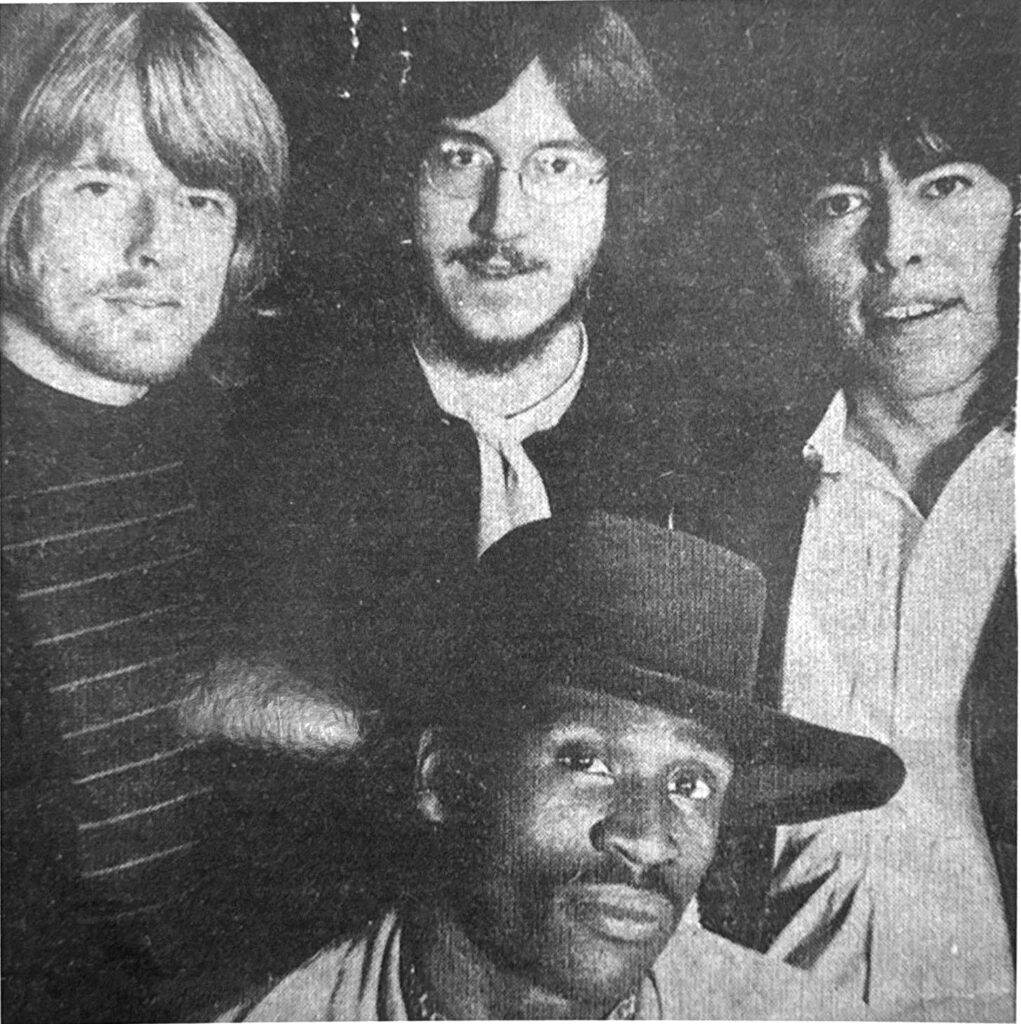
“A lot of times,” Gilmore recalls. “John would leave chord progressions and a rhythm that he wanted for bass and drums, and he’d ask us to cut those tracks. We’d do it, and when we came back in a day or two, we’d hear a song that he’d written around them, putting in all the guitars. That’s actually how [the famous Cale composition] ‘After Midnight’ was written.”
The guys had been playing around L.A. for a while when they heard that the famed Sunset Strip nightspot the Whisky a Go Go was looking for a band to provide some relief for its house act, singer Johnny Rivers, who had recently started what would be a long run as a Top 40 recording artist.
“So we auditioned, and we got the gig. We’d play when Johnny Rivers was out on the road, or had days off. It was a good gig,” remembers Gilmore. “But then, after we’d played there a few months, Elmer Valentine, who was the club’s owner, called John over there. Sanders and I went over, too, and sat in a booth with ‘em.
“Elmer Valentine said, ‘John, you’re doing great, but on the marquee out there says ‘Johnny Cale’ one week and ‘Johnny Rivers’ the next. That’s really pretty similar. Would you mind changing your name to JJ Cale?’
“Cale thought about it a minute, and then he said, ‘Well, man, I don’t care what you call me, just as long as you pay me.’”
Gilmore laughs. “There was a guy named John Cale who was in the Velvet Underground, and Cale may have been thinking about that. And I know he liked B.B. King, so he probably didn’t mind JJ Cale.”
The trio did so well that, in the fall of 1965, they were asked to go to Atlanta, Georgia, to be the house band for a new Whisky a Go Go. They played there six nights a week for about six months, Gilmore says, until Cale made the tough decision to concentrate more on his songwriting and disbanded the trio. Cale headed for Nashville and Gilmore returned to L.A., where he continued to play in clubs, renting a house in Sherman Oaks near the famed Plantation, home to lots of Tulsa musical expats. And, when a gifted guitarist named Jesse Ed Davis arrived in town from Oklahoma City, he took over a spare room in Gilmore’s home.
“Jesse told me he was working with a guy named Taj Mahal on an album, and that Taj had booked a gig up in San Francisco. Could I take him to the airport? I said yeah, and when we pulled in, we saw Taj sitting on the curb with his head hanging down. Jesse introduced me to him and said, ‘What’s wrong, Taj?’
“He said, ‘Man, my bass player won’t get on an airplane.’ And they were supposed to play that night. So Jesse turns to me and says, ‘Hey. You wanna go?’”
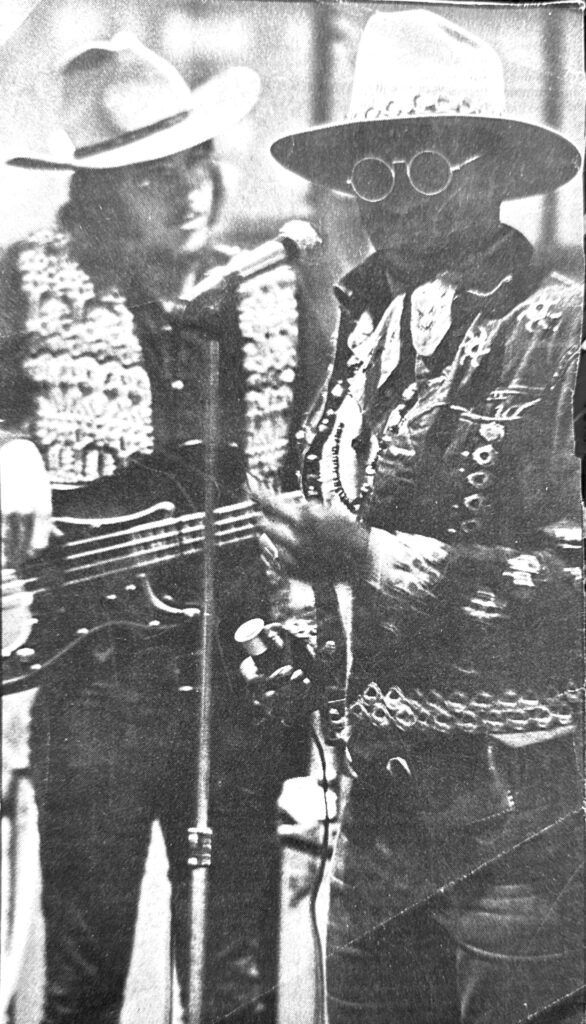
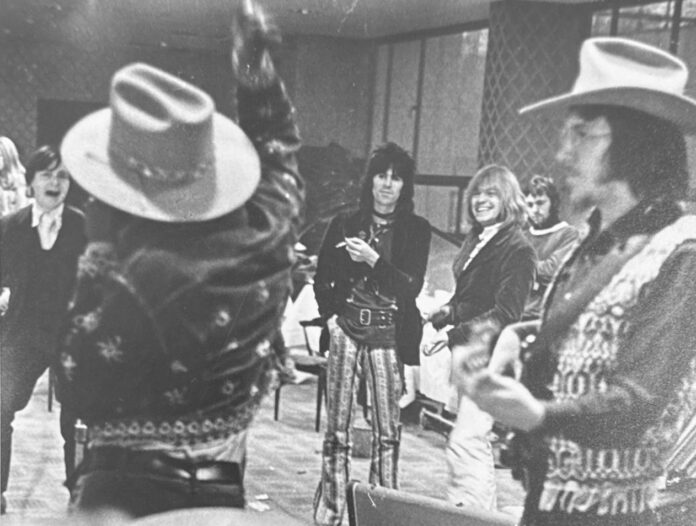
Gilmore raced back to his house, picked up his bass, and made the flight. He also made a great impression on Mahal, who hired him. It began an association that lasted for years of touring and critical acclaim, as well as a spot on one of the most famous, or infamous, music specials of the 1960s, The Rolling Stones’ Rock and Roll Circus.
“That also involved the Whisky a Go Go,” Gilmore notes. “We were playing there one night, and I looked down on the dance floor, and there were Mick Jagger and Keith Richards dancing around. They looked like they were having a great time. When we took a break, the club owner came over and said, ‘Those Rolling Stones want to talk to you.’
“Well, we went over to their booth and they told us they loved our band. They said, ‘We’re getting ready to make an hour-long made-for-TV special. It’s going to star The Who and Jethro Tull, and John Lennon’s throwing a group together with Eric Clapton and Mitch Mitchell. You guys want to come over [to England] and do it? You’d be the only American band in it. We’re doing it in two weeks.’
“It was like one of those tales you hear in the music business that never happens. But this one happened. They sent us first-class tickets and put us up in a hotel. We actually had to kind of go unannounced, because we hadn’t had time to get the musicians’ union contract in London.
“But man, what a great thrill. We had so much fun doing it, and we kept thinking, ‘If this comes out on American TV, it might really help our little combo get booked.’ We kept waiting, and kept waiting – and then we heard that the Rolling Stones didn’t like their part in it. I guess [Rolling Stones member] Brian Jones was kind of messed up during the filming, and they felt like they were upstaged by The Who,” he says with another chuckle.
Shot in December of ‘68, the special finally made its official debut in October of ‘96, at the New York Film Festival – whose directors flew Gilmore and another Tulsa rock ‘n’ roll great, Chuck Blackwell, Taj Mahal’s drummer during the filming, to the screening.
Gilmore had long wanted to escape the city and own a farm, and by the time The Rolling Stones Rock ‘n’ Roll Circus premiered in New York, he’d had a dairy farm outside of Tahlequah for years. He’d also continued to play with a number of different area bands, including Rockin’ Jimmy Byfield and the Brothers of the Night, whose albums garnered them a substantial overseas following.
Then came the chance to take over Tahlequah’s Riverside Resort, which continues to be run by him and his family.
Gary Gilmore and many of his contemporaries mentioned in this piece have long been associated with the so-called Tulsa Sound, which I’ve come to believe has as much to do with the camaraderie of the players than any specific musical style. I was happy to find out that he agreed.
“You know, Chuck Blackwell called the Taj band ‘the sweetest of brotherhoods,’” he says.
“I really appreciated that because I think that’s a big part of it. It was a special group of musicians who grew up at the same time and really enjoyed playing together. And you could tell it.”