An eye-catching “Tree of Life” holds the couple’s large wine collection. Photo by David Cobb.
An office offers ample storage. Photo by David Cobb.
A home at Lake Aluma. Photo by David Cobb.
Photo by David Cobb.
The master suite features windows open to the beautifully landscaped backyard. Photo by David Cobb.
Poolside entertaining is easy in the home’s backyard, featuring dining areas, limestone pathways, rock gardens and a waterfall. Photo by David Cobb.
Unusual chandeliers can be found in many of the renovated rooms, including the kitchen. Photo by David Cobb.
Antique english wine casks and a large chandelier anchor the eclectic dining area.Photo by David Cobb.
A sunroom overlooks the home’s garden. Photo by David Cobb.
The music room is an eclectic mix of furniture and decor styles. Photo by David Cobb.
An eye-catching “Tree of Life” holds the couple’s large wine collection. Photo by David Cobb.
Intimate conversation areas can be found throughout the spacious home. Photo by David Cobb.
Established in the 1940s as a hunters’ haven, Lake Aluma is now a year-round enclave in northeast Oklahoma City. On the pristine lake circled by beautiful homes, canoes and paddleboats rest at the shoreline as swans and geese cohabit amiably. The picturesque setting is an ideal snapshot of relaxed country living.
Today, many of the older homes are being refurbished or replaced with newer homes befitting the bucolic setting.
In Amy and Roger Spring’s quest for the perfect home, they decided to renovate the dated Lake Aluma bungalow that they’ve lived in for the past several years.
Initially, the couple planned only to screen in a porch, but they eventually gutted the entire house and added 2,000 square feet to the existing 4,100. Oklahoma City designer Janie Comstock predicted a year to achieve the home’s transformation. The Springs moved out; the workers moved in.
“The only input Roger had was on the ‘tree of life’ he wanted for his wine storage,” says Amy Spring. “It is truly a work of art.”
So is the rest of the house. Rock walls and limestone steps now curve toward the spacious front lawn. The covered front porch can host 100 guests for outdoor entertaining. From the narrow road that winds through the wooded setting, the first impression suggests a Colorado hunting lodge.
The rear lawn features poolside entertaining and dining areas. Limestone pathways, wood decking and natural landscaping add charm. Native trees and perennials accent rambling rock gardens and berms. A fire pit provides warmth, while a waterfall adds nature’s music.
As landscapers embellished the grounds, the home’s interior assumed a sophisticated personality, designed to complement the lifestyle of parents with two children and demanding careers.
The main level was redesigned. Walls and windows were moved to open the living space; the rear grounds are visible from the entrance. A den, a music room and a sunroom overlook the garden.
The east wing, adjacent to the dining area, includes a library that offers overflow seating, a cozy den revealing lake views, the master suite, a masculine retreat and wine cellar.
The west wing houses the well-appointed kitchen, utility area, an office with abundant storage and the children’s suites. They never miss school or social events due to a floor-to-ceiling calendar nearby. Amy Spring credits Clutter Busters with streamlining her organizational skills.
“Organization is one of Amy’s fortes,” Comstock says. “She forgot nothing in considering how they live and entertain.”
The kitchen has storage areas for the children’s snacks, strategically placed for their limited reach. Their upstairs playroom and theater contains areas for toys, games, crafts and sports gear.
During the renovation, Spring and Comstock shopped the region for furnishings and accessories to create a dramatic look in every room. Herringbone patterned wood floors and reclaimed wood beams anchor most rooms. Walls are neutral, showcasing vividly colored art. Unusual chandeliers, many of them antiques, create special lighting effects.
In every room, there are unique touches – a Grecian door, a pecky cypress ceiling inset, English antique wine casks, antique doors on twin refrigerators. Several areas invite intimate conversations or offer cozy reading nooks.
Now, dramatic art, treasured antiques and period and contemporary furnishings give this home across the lake a loved and lived-in look and feeling.
When commentators called the 2008 presidential election for Barack Obama, author and storyteller Clifton Taulbert celebrated, but not whole-heartedly. The child in him, raised in the segregated Mississippi Delta of the 1950s and 1960s, waited for the other shoe to drop. Surely there was a miscount. Or perhaps this was a practical joke unleashed on an impossibly large, national scale.
“I’m 50 years removed from [segregated Mississippi], but it’s a lesson of race and place that lingers. It still shows up today because we’re still seeing a lot of African-American firsts,” he says.
Standing in a hotel room on an otherwise average Tuesday evening in suburban Anytown, U.S.A., Taulbert was wrestling with the extraordinary. America had a black president. But initially, he couldn’t enjoy the finality of victory, the end of an era, the soulfully satisfying conclusion to one of the most important public conversations in the country’s history.
“I stood in the middle of the floor, and I cried. I still cry when I think about it today because I came from an era where this was impossible – totally and completely impossible. It was surreal. I thought I’d eventually wake up and none of it would have happened. I couldn’t believe it because it wasn’t believable,” Taulbert recalls.
He believes in the illuminating power of a story told well, and in his 12th book, The Invitation, Taulbert explores this “cultural post-traumatic stress disorder.”
It would be a year following the 2008 election before the story of The Invitation crystallized. It would take another six years before it saw bookstore shelves. Taulbert’s search for meaning behind the second-guessing, the hypersensitivity to the improbable, emerges in the pages of The Invitation as cultural post-traumatic stress disorder.[pullquote]”If communities can be built in the face of segregation, they can be built under any conditions. Businesses with holistic communities, where every voice is respected, can succeed regardless of time and agendas.”[/pullquote]
The Invitation – his recounting of an improbable friendship of a black baby boomer and the southern descendant of generations of slaveholders – invites readers to remember the lessons of segregation without reliving it; and it turns out, there is a sort of therapy for Taulbert’s brand of PTSD: hope.
“If the past shows up, hope is the most important bulwark. Reality isn’t the world of our childhoods. The future is not written. Be hopeful,” he says.
Taulbert’s frustration with PTSD emerges not just narratively, but stylistically. Every time the story starts rolling, Taulbert stops to check the surroundings and the audience. The discomfort of being watched and the low-level anxiety of always watching constantly remind the reader what The Invitation examines.
Once Upon A Time
It’s unlikely that Taulbert’s first book, 1989’s Once Upon a Time When We Were Colored, would have made it to the big screen without its hopeful message.
Starring Phylicia Rashad, the film was a milestone for Taulbert. His life story, he saw, resonated powerfully with those of a much larger audience than the book gathered. It was also an important sign that his beliefs about community could resonate with a larger audience, as well. And it would find that audience in some unlikely arenas.
Taulbert credits his escape from poverty to the small community of his Mississippi hometown, Glen Allan, and to the even smaller community of the extended family – his “Porch People” – that raised him. His elders’ shared vision of his future, he says, shaped him before he was old enough to understand that he was being shaped.
“Community is about unselfish action, and ordinary people rising to the heights of leadership,” he says. “In my community, people did anything and everything necessary to protect kids in the world of legal segregation. In order to do this, the community came together and wove a safety net of sorts capable of catching us when needed.”
In 1997, two years after the release of the film, Taulbert codified the lessons of his youth in Eight Habits of the Heart. It was written proof that memories of caution aren’t the only ones that have stayed with him. Eight Habits contains messages of community carried forward from his younger years in the Delta. His forward-thinking elders, it turns out, were entrepreneurial thinkers.
With his consulting company, the Freemount Corporation, Taulbert has carried that gospel of community to everyone from nonprofit organizations and public school districts to Fortune 500 corporations.
“The message in Eight Habits resonates in a lot of places. I recently saw it resonate really well with Idaho’s public schools and the Human Rights Education Center. If communities can be built in the face of segregation, they can be built under any conditions. Businesses with holistic communities, where every voice is respected, can succeed regardless of time and agendas,” he says.
With Taulbert’s help, cutting-edge business strategies emerge from the time-honored customs and traditions of the Mississippi Delta. They target, of course, the most significant investment of every business: people. Developing human capital, says Taulbert, is where businesses need to succeed first. His ideas have reshaped a wide range of organizations, from the FBI and the National Security Agency to Ford Motor Co. and Harvard University.
Other forays into the business world include Roots Java Coffee, an African-American owned coffee brand that imports and retails coffee from war-torn Rwanda. The direct link it provides between the American retail market and some of the world’s most sought-after coffee beans is slowly but surely pulling a group of hard-working Rwandans out of poverty.
Doing business with the lingering lessons of Eight Habits in mind defangs the past’s trauma, softening harsh memories by creating real communities with real people – at home and around the globe.
Little Cliff
Clifton Taulbert is best known for his books of nonfiction, including Once Upon A Time When We Were Colored, which was made into a successful movie released in 1995. Taulbert has also penned a trilogy of children’s books that revolve around a young boy growing up in Taulbert’s hometown of Glen Allan, Miss. In the Little Cliff series, Taulbert tells the stories of the early years of Cliff, a precocious young boy at the center of the series. Illustrated by E.B. Lewis, an award-winning illustrator and artist, the books hold Taulbert’s belief in community at the forefront of stories of the young child’s adventures.
Taulbert says he was prompted to write the three books – Little Cliff and the Porch People, Little Cliff’s First Day of School and Little Cliff and the Cold Place – for bittersweet reasons.
“Once upon a time, my wife, Barbara, and I shared the joy of a daughter who passed away at age 7,” Taulbert recalls. “Annie loved books and loved reading. It was my job to read to her at home and at her school. She clearly understood that her father was an author.
“After she passed away, I decided to write books for kids to always remember our daughter’s love of books and reading,” he continues. “I know I need to write several more – and hopefully one day I will.” – Jami Mattox
Acrocanthosaurus atokensis (“High-spined lizard from Atoka”)
Museum of the Red River Idabel
This carnivorous dinosaur (theropod) was first discovered in early-mid Cretaceous deposits (125-100 million years old) near Atoka, Okla., in 1940. Similar specimens have been found in southeast Oklahoma, Texas and Utah. It is the largest predator known from its time and was designated the State Dinosaur of Oklahoma in 2005. A cast of the fossil skeleton is found at the Museum of the Red River; the original skeleton is housed at the North Carolina Museum of Natural History.
Can three conductors lead one orchestra? Tulsans will find out as Tulsa Community College Signature Symphony continues its search for a conductor to replace Dr. Barry Epperley, the orchestra’s conductor and artistic director since it was founded in 1978.
The three candidates – Andrés Franco, Michael Rossi and Timothy Verville – will each lead the symphony for one performance during the 2014-15 TTCU Pops Series and one performance during the 2014-15 Williams Classics Series. All performances will take place at the VanTrease Performing Arts Center for Education on TCC’s southeast campus.
“This will be a great opportunity for the arts community to see different conductor styles as each candidate takes the baton,” says Brett Campbell, TCC southeast campus provost and conductor search committee chairman. “We will see the creativity these conductors can bring to the professional orchestra as well as how they shape the sound and how they work with our Signature Symphony musicians and chorale members.”
Tickets for the upcoming season are available at the VanTrease PACE ticket office.
Nineteen-year-old Kyle Tyson continues her passion for dance despite a crippling illness that left her partially paralyzed years ago. Photo by Brandon Scott.
Nineteen-year-old Kyle Tyson continues her passion for dance despite a crippling illness that left her partially paralyzed years ago. Photo by Brandon Scott.
Nineteen-year-old Kyle Tyson continues her passion for dance despite a crippling illness that left her partially paralyzed years ago. Photo by Brandon Scott.
Nineteen-year-old Kyle Tyson continues her passion for dance despite a crippling illness that left her partially paralyzed years ago. Photo by Brandon Scott.
Tyson and her therapy dog, Dessa, practice bar work. Photo by Brandon Scott.
Like many other 19-year-olds, V. Kyle Tyson has spent the summer preparing for college, finding a place to live, choosing her classes and worrying about how she’ll make new friends. Yet, Tyson isn’t quite like most 19-year-olds.
In 2011, when Tyson was 15, an illness left her paralyzed from her collarbone down. Doctors diagnosed Tyson with transverse myelitis, a neurological disease caused by an inflammation of the spinal cord.
In the following months, Tyson slowly regained feeling in her extremities; however, the swelling in her spine persists.[pullquote]“There aren’t a lot of dance programs for people with mobility problems,” says Tyson. “iMErge puts students with mobility problems alongside other able-bodied students.”[/pullquote]
“I have good days and bad days,” says the Broken Arrow teen. “I fake it to make it some days.”
Medications allow Tyson to walk briefly, but she requires a wheelchair or a walker most of the time.
Through all of the adversity, Tyson has never lost sight of her passions in life.
“I have been dancing since I was 2 years old,” she says. “It never occurred to me to stop now.”
Tyson became the first wheelchair-bound person to perform for the Youth America Grand Prix, the world’s largest student ballet scholarship competition.
“I didn’t know it at the time,” recalls Tyson. “I was just so excited to be out of the hospital and be with [my friends]. I was very excited to even get to compete.”
Tyson’s mother, Laura Tyson, has since created iMErge, a performing arts program for teens who are physically limited. iMErge is part of Oklahoma Performing Arts, a center for art education.
“There aren’t a lot of dance programs for people with mobility problems,” says Tyson. “iMErge puts students with mobility problems alongside other able-bodied students.”
Tyson, a recent graduate of Oklahoma Performing Arts, also teaches dance to children as young as 4 years old.
“I love teaching little kids,” shares Tyson. “They are very accepting of what I can and can’t do. I show them everyone has limits, but you can still learn. I teach them, and they teach me.”
Tyson has big goals ahead. She plans to study public relations and minor in acting and film.
“It will be a struggle at first,” Tyson says of college. “But, everybody struggles at first anyway. I am excited for this adventure.”
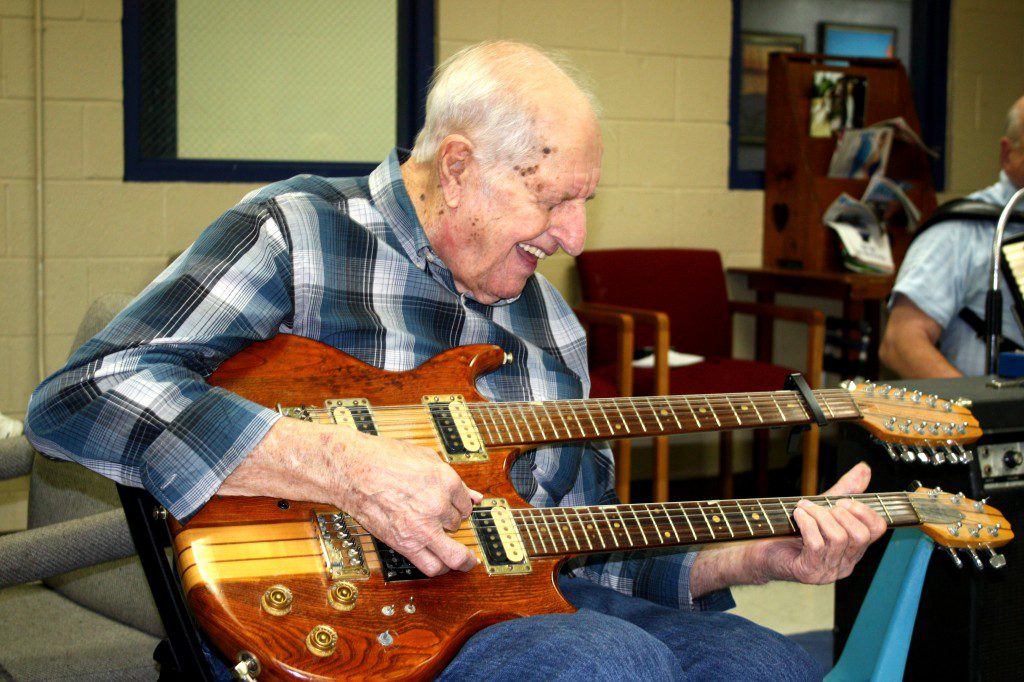
Despite blindness from glaucoma, Beanie Fraley, 89, continues to jam on his double-neck guitar during monthly sessions at Tulsa’s Reed Community Center.
Photo by James Avery.
Despite blindness from glaucoma, Beanie Fraley, 89, continues to jam on his double-neck guitar during monthly sessions at Tulsa’s Reed Community Center.
Photo by James Avery.
Photo by James Avery.
Photo by James Avery.
Photo by James Avery.
Photo by James Avery.
Photo by James Avery.
Photo by James Avery.
Photo by James Avery.
Photo by James Avery.
Photo by James Avery.
Photo by James Avery.
Photo by James Avery.
A vacation trip prevents drummer Don Hartzell from making a Friday morning gig at Reed Community Center, but the four other musicians who gather in a room at the west Tulsa recreational center every month are loose and jamming by a little after 9 a.m. As kids traipse by on their way to the basketball court, the men sit facing one another, instruments in hand, taking turns calling out tunes that were popular well before any of those passing youngsters were born.
“Let’s try ‘Cab Driver’ in D,” suggests bassist Ed Davison, and in a moment, they’ve launched into the old Mills Brothers standard with the ease and grace of the Queen Mary pulling out of New York Harbor. They’re comfortable playing classic pop, and there’s a good reason for it: Individually, they’ve been making music since the ‘40s.
“They call me the kid of the bunch,” says Davison. “I’m 80.”
Age-wise, the others fall between Davidson and guitarist Lee Oliver, 93, who not only sings and plays solid rhythm, but can also spin out a nice lead when the situation calls for it.
Tom Bordner, behind his accordion, calls the Earl “Fatha” Hines evergreen tune “Rosetta,” and Oliver and Davison leaf through big folders of chord and lyric sheets on the stands in front of them. Beanie Fraley, playing a double-neck guitar (12-string above, six-string below), has no need for a music stand; glaucoma robbed him of his sight a dozen years ago.
The four begin “Rosetta,” which was also a favorite of western-swing king Bob Wills. It sounds more Wills than Hines, which is appropriate, since 89-year-old Fraley is one of the last men standing who played, albeit briefly, in one of the golden-age western-swing groups led by a Wills brother.
Fraley would’ve been somewhere around 10 years old when Bob Wills led his ragtag bunch of musicians out of Texas and through Oklahoma City to Tulsa, launching from T-Town a new sound that would make its way across much of America and beyond. At its base was the kind of fiddle music Wills and his father and grandfather had played for ranch house dances; by the time he got through with it, however, you could hardly find a musical style that it didn’t contain.
As western swing grew and spread throughout the ‘30s and ‘40s, other bandleaders came along to get a piece of the action, including Leon McAuliffe, Wills’ one-time steel guitar player. Wills encouraged his three younger brothers to front their own bands, and they did, giving the music world Johnnie Lee Wills and His Boys, Luke Wills’ Rhythm Busters and Billy Jack Wills’ Western Swing Band. Although Johnnie Lee would stick close to Tulsa, the others would emulate their big brother and work throughout the west and southwest.
It was with Luke Wills, then based in Fresno, Calif., that Fraley made his mark – if only briefly.
“It must’ve been about ‘47 that Luke made the trip out here [to Tulsa] and toured back to Fresno,” Fraley says. “[Guitarist] Junior Barnard had made the tour back here with him, but Junior didn’t want to go back. They put the word out that they were looking for a guitar player. So I was able to tour with Luke.
“It didn’t last a long time – at least a couple of weeks, I’d guess. But some eventful things happened on that trip. Bob Wills had loaned Luke his ‘41 Cadillac Town Car. Billy Jack had just bought a new Plymouth, and he’d loaned it to Luke; and those two cars were what was making the trip, one of ‘em hauling the trailer. Well, the fan that cools the engine went out on that Cadillac up in Burley, Idaho, and we couldn’t find nothing to fix it with. So they put a block of wood under the hood and tied the hood down and drove that Cadillac all the way back to Fresno,” Fraley says. He laughs. “I imagine that engine was shot by the time it got back there.”
Once they got to Fresno, he remembers, Luke Wills dismissed him from the band, “and it seems like the other guys were let out, too. So I went up to Merced (California) and played in a place called Blue’s Rainbow Club. It was just a part-time job. The singer there was Curly Lloyd. As Jack Lloyd, he went on to play [and sing] with Bob Wills.”
Luke Wills wasn’t the only western-swing bandleader to share a stage with Fraley. Right before going on the road with Luke, Fraley spent a little time with the Tulsa-based McAuliffe and his jazz-influenced group.
“I auditioned for him down at the Musicians’ Union Hall, right here in Tulsa,” he recalls. “Leon, he made a comment about me being able to play inverted chords; he must’ve thought I had more music theory than what I did.”
He laughs again. “He hired me, but I wasn’t able to stay. They read arrangements and stuff, a lot of charts, so I was only with Leon about a month or so.”
That gig may have been foreshadowed several years earlier, when a young Fraley was forced to spend six months in a sanitarium in Talihina, following his exposure to tuberculosis.
“I was 14 years old,” he says. “My bronchial tubes were infected – praise God, I didn’t have anything in my lungs. But while I was there, Leon McAuliffe came there to see his first wife. I think she passed away down there, a little later. I picked up my first guitar while I was there, and seven years later, I was playing in his band.”
From then on, Fraley only put his guitar down once for any extended period of time – from 1967 to ‘75, while he was working for an appliance delivery service in Tulsa. Once he picked it back up, however, he began developing a new way of tuning and stringing a 12-string guitar. His experimentation led to a story in Guitar Player magazine’s October 1983 issue.
“I got letters from guitar players all over the world – Taiwan, England, South America, Canada. I’d written an instruction book the best I could with my limited theory, and I sold quite a few of ‘em. I was in the process of resurrecting it for the Internet when I lost my eyesight,” Fraley says.
He still plans to make the technique he calls Twelve-String Magic available on the web.
Fraley’s 12-string magic weaves its spell particularly well this Friday morning on Duke Ellington’s moody “(In My) Solitude,” the others joining in to create a sound that recalls the cocktail-jazz of accordionist Art Van Damme. It’s one of many jazz and pop tunes the jammers do, sometimes led by Fraley’s vocalist wife, Imogene.
Fraley explains that they used to play more country, but the singer who brought in most of those songs recently passed away.
Time and the Reaper have indeed claimed many of the jammers over the years, including steel-guitarist Buster Magness, Fraley’s longtime friend who recorded and played with Johnnie Lee Wills, and Oklahoma City-based western-swinger Merl Lindsay. In the beginning – and no one’s quite sure when that was – it was a big group that played in conjunction with a breakfast at the center.
That was some time ago, though. This morning, it’s just these four men and Imogene, filling up the little room off the hallway, joking with one another, singing the familiar tunes and fingering the familiar chords. There may not be many of them left, but they play on, and their music does not die.
Young the Giant. Photo courtesy Roadrunner Records.
Friday, July 25-Saturday, July 26
If you didn’t visit the inaugural Center of the Universe Festival in the Brady Arts District last year, you probably kicked yourself for missing what became one of Tulsa’s biggest music events of the year. Headlining bands OneRepublic, OK Go and Neon Trees were just the tip of a promising iceberg of relief from the entertainment lull of a scorching July weekend in Oklahoma, and the anticipated 40,000 spectators turned into more than 80,000 in actual attendance. Yielding infinite promise, the 2014 Center of the Universe Festival brings AWOLNATION, Fitz and the Tantrums and Twenty One Pilots to the main stages Friday, July 25. Headliners Young the Giant (pictured), Capital Cities and Cold War Kids play to the masses Saturday, July 26. Look for an additional stage at this outdoor festival touting more than 100 music acts throughout the district. General admission ($20-$50) and VIP ($175-$200) tickets are available at www.centeroftheuniversefestival.com.
When starting a new medication, the more you know, the better, says Dr. Theron Bliss, a primary care physician at St. John Health System.
“The better informed a patient is about their disease and their treatment, the better they usually do in terms of their care,” he says.
He advises patients to start with the basics by educating themselves about their disease or condition, medications prescribed and the doctor’s goals for treatment.
“Don’t be afraid to ask questions until you are comfortable [that] you understand,” says Bliss. “It’s important to understand why you are taking a prescribed medication and what the medication will do for you.”
Ask about the side effects and possible drug interactions.
“Be sure your doctor knows about any other medications you are currently taking and about any other medical conditions you have, especially if you are seeing a specialist or a new doctor,” says Bliss. “They may not have access to all your medical records.”
Make sure instructions are clear regarding how and when to take a prescription medication.
“If you need to take it on an empty stomach, [taking it] first thing in the morning would probably work best,” says Bliss. “For people with several daily medications, a pill organizer can help keep track of what to take when.
“Make the medication part of your routine,” he continues. “You’ll be more likely to remember it each day.”
Sexual health is an important yet often overlooked part of total health.
Some believe sexual decline is a natural part of aging, but it doesn’t have to be, says Dr. Lynn Frame, an obstetrician and gynecologist practicing at Utica Women’s Specialists.
“I ask every patient how their sex life is,” says Frame. “There are effective treatments available. I have patients enjoying an active sex life well into their later years.”
Sexual dysfunction can be a sign that something is wrong, especially in younger women. Sexual health should be a part of a yearly well women exam.
“Don’t be too embarrassed to bring it up to your doctor and your partner,” says Frame.
Hormone replacement therapy can be beneficial for postmenopausal women experiencing pain during intercourse or a decreased sex drive. Conditions like endometriosis can cause pain during intercourse. Also, social and emotional issue can impact sexual health. It’s important to look for the root causes of the problem, Frame says.
“The important thing to remember is help is available,” says Frame.
Extra pounds on the scale can carry more than just risks to self-image. They can impact health and quality of life. Fighting obesity can seem like an impossible battle.
“Obesity is a medical condition, just like high blood pressure and diabetes,” says Dr. Hamilton S. Le, medical director of INTEGRIS Weight Loss Center in Oklahoma City.
If you are more than 100 pounds overweight – or more than 30 pounds overweight and struggling with conditions like high blood pressure, diabetes, sleep apnea or high cholesterol – bariatric surgery may be a viable option for beneficial weight loss.
“Surgery is one treatment option and should be viewed as a tool to assist patients [needing to] reset their metabolism and get to a healthier weight,” says Le.
Bariatric surgery (including gastric bypass) can offer such benefits as weight loss, improved quality of life and improvement of certain medical conditions, says Le. However, as with any surgery, there are risks. When considering bariatric surgery, find an experienced and certified surgeon who addresses a comprehensive weight loss approach.
Le also recommends having a supportive family member or friend attend appointments to help keep track of important information. Le also advises visiting a support group to meet postoperative patients.
“Education is vital to prepare for the lifestyle changes after surgery,” says Le. “Long-term success will be up to the individual who follows up with their doctor, maintains healthy dietary choices and makes physical activity a daily routine.”