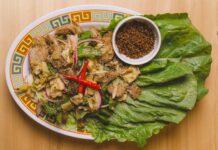
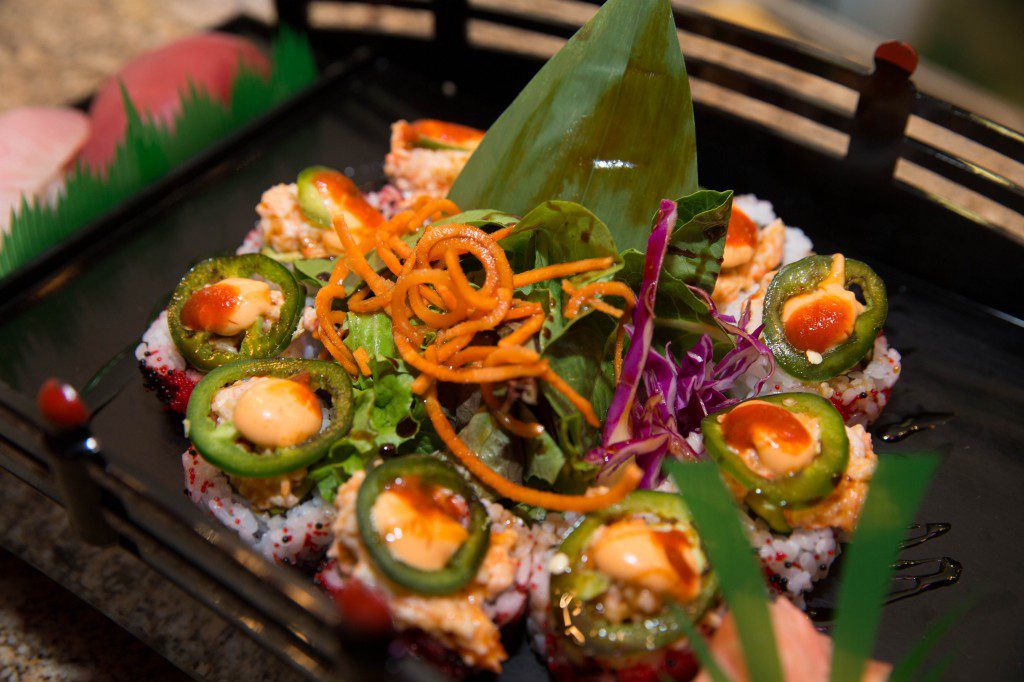
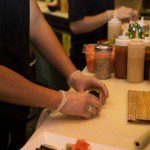
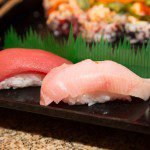
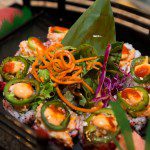
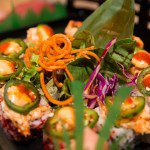
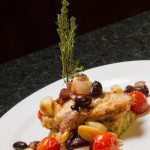
The Ring of Fire roll is served with various nigiri sushi on the side. Photo by Brandon Scott.
Ring of Fire at Akira Sushi Bar. Photo by Brandon Scott.
Ring of Fire at Akira Sushi Bar. Photo by Brandon Scott.
Going out for sushi can feel like an event, which isn’t necessarily bad. But sometimes you’d rather skip the reservations or the wait for seating to become available. Sometimes you don’t want the bother of putting together an outfit. Sometimes, you just want a couple of awesome rolls in an easy, casual setting. If that craving hits you in Owasso, you’re in luck. Akira Sushi Bar brings a more-than-decent selection of sushi combinations to the table along with pleasant, attentive staff and food quality rivaling Tulsa’s hot-spot establishments. That’s not to say Akira suffers from lack of atmosphere.
Owners Quinton Wong and Chef Huy Huynh, who worked together at a Tulsa sushi restaurant before striking out on their current venture, have created a refreshingly relaxed atmosphere behind an unassuming storefront on the frontage road parallel to U.S. 169. Some may have trouble getting to the shopping center south of 96th Street North, but for those who find it, the experience is one many can and will appreciate. Serving special makimono rolls and fresh sashimi dishes along with entrees of chicken, steak and creatively-made sides, Akira Sushi brings its best to the table, and don’t be surprised if that order arrives sooner than you expect. 9455 Owasso Expressway Frontage Road, Owasso. www.akirasushibars.com
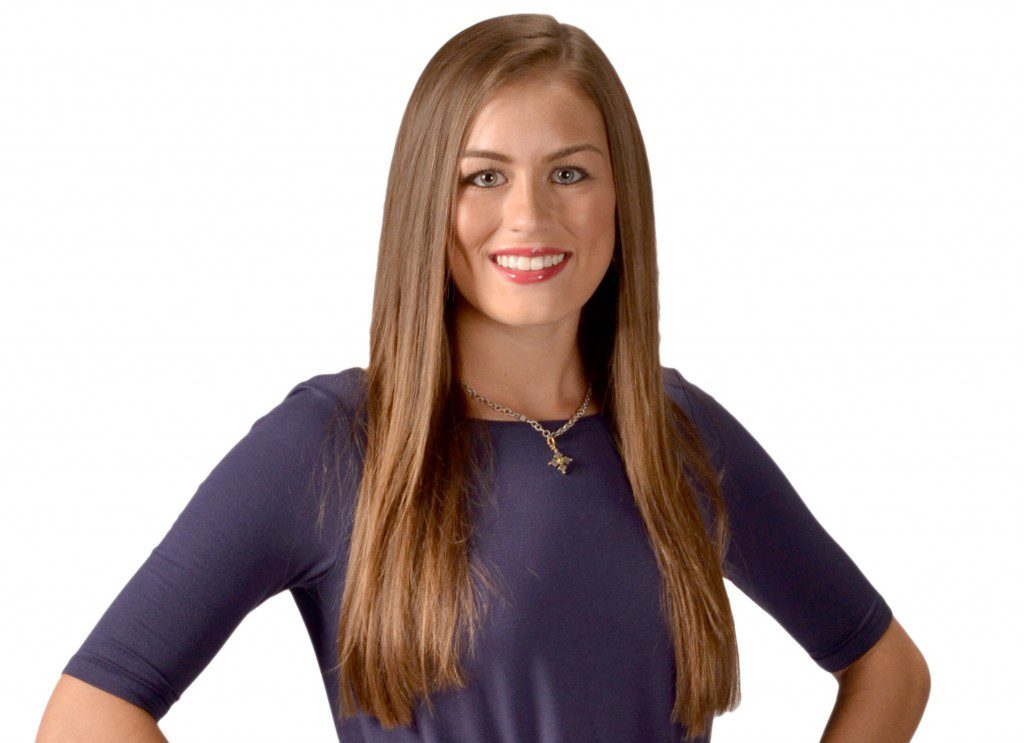
Attending: Harvard University
Major: Computer science and art
What are your career plans?
To design, code, and animate my own games and software. Also, to create programs to spread education on topics that many schools don’t even offer (like computer science) and [to create] organizations to help those without many opportunities.
What led you to want to pursue that field?
My love of coding began by taking a class I never would have taken had my freshman language class program not been canceled. I fell in love with coding and decided I wanted to study it in the long run, along with my other favorite subjects of drawing and art. I realized I also want to help others who may be in a situation where they could never learn about such an amazing and applicable subject in today’s society. I want to help create opportunities for more to learn. I also want to create games that are not just fun to play, but also beautiful to experience – like many of those that have undoubtedly helped to shape who I am today.
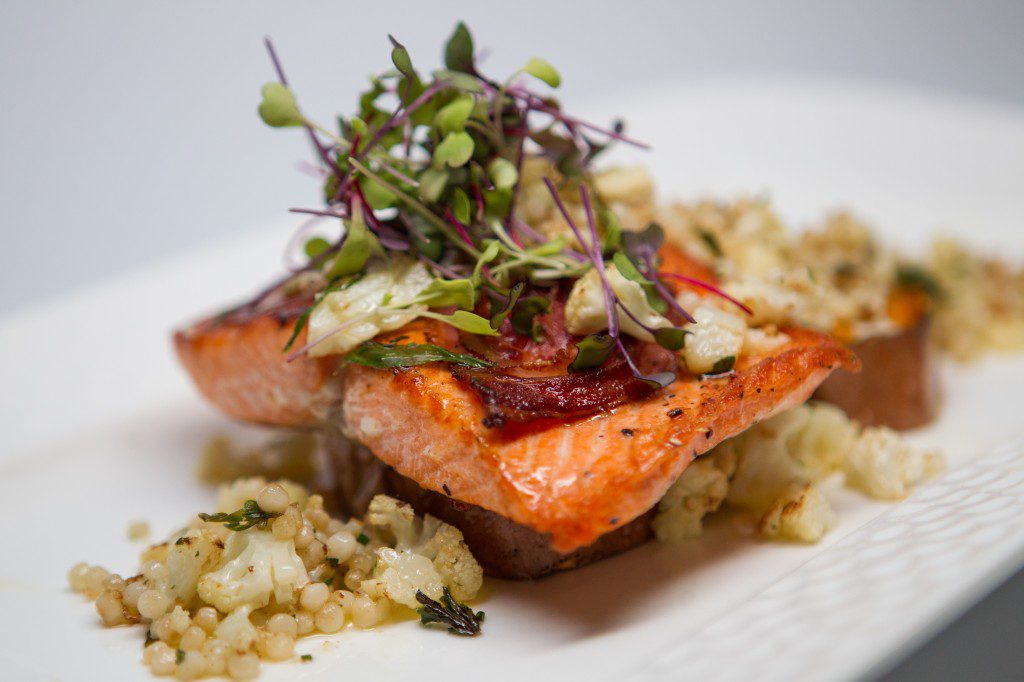
Pancetta crusted salmon is topped with a salad of microgreens and served at District 21 Restaurant. Photo by Brent Fuchs.
Below: A key lime tart is created through collaboration with the culinary arts program’s pastry lab. Photo by Brent Fuchs.
Heirloom tomato and buratta salad at District 21 Restaurant. Photo by Brent Fuchs.
Pork with soy glaze at District 21 Restaurant. Photo by Brent Fuchs.
T-bone steak at District 21 Restaurant. Photo by Brent Fuchs.
Pancetta crusted salmon is topped with a salad of microgreens and served at District 21 Restaurant. Photo by Brent Fuchs.
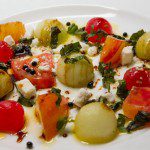
Melon salad at District 21 Restaurant. Photo by Brent Fuchs.
Molten lava chocolate cake at District 21 Restaurant. Photo by Brent Fuchs.
Entering District 21 is not like walking into a traditional classroom. Dark wood dining tables and upholstered chairs stand in for desks. There’s no chalkboard; a rich gold banquette lines the wall. And students don’t complete their work on pencil and paper. Assignments are presented on white plates.
District 21 Restaurant is operated by Francis Tuttle Technology Center’s culinary arts program. It is here where students ready to graduate unite the skills and crafts acquired and honed through various culinary classes.
“District 21 is like a capstone class for [students about to graduate],” says Marc Dunham culinary director at Francis Tuttle. “It provides a venue for students to bring what they’ve been learning and practicing into a venue with customers, and bring it into context.”[pullquote]“We have an advantage over other restaurants in that we can be very experimental and take risks because we are an educational facility … People are a little more adventurous when they step foot in our restaurant because they’re participating in somebody’s education.”[/pullquote]
The challenges faced at District 21, he says, are ones that students will encounter in the real world.
“The pressures of time and customers’ wants and needs – we’re trying to incorporate that into the educational experience prior to students going out to get a first job. If the student is engaged, they are better prepared to enter the workforce and be more successful.”
District 21 recently completed its first year in business and is preparing to reopen Aug. 12 with new students in the kitchen. As Dunham points out, patrons to the restaurant tend to be a little more forgiving, but Chef Carlos Martinez, restaurant director at District 21, makes sure that diners receive the best food possible. Students are held to the standard of paying customers, and the kitchen does not allow mistakes to be sent out. If a dish is not executed correctly, says Dunham, the student starts over.
“We have an advantage over other restaurants in that we can be very experimental and take risks because we are an educational facility, and that’s good for us and for Oklahoma City. People are a little more adventurous when they step foot in our restaurant because they’re participating in somebody’s education,” says Dunham.
And part of that education is turning out beautiful plates. Steaks, short ribs, seafood and charcuterie all make regular appearances on a menu that changes on a near-weekly basis.
“We have things that hang around [the menu] for a while, but Chef Carlos likes to be creative, and a lot of what is on the menu is driven by in-season produce along with collaboration by instructors in other parts of the culinary program,” Dunham says.
Desserts served at District 21 are brought in from the pastry lab; the charcuterie plate – a collection of cured meats – are all made in-house. Dunham expects more pasta dishes to be added to the new menu, a great move given that Chris Becker, the owner of Della Terra Pasta – an Oklahoma City kitchen that lovingly prepares fresh pasta by hand – is part of the Francis Tuttle culinary arts team.
“We want as many people to come [to District 21] as possible, because the more they come, the better education these kids receive,” says Dunham. “They will be the next wave of chefs in our state.” 12777 N. Rockwell Ave., Oklahoma City. www.d21dining.com
Whether public or private, in boom or bust times, universities benefit in numerous ways from their alumni. Those who have earned their degrees and left the hallowed halls of their alma maters continue to contribute to institutions of higher learning across the country – and Oklahoma is no exception.
Much of the alumni contribution takes the form of a financial boost, though attaching an exact dollar figure to it is difficult.
At Oklahoma State University, for example, alumni giving helped push the current fundraising campaign, “Branding Success: The Campaign for OSU,” over its $1 billion goal last year, says Jim Berscheidt, senior associate vice president for marketing and communications. The campaign has been active for more than six years and will continue until Dec. 31, as remaining projects still require funding, he says.
“Tens of thousands of alumni are helping make the transformational campaign a huge success and impacting the lives of current and future students,” Berscheidt says. “Many alumni have created new scholarships for OSU students, supported the expansion of academic programs or helped create new ones, and contributed to improving university facilities through renovation or new construction projects.”
Alumni contribute not only money but time invested in morale-boosting university events.
This becomes most noticeable during the school year, when thousands of OSU alumni return for sporting events, commencement exercises and homecoming festivities, according to Alumni Association Director of Communications Chase Carter. The Alumni Association also works with more than 300 volunteers nationwide to support its 100 regional groups, which last year hosted more than 900 events with more than 25,000 alumni and fans in attendance, says Carter.
But such efforts are by no means limited to the state’s largest universities. Every little bit helps during trying economic times, and morale remains important to any educational institution, including smaller ones.
At Oklahoma City’s Mid-America Christian University, alumni are an important force behind positive growth, says Carol Alsip, associate director of annual campaigns for the college.
“There are several different avenues in which our alumni support us,” Alsip says. “Some [support] financially, some teach for us in the traditional College of Arts and Sciences in our one-night-a-week, on-campus College of Adult and Graduate Studies program, and some even through our online program.”
The process by which colleges reach out to alumni is itself multifaceted. Social media and electronic giving play an increasingly significant role, Carter says.
But regardless of the means by which they accrue, financial contributions will always be vital to a university’s continued success, thus placing a high value on effective outreach to those in a position to give.
“The OSU Foundation encourages alumni giving by inviting them to participate in activities throughout the academic year and talking directly to alumni about how their gifts make a difference in students’ lives,” Berscheidt says.
Smaller universities, meanwhile, look for new ways to reach out to former students. MACU does not currently employ an alumni director, Alsip says.
“But we are researching ideas and ways of further engaging our alumni until we have the capacity to add that position,” she adds.
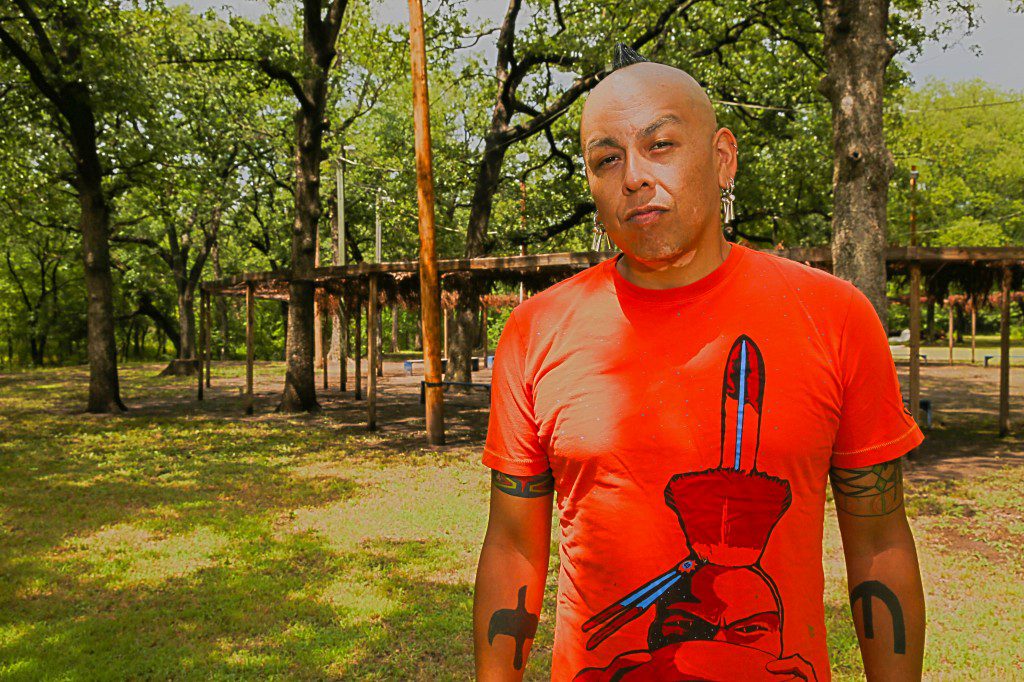
Bunky Echo-Hawk, wearing one of his own designs, exercises his voice through art.
Photo by Brandon Scott.
Charlie Soap tells the story of he and his late wife, Wilma Mankiller, on a quest to bring water to a rural community in the 2013 film The Cherokee Word For Water.
Luck favors Charlie Soap. His quest to bring water to the rural community of Bell, Okla., in the 1980s brought him into the orbit of Wilma Mankiller. The young activist cut her community development teeth on the Bell Water Project and later became the first female chief of the Cherokee Nation of Oklahoma. Married in 1986, the two were inseparable until her death in 2010.
Two years later, Soap set out to tell the Bell Water Project story on the big screen, but to do it, he’d need to tell his wife’s story, too.
“In the beginning, I was very apprehensive about the movie,” Soap, also Cherokee, says. “I wanted to make sure it was done right. I’ve seen plenty of films that didn’t do justice to the people whose story they told. They could’ve been done better. I was really nervous about doing Wilma’s story.” [pullquote]”After we showed the movie, it got a standing ovation, and people were talking about projects for Moore. It was a very heartwarming experience,” he says.[/pullquote]
While The Cherokee Word for Water was his first film project, telling stories with pictures wasn’t new to Soap. An accomplished photographer, he was accustomed to chronicling events with images. Learning the technical aspects of filmmaking didn’t slow him down nearly as much as the deja vu that came with directing such a personal story.
“It was difficult for me to get into at first. The executive producer, Paul Heller, noticed that I was holding back. After thinking about it, I realized it was too new for me because Wilma had only passed about a year earlier. It was too fresh and painful. I took some time off but came back saying, ‘This is my story. This is mine and Wilma’s story. I can do this. Let’s do it right. Let’s make a movie,’” he says.
Mirroring the story it tells, the film itself is a community effort, from the extras pulled from the Bell area to the film’s distribution. It’s currently available at select screenings around the state. The screenings are typically hosted by activist groups working in the communities where they’re held. Soap hopes the film will inspire audiences to take on their own community development projects. So far, it’s hit the mark.
“The movie really inspires people. We screened it in Moore a week after [the 2013] tornado. On my way to the theater, I was worried nobody would show. When I got there, the place was full. I was really surprised that people came to see it. After we showed the movie, it got a standing ovation, and people were talking about projects for Moore. It was a very heartwarming experience,” he says.
Until finances permit, The Cherokee Word for Water won’t see a big release. But while its distribution might not be as widespread as for a Hollywood feature, its production values and story make it worthy of wide release. The film has sparked interest in other projects, including a documentary film about Mankiller.
“We were advised by people in the business to take this movie directly to the public and see what kind of reception it gets. We’ve been doing that for a couple of years, and the response has been great. Wilma was well known and very popular. The theaters sell out,” he says.
Even as school cafeterias offer more choices to students, some parents still opt to send their children to school with a packed lunch. No matter the reason, parents strive to pack lunches that are healthy and appealing.
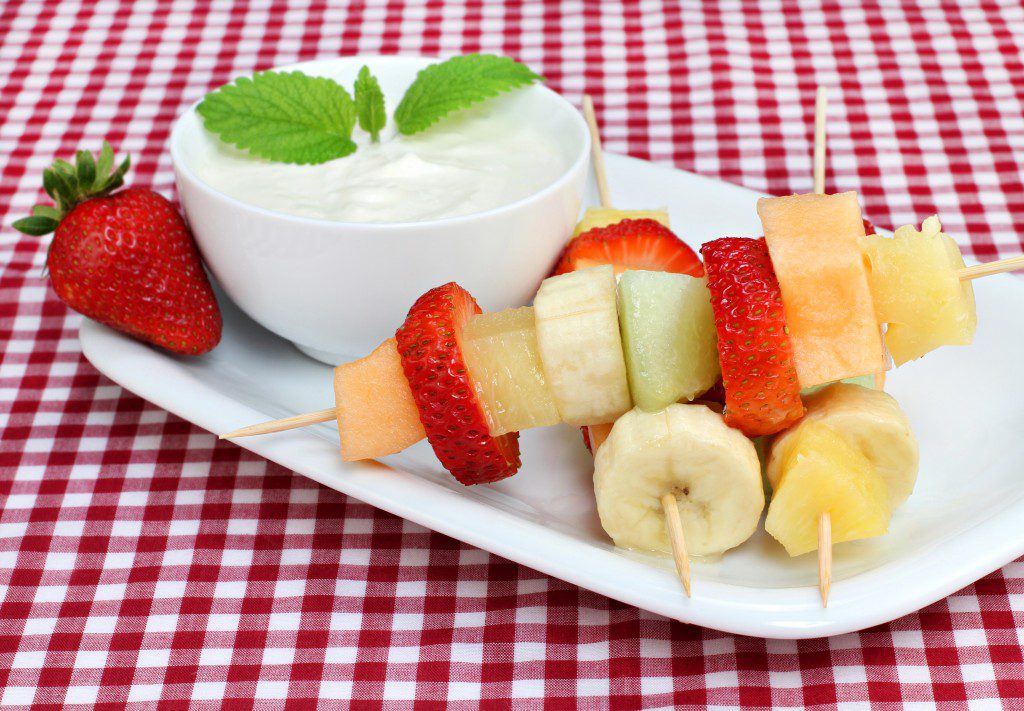
“Eating a rainbow” is more than a pretty metaphor. With fruits and vegetables, different colors generally signify an abundance of specific nutrients. Orange produce is high in vitamin C and beta-carotene. Red is indicative of heart-healthy foods. Yellow foods tend to be high in potassium and aid in digestion. Green foods are often high in iron and help strengthen the immune system. Purple vegetables and fruits could be called “brain food” – not only are these foods good for your memory, they can also help prevent some forms of cancer.
Make these healthy foods appealing for kids by threading them on a toothpick or skewer and providing a healthy dip. Ranch dip is a good choice for veggies, while a simple yogurt dip is scrumptious with fresh fruit. Luscious Low-fat Yogurt Dip
1 small container vanilla yogurt
1-2 tbsp. lime juice
1/2 tsp. finely grated lime zest
1-2 tsp. honey
1/2 tsp. vanilla
In a small bowl, combine all ingredients. Serve with fresh fruit. Makes about one cup.
Half-rack of Lamb Percillade at La Baguette Bistro & Bakery. Photo by Brent Fuchs.
Baked brie at La Baguette Bistro & Bakery. Photo by Brent Fuchs.
Roasted beets and Manchego cheese at La Baguette Bistro & Bakery. Photo by Brent Fuchs.
Half-rack of Lamb Percillade at La Baguette Bistro & Bakery. Photo by Brent Fuchs.
Chicken confit Mediterranean at La Baguette Bistro & Bakery. Photo by Brent Fuchs.
Chocolate mousse at La Baguette Bistro & Bakery. Photo by Brent Fuchs.
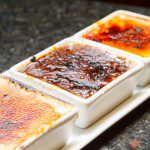
Trio of brulees at La Baguette Bistro & Bakery. Photo by Brent Fuchs.
La Baguette Bistro & Bakery. Photo by Brent Fuchs.
Some say the best part of any meal is dessert. While the desserts at Oklahoma City’s La Baguette Bistro & Bakery have assumed an exalted status, the rest of the menu is also worthy of exploration. Started in 1988 by brothers Alain and Michel Buthion, this happy little melt of French and American cultures is a regular stop for many Oklahoma City dwellers picking up French bread loaves, cakes and pastries from the bakery portion. The bistro is also a favorite place for locals to bring out-of-towners for authentic French flavor. From simple dishes, such as French onion soup and Croque Monsieur – a kind of ham and cheese sandwich – to more complex fare, like mussels or succulent roast duck, La Baguette Bistro brings a delicious twist to tradition. And if dessert is still on your mind, the chocolate mousse cake is a local favorite. 7408 N. May Ave., Oklahoma City. www.labaguettebistro.com
Quiche at Florence Park Cafe. Photo by Brandon Scott.
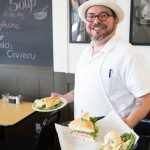
Florence Park Café owner Jonathon Haring brings fresh tastes to customers. Photo by Brandon Scott.
Quiche at Florence Park Cafe. Photo by Brandon Scott.
Florence Park Cafe. Photo by Brandon Scott.
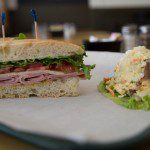
Ham sandwich with homemade potato salad at Florence Park Cafe. Photo by Brandon Scott.
Growing up, Jonathon Haring’s mother insisted that her sons learn how to do three things: sew, cook and laundry. Haring later worked as a photographer for the Tulsa World, but he never lost a passion for cooking and baking. Joking that he needed a vocation with tighter deadlines and more stress, he opened Florence Park Café earlier this year in the location that previously housed Luna Bread. Haring’s slogan – “Nothing fancy, but everything fresh” – speaks volumes about his philosophy regarding food.
“I want food to taste like food. There’s nothing out of a mix or with a lot of preservatives,” he says. “Everything starts from scratch.”
Although Haring caters private dinners, the restaurant focuses on breakfast and lunch. Florence Park Café serves breakfast all day along with sandwiches, homemade soups, fresh bread and more. Haring also offers vegetarian and vegan options each day. 3144 E. 15th St., Tulsa. 918.619.6300
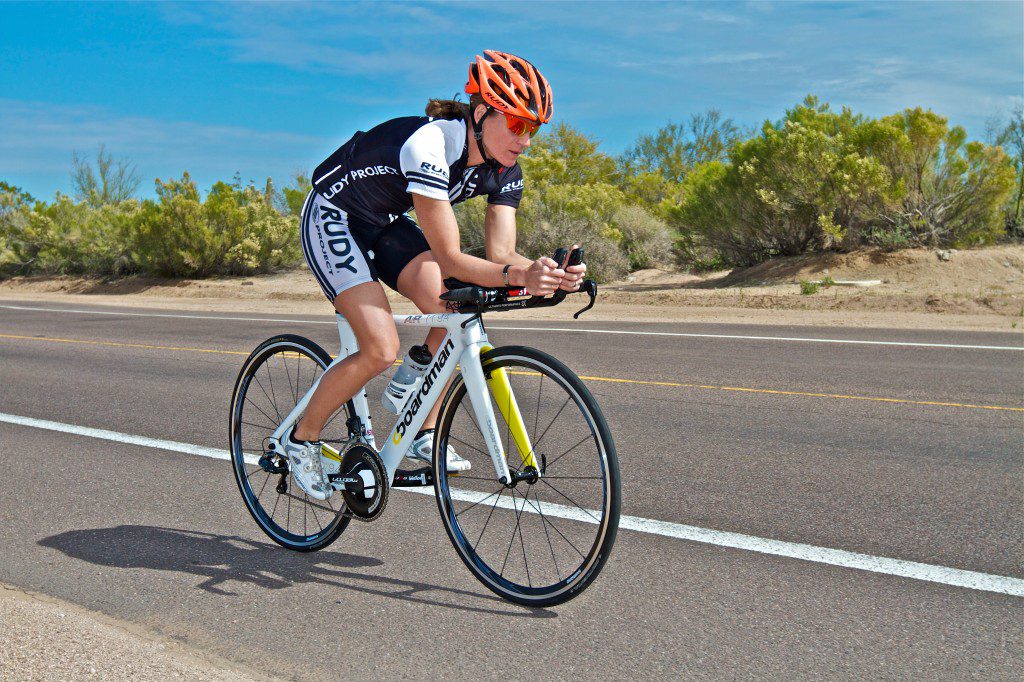
Dr. Amanda Stevens competes professionally in triathlons all over the country. Photos by Randy Sadler.
Dr. Amanda Stevens competes professionally in triathlons all over the country. Photos by Randy Sadler.
Dr. Amanda Stevens competes professionally in triathlons all over the country. Photos by Randy Sadler.
Dr. Amanda Stevens competes professionally in triathlons all over the country. Photos by Randy Sadler.
Dr. Amanda Stevens competes professionally in triathlons all over the country. Photos by Randy Sadler.
Dr. Amanda Stevens competes professionally in triathlons all over the country. Photos by Randy Sadler.
Dr. Amanda Stevens competes professionally in triathlons all over the country. Photos by Randy Sadler.
Dr. Amanda Stevens competes professionally in triathlons all over the country. Photos by Randy Sadler.
Dr. Amanda Stevens competes professionally in triathlons all over the country. Photos by Randy Sadler.
Oklahoma native Dr. Amanda Stevens has been pushing her body to its limits since she was a child, and now she has reached her own mountaintop as a professional triathlete. She is committed to empowering children across the nation, and primarily in Oklahoma, to do the same. In addition to competing professionally, Stevens travels the nation as a motivational speaker.
In what is your passion for fitness and competition rooted?
I grew up a competitive swimmer, and as a child, swimming was definitely where my heart was. I was lucky enough when I was in medical school at OU to get involved in the sport of triathlon, and I was on the fast track to the professional rank. I’ve been racing as a professional now for about 10 years…That’s pretty much been my full-time job, and I’m blessed and grateful that I get to compete in this way for a full-time job because it’s absolutely what I love doing. It’s allowed me to travel the world and meet other athletes and like-minded people and really experience life.
How instrumental has your medical background been in your athletic career?
I’m not practicing medicine right now. It was a tough decision to make, but I couldn’t put my whole energy into medicine and my career as a triathlete at the same time. But I still dabble a little bit here and there, mainly through promoting health and wellness. I spend a lot of time helping kids develop healthy eating habits, teaching them to exercise and encouraging them to follow their dreams. I also coach a team of triathletes, and I think that’s where the bulk of my medical experience comes [into good use].
Did your passion for sports spark your interest in science and medicine, or vice versa?
I think they go hand-in-hand. I grew up swimming and playing other sports. I didn’t really get the bug for medicine until I was in junior high. We had a science class, and I did my first dissection. I thought it was the most awesome thing in the world. So I went home that night and told my parents I wanted to be a doctor, and they were kind of thinking, “Where did that come from?” because none of my family or extended family were doctors. But then in high school, I grew to really love science and chemistry; and in college at Texas Christian University, I became really interested in anatomy and physiology, so I continued on the pre-med track.
How big is the need for fitness education, particularly in Oklahoma?
I think it is huge. I’m living and training my team in Boulder, Colo., now. If you look at [Boulder and Oklahoma] as far as demographics, Boulder is one of the healthiest places in the country, and Oklahoma is almost always in the bottom couple of states in regards to health. There’s a stark difference. When my athletic career is over, my husband and I will most likely settle back in Oklahoma, and I really hope to have more of an impact here in the state. Childhood obesity is still on the rise in Oklahoma. A huge amount of kids are overweight, and I think that’s going to set them up not only for health problems, but potentially [problems in] many other areas of life.
What are some of the things you’re planning for in the near future?
I have two world championship events coming up in September. My primary focus for those events is to not only be on the podium, but also be on the top of the podium. I can see myself racing as an athlete for two or three more years. After that, it’ll be time to pass that up, and my husband and I will settle down and start having some kids. At that point in my life, I think I’ll get back into medicine and hopefully be able to make a huge impact in Oklahoma on health and wellness.
The Mill City Museum is a fascinating study in history and structure. Photo courtesy Minnesota
Historical Society.
Weisman Art Center. Photo courtesy Meet Minneapolis.
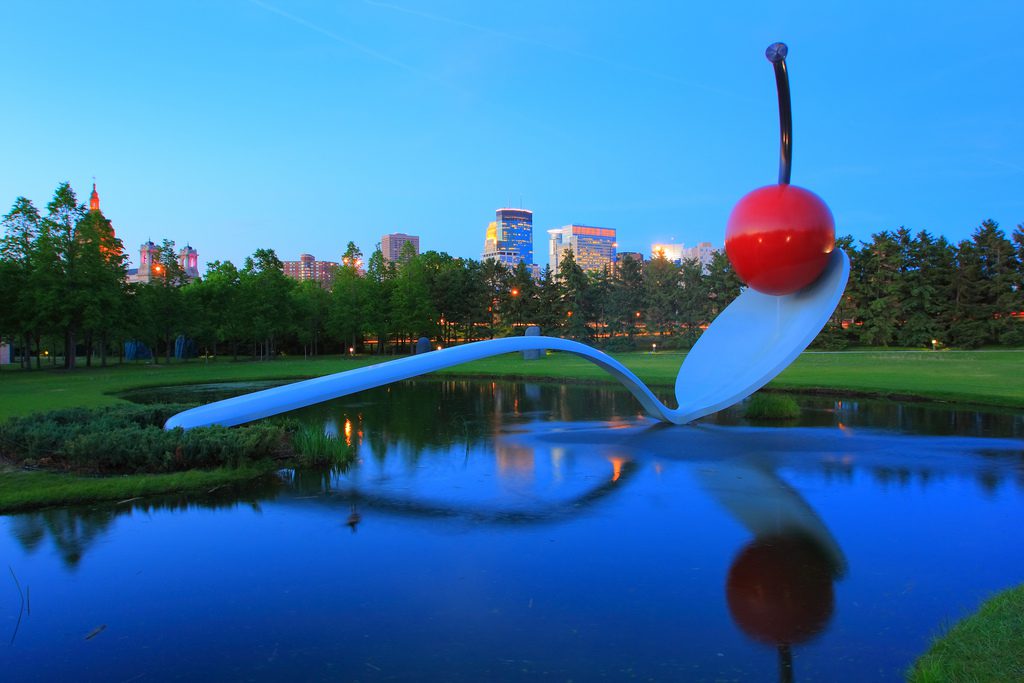
Claes Oldenburg and Coosje van Bruggen’s Spoonbridge and Cherry is a highlight of the Minneapolis Sculpture Garden near the Walker Art Center. Photo courtesy Meet Minneapolis.
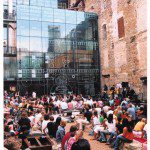
Locals and visitors gather outside Brits Pub on Nicollet Mall for fantastic views. Photo courtesy Meet Minneapolis.
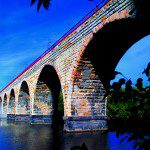
The historic Stone Arch Bridge over the Mississippi River. Photo courtesy Meet Minneapolis.
In a matter of weeks, trees covered in lush green leaves will soon break into their autumnal spectrum. Hazy summer bliss, however, lingers and bids late vacationers to make their plans before the first frosty morning. In Minneapolis, that’s usually around October, but in August, the western half of Minnesota’s Twin Cities is a balmy treasure of fine attractions, and the arts are rampant. If Minneapolis is on the radar for a quick out-of-town getaway, the City of Lakes is abound in sophisticated culture with alcoves of quirky charm throughout. Those who look for it will find Minneapolis a thriving metropolis filled with a spirit of discovery from its history to the present. Get a closer look at the beauty, architecture and art of a city that knows what it is to live in a masterpiece.
Mill City Museum Minneapolis was once the flour mill capital of the world, and the Mill City Museum stands as a reminder of those days. Constructed into the ruins of what was once the Washburn A Mill built in 1874, the museum was created by the Minnesota Historical Society after the Minneapolis Community Development Agency cleaned up the abandoned site and fortified its aged walls. In its milling heyday between 1880 and 1930, the mill turned out enough flour to make 12 million loaves of bread daily. Today, Mill City Museum exhibits old factory equipment, an interactive Water Lab highlighting the impact of nearby St. Anthony Falls on local industries, a ride up the Flour Tower, the Baking Lab and an explosive surprise. www.millcitymuseum.org
Weisman Art Center Located on the University of Minnesota campus in Minneapolis, the Weisman Art Center features a stunning collection of work by such 20th century American artists as Georgia O’Keeffe and Marsden Hartley as well as art across all disciplines. But the art isn’t just on the inside – the Weisman Art Center was designed by Frank Gehry, the architect famed for creating the ribbon-like splendor in effect at downtown Los Angeles’ Walt Disney Concert Hall and at the Guggenheim Museum Bilbao in Spain as well as the Cubist-inspired Ray and Maria Stata Center at MIT. The Weisman is a teaching center, which means the art created and shown there is ever-changing and evolving. www.weisman.umn.edu
Walker Art Center The Walker Art Center’s prestige goes deep like its long-established origins – when lumber tycoon T.B. Walker built a room onto his house in which to hang his 20 favorite paintings, he opened the doors, allowing anyone who wanted to view them inside. That beginning in 1879 was the catalyst for an institution that has grown into an internationally recognized center for visual arts, performing arts and creativity. Housing a diverse and expansive range of contemporary art, the campus also includes exhibition galleries, performance spaces, architectural marvels and the Minneapolis Sculpture Garden, home to brilliant landscaping, water features and sculptures. The most famous of its artworks, Claes Oldenburg and Coosje van Bruggen’s Spoonbridge and Cherry, has become iconic of the city itself. www.walkerart.org
Guthrie Theater When the founders of the Guthrie Theater started it in 1963, their goal was to create a first-rate acting company devoted to producing classic work out-of-reach from commercially driven Broadway. Sir Tyrone Guthrie and his partners accomplished that goal and created a center focused on theater excellence and education. In 2006, construction was completed on a new facility featuring three stages, a coffee bar, restaurant and the Endless Bridge – a cantilevered lobby extending more than half a block from the theater toward the Mississippi River. The design helped earn architect Jean Nouvel the Pritzker Architecture Prize. Currently, the theater features productions of My Fair Lady and Christopher Durang’s 2013 Tony Award-winning Best Play Vanya and Sonia and Masha and Spike through the month of August. www.guthrietheater.org
Stone Arch Bridge Minneapolitans love their historic Stone Arch Bridge so much that they hold a festival for it every June. The rest of the year, residents and visitors alike admire the old bridge, which was built in 1883 as a railroad crossing over the Mississippi River. Made of granite and limestone for its entire length, the bridge is now for pedestrians and bicycle riders only, and as part of the Saint Anthony Falls Historic District, it is on the National Register of Historic Places. Located just below Saint Anthony Falls, the bridge is a lovely foreground to shots of downtown Minneapolis and the skyline. It’s also a favorite gathering place. www.stonearchbridge.com
Nicollet Mall Nearby Bloomington’s Mall of America seems to be the most famous mall in the Twin Cities region, but Nicollet Mall is Minneapolis’ commercial heart. Running for 12 blocks on Nicollet Avenue, the stretch is a picturesque pedestrian district running through downtown and lined with such stores as Saks Fifth Avenue OFF 5th and Macy’s. The district is also known for its theaters, restaurants and nightspots, many located within some of the town’s historic buildings. On Thursdays, the Nicollet Mall Market sets up with produce vendors and more.
At A Glance
Access: Arrive in Minneapolis through the Minneapolis-Saint Paul International Airport. Get around town by a light rail system, city buses and taxis. Commuter trains run to Saint Paul and the suburbs. The city also features many dedicated bike lanes. Climate: Temperatures in August average in the low 80s and drop about 10 degrees each successive month through fall and winter. Main attractions: NFL Minnesota Vikings, Minnehaha Falls, Basilica of Saint Mary, NBA Minnesota Timberwolves
Festivals
Minnesota Fringe Festival: Fringe festivals – those showcases of theater and performance arts that take over cities in a flurry of unbridled creativity – are turning up everyone around the world, but one of the oldest and largest of them hits Minneapolis every summer. The Minnesota Fringe Festival this year features 169 performances across 11 days at 19 venues from July 31 to Aug. 10. Exciting and unique, Minnesota Fringe frequently uncovers cool new talent and voices in arts. www.fringefestival.org/2014/ Ethnic festivals: We usually think of Nordic heritage when we consider the early days of Minnesota statehood and immigration, but the region also is steeped in Celtic culture. That tradition is celebrated with the Welsh North American Association’s North American Festival of Wales, and visitors get to experience all the hallmarks, including songs, Welsh food, crafts and art. A line-up of lectures is also scheduled for Aug. 28-31 (www.thewnaa.org). Also in August, look for Irish Fair of Minnesota (www.irishfair.com), FinnFest USA 2014 (www.finnfestusa2014.org) and the Twin Cities Polish Festival (tcpolishfestival.org).
Stay In Style
W Minneapolis Hotel: Tulsa isn’t the only city with stunning Art Deco architecture: The Foshay Tower was constructed in 1929 just before the stock market crash that sent the U.S. into the Great Depression. Today, it is the W Minneapolis. Sumptuous for its time when it was built, the W Minneapolis is still decadent with a contemporary elegance that complements this historic structure. Visitors frequently remark on the views from the 30th floor observation deck and the Prohibition Sky Bar on the 27th floor. www.wminneapolishotel.com Le Meridien Chambers Hotel: A weekend of the arts deserves a stay in accommodations created for both aesthetic and physical comforts. The luxurious Le Meridien Chambers Hotel is located in the heart of the city close to Nicollet Mall and the Hennepin Theater District. Classic luxury and the arts blend seamlessly with more than 200 art works displayed throughout this boutique hotel located in two landmark buildings. So committed is Le Meridien Chambers that the hotel partnered with the Walker Art Center. The key card guests receive at Le Meridien and Minneapolis Art Hotel opens more than just a room door. www.lemeridienchambers.com