Home Blog Page 735

Inner Space

To the uninitiated, navigating downtown Tulsa’s streets can be a challenging proposition. With a seemingly random array of one-way streets joined with two-way thoroughfares, finding one’s way to an intended destination in the heart of Oklahoma’s second-largest city can fray nerves.

Yet it is what happens after arrival at a destination that frustrates both the occasional visitor and seasoned downtown denizen alike. Finding the ideal place to park can either make or break one’s view toward Tulsa’s downtown. With private and public parking areas spread across a wide swath of downtown, the parking proposition often boils down to a question of proximity and physical stamina. It is a quandary that has not gone unnoticed by both public and private parking administrators and one that both view as one of the most important issues facing Tulsa’s vibrant and growing downtown.

Space: The New Frontier

“The challenge is to change the mindset and start dealing with parking like any other infrastructure,” says Tulsa Parking Authority (TPA) Director David Giacomo. “As a whole, it doesn’t take much more pressure in a system to make you have to add more spaces.”
Citing census figures, Giacomo says downtown Tulsa plays host to 30,041 in-bound commuters daily, while serving these commuters with 22,345 privately administered parking spaces. These private parking slots are augmented by 7,696 public parking spaces. Of these public parking spaces, 1,696 are metered parking.

Despite a robust surge in downtown residential dwellings, downtown Tulsa’s parking industry is a day game, dictated by the ups and downs of a commercial area that, despite Tulsa’s loss of the title “Oil Capitol of the World,” remains exposed to the fickle nature of the oil and gas industry. As the energy sector steadily recovered from the jolt of 2008’s economic recession, Giacomo says a visual gauge of the recovery can be seen in the number of occupied public slots in the heart of downtown’s traditional business areas. “We have noticed an increase in occupancy in what we call the ‘super block.’” The “super block” area, Giacomo explains, is the area surrounding the Bank of Oklahoma Tower.

With the heart of the business district straddling Boston Avenue from approximately Sixth Street and stretching to First Street, Giacomo says one of the biggest liabilities facing the city’s public parking offerings isn’t so much one of availability as it is one of access. “The reality is it’s too far from anywhere,” he says, pointing to what he describes as underutilized surface lots on downtown’s southern boundaries as an example. “It’s a little bit far from the core of downtown.”

For private parking companies such as Central Parking, proximity to the action has proven a lucrative and enduring endeavor. Operating approximately 4,500 spaces in the heart of downtown’s business district, Standard Parking Corporation Executive Vice President Mike Wolf says his company’s Central Parking division has enjoyed a presence in downtown that has endured for well over three decades. The surge in oil and gas industry activity has had a positive impact on his company’s Tulsa operations, as well. “As the Tulsa economy has grown over the last 48 months, we have definitely seen an increase in demand for parking,” he says. With the Tulsa area shielded from the full fury of the economic cyclone that lashed the nation nearly five years ago, Central Parking’s growth represents a continuation of a trend brought about by Tulsa’s newfound affinity for all things downtown that began at the turn of the century.

Stay And Play

Not so long ago, the area stretching from Brady on the west to Greenwood on the east, and with a southern boundary of First Street extending north to I-244, stood as a shining example of an area grasping at any semblance of life that might come its way. After a little vision met up with some old-school desire, the area now proudly holds the distinction as one of downtown Tulsa’s go-to places for seemingly limitless entertainment options. Home to one of the best minor league baseball venues in the country, in the form of ONEOK Field, and the chic Brady Arts District, the area has proven both a source of opportunity and challenge where parking is concerned.

“Brady is a funny area,” Giacomo concedes. “I think there’s a big potential in Brady.” With the recent relocation of KOTV television’s studios to the Brady area from its long-time home at the corner of Second and Elgin, the business aspect long associated with the area south of First Street has finally crossed the railroad tracks that served as something of a dividing line in downtown thinking, and it has forced parking planners to analyze and reanalyze the needs of Tulsa’s new “it” area. “I think we have done six studies, and they are ongoing,” Giacomo adds.

The private sector is keeping a close eye on the Brady District, as well. With a tight parking market also comes the inevitable plea for more spaces. And often, that involves a plea for additional parking garages. “To build a garage, a lot goes into the thought process,” Giacomo says. “A garage cannot pay for itself.” Monthly garage parking fees range from $85 to $130 per month, he explains, and are determined by a use-demand formula.

“Whether, and how much, the increased demand actually benefits any particular parking garage actually depends on the exact location of the demand, the hours when the demand exists and the number of parking spaces available in the area at that time,” Wolf says.

As downtown Tulsa’s entertainment offerings have blossomed, a new class of permanent downtown residents has followed the fun. And parking planners have taken notice. “Residential growth in downtown has certainly helped contribute to the overall growth in downtown Tulsa. As Tulsa continues to grow, we normally would expect to see additional parking demand as a result,” Wolf says. “As that occurs, we will continue to pursue opportunities that would align with our business model.”

“It depends on the demand generator,” Giacomo says of any potential parking garage construction. “We’ve had a lot of inquiry about residentials.” Giacomo explains that recent residential conversions have put pressure on a parking garage at Fourth Street and Boulder, and new construction on Archer Street is expected to put additional pressure on already-tight parking inventories in the Brady District.

A Soft Landing

The brave face of Tulsa’s revived downtown and its continuing mission to join the big leagues of American cities remains a work in progress. As downtown Tulsa continues to develop its 21st century identity, infrastructure issues will rear their heads now and then. Parking infrastructure challenges are a symptom of a downtown awakening after a decades-long nap. Although absent from any official plans in the short-term, innovations such as the construction of new garages to meet the needs of new residential developments and shuttles to facilitate business commutes from downtown’s southern extremes into the heart of Tulsa’s business world may someday prove viable resources. It’s simply a question of when and how.

Endangered Oklahoma

Oklahoma is home to 20 animal species that are considered endangered or threatened. Some of these species, like the Whooping Crane, are only temporary residents, passing through the state during yearly migrations or stopping for a few months to breed. Others, like the small catfish Neosho madtom, are only found primarily in Oklahoma.

One ongoing conservation program in the state concerns the red-cockaded woodpecker. These black-and-white striped birds make their homes in live, mature, old-growth pine trees in McCurtain County Wilderness Area in southeast Oklahoma.

“In Oklahoma we have only one population of woodpeckers left,” says Mark Howery, wildlife biologist with the Oklahoma Department of Wildlife Conservation. “Since 1992 we’ve been working to improve the safety of the trees and the habitat around the trees.”

Some of these measures include building guards around the bottom of the trees to deter predators and ensure the health of the pine forest these birds call home. There is also an effort to diversify the Oklahoma population of woodpeckers. There are only about 60 living in Oklahoma and about 6,800 in the U.S.

The black-capped vireo’s recovery is a great success story of Oklahoma conservation. The only population in Oklahoma is in the Wichita Mountain Wildlife Refuge and on Fort Sill near Lawton. The birds only produce a few offspring every year, and its population was ravaged by habitat destruction and brown-headed cowbirds. These cowbirds lay their eggs in the nest of black-capped vireos, and when the much larger cowbird chicks hatch, they kill or overpower the vireo chicks and are raised by the vireo mother.

Efforts to combat the cowbird population and to preserve the scrubland of the Wichita Mountain Wildlife Refuge have been incredibly successful. 

“Over the last 25 years, the population has grown from about 85 birds to around 4,000 birds,” says Howery.

Even with success stories like these, conservationists in Oklahoma and around the country have an uphill battle to fight.

The U.S. Congress apportions around $100 million annually for endangered species conservation, and only between $80,000 and $100,000 of that money makes its way to Oklahoma each year. With funding like this, the state’s conservationists are forced to spend the money where it can do the most good, which means that many of the state’s 11 threatened or endangered species of fish, crustaceans and mollusks are left out due to the difficulty of working in state waterways.

“I don’t want to say that $100 million a year is chump change, but when you spread $100 million across 900 species, there’s not a lot to go around,” says Howery. 


OKLAHOMA'S ENDANGERED SPECIES

Seasonal

Whooping Crane (Grus americana): This unique species of bird resides in Oklahoma during the spring and fall and can usually be found in wetland areas.

Black-capped Vireo (Vireo atricapilla): The tiny songbird passes through Oklahoma between April and September, settling in bushy thickets and forested areas.

Permanent

Gray Bat (Myotis grisescens): The gray bat lives in the Ozark region of Oklahoma, occupying various caves throughout the summer and winter months.

Indiana Bat (Myotis sodalis): These bats live isolated in forested habitats and reside in caves only during hibernation.

Ozark Big-eared Bat (Corynorhinus townsendii ingens) Ozark Big-eared bats are not migratory; their movement is almost always confined within the limestone caves in which they reside.

Piping Plover (Charadrius melodus): This bird resides around wetlands and has diminished in population due to dam construction.

Interior Least Tern (Sterna antillarum): Terns reside in small groups along rivers and lakes.

Red-cockaded Woodpecker (Picoides borealis) This species of bird nests in pine woodlands, much of which have been infected with various fungal diseases.

Arkansas River Shiner (Notropis girardi): Ironically, most Arkansas River Shiners inhabit the Canadian River in Oklahoma, eastern New Mexico and western Texas.

Ozark Cavefish (Amblyopsis rosae): The Ozark Cavefish lives in subterranean water, much of which is threatened by pollution.

Neosho Madtom (Noturus placidus): Found in the Neosho River system, this species of Madtom spends most of its life in regions of water that are inaccessible to other species.

Leopard Darter (Percina pantherina): Leopard Darters travel from shallow, clear pool regions in the summer, fall and winter months, to relatively deep riffles in the spring.

American Burying Beetle (Nicrophorus americanus): The American Burying Beetles inhabit a variety of different regions throughout the year, reproducing each spring and summer inside large mammal carcasses.

Ouachita Rock Pocketbook (Arkansia wheeleri): This treasured freshwater mussel lives primarily in he Kiamichi River in Oklahoma, the Little River in southeastern Oklahoma and southwestern Arkansas and the Ouachita River in Arkansas.

Winged Mapleleaf (Quadrula fragosa): This beautifully shaped mussel exists in shallow rivers and streams all throughout Oklahoma.

Scaleshell (Leptodea leptodon): This freshwater mussel usually lives at the bottom of fast-flowing water.

– Nathan Porter

Carnal Pleasure

There was once a time when the term “meat market” had a literal meaning.

Like its modern contemporary, it was a place where one sought carnal delight. But that’s where the similarities end. In the classic context, meat markets were local, friendly places where neighborhood butchers knew every customer’s name – including the youngest patrons – and had a nearly encyclopedic memory of what most regular customers were coming in for.

Like so many other examples of classic Americana, these true meat markets have fallen, more or less, into fading memory. Yet for those meat markets that have withstood time’s punishing advance, the ability to modernize while maintaining yesteryear’s folksy approach to doing business has proven the difference between becoming a memory or a living icon.

By any definition, 100 years is a long time for a business to keep its doors open. But that’s exactly the distinction enjoyed by Oklahoma City mainstay Bill Kamp’s Meat Market. Standing strong in its 103rd year, owner and manager Bill Kamp says his family-owned business has learned how to change with the times.

“The critical thing is to have a niche, and strive to provide the best quality you can,” he says.

Kamp’s sentiment is a belief shared by Tulsa’s Perry Isom, owner of Perry’s Food Store. Now in its 73rd year of operation, Isom represents Perry’s second generation of ownership. “There’s not a whole lot of markets around,” Isom says of mom-and-pop butcher shops. Specializing in meats while offering a grocery selection as well, Perry’s is a small grocer by modern standards. However, Perry’s recently opened a second Tulsa location to complement its long-running midtown operation. “I’ve gone with the items (customers) can’t get anywhere else,” says Isom.

Where local butcher shops were once the go-to place for even the most basic cuts of meat, the modern butcher shop has morphed into an operation catering to an increasingly knowledgeable and discerning clientele. Kamp attributes the change to the dawn of the internet era, the rise of the so-called “foodie” movement and the comparative ease and availability of international travel when compared to two generations ago. “The business model that I came up in wouldn’t work here,” he says, citing an example of a customer showing an internet picture of a cut and requesting Kamp duplicate it. “We’ve been in it so long, we’ve done it all. It’s just crazy.”

With large-scale supermarkets having virtually eliminated these small-scale meat operations from the cultural landscape, both Isom and Kamp say dedication to the art and a family legacy continue to contribute to their respective success stories. Where large market operations often use industrial saws to harvest their meat, Isom and Kamp speak almost reverently of their butchers’ ability to extract choice cuts, commonly using nothing more than a hand-held knife. “We have an extraordinarily skilled and experienced staff,” Kamp says. “We’re basically doing the same thing we’ve done for 100 years.”

However, undeniable long-term success and a dedicated clientele have not clouded Isom’s vision to the modern realities of small-scale meat markets. “We make it look easy,” he says. “But it’s not easy. It’s a scary business.”

On The Ropes

The comic-book industry has never seen, and will never see again, anything like the explosion that happened in the 1980s, when the proliferation of specialty shops, the influx of maverick independent publishers printing black-and-white books and the rise of collectors and speculators combined to blow the field wide open. Although they were still overlords of the scene, the old-line kingpin companies Marvel and DC found their gates suddenly stormed by upstart titles and creators, often carrying experimental or off-trail content well outside the boundaries of the establishment.

It couldn’t last, of course. And it didn’t. By the early ‘90s, the speculators had fled to other financial opportunities, the comics shops found themselves with stacks of independent product they couldn’t give away, and DC and Marvel were busy flooding the newsstands with so many titles that there was no room left for anyone else. As I once said at a comic-book convention panel discussion, Marvel was Godzilla, DC was King Kong and the rest of us were Tokyo. 

But while it was happening, it was golden, especially to those of us lucky and blessed enough to have been a part of it. My Claremore-based artist partner Terry Tidwell and I got in on the action with the series The Miracle Squad, The Twilight Avenger and The Uncanny Man-Frog, in addition to working with others on separate projects. And because these publishers allowed – and in many cases encouraged – their creators to think beyond adventure and superhero situations, my friend James Vance found an outlet for his brilliant Depression-era tale Kings In Disguise, which had begun life as a play presented by the Tulsa Parks Department a couple of years earlier.

Published by the Wisconsin-based Kitchen Sink Press, which had established itself years earlier as a leading underground-comix imprint, Kings In Disguise went on to win the two biggest awards in the industry, along with international accolades from both within and outside the comic-book community. When it was reprinted by the major New York book publisher W.W. Norton & Company in 2006, Time magazine’s Andrew Arnold wrote, “a groundbreaker of form when it first appeared, Kings In Disguise remains one of the best graphic novels ever published.” 

A tough act to follow? You bet. But Vance and his Kings In Disguise collaborator, artist Dan E. Burr, have done it, and then some, with the brand-new On The Ropes. A sequel to Kings that’s once again published by Norton, On The Ropes finds young protagonist Fred Bloch rolling through the heartland with a WPA circus, and soon becoming involved – as he did in Kings – with the labor-management violence that plagued 1930s America. A sense of impeding tragedy drenches every page, but there’s hope and love as well, all played out in a setting memorably conveyed by Vance’s words and Burr’s drawings. There’s not an inauthentic line, whether drawn or uttered, in the whole book, which reflects the creators’ determination to get it right on every level.
 

“It’s fiction, obviously, but I felt like I had to know what was going on in the world at the time."

“Everything had to be correct, historically,” Vance says. “It’s fiction, obviously, but I felt like I had to know what was going on in the world at the time. And this two-month period, basically, in 1937 (when On The Ropes occurs) was incredibly full of events. With the labor material alone, we’re talking about the Memorial Day massacre – which is in the book – the Little Steel Strike and other strikes all over the place. At the same time all this is going on, the Golden Gate Bridge opens, and Orson Welles is rehearsing (the controversial pro-union musical) The Cradle Will Rock in New York and losing his gig with the WPA Theatre because of it.

“I just wanted to make sure that the story was not only plausible, but also accurate, and that it was all placed within the correct framework,” he adds. “So if you really cared about these things, you could pick up on the references and find further things to read about them. It’s not a historical document. It’s certainly not footnoted. But you can follow a lot of the threads that are planted in there, and they’ll take you into things that were really happening at the time.”

Like Kings In Disguise, On The Ropes first saw life as a play scripted by Vance and produced in Tulsa. But On The Ropes, although a sequel to Kings, actually came first. 

“It was a play I wrote back in 1979, the second full-length play I’d written,” he recalls. “I was taking some classes and working at what was then Tulsa Junior College, now TCC. I’d been working in theater in the area on and off for some years, and I finally got the nerve to put some things I’d written out in front of the public. Carlton Winters ran the theater program there, and he put on my first full-length play, which was called Fireflies.”

Fireflies ended up winning some awards, and, says Vance with a chuckle, “since the awards came with cash, I thought, ‘Well, I’ll keep after it.’”

So, the next year, Vance and Winters followed up with On The Ropes – which, unlike Fireflies, was a period piece.

“I’ve been asked why I used that setting and subject matter, and there’s really no concrete answer,” he says. “I know I was looking into ‘30s theatrical history, and I’d seen something about the WPA Theatre projects that were being done back then. I was probably checking out Orson Welles’ stuff for the WPA Theatre, but it’s been so long ago that it all runs together.

“I do remember being at a restaurant talking to somebody, and just out of the blue, the image of a guy standing on a gallows talking to a bunch of people came to me. I thought, ‘Well, I can do something with that.’ So that sort of got jammed up with what I was looking into at the time, and I started trying to cobble together a story of the WPA Theatre with a guy on a gallows. It just grew from there.”

That guy, Gordon Corey, is a pivotal character in both the play and the graphic novel. Complex and disturbing, he was in a way inspired by then-TJC director, Carlton Winters, a legendary figure in Tulsa theater, who took the role in the stage production.

“If I hadn’t known Carlton was available when I was writing the play, the character would have been different,” explains Vance. “I probably would’ve written something that was a little safer, that a one-size-fits-all actor could’ve done. But having somebody of Carlton’s ability made it possible for me to just let it go, to pull out the stops and let Gordon be everything he could possibly be.”

And, interestingly enough, Winters’ visual presence is also felt in the graphic novel.

“Dan Burr drew some character designs and sent them to me, and I said, ‘I like Gordon, but he’s going to age back and forth, because there are flashbacks. So let’s do something with his hairline, or his eyes, something to show that he’s aging,’” remembers Vance. “So he monkeyed with Gordon’s hairline and sent it back to me – and it looked just like Carlton!”

Available from W.W. Norton & Company in a beautiful, oversized hardback, On The Ropes can also be purchased from area bookstores as well as www.amazon.com and other online outlets. Kings In Disguise is also still available and highly recommended.

And if you have any spending cash after purchasing those two, I humbly direct you to www.pulp2ohpress.com (or www.amazon.com), where you can find a collection of my own Miracle Squad stories from the ‘80s in graphic-novel format.

Scenic Overlook

“We wanted to be part of the scene and scenery of downtown,” says the homeowner. “And it was important to create a low-maintenance lifestyle.”

So this couple decided to downsize from their south Tulsa home and move into 2300 Riverside, achieving all their goals.

The stunning view towards downtown and over the Arkansas River, along with the wrap-around balcony, were part of their attraction to this particular condo. But the space was chopped up into small rooms, so they brought in Doug Campbell, owner of Campbell Design Associates, to assist with the renovation.

“Doug listened to our needs and nailed it,” says the homeowner. The three-bedroom, two-bath unit was transformed into a spacious two bedroom with a large, shared office, while the living room and kitchen were opened into one large area. “It was always about focusing on the view,” says Campbell.

During the seven-month renovation, walls were stripped down to the studs, and a small pantry was added, capturing a few feet of balcony space. The existing wood floors were refinished with a custom satin polyurethane stain created by Campbell. Because of the ceiling structure, Campbell specified track lights from Tech Lighting, available through Urban Furnishings.

“It was always about focusing on the view.”

In addition, the couple worked with Robinson Glass to replace the numerous original single-pane floor-to-ceiling glass windows and doors that wrap around the unit with an energy efficient alternative. Screens were also added to the two large glass sliding doors to take advantage of the breeze during the spring and fall. The Phonograph Electronic Architecture installed automated window coverings to shield the large span of glass. Since there is sizeable west exposure, the blinds are programmed to close every day precisely at 3 p.m.

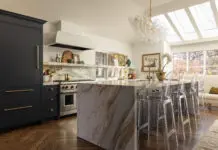
Scott Pohlenz, owner of Pohlenz Cucine Moderne, was added to the team as the kitchen planning took shape. “My goal was to have the kitchen blend into the space so it almost disappears,” says Pohlenz. Utilizing his exclusive Italian line, Demode by Valcucine, the 12 feet of flip-up upper cabinets are lacquered glass with a glossy finish and do practically disappear as they reflect the city skyline. Below the cabinets are a rich dark oak melamine and brushed metal hardware integrated into the design. The countertop is Nero Orion with a hammered finish, supplied by Midwest Marble.

And with the goal of always focusing on the view, Campbell chose a blend of neutral finishes, including Benjamin Moore’s Bone White for the walls. The 66-inch round glass dining table and the base were custom made, as were the dining chairs. Campbell custom designed the living room seating with a textured fabric from Belgium. The dual purpose, leather-wrapped custom table serves as both an ottoman as well as a cocktail table. And the sleek console under the television was purchased from Richard Neel Home.

The master bedroom is also an extension of the homeowners’ goal to have their home be low maintenance with a simple, sophisticated style. The bedcovering is from T.A. Lorton, and the art is by Abersons Exhibits. Campbell designed the bench and nightstands, and they were custom built to his specifications by local craftsmen.

Benjamin Moore’s Coastal Fog was used in both the master and guest bedroom. In the guest bedroom, they utilized an existing headboard, but the nightstand and closet were also custom designed by Campbell and fabricated locally.

“We absolutely love it and have entertained more since being here than we did in our larger home,” says the homeowner, thrilled to be part of the scene and scenery of downtown.

Based On Merit

One-and-a-half million high school students want one. Less than one percent of those students even have a chance of getting one. OSU-OKC’s Dr. Bill Pink is a member of the elite committee that awards them. They are National Merit Scholarships, and Pink, the school’s vice president of Academic Affairs, is the first representative from the college to serve on the National Merit Scholarship selection committee. Last year, Pink reviewed 16,000 applications. And, he says, every single one was worth the time and effort.

Oklahoma Magazine: How did you get appointed to the committee?
Dr. Bill Pink: I’m a co-chair on a national advisory committee with the College Board. This committee plans a College Board conference focused on the future of African American education. My colleagues on the committee are from all over the country. One of the individuals that I work with on that committee recommended me to the National Merit Scholarship committee. Upon his recommendation I got a phone call last fall to see if I was interested in participating. That’s an invitation that you don’t say no to. Another factor with my selection was that it’s been since 1987 since they’ve had somebody from Oklahoma on the committee. It was time to get Oklahoma represented on that committee again.

OM: What do you look for in candidates?
BP: We see what we call the best of the best in our country. We see good academic scores. We see a lot of extracurricular activities. But we also see students that are on a whole different level. One of last year’s applicants filed for a patent on an invention he designed to help his sick mother. We saw students that created phone apps for increasing productivity. We had a student so good with music that he gave piano recitals around the world. We see students that go above and beyond the grades and the extracurricular activities. Some of these students spent summers at research institutions around the world, working in areas like bioengineering and other sciences. They’re working hand in hand with graduate students to produce cutting edge research. And they call this their ‘off time.’ These are the students we look for.

OM: With 16,000 applications, the process must be grueling. What’s the reward?
BP: Everyone should have a chance to review National Merit Scholarship applications. They give me a feeling that we have a generation of citizens coming up in this country that is impressive and focused on how they can make their country better. It makes me feel good to review those. It’s really a gratifying experience. It makes me feel good about our future.

OM: What does Bill Pink do in his spare time?
BP: I’m heavily involved with my church. I’m a worship minister. My faith and my family mean a lot to me. Those are two vital pieces of who I am that will always be there. They’re at the top of my list as far as what my priorities are. If we’re talking about hobbies, golfing and fishing come up quite often. 

Our Favorite Places

The most varied terrain in the nation, more miles of shoreline, rich history, eye-popping architecture and the nicest people around – Oklahoma has it all. When we asked Oklahoma’s tourism experts to dish on their favorite spots in the Sooner State, they gave us enough things to do to keep you going all summer long.

Borderlands

When many people consider travel, they do so with images of sandy beaches, exotic locales and enough of the unusual to be appealing but not off-putting. But while those things and more are readily available at the pantheon of great vacation destinations around the world, many are also available in America’s heartland and often within just a few hours drive from much of Oklahoma.

Oklahoma’s neighboring states offer a host of terrific, often underexposed attractions and destinations that can easily become the foundation for any summer vacation, weekend getaway, or romantic escape.

But where to start? To address that question, Oklahoma Magazine sought the recommendations of top tourism officials in their respective states for thoughts on the top five can’t-miss attractions, regions and towns  – an ideal recommended itinerary of sorts for those who want to get to know their region and have a good time simultaneously. 


Show Me A Good Time

To get to know Missouri’s cities and quaint towns, Missouri Division of Tourism director Katie Steele says to consider traversing the 300 miles of Route 66 across the state. Famed Ted Drewes Frozen Custard is along the scenic route, as is the Big Piney River and ample canoeing opportunities, Carthage and its historic courthouse and numerous small stops featuring memorabilia and a taste of the legendary highway’s history.

Steele also recommends the Gateway Arch in St. Louis. “It’s one of the more iconic sites in the country, not only because of the amazing architecture, but also because the experience of riding to the top is not something one soon forgets,” she says.

Missouri is home to five professional sports teams and several gaming establishments, but it is a lesser-known site Steele recommends for sports or history fans and for families – the Negro League Hall of Fame. The Hall tells the story of the league in which African-Americans played baseball prior to racial integration. “Jackie Robinson is just one player whose story is told there; you can also learn about many great players who never made it to the Major Leagues,” Steele says.

Of course, Missouri is famous for its spectacular scenery and outdoor opportunities, and Steele cites Elephant Rocks State Park in southeast Missouri as one of the most popular. Billion-year-old granite boulders appear like great elephants and appeal both for the natural amazement and for the sporting chance to climb them.

No visit to the Show Me State is complete without a visit to Branson, the Las Vegas of the Midwest, with its stellar host of theaters, famed live performers and shows and numerous other sources of entertainment. “It’s a great family destination, and Branson has a special vibe because of the number of performers who work and live in the city,” Steele says. 

The Natural State Meets Cosmopolitan

Arkansas has forced its way into the national consciousness with a couple of recent significant events – the Bill Clinton presidency and the opening of the Crystal Bridges Museum in Bentonville. Both figure into the state’s top five must-see destinations.

Arkansas Tourism Director Joe David Rice cites the astounding Crystal Bridges Museum as one of the keys to northwest Arkansas (Fayetteville, Bentonville, Eureka Springs) and as being one of the must-visits in the state. “The building alone is worth the visit because of its architecture and the way it is built into the surrounding environment,” Rice says. “And that’s before you even consider the unrivaled collection of American art.”

Other visitors will find fast-growing Fayetteville and its many University of Arkansas attractions appealing. Quirky Eureka Springs continues to be one of the most popular destinations for visitors from all over. “Eureka Springs is eclectic and unusual – a quaint little town that people find fascinating and enjoyable,” says Rice.

Central Arkansas’ Little Rock and North Little Rock is another region that makes the list. Since the opening of the Clinton Library, more than $1 billion has been invested in the area in new restaurants, shops and even a trolley system. A new ballpark and trails along and bridges over the river provide plenty of green space from which to observe the incredible growth the city and region are undergoing.

Hot Springs is “probably the best family oriented destination in Arkansas,” Rice says. He cited the combined Magic Springs water park and Crystal Falls amusement park as key attractions to families. Garvan Woodland Gardens draws those interested in lush botanical gardens while The Gangster Museum of America re-tells the story of Al Capone and other famous 20th century mobsters who sat aside their weapons while relaxing and scheming in Hot Springs. Honeymooners also find the guesthouses and quaint splendor of the town appealing.

Established in 1972 as the first National River, Buffalo National River flows for 150 un-dammed miles out of the Ozarks and is a natural marvel. “It’s a place where you can still see the natural beauty of the Ozarks,” Rice says. The upper stretch of the river is for experienced canoers, while the central and lower areas are perfect for those of any level, as well as floaters and others who enjoy placid outdoor recreation.

Finally, Great River Road in Arkansas parallels the Mississippi River as just one component of a path that continues through numerous states. It is here that the Blues were born and the inspiration for the tales of Mark Twain occurred. Along the scenic route are Civil War battle sites, plenty of green spaces and wildlife, making for a distinct Arkansas travel experience.

Rockies And Regional Rewards

Colorado’s geographic diversity provides plenty of attractions beyond the ski resorts famous to most sports-oriented Oklahomans.

“Rocky Mountain National Park is one of the country’s most iconic national parks,” says Al White, director of the Colorado Tourism Office. “The 415-square-mile park has more than 350 miles of hiking trails, 150 lakes, 450 miles of streams and 72 named peaks higher than 12,000 feet. There is so much to do in the park, from hiking and rafting to camping and wildlife watching. The park is also home to Trail Ridge Road, one of my favorite spots. It sits at more than 12,000 feet in elevation, the highest road of any U.S. national park. The views are amazing, as more than a quarter of the park is above tree line.”

Bent’s Old Fort National Historic Site is another must-see. The fort is a meticulously reconstructed trading post on the mountain branch of the Santa Fe Trail. Starting in the 1840s, traders, trappers, travelers and Cheyenne and Arapaho American Indian tribes gathered peacefully for trade and commerce. “The Fort recreates that experience today, thanks to some very talented living historians, who can transport you back hundreds of years ago and give visitors a real window into frontier life,” White says.

He also recommends the Colorado National Monument. “This is a very special place in Colorado, just outside of Grand Junction. It’s a favorite spot for photographers, who can capture some amazing shots of amazing canyons and rock formations. Visitors to the park can enjoy hiking and bicycling as well as wildlife watching. The Monument is home to red-tailed hawks, golden eagles, ravens, desert bighorn sheep and more,” says White.

Central Colorado’s Royal Gorge Bridge and Park is another fascinating attraction. The Royal Gorge is home to an engineering marvel: one of the world’s highest suspension bridges, measuring 956 feet high and stretching a quarter mile across the canyon. The Arkansas River, one of the longest rivers in the country (and one of the top whitewater rafting rivers, too) churns below the bridge.  

Finally, Great Sand Dunes National Park & Preserve is a distinct Colorado experience.

“Outside of Alamosa in southern Colorado, the Great Sand Dunes are home to the largest sand dunes in North America,” White says. “The dunes attract visitors who hike and even use modified skis and snowboards to traverse the sandy slopes. It’s much different than skiing Colorado’s world-renowned powder, of course, but it’s a favorite activity for visitors to the park.”

Tourism Is Bigger In Texas

It isn’t easy for even the most informed Texan to narrow down the massive state’s many attractions to a top five. Given its relative size and population, some of its cities alone can be terrific, fulfilling vacation destinations. But the state’s tourism officials were happy to share ideas, some of which might be relatively new even to Oklahomans next door.

In Galveston Island, the past is becoming present with the recent opening of the Historic Pleasure Pier. Based on the original Pleasure Pier that was built on the island in the 1940s, this amusement park offers 16 rides, a full-service restaurant, midway games, shopping and live entertainment, all overlooking the beautiful Gulf of Mexico.

The Perot Museum of Nature & Science  – the result of a 2006 merger of the Dallas Museum of Natural History, The Science Place and the Dallas Children’s Museum – provides a world of exploration at its current Fair Park campus. But the Museum has its sights set on creating a new, world-class venue at a centrally located 4.7-acre site in Dallas’ Victory Park to supplement the Fair Park museum. The new, $185-million museum features the latest technology and innovations in conjunction with authentic collections and hands-on activities, all designed to educate present and future generations.

“2012 and 2013 have brought many new opportunities for family-friendly travel in Texas,” points out Texas Tourism’s director of Tourism Brad Smyth. “The Perot Museum of Nature & Science brings a world of interactive exploration to Dallas, while along the Texas Gulf Coast, The Galveston Island Historic Pleasure Pier stretches more than 1,000 feet over the Gulf of Mexico offering rides, games, food venues and more.”

The Texas BBQ Trail is another sure-fire hit for foodies and families. Travelers can sample some of the best slow-smoked barbecue in the state on this trail that takes visitors through barbecue joints in Elgin, Lockhart, Luling and Taylor. While open year-round, most of the trail’s big events take place during the summer months, including the Taylor International BBQ Cook-off in September.

Similarly, the Texas Hill Country Wine Trails celebrate the state’s wine renaissance. Many might recall that in the 1970s, a wine revolution swept through Texas, jumpstarting the birth of vineyards and wineries throughout the state. Today, Texas ranks fifth among wine-producing states.

“For travelers who want an experience beyond our dynamic cities, The Texas Hill Country provides scenic landscapes, charming historic towns, 185 wineries and 220 family-owned vineyards to explore, making for a truly unique experience,” Smyth says.

Finally, the Sea-World Aquatica Park is a relatively new Texas draw, having opened just over a year ago. Aquatica – an extension of the water park in Orlando, Fla. – features three terraced pools, a giant wave pool, meandering rivers and racing rides – including a one-of-a-kind family raft ride that goes underwater through a reef filled with stingrays and tropical fish and another ride that sends family rafts up a zero-gravity wall where riders experience weightlessness. More than 42,000 square feet of white, sandy beaches also cover the park.

Where Desert Meets Sky

New Mexico is home to three UNESCO World Heritage Sites, and each makes the list of must-see stops in the diverse state. Taos Pueblo is one of the oldest continually inhabited communities in North America. The multi-storied adobe buildings have been continuously inhabited for more than 1,000 years. Archaeologists say that ancestors of the Taos Indians lived in this valley long before Columbus discovered America. The Chacoan people of Chaco Canyon combined many elements – pre-planned architectural design, geometry, landscaping, astronomical alignment and engineering – to create an ancient urban center of spectacular architecture. Carlsbad Caverns National Park is home to 117 known caves all formed when sulfuric acid dissolved the surrounding limestone.

“The large cave chamber, The Big Room, is almost 4,000 feet long, 625 feet wide and 255 feet at its highest point, making it the third largest chamber in North America and the seventh largest in the world,” says Veronica Valencia, New Mexico Tourism Department director of marketing and communications. “There is an incredible exodus of Mexican free-tail bats out of the cavern in the summer.”

The Green Chile Cheeseburger Trail is an entirely different type of New Mexico attraction. Green chile gives the region’s cuisine a distinctive style and is widely used in the green chile cheeseburger. This culinary creation is New Mexico’s passion. Restaurants across the state include the signature dish on their menu, which has led to the creation of the Green Chile Cheeseburger Trail, comprised of 48 chile-devoted restaurants. The trail maps out where each restaurant is located so visitors and locals can enjoy the infamous cheeseburger to their hearts’ content.

Although New Mexico has several interesting cities and countless scenic small towns, a visit to Santa Fe is a must. The combination of Native American and Southwest-inspired arts and culture and distinct artsy vibe of the city make it a must as either a base of vacation operations or a targeted visit.

Still, much of New Mexico’s appeal rests outside major urban areas, Valencia says. “It’s a place for travelers with an adventurous spirit and thirst for authenticity, looking for discovery of the off-the beaten path experiences, connection with the past, the land, their families and an adventure that feeds the soul.” 

More Than Meets The Eye

Kansas conjures images of cornfields, slow small towns and wide-open spaces. But it is also home to fascinating attractions, many of which are just a short distance from the Oklahoma border.

Chief among those sites is the Eisenhower Presidential Library and Museum in Abilene.

“The Museum continues to evolve, and it is very well done,” says Kansas Tourism marketing director Richard Smalley. “It documents his role in World War II with a timeline that extends into his presidency.”

Kansas’ version of Manhattan might not be home to Madison Avenue, but in and around the city are a number of attractions that make it a singular destination. “If you take the National Scenic Byway along Highway 177, you will go through Cottonwood Falls – a little town with a five-star hotel with only 15 rooms,” Smalley says. “There is a café there where on Friday nights they have jam sessions right on the street in front.”

Farther north is the National Tall Grass Prairie Reserve, Smalley says, and the brand new Flint Hills Discovery Center is a must. “One thing that often blows people away is the short video there that talks about the Great Plains, the great storms, the prairie,” Smalley says. “It actually snows inside the theater.”

Hutchinson is home to the Kansas Cosmosphere and Space Center, another can’t-miss, Smalley says. “It has the largest collection of U.S. space artifacts outside The Smithsonian and the largest collection of Soviet artifacts outside Russia,” he says. “In addition to being fascinating, it is also great for kids because there are hands-on components. It takes you through the early era of the Space Race with a side-by-side comparison as equipment and procedures developed on either side.”

Finally, Smalley says that those seeking something different should visit the town of Lucas. There, S.P. Dinsmoor’s Garden of Eden is one of the state’s great wonders. Created more than 100 years ago by Civil War veteran Dinsmoor, the massive, diverse sculpture collection towering over visitors’ heads is impressive and unique.

The Next Act

“If there is anything else you could do and possibly be happy, then go do that instead.”

The words of advice are spoken only slightly in jest by Scott Black, managing director of Tulsa Ballet. He is talking about the ultra-competitive nature of the art of ballet, and of the dedication required to become a world-class dancer. But he is also describing the love for the art form that allows one to ignore the sore muscles and creaky joints that follow hours spent in dance studios.

He is talking about Ma Cong.

“You don’t often have dancers that come along and really grow with a company like Ma has,” says Black. “The audience has seen something special in him from the moment he arrived. He captivates on stage.”

It has been obvious to Tulsa audiences since he joined Tulsa Ballet in 1999 that Cong is happiest when on stage. It has been his one love since he was a child in China, performing for audiences 3,000 strong as a precocious 3-year-old.

“My mom knew when she was pregnant with me that I would be a dancer,” Cong says. “I was moving and kicking a lot in the womb.”

At age 10, Cong was one of only four students out of 4,000 candidates chosen to join the Beijing Dance Academy. He traveled nearly 2,000 miles alone from his home in Yu Xi, the first steps in a life spent following the ballet, steps that have taken him to the National Ballet of China and all around the globe before eventually landing in Tulsa.

“I was really lucky that Marcello found the tape of me,” Cong says. He is referring to Marcello Angelini, the Tulsa Ballet’s artistic director, who recruited Ma in 1999. “Lucky” is a word he uses often. It is quite obviously the wrong word, but he truly believes it to be the right one.

“He thinks he’s one lucky guy, and in some ways maybe he is,” says Jackie Kouri. “But he’s earned everything he’s ever received. I’ve never known anyone so humble and grateful, so brilliant in so many ways. He gives all the credit to everyone else.”

Kouri, a longtime supporter of the Tulsa Ballet who chaired the company’s integrated campaign that raised more than $17 million, has closely followed Cong’s career since he arrived in Tulsa. She has seen the things that drew the attention of Angelini when he offered Cong a contract without ever having seen him dance in person.
 

“I realized that he was spending his lunch break in one of the studios choreographing steps for himself.”

“I hired Ma from a videotape,” recalls Angelini. “When he arrived, it was clear that he had a lot of talent. He was charismatic, gifted with a very unique movement quality, eager to succeed and not afraid to do as much work as necessary to fulfill his dreams. Within a short time he was promoted to soloist and then to principal dancer.”

Perhaps there was some luck involved, but not in the way Cong describes. The Tulsa Ballet has been lucky in almost every aspect regarding its relationship with Cong, from persuading him to join to his decision not to leave.

“It was hard for me at first,” Cong says of moving to Tulsa. “I was completely shocked. It was a completely different vibe. There were no people walking. Everyone drove everywhere. I didn’t speak any English, only a few words. After the first six months, I thought I might go home. It was hard, being young. But soon I began making new friends. There were so many generous, kind people who want to help you. I began to see the passion and energy of the city.”

Fourteen years later, Cong’s career as a dancer draws to a close. He retired from his position of principal dancer with the Tulsa Ballet in May to focus on his burgeoning career as a choreographer. It is a path he has been on since not long after arriving in Tulsa, when a bit of luck led to Angelini’s commissioning his first work as a choreographer.

“I realized that he was spending his lunch break in one of the studios choreographing steps for himself,” Angelini recalls. “I started ‘spying’ on him and became aware that he had a lot of potential as a choreographer, too. So, in 2004, I commissioned his first creation for the company. Folia was a great success, so I commissioned (from) him a second one. The great thing about Ma is that he grew with each new work he created for the company. Today he is a very successful choreographer, having created or staged works for a dozen American companies and already starting to receive international interest and commissions.”

Cong’s original works have been performed around the country and across the globe. It is this role that has allowed him to transition smoothly from the physical demands of being a full-time dancer while allowing him to remain firmly at work in the arts.

“I’m not young anymore,” Cong says. “It gets harder to wake up to knee and back pain. I had to realize that it doesn’t matter how much passion you have. Physically, I need a break.

“But I’m really lucky that Marcello discovered me,” he continues. “It can be hard for an artistic director to find that creative source. But for me, the art is a mission. I want to inspire and educate, to make people feel that they are related to the art form. Art is food for the soul. Without art, you have no food.”

Even as he says farewell to the stage as a performer, fans of ballet in Tulsa can expect to continue to see plenty of Cong in other roles, such as his recent turn as dance choreographer for Tulsa Opera’s production of Aïda. Or simply as a Tulsan, where he might be spied strolling along Riverside, enjoying nature and the sights of the city.

“I always love to see the active side of the city,” he says, “People out running, the birds singing. People in Oklahoma are very generous, and I have a lot of appreciation for that. It is very easy to relate to people here. When you walk down the street, people say hi.”

If you’re lucky enough to run into Cong on the streets of Tulsa, make sure and say, “Hi.”

What We're Eating

Okie Baha

Big Truck Tacos
Big Truck Tacos is not just a clever name; the eatery offers its one-of-a-kind tacos from the window of a food truck as well as from a converted drive-in located along 23rd Street in Oklahoma City. The tacos, burritos and other menu items are packed with fresh, flavorful ingredients that create powerful flavors. The Okie Baha taco is a lighter take on California fish tacos: marinated tilapia is grilled and served on a tortilla topped with jicama-cabbage slaw and a garnish of green onion. The crunchy bite of the slaw combined with the flakiness of the fish and the sturdy tortilla creates a textural punch and a pleasant appeal. 530 NW 23rd St., Oklahoma City. www.bigtrucktacos.com

Breakfast Pizza

Wild Fork
It’s the most important meal of the day, yet some of us still neglect to eat a good breakfast. Thank goodness for restaurants like the Wild Fork, open six days a week at 7 a.m., that help us in our quest to start the day off right. The two-egg breakfast, biscuits and gravy, omelets – the staples are all offered. But Wild Fork offers twists on breakfast, including with a breakfast pizza. Homemade wheat crust is topped with scrambled eggs and cheese, then a variety of toppings, from garden vegetables and herbs to bacon, spinach and tomato, is added, creating a nutritious and filling breakfast. What a way to start the day. 1820 Utica Square, Tulsa. www.wildfork.com