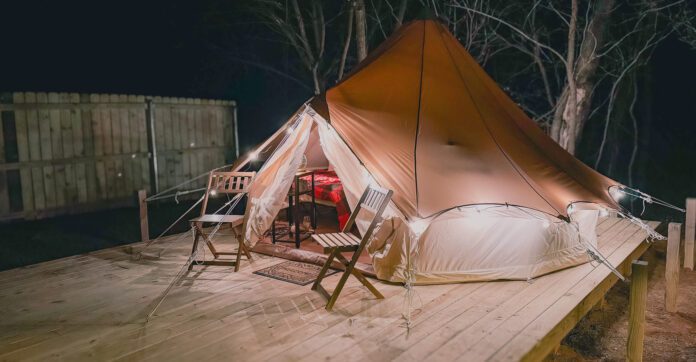
Red Rock Canyon Adventure Park, under new leadership, offers ‘glamping’ – or luxury camping – experiences.
Top and bottom photos courtesy Red Rock Canyon Adventure Park
Within Oklahoma’s some 70,000 square miles lie an array of wonders kindly provided by nature’s hand. One of the more spectacular offerings is only an hour’s drive west of Oklahoma City, where the Red Rock Canyon beckons travelers.
The nature destination, which was once a winter haven for plains Indians and later a stopover for wagon trains bound for the West Coast, has new ownership, who took over operation of the now-named Red Rock Canyon Adventure Park early this year. They’re promising improvements that are designed to make a visit to this scenic locale even better.
The 311-acre enclave of beauty lies on the south doorstep of the town of Hinton, itself a bustling community of just over 3,000 that is experiencing a new uptick of economic growth.
Photo courtesy Red Rock Canyon
Brandi Kaiser, Hinton Chamber of Commerce director, says the park, the proximity to Interstate 40 and the re-opening of a private prison southwest of the city with its accompanying jobs, together are spurring an economic renewal in Hinton.
But it’s Red Rock Canyon that’s the big draw, says Kaiser, particularly in the warmer months.
That sentiment is echoed by Art Peters, curator of the Hinton Historical Museum and Parker House on Hinton’s main street.
“Half of our visitors are either going to or coming from the canyon,” he says. “When Red Rock Canyon is busy, we’re busy.”
Jesse Roberge, co-owner of the Red Rock Canyon Adventure Park, recently completed a lease agreement with the state of Oklahoma to operate the park. He says the place is beautiful now – but will be much better for visitors once planned improvements are put in place.
“This is an awesome park,” says Roberge, who relocated to Hinton from Washington state. “If we are able to achieve our goal, this will be a premier park in the state.”
Currently, the park has 50 spots for recreational vehicle camping, and about 30 pads for tent camping. Roberge says the park will be adding eight “glamping” trailers, which are akin to luxurious tents, ideal for individuals or families who want an upscale camping experience but might lack the resources to purchase trailers or the accompanying camping equipment.
“We will provide that for them,” he says. “This will be new to the park in a premium way.”
One immediate task, Roberge says, is to cut back some overgrowth to better expose the red rock canyon walls, sculpted by wind and water over time but mostly hidden by foliage. Security also will be tightened, he says.
The Hinton Historical Museum harbors an impressive collection of carriages and vintage automobiles.
Photo courtesy Hinton Historical Museum
Visitors might find the Hinton Historical Museum’s collection of interest. Peters says the museum houses what he believes to be Oklahoma’s largest collection of carriages: “Everything from small buggies to the horse-drawn carriages,” he says.
The museum is also home to seven antique automobiles, plus extensive collections of antique telephones and the various types of barbed wire used during the settling of early day Oklahoma.
Peters says the adjoining Parker House was originally a farmhouse built three miles west of Hinton, but was moved into town and donated to the Town of Hinton. Parker House is open for tours during regular museum hours, he says.
If the museum and canyon aren’t enough to entice visitors to Hinton, the chamber of commerce offers events throughout the year. These include the annual Independence Day celebration, held on July 3, the Red Rock Cruisers Classic Auto Show, held on Oct. 5, as well as an annual Christmas parade.
Kaiser says the auto show featured several food trucks last year, and that more improvements are in the planning stages.
“We’re trying to build it up and make it better,” she says.
Hinton Historical Museum and Parker House 405-542-3181
Background photo caption: Red Rock Canyon Adventure Park, under new leadership, offers ‘glamping’ – or luxury camping – experiences. Photo courtesy Red Rock Canyon Adventure Park
Evan Tipton & Cassie Reese Tipton, Steve Driskell, Tina Parkhill;
Oklahoma Speaker’s Ball, OKC
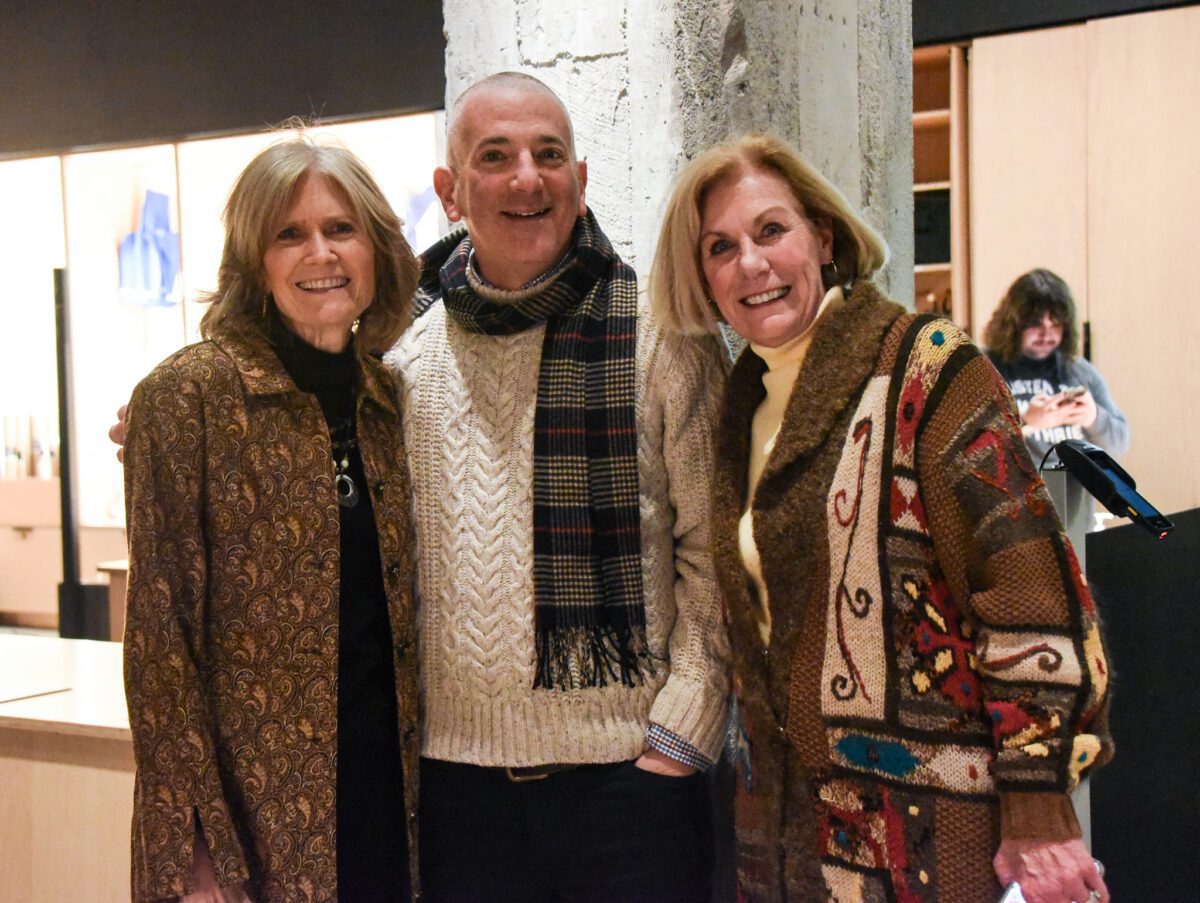
Carol Spears, Steven Jenkins, Kathy Collins; Prelude to Rosanne Cash: An Evening at the Bob Dylan Center, Tulsa Town HallMark Funke, Larry Nichols, Andrew Weyrich;
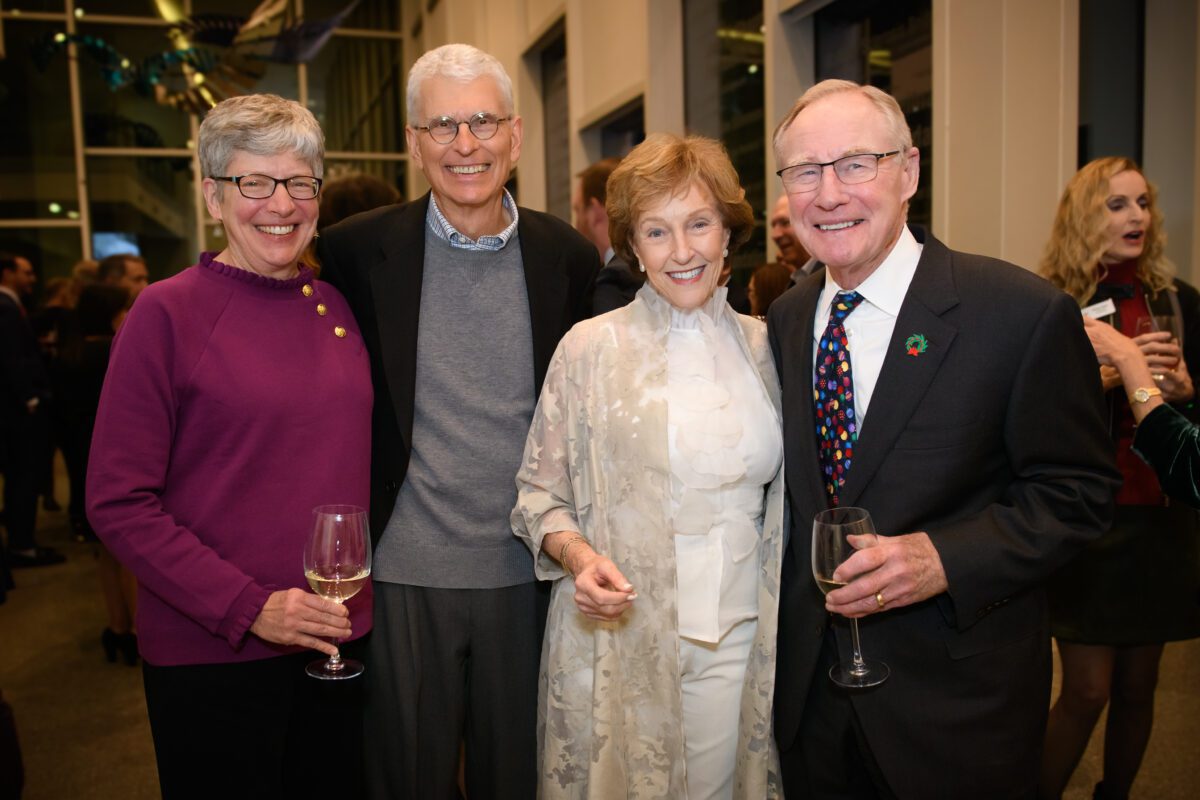
President’s Christmas Party, Oklahoma Medical Research Foundation, OKCGigi McEver, Rod McEver, Ann & Burns Hargis;
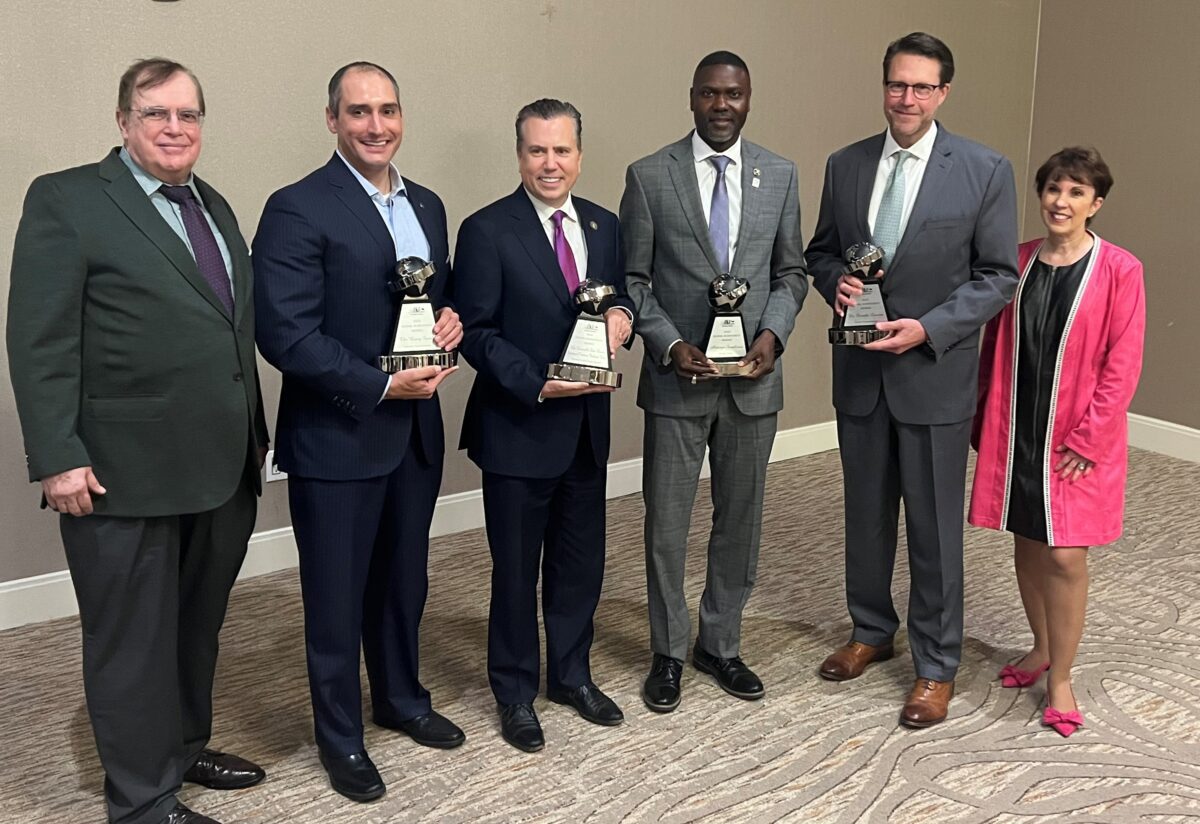
President’s Christmas Party, Oklahoma Medical Research Foundation, OKCRon Sutor, Brian Busey, Dan Boren, Aldwyn Sappleton, Dwight Lawson,
Mary Blankenship Pointer;
Sister Cities International Global Achievement Awards, OKC Zoo Evan Tipton & Cassie Reese Tipton, Steve Driskell, Tina Parkhill;
Oklahoma Speaker’s Ball, OKCMike & Jana Neal, Evan Tipton & Cassie Reese Tipton; Oklahoma Speaker’s Ball, OKCSterlin Harjo, Lindsay Aveilhé; ArtNow 2023 Focus Awards, Oklahoma Contemporary, OKCKaitlyn Schmitt, Steven Gattis;
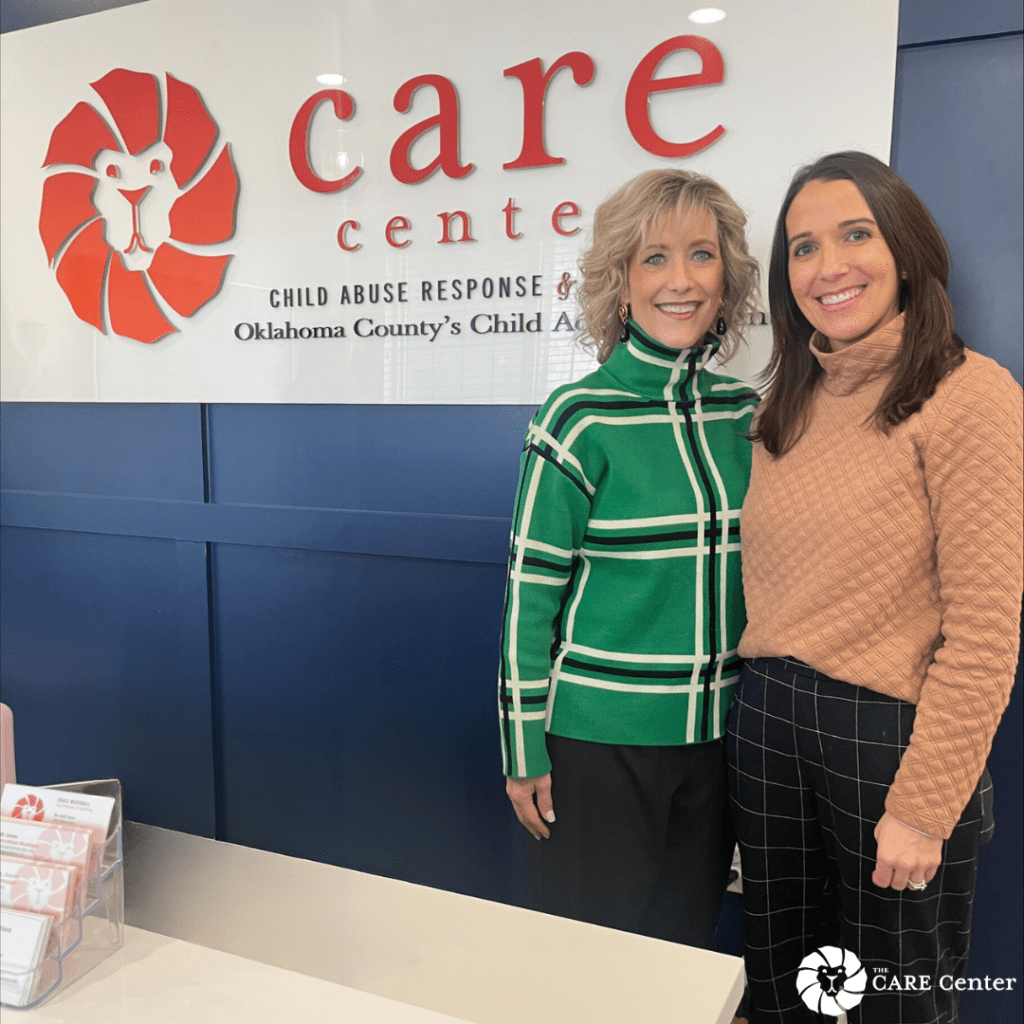
Monument Valley exhibition, Living Arts, TulsaStacy McNeiland, Rachel Canuso Holt; CARE Center gathering, CARE Center, OKCTodd Dobson, Erin Engelke, Jeff & Marisa Records,
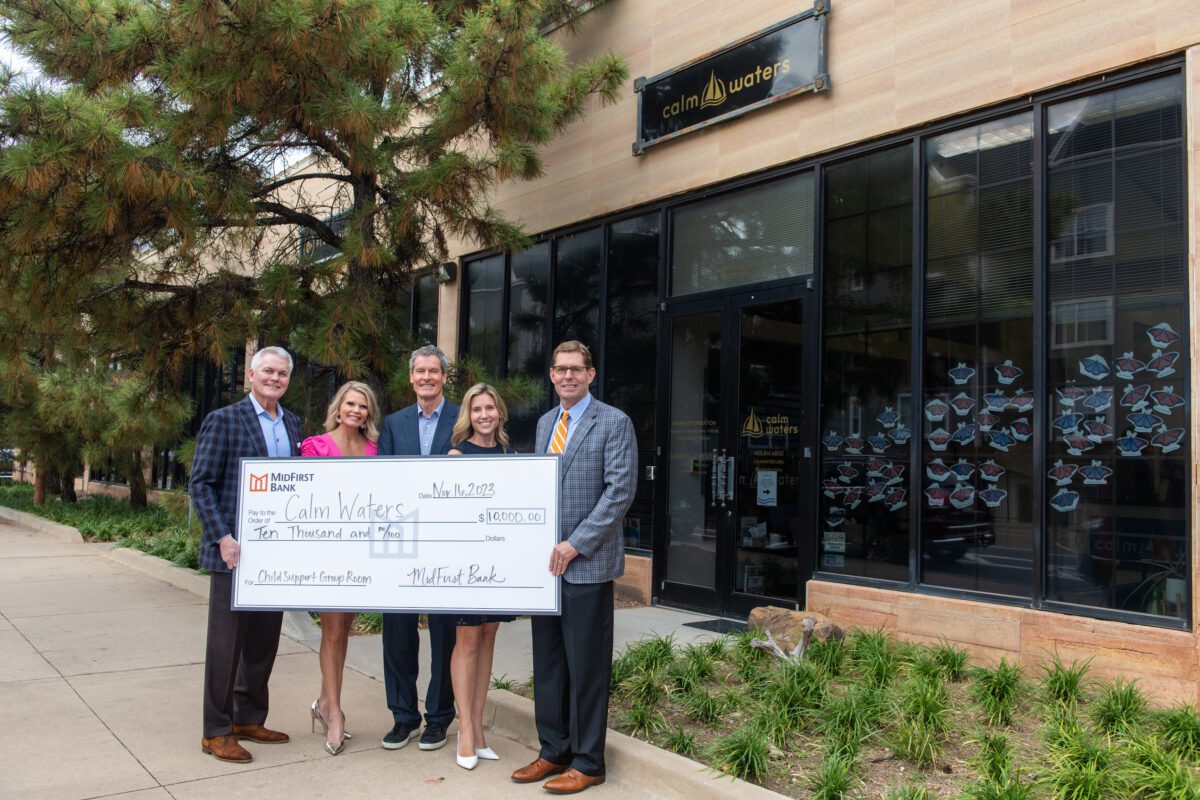
Garland Wilkinson; MidFirst Bank Child Support Group Room donation,
Calm Waters Center for Children and Families, OKCBrian Harris, Michael Stuemky, Camille Burge, Laura Whitehead;
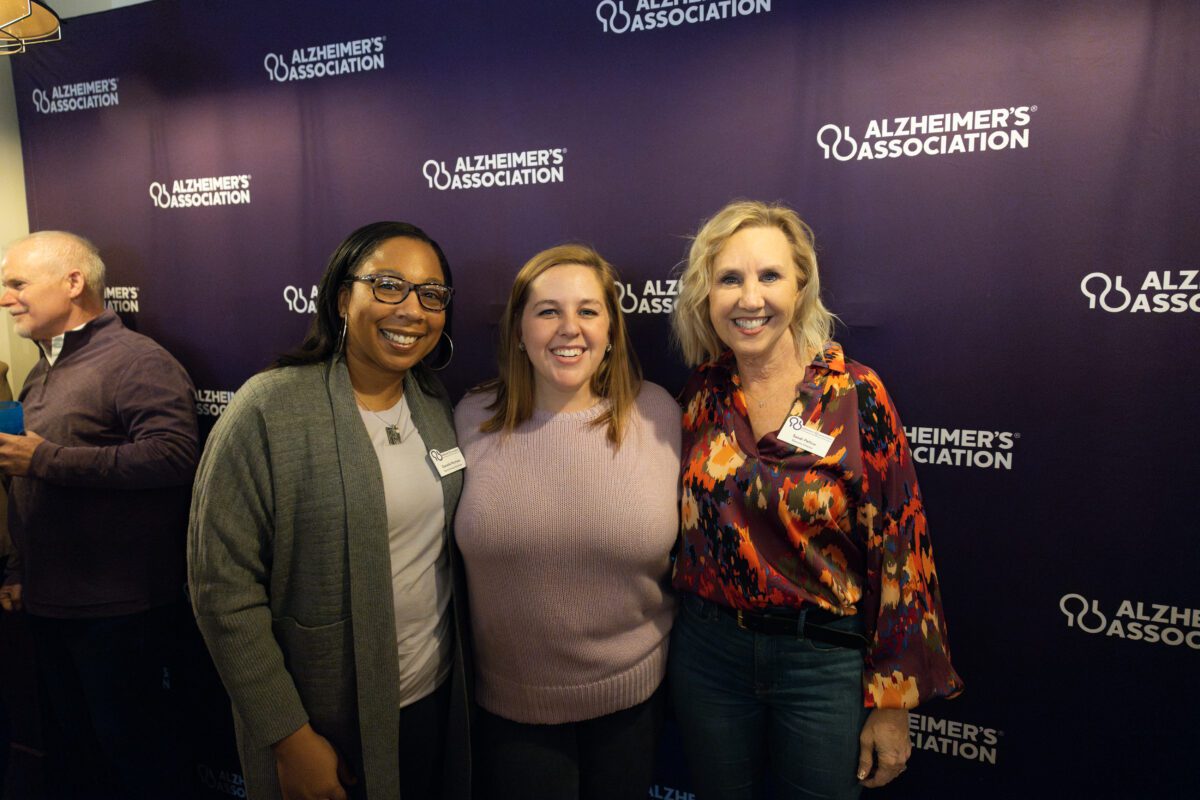
Holiday gathering, Big Brothers Big Sisters of Oklahoma, OKCDanielle Morrison, Meggie Gaskins,
Sandi Pellow; Isla’s Kitchen Grand Opening/Fundraiser, Alzheimer’s Association Oklahoma Chapter, Tulsa
For some, Valentine’s Day may just be another Wednesday – and that’s just fine. But if you’re looking to celebrate the day of looooove, either with your partner or your best friends, we’ve got plenty of event suggestions.
For Nature Enthusiasts
If you prefer a guided structure in the great outdoors, the Ray Harral Nature Center in Broken hosts an event on Feb. 10. All you’ll need is a jar – and you can even buy one at the center. Then, with you beau or bestie, walk around in nature and collect items in your jar, like stones, rocks and moss. You can head to a center classroom after collecting your items to put the finishing touches on your keepsake.
If, instead, you’d just like to take a stroll or hike, you can venture to the Lake Hefner lighthouse in OKC, the Gathering Place in Tulsa, the ‘Unexpected Us’ installation at OKC’s Scissortail Park or Tallgrass Prairie Preserve in Pawhuska.
For Performance Lovers
Dinner and a show? Always a great recipe for Valentine’s Day.
Fans of classical ballet can venture to the Tulsa Performing Arts Center for two shows – Tulsa Ballet’s Strictly Gershwin from Feb. 8-11, and Ailey II, which brings together early career dancers with emerging choreographers on Feb.13.
At OKC’s Civic Center Music Hall, book tickets for OKC Ballet’s Giselle, running Feb. 9-11. For something a bit quirkier, try Adele Wolf’s Valentine’s Follies on Feb. 10.
For Creatives
If you and your snookums prefer an out-of-the-box experience this V-Day, try some art-centric activities.
In Tulsa, the Champagne and Chocolate fundraiser for Living Arts is a swanky option happening Feb. 24. The gallery doors are open for guests to enjoy libations, chocolate, art and fashion.
In OKC, the V-Day Bash at Factory Obscura happens Feb. 12. Guests can enjoy live music, love-themed gifts, unique art, bouquets for sale and some delicious bites.
For the Kiddos
Spreading love and positivity shouldn’t just be for the adults – so if you’ve got children to entertain around V-Day, try one of the following.
On Valentine’s Day proper, venture to Tulsa’s Philbrook Museum from 10 a.m. to noon. Kids are welcome to make their own crafts with help from parents, and discuss ways to celebrate family and friendship all year ‘round.
On Feb. 11, visit OKC’s Myriad Botanical Gardens for the Love Bug Rock Gardens event. You and your little one can paint a bug-themed rock garden for some creative, hands-on quality time.
For Diners and Drinkers
If you’re instead looking for the traditional romantic dinner option, there are plenty of routes to take.
In Claremore, venture to the Pink House on V-Day. Enjoy a candlelight dinner and special prix fixe menu. Other spots for an upscale meal include Boston Title and Abstract, Ti Amo Ristorante Italiano, Mahogany Prime Steakhouse and Doc’s Wine and Food in Tulsa. In OKC, try The Rose Room, Vast, Stella Modern Italian Cuisine and FLINT.
For Gals and Pals
Celebrating friendship is a worthy way to spend your Valentine’s Day.
Options abound. In Owasso, try the Galentine’s Day Candlemaking Class at Emersumnice Brewery on Feb. 4. Tulsa’s The Vault offers a Valentine’s themed cocktail class on Feb. 8. You can enjoy the Galentine’s Day Ceramics Class at Tulsa’s NEFF Brewing on Feb. 11, or the Galentine’s Day Party on Feb. 13 at Claremore-based Vintique Charm.
In OKC, venture to the Oklahoma History Center on Feb. 10 for a Valentine-themed beginner’s crochet class. Popular Edmond restaurant Farmers Grain Kitchen + Cellar hosts a Galentine’s Day party on Feb. 9. Or, venture to Harrah’s The Simple Brew on Feb. 17 for a Galentine’s Day Sip and Shop party.
More than ever before, interactive and gamified educational approaches are appealing to current students. Photo courtesy Oklahoma State University
Trends in Higher Education
The industry is evolving more quickly than ever, and “it’s a fascinating time to be in education,” says Julie Dinger, Ph.D., the president of Oklahoma Panhandle State University in Goodwell. “We’re in the midst of the biggest culture shifts I’ve ever seen, as there are new, ongoing adaptations to artificial intelligence, a rise in machine learning – and it’s more important than ever for students to be life-long learners.”
Technology is changing rapidly.
“For example, a year ago, our students were encouraged to be prompt engineers, depending on the track they’re on. Fast forward to now, and we’re hosting a conference with the topic: ‘Can AI improve your career?’ where we talk about yes, the threat of AI – the bad stuff like plagiarism – but also how to use it as engaged learning. These fast changes, it’s akin to email when it was new; some professors loved it, some didn’t. Now it’s 30 years later and email is nonnegotiable. I suspect that AI will also become ubiquitous.”
AI tools are prevalent across the state in higher learning institutions, including Tulsa Community College.
“One AI tool we are exploring to use in Career Services is WriteSea, which students use to help create resumes and prepare for job interviews,” says the college’s senior vice president and chief academic officer, Angela Sivadon, Ph.D. “It has a tracking component that allows administrators to monitor student usage and progress within the program. The tool helps to free up valuable time for career counselors to engage in other essential tasks with students.
But artificial intelligence in the classroom isn’t the only trend on the rise; dual credit participation and skills-based training are also gaining traction.
“TCC has seen a surge in high school students dually enrolled in our programs in the last few years,” says Sivadon. “We’re the largest provider of dual credit degrees in the state, and we offer dual credit programs to 13 school districts. It reflects a growing interest among students to engage in college learning early, giving them a head start on post-secondary education. We’re also seeing a shift in how students are obtaining an education, often stacking credentials and experience from different places, rather than from a single institution. Students are seeking a mix in skills-based training and experiential learning, like internships or apprenticeships. It shows students value interactive educational experiences.”
Gamification in learning continues to gain traction and is a great way for educators to increase student engagement.
“Gamification can help create a more collaborative, student-centered approach to learning in the classroom and can help students build relationships with each other and their instructors through teamwork, competition, shared goals, micro-learning and increased participation,” says Mautra Staley Jones, Ed.D., president of Oklahoma City Community College. “Additionally, gamifying education appeals particularly to Gen Z students who are typically more comfortable with technology and digital games to help keep them stay actively engaged in the learning process.”
Accessibility: Micro-Credentials, Workforce Certificates and Badges
Micro-credentials – short, focused credentials designed to provide in-demand skills – are helping to keep education accessible to more people. This also helps in meeting specific needs of employers in the state.
“NSU has been, and will continue to be, fully engaged in providing the education needed in our current workforce, which includes micro-credentials, certificates and badges,” says university president Rodney Hanley, Ph.D. “We have spent the last few years finding ways to stack credentials to help move students towards a degree while also obtaining the education they need in their current job or career goals. We are also serving businesses in the area by developing new pathways to help meet the critical occupations in Oklahoma, while streamlining our processes and systems to help make this easier for students wanting a different kind of education and serving our businesses in the area.”
At TCC, workforce certificate programs run the gamut, “from cybersecurity to EMT training to childcare,” says Sivadon. “Micro-credentials offer flexibility to students who may not have the resources to obtain an associate or bachelor’s degree. Credentials allow them to tailor their education to their specific needs and circumstances. Micro-credentialing shows the importance of short-term goals for students. When students complete a micro-credential, they’re more likely to pursue the next educational milestone.”
Staley Jones adds: “The time invested in earning a degree at any level is extensive and often is cited as a barrier to education. OCCC has been a pioneer in Oklahoma in both offering and awarding micro-credentials. Most of our micro-credentials were born from partnerships with our industry-informed advisory boards and the feedback we received demanding skills needed immediately in the workforce. We analyzed our course offerings within our programs and grouped specific courses together to train those skills needed to fill gaps in the workforce.”
At OU, leadership is focused on holistic education, meaning that both foundational knowledge and skills for personal growth are taught in tandem. Photo courtesy the University of Oklahoma
A Look at the Stats
As of 2023, Oklahoma is still ranked 45th in education, a ranking that measures both educational attainment and the quality of education. There are myriad factors as to why the state has this ranking, and institutions are working to better our numbers, one initiative at a time.
“Oklahoma’s educational ranking serves as a catalyst for transformative action and innovation within our educational institutions,” says Staley Jones. “Factors influencing this ranking include historical educational funding levels, teacher retention rates and access to advanced educational resources. However, the accurate measure of our progress lies in the proactive steps being taken to enhance our educational landscape.”
Oklahoma State University is working diligently to alter those rankings.
“We’re focused on providing the best possible education for our students, preparing them to shape fulfilling careers and make a meaningful impact as problem solvers and community builders,” says provost Jeanette Mendez, Ph.D. “In the fall of 2022, we unveiled the We Are Land-Grant strategic plan, which includes a mandate to take a student-focused approach as we strive to cement OSU as the nation’s preeminent land-grant institution. A key component of that plan is expanding educational access. We aim to recruit an increasing number of college-ready undergraduate students, increase scholarship support for students and work to reduce student debt with specific, measurable targets.”
But the plan doesn’t just benefit college students.
“On the K-12 side, we are working hard with our partners at the Oklahoma State Regents for Higher Education to recruit and train teachers, designing innovative approaches to training like the OSUTeach program, finding financial incentives for students both from OSU funds and State Regents programs, and providing crucial early career support for teachers through programs like OK-Thrive and continuing professional development for teachers,” says Mendez.
Challenges in 2024 in Beyond
Hurdles for education include the need for continual learning surrounding advanced digital platforms in our hybrid education space, as well as the human circumstances of teacher, student and administration burnout. Educators are meeting these challenges with innovation.
“Education and higher education are changing at a rapid pace,” says NSU’s Hanley. “It is always difficult, regardless of the sector, to constantly evolve and change to meet the changing needs and dynamics. Higher education is certainly no exception to that as we seek to raise salaries, quality and innovation while maintaining and even lowering costs. There is great discourse about the varying opinions on how to manage and respond to this changing landscape. It is no simple task for higher education leaders, and every institution is managing that differently.”
The uses – and potential abuses – of artificial intelligence continue to both vex and inspire education leaders.
“AI is obviously something we have to adapt to,” says OSU’s Mendez. “Instructors will change their methods of assessment, and the new technology provides a good opportunity to evaluate what our students need to know when they graduate from college. A favorite method along these lines: Instead of just asking students to do a list of math problems, give them a problem and a common incorrect answer, and ask how a student might have arrived at this wrong answer – or how a typo might have caused a computer to give “wrong” output.”
The projected enrollment cliff – the dramatic drop in the college-age population beginning in 2025 – poses the challenge of “how to stay relevant when national higher education enrollment numbers are on the decline,” says TCC’s Sivadon. “We are focusing on our workforce skills training programs and emphasizing practical skills that students can directly apply to their careers. Ensuring transfer to a four-year institution is seamless for students and that they are prepared to complete their bachelor’s degree is essential in meeting their career goals. We can also promote post-secondary education for students by connecting with them early in high school. Helping them develop a college mindset can motivate them to pursue higher education and to better understand the possibilities post-secondary education can provide.
Remaining relevant to the current workforce and its needs is also a challenge.
“It’s critical our curriculum aligns with career fields that are changing rapidly due to technology, such as in STEM and healthcare sectors,” says Sivadon. “We work proactively with employers through advisory councils to understand their evolving needs so we can provide students with relevant skills and technology.”
Preparing Students
Higher learning professionals are charged with preparing students for post-college life – not only in educational benchmarks but in soft skills like collaboration and strategic communication.
Leadership at Oklahoma City Community College believes it is the responsibility of educators to set their students up for success in all areas of life. Photo courtesy OCCC
“Helping individuals, families and communities recognize the power of higher education is a continuous challenge,” says Jerrid Freeman, Ed.D., NSU’s vice president for student affairs and enrollment management. “A college education has the ability to change the trajectory of lives for generations, and this is something we see year after year at NSU. The world is changing, though, and we must keep up to ensure students receive the support and training they need. For NSU, this means providing programs in flexible formats – with many being completely online – offering micro-credentials and certificates and maintaining partnerships with businesses and other institutions to ensure a better life for our graduates and our state.”
The University of Oklahoma places an emphasis on smart strategy when preparing their students for life after college.
Oklahoma Panhandle State University creates students who will become life-long learners. Photo courtesy OPSU
“At the heart of OU’s ‘Lead On, University’ Strategic Plan is our fundamental purpose – we change lives,” says a rep from OU. “To that end, the university provides a holistic education, ensuring students acquire the foundational knowledge and skills necessary for personal growth and responsible citizenship. Our tailored educational pathway is designed to empower students as future leaders, enabling them to navigate the intricacies of the world with respect and dignity for all. The university also recognizes that the development of soft skills is an important part of a student’s education. At OU, many of these skills are taught as part of our general education curriculum.”
At OSU, student requirements aren’t just ticks in a box.
“Our goal is for students to be career ready, and that is not just a matter of completing a specified number of courses in specific areas,” says Mendez. “We are taking steps to ensure our graduates exhibit four competencies: professional preparedness, engaged citizenship, ethical leadership and personal responsibility.”
At OCCC, that mission is also taken seriously.
“It is absolutely the responsibility of higher education learning professionals to arm our students with as much knowledge as possible to set them up for success,” says Staley Jones. “And any failure to do so is a huge disservice to not only those we serve, but also those who depend on them.”
Financial Aid, Scholarships and Educational Access
College tuition, along with just about everything else, has risen exponentially over the last 5-10 years. Colleges are working to combat inflation while maintaining high benchmark standards.
Accessibility is foundational at Northeastern State University; leadership cultivates myriad scholarship and work study opportunities. Photo courtesy NSU
Oklahoma Panhandle was recently ranked by Third Way International as a No. 1 college for Economic Mobility – the highest rating possible, says Dinger. She says this emphasis on accessibility will continue.
“Accessibility is foundational in our conversations each year as we work to set the budget,” says NSU’s Freeman. “We know the students we serve, and we want to do everything we can to help higher education at NSU be possible. We not only work to make our tuition financially feasible, but we will continue to grow our scholarships and ways to assist those who need the financial support. NSU also makes great efforts to provide courses and programs in online formats to meet the needs of working students.”
OSU efforts to help students financially is part of what defines the school itself.
“Accessibility is part of our mission as a land-grant university,” says Mendez. “In June 2023, the OSU A&M Board of Regents approved the 2024 budget with tuition and mandatory fees remaining flat for the second straight year. Within the strategy are specific plans to increase student access, affordability, retention and enrollment.”
At TCC, resources are ample for current and prospective students.
“TCC remains affordable through our competitive tuition rates and the Tulsa Achieves program, which provides tuition assistance to Tulsa County students,” says Sivadon. “We also provide tuition waivers for up to 27 hours for high school students for dual credit. Scholarships funded by the TCC Foundation, offered annually, contribute to the financial support of students pursuing their academic goals. We know these measures work because more than 70 percent of our students leave TCC debt-free.
With financial aid, scholarships and accessibility, TCC is proud that more than 70% of its students leave debt-free. Photo courtesy TCC
Even better, TCC’s affordability “also extends to resources,” says Sivadon. “As inflation drives up the prices of textbooks, we’re utilizing open educational resources, like free online books and materials. We have faculty members who are contributing to open educational resources and having access to these lifts the financial burden of expensive textbooks.”
At OU, the team understands how big an investment a college degree is – and leadership works to make that investment worthwhile.
“OU students are surrounded by opportunities to gain valuable, real-world experiences that make their OU degree worth the investment. [We] offer an extensive alumni network around the world and a Career Center office that aids students with everything from resume building to mock interviews to on-campus career fairs,” says a rep from OU. “To help with the cost of higher education, our No. 1 fundraising priority is to increase the availability of need-based aid, so that students who can succeed and excel can do so at OU. Plus, OU’s Crimson Commitment program, which began in 2018, also provides qualified Oklahoma’s Promise students with up to $9,085 to cover annual fees and 100% of tuition.”
ITR Vu offers the French 75, topped off with champagne. See the recipe later in the feature. Photo by Stephanie Phillips
What to Order if You Like …
Maybe you’re getting a little tired of the same ol’ same ol’. After all, a vodka soda, Old Fashioned or gin and tonic can only get you so far. If you’re looking to switch up your drink order for a night, try one of the following.
If you like citrus, order:
Tom Collins – Gin, lemon juice, sugar, carbonated water
St. Clements – Vodka, orange juice, lemon-lime soda, bitter lemonade or clementine juice
French 75 – Gin, champagne, lemon juice, sugar
Paloma – Tequila, lime juice, grapefruit-flavored soda
If you like coffee, order:
Espresso martini – It’s all the rage for a reason; vodka, espresso, coffee liqueur
Bloody Maria – Tequila, tomato juice, lemon, Tabasco sauce, black pepper, celery salt, lime
Rub and Rye – Whiskey, lemon juice, mesquite salt, maple syrup, egg white, barbecue bitters, beer of your choosing
Trends to Watch
Kicking back with a nice beveragino has been all the rage for thousands of years. But trends are always cycling in and out of public consciousness. For 2024, here are a few you may see more often than not:
Smaller cocktails – Both good on the liver and on the wallet!
Dessert cocktails – Something sweet for a nightcap or late-night treat.
RTD (ready to drink) cocktails – Canned or on-tap drinks, these have a bevy of pros: cheaper, less time waiting for a drink and less work for a busy bartender
Fun with ice – Your ice cubes are getting fancier this year, whether it’s logo-stamped iced, unique shapes or edible items frozen within the cube.
Cocktail Highlights
Oklahoma bartenders are giving it everything they’ve got these days. The next time you’re out, order one of these goodies:
Photo courtesy Palo Santo
Tuki Tuki Ta Palo Santo, OKC Blanco tequila, 12-year rum, Pedro Ximénez sherry, plum bergamot black tea, orgeat, lemon and Angostura
Photo courtesy Bread & Butter PR/FLINT
Colcord Cooler Flint, OKC Raspberries, lime juice, Sprite, ginger ale and pineapple juice (Mocktail!)
Photo courtesy HumanKind Hospitality Services
November Rain The Daley, OKC Widow Jane Paradigm Rye, blackberry sage syrup, Pasubio alpine amaro, lemon juice and lemon bitters
Photo by Brent Fuchs
Old Town Swizzle The Library of Distilled Spirits, OKC
Hamilton pot still rum, Clairin Rhum Agricole, Chinola passion fruit liqueur, lime, pineapple, Velvet Falernum, an Angostura bitters float, a dash of saline solution, a mint bouquet and dusted nutmeg for garnish
Photo by Stephanie Phillips
French 75 In the Raw Vu, Tulsa Gin, simple syrup, fresh lemon and champagne
Photo by Stephanie Phillips
Wisteria Bar Serra, Tulsa Butterfly pea flower tea, blueberry syrup, lemon and ginger (Mocktail!)
Photo by Stephanie Phillips
Tulsa Thyme Summit Club, Tulsa Gin, mint syrup, lemongrass syrup, lime juice, splash of soda, Empress gin float on top with a thyme sprig garnish
Photo courtesy Provision Concepts/Sidecar
Big Chai Energy Sidecar Barley and Wine Bar, OKC Rum, vodka, macadamia nut, cranberry, pineapple, real coconut and lemon
Photo by Stephanie Phillips
Golden Slumbers Hemingway, Tulsa Siempre reposado tequila, Kuma turmeric liqueur, yuzu, lime and a lambrusco float
Photo by Stephanie Phillips
Ti Amo Summit Club, Tulsa Mandarin vodka, cappelletti, peach schnapps, vanilla syrup, lemon juice, grapefruit juice, splash Sparkling rose, half slice of grapefruit, topped with ice and soda water
Understanding Wine Vocabulary
Maybe you’re heading to a wine tasting with friends or want to impress your in-laws with a great pairing. No matter the incentive, it always helps to know your wine vocab. Blow ‘em away with the following:
Aeration – The addition of oxygen to round out or soften a wine; you’ll often hear people saying they are “letting the wine breathe” before drinking it.
Body – A sensation in the mouth that describes the weight and fullness of wine; full-bodied wines include Malbecs and Syrahs, light-bodied wines include Rieslings and Italian Prosecco.
Finish – This is the impression left in the mouth after swallowing the wine, i.e. lingering textures and flavors. Wines can have fruity, oaky, jammy, smooth, tart and vegetal finishes, to name a few.
Oxidation – When wine is exposed to air, it undergoes a chemical change ala oxidation. This change can be good – unlocking more flavors – or bad – leading to a flat or dull taste.
Tannins – These compounds found in wine are the elements that leave a dry or puckery feeling in the mouth. Tannin-heavy variations include Cabernet Sauvignon and Petite Sirah. Avoid tannins with a glass of Pinot Grigio or a rosé.
New Watering Holes to Try
The Daley in OKC welcomes drinkers and diners Tuesday through Saturday. Photo courtesy the Daley
It’s nice to have your go-to Cheers bar, but you can shake things up with the following new(ish) bars around OKC and Tulsa:
Bar K, OKC – Dog-friendly bar and community space with a full menu, drinks on tap, and treats for Fido, too
Glamour, OKC – A high-end restaurant and club, perfect for a girl’s (or boy’s!) night out
GHST, OKC – Vibrant and sleek restaurant/bar open late with tasty bites
The Grove Bar, OKC – Trendy bar with tons of outdoor seating, plus karaoke nights and live music year-round
Tina’s, Tulsa – A warm and inviting bar with killer burgers and cocktails on draft
Noche, Tulsa – A lively atmosphere with Mexican grub and a bustling agave bar
Bishop Quigley, Tulsa – An inconspicuous pub in Maple Ridge perfect for a night cap
Home Bar Essentials
With inflation on the rise, a lot of people are perfecting their home bar set-ups to avoid overspending on a night out. So, what do you need at home for a great drink?
Various glassware – rocks glasses, Collins glasses, coupe glasses
Spirits of your choosing, plus liqueurs like vermouth and amaretto
Mixers and garnishes, from soda water and juice to olives and cherries
A bar cart
Bottle openers and corkscrews
Jiggers or mini measuring cups
Shakers and strainers
Mixing glasses and stirring spoons
Ice makers and molds
Cutting boards and peelers
Beware the Consequences!
Unless you’re in blissful denial, you probably know alcohol isn’t good for you. It negatively affects your heart, liver and weight, and is associated with higher blood pressure.
As a diuretic, alcohol also causes the body to urinate more frequently – which, in turn, causes dehydration in the body … meaning your skin will pay the consequences.
All that being said, flip to the next page for some mocktail recommendations and ways to cut back.
The Rise of Mocktails
People don’t drink for a variety of reasons. Maybe someone is extending their Dry January, looking to get healthier, tackle bad habits or just don’t like the taste of booze. That doesn’t mean they can’t go out and get a fun libation sans spirits! If you’re looking to enter your mocktail era, visit one of the below for a sip:
The Tavern’s ‘Blue Dream’ – Blueberry, lemon, lime with a sour candy rim
Nothing’s Left Brewing’s ‘Stardust’ – Warm and sweet raspberry, stone fruit syrup, jalapeno, non-alcoholic sparkling sangria
OKC
The Daley’s ‘Sugar, Spice and Everything Nice’ – Spice, lemon, chai syrup, spiced bitters, heavy cream, egg white, cream soda
Red Rooster’s ‘Eeyore’ – Lime juice, ginger beer, ginger serrano agave with a chili rim
Riserva’s ‘My Big Fat Greek Mocktail’ – Spice, lemon, house hibiscus tea syrup, hibiscus foam
Creating Healthy Drinking Habits
If you enjoy alcohol but want to cut back, the process may seem a little overwhelming. After all, it’s hard to say no if you’re out with friends and want to have a good time. But it’s manageable to imbibe in small doses. Here’s a bit of advice to help:
Set measurable goals. You can say you want to ‘cut back,’ but you need actual, reachable objectives to do so. Consider setting limits on the number of drinks you’ll have in a night out or the number of drinks you’ll have in a week or month. You can also set more general goals, like no drinking on weeknights.
If you’ve got a home bar and prefer to make your own drinks, be conscious about the amount of alcohol you’re pouring. A cocktail can be just as delicious with half the liquor.
If you’re money-conscious, make a hardline budget for how much you spend on alcohol in a month. It’s hard to argue with the numbers.
For social drinkers, aim to sip on a glass of water between each drink. Not only will this slow you down, but it will help your wallet!
Bonus Recipes!
Still thirsty? We’ve got more cocktails for you to try …
Cristie Lehr-Hawkins, M.D., medical director of Fig Medical Spa in Tulsa, says she continues to see more people taking both a natural and preventative approach to skincare.
“People are wanting more preventative treatments for overall face and body rejuvenation,” says Lehr-Hawkins. “And one of the big trends is the desire for radiant, glowing skin. Skinvive, a new injectable moisturizer, helps achieve that. As a modified hyaluronic acid injection, Skinvive hydrates and refreshes the skin with results lasting six months or more.”
Other popular noninvasive treatments include the use of laser, radiofrequency and intense pulsed light (IPL) therapy with the combination of newer regenerative treatments.
“We’re using platelet-rich plasma (PRP) therapy, where we can create volumization in a natural, nonsynthetic way using the patient’s own blood platelets,” she says. “We also use the EXOIE Skin Revitalizing Complex that uses plant stem cell technology to support the restoration and regeneration of a youthful appearance.”
Cathleen LeBeau, P.A., co-owner of Utica Square Skin Care Clinic in Tulsa, says one of the most popular treatments is BBL – or BroadBand Light therapy.
“It not only corrects pigmentation, but when used as part of a long-term maintenance plan, the light rejuvenates the cell and actually helps reverse aging,” she says.
For pigment correction, LeBeau typically recommends two to three corrective BBL treatments, each one month apart, and then maintenance treatments every three months, six months, or annually, depending on the patient. An added benefit to BBL is that there’s no downtime – however, patients must stay out of the sun for two weeks before and two weeks after a treatment, as well as pause the use of any retinol products.
For those wanting to smooth and tighten skin, LeBeau says Thermage, a non-invasive radiofrequency therapy, helps create a younger appearance.
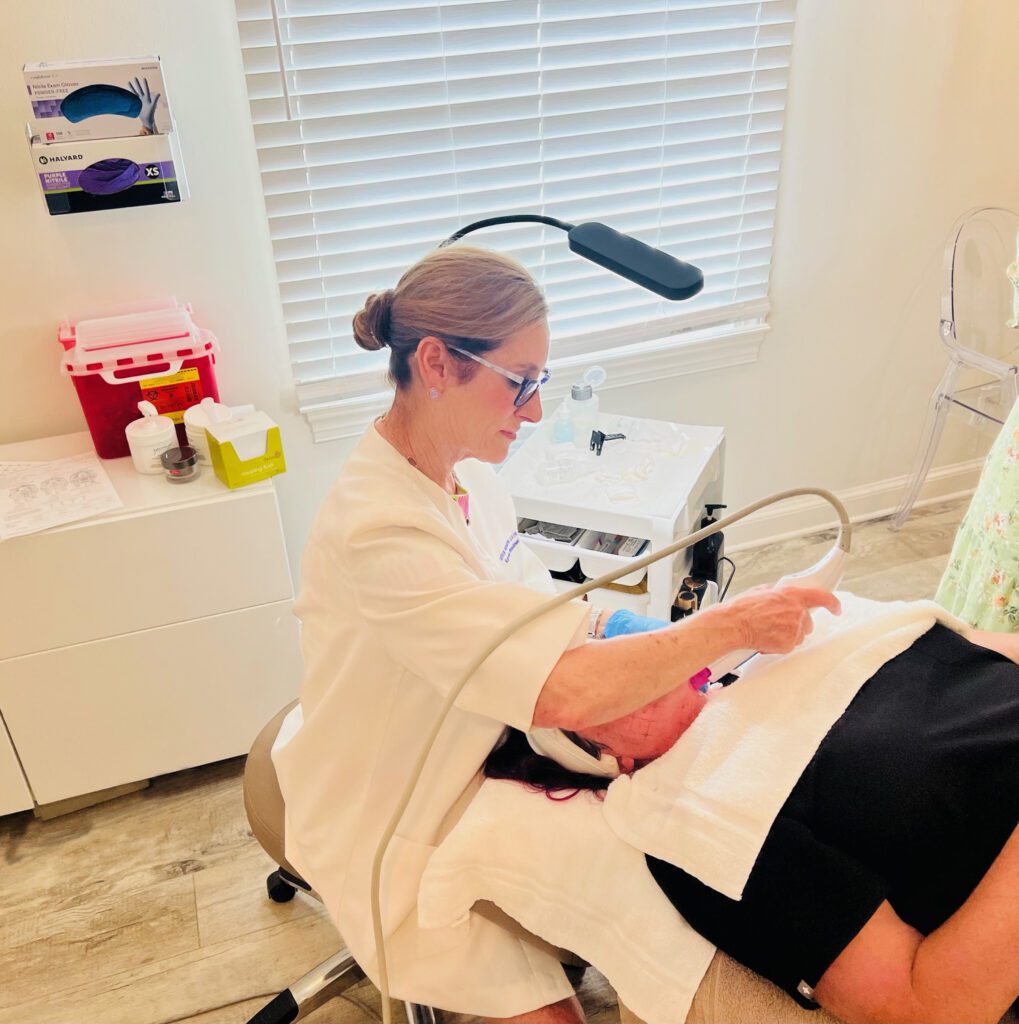
Utica Square Skin Care in Tulsa offers a variety of non-invasive skincare treatments with minimal downtime. Photo courtesy Utica Square Skin Care
“Thermage uses your own collagen to stimulate new collagen production,” she says. “It takes about six months to build, but the results are great and can be sustained for three to five years. It can be used on any part of the body – face, neck, stomach, legs – anywhere to help with sagging skin. We use it on people’s eyelids who aren’t yet candidates for blepharoplasty and we use it regularly on the neck and face to help with mild jowling.”
Kasey L. Swayden, P.A.-C., with Radiance Medical Aesthetics of Oklahoma in Oklahoma City, says additional procedures gaining popularity are Sculptra and Hyperdilute Radiesse – collagen-stimulating injectables used in the face and neck to restore volume and improve skin condition.
“These products work by triggering our bodies to produce more collagen and elastin, so results are not immediate,” she says, adding that results typically appear around six weeks and can last up to two years. “Because we’re always aging, we advise getting maintenance treatments annually. Both Hyperdilute Radiesse and Sculptra are great choices for someone who is looking to look younger and refreshed and maintain a natural appearance.”
As an alternative to a traditional facial, HydraFacials are becoming a part of patients’ regular skincare routine.
“HydraFacial is an advanced facial that uses a specialized handpiece to gently exfoliate the skin and extract the pores,” says Swayden. “The traditional extraction process can be painful and cause redness, but not with HydraFacial. Once the skin is clean and the pores are clear, HydraFacial delivers hydrating serums and optional boosting serums deep into the pores. This leaves your skin glowing, hydrated and protected. Hydration is the foundation for healthy skin, and we recommend getting a HydraFacial every four to six weeks to maximize the health of your skin.”
Beyond skincare, Lehr-Hawkins says she’s noticed a greater interest in hair health.
“Hair restoration isn’t just for people who are experiencing hair loss,” she says. “People are wanting to strengthen and nourish their hair. Through our Alma TED system, we’re able to stimulate the hair follicles, resulting in hair that’s shinier, thicker and healthier.”
Tech Advances and Staying Safe
Swayden says aesthetic laser technology has vastly improved over the last decade.
“We can safely and effectively treat a variety of skin concerns on all skin types and tones, whereas laser treatments used to be unsafe for skin of color,” she says. “Additionally, the laser treatments available today are more comfortable and require less downtime.”
For anyone wanting to start laser treatments, Swayden suggests beginning with BBL, and shares the advice that “when it comes to lasers, who is operating the device matters, for a number of reasons – most importantly, your safety.”
When choosing a provider, “make sure they invest in regular training,” Swayden continues. “Protocols and parameters are always evolving, and training is vital to deliver the safest treatments and the best results. Training is expensive and time-consuming, and the treatment price usually reflects this. When it comes to aesthetic procedures, do your research, and don’t price shop. If it sounds too good to be true, it probably is.”
Plastic Surgery: What’s Trending
Facelifts
Ivan Wayne, M.D., a facial plastic surgeon with W Facial Aesthetics in Oklahoma City, says he’s seeing an uptick in patients wanting neck and face rejuvenation.
“The use of semaglutide medications such as Ozempic has given many people the lean body they want, however the loss of fat in the face and neck brings loose skin along with it,” he says. “The ‘Ozempic face’ issue, combined with the popularity of the deep plane facelift, has fueled a boom in facelift surgery.”
But he emphasizes that the deep plane facelift is “not your mother’s facelift.
“It avoids the windswept, over-pulled look that was so unnatural,” he says. “This rejuvenation technique creates a natural, refreshed look. Downtime is one week for suture removal, two weeks to return to work, and six weeks for full recovery.”
Dr. Ivan Wayne of W Facial Aesthetics in OKC says deep plane facelifts and liquid rhinoplasties are gaining popularity. Photo courtesy W Facial Aesthetics
Nose and Eyelids
“Rhinoplasty remains one of the most common cosmetic procedures for younger patients desiring a reduction in the size of the nose, removing a bump and making the tip more refined,” says Wayne.
A new technique gaining popularity, he says, is the ‘preservation rhinoplasty,’ which offers minimal downtime and long-term results.
“I have been using [preservation rhinoplasty] for my rhinoplasty surgeries, and it is amazing how quickly patients recover and how natural the noses look,” he says.
For patients with a drooping nasal tip or a large hump, Wayne says “a liquid rhinoplasty can be done, where fillers are used to contour the nose – making a hump look less prominent while raising a long droopy tip.”
The procedure typically takes around 15 minutes under local anesthetic and results can last from one to two years. However, he notes that not every patient can benefit from a liquid rhinoplasty, and an expert evaluation is needed to determine if this treatment is right for you.
Another popular procedure that Wayne says has benefited from a more modern approach is blepharoplasty, or eyelid surgery.
“Excess upper eyelid skin is trimmed in a one-hour procedure in the office under local anesthetic,” he says. “The bulges seen in the lower lid that can make us look excessively tired are addressed by scarless fat reduction and supplemental micro-fat grafting to the hollows, creating a very natural look. Both upper and lower eyelids have about a one-week recovery.”
Thai Do, M.D., an ophthalmic plastic and reconstructive surgeon with Dean McGee Eye Institute in Oklahoma City, says cosmetic lower eyelid blepharoplasty is one of institute’s most sought-after procedures.
“This procedure typically involves the careful removal of lower eyelid fat using a skin-sparing approach,” he says. “Additionally, we may recommend adjuvant laser treatment to further reduce lower eyelid wrinkles and enhance the overall appearance of the lower lids. Through these combined approaches, our goal is to achieve facial rejuvenation, leaving our patients looking refreshed and youthful, with a reduction in the signs of tiredness and aging.”
Do’s colleague, Jeremy Tan, M.D., also an ophthalmic plastic and reconstructive surgeon with Dean McGee, says the most common cosmetic procedures he performs are upper and lower eyelid blepharoplasty and forehead lifts.
“Each patient has unique anatomy with different age-related or genetically predisposed changes that dictate how to proceed with the procedure,” says Tan.
To support an overall rejuvenated appearance, Dean McGee also offers Contour TRL – a tunable resurfacing laser that allows physicians to adjust the depth to which the laser penetrates the skin.
“Contour TRL is a deep resurfacing modality available on our Sciton laser,” says Tan. “It’s great for addressing crepiness to the skin and deeper wrinkles in the face, however, comes at the cost of more downtime.”
After a treatment, patients can expect skin to be red and swollen, and recovery time is typically between eight and twelve days. In addition, Tan says there are some medical issues, medications and skin types that may preclude patients from being candidates for Contour TRL, so making an appointment to review available options is best.
Preventative Care: Ask the Experts
When it comes to preventative skin care, LeBeau says it’s first important to remember that our skin is our largest organ.
“What you put on your skin matters, and it matters to your entire body,” she says. “What’s trending on TikTok may not be the best thing for your skin or be suited for your particular skin needs. Instead, it’s important to be using skincare products that have gone through clinical trials and shown proven results. I often tell patients that the clinic treatments we provide will make about a 30% difference, but it is their daily home skincare routine that will make a 70% percent difference in their skin.”
Meaning what we do – or don’t do – every day can significantly impact how much, and how quickly, our skin ages.
“Everyone needs to be wearing sunscreen,” says LeBeau. “So much of what we do in our clinic is reversing sun damage, which causes premature aging, wrinkles, uneven skin tone, and creates sunspots. And it needs to be a quality physical sunscreen, not chemical, that’s going to provide a barrier between UV rays and your skin.”
Secondly, she recommends the regular use of retinol.
“Retinol has been shown, over time, to reduce fine lines and wrinkles,” she says. “And we now have retinol in forms that people can use every day to receive its benefits without dealing with red, flaking and peeling skin.”
While LeBeau knows that most people want to avoid spending a lot of money on skincare, she says they should think of their skin as an investment.
“How you invest in your skin today will affect your skin later, and the better you invest the better the benefits,” she says.
Lehr-Hawkins says while they see patients of all ages, she’s seen an increase in younger people desiring an individualized skincare program.
“They’re wanting a combination of in-office and at-home treatments to help maintain the health of their skin and help achieve a healthy glow,” she says “Patients are taking a greater interest and more responsibility in their skincare – making them more committed to the outcomes.”
Before You Go: What to Know
When beginning any type of aesthetic treatment, it’s important to have goals in mind – but also healthy expectations.
“Most of us know what we want to improve, and that’s the best place to start when scheduling a consultation,” says Swayden.
“We see many patients with friends who have seen incredible results, so they want exactly that treatment,” she says “It’s important to remember that we are all unique – from our anatomy to our skin tone and skin health. What worked for your friend may not give you the best results. Research your provider, trust their expertise, and understand that they may recommend a treatment much different than the one you had in mind.”
Swayden says it’s best to be open to different options and to consider your budget and time commitment.
“Remember, you don’t have to receive treatment or purchase anything on the day of your consultation,” she says. “Listen to your provider’s recommendations and express your budget and time restrictions at that time. Often, your provider will be able to provide financing options and other budget solutions as well. Then, take it all home and think it over before taking the leap.”
The phrase “mind over matter” holds some truth when it comes to making the most of your golden years. Although an active lifestyle and genes go a long way, studies suggest that maintaining a positive mindset can have a significant impact on a person’s lifespan.
In a 2022 study published by the JAMA Network – an open access medical journal published by the American Medical Association – a group of nearly 14,000 adults, 50 years and older, were studied for four years. Researchers found that participants who demonstrated higher levels of aging satisfaction benefitted from reduced mortality rates around 43%. They were also more likely to engage in regular physical activity and experience lower levels of loneliness. Another study published by the National Library of Medicine showed that older adults who maintained an optimistic outlook lived up to 7.5 years longer than adults with negative self-perceptions.
“A lot of times, health is a feedback loop rather than a straightforward motion,” says Blake O’Brien, M.D., an internist with INTEGRIS Health. “To keep the mind healthy, one has to work on keeping the body healthy and vice-versa. Keeping a positive mindset and good self-perception about changes while aging helps keep the mind toward improving or maintaining the body’s ability to be active and stay fit. This, in turn, improves one’s perception and helps to generate a positive mindset.”
Like all other phases of life, growing older comes with challenges. However, there are several ways that older adults can find harmony with late-life changes, and in turn, boost their overall wellbeing:
Sustain a sense of purpose. Older adults can find meaningful ways to contribute to society in retirement. Volunteering for a cause, exploring new interests and joining a community of like-minded people can form pathways of connection.
Reject ageist stereotypes. Despite the growing population of older adults in the U.S., negative messages about aging are prevalent and inaccurate. Many older adults can stay active and sustain their independence for the majority, if not all, of their lives.
Stay in touch with family and friends. Social isolation is a common struggle for seniors and is often correlated to serious health conditions.
Try a new activity or hobby. Some older adults may find that they are unable to do the same things they did as a young adult. However, it’s never too late to develop a skill. Cultivating new hobbies can boost a person’s self-esteem and their quality of life.
New Medical Updates
For centuries, humankind has searched for an antidote to slow down or reverse the aging process. Growing older is inevitable, but pharmaceutical breakthroughs and the advancement of technology are helping treat and even prevent certain geriatric conditions.
In 2023, the Food and Drug Administration (FDA) approved Leqembi, a prescription medicine for adults that have mild cognitive impairment from early onset Alzheimer’s or dementia. Leqembi is the first prescription drug to receive full approval from the FDA; the drug reduces plaque buildup on the brain associated with Alzheimer’s, helping slow the progression of the disease.
The FDA also approved a vaccine for respiratory syncytial virus (RSV) in May 2023. RSV is an illness that annually kills 6,000-10,000 American adults 65 and older. GlaxoSmithKline is a targeted treatment for adults who are 60 and older, and it has been found to be 83% effective at preventing the spread of RSV.
Researchers have uncovered more information about the development and treatment of arthritis, which affects over 52 million people in the U.S. In recent years, researchers have found a connection between periodontal health and rheumatoid arthritis. Studies suggest that people with rheumatoid arthritis can lessen their arthritic symptoms by maintaining good oral hygiene.
O’Brien shares recent medical research regarding thirst in older adults.
“The mechanism for thirst in your body already turns on too late and turns off too early, as we’ve all heard from a parent or coach,” he says. “As adults age, this becomes even more apparent, as the time between thirst and dehydration shrinks to minimal levels. It is recommended to maintain hydration throughout the day rather than just drinking when thirsty.”
Although time will catch up to all of us, tried-and-true methods hold steady.
“When I was in residency … I began to notice a pattern in the healthiest people in their 70’s and 80’s,” says O’Brien. “They kept alcohol to a minimum, they didn’t use tobacco and they were active. Unfortunately, there are always some who will suffer a fate of genetic or random circumstance, leading to loss of independence. However, the most healthy, happy and longest living people were those that enjoyed life in moderation, and this reaped benefits as they aged.”
When Is It Time to Move?
Life is full of transitions. Knowing when to move into a retirement community or assisted living facility can be both a difficult and emotional decision.
There isn’t a magic number for deciding when the time is right; each person ages differently, and many seniors can maintain their independence with little to no help from others. However, there are some telltale signs that a new living arrangement may be worth considering.
“It may be time to explore independent living if cooking and cleaning are a burden, or something you would prefer someone else handle for you, or [if] you are feeling overwhelmed by home maintenance tasks,” says Kayla Nelms, corporate director of marketing at Cedarhurst Senior Living. Other signs to look for are frequent falls, poor hygiene, elevated health problems and chronic loneliness or isolation.
In independent living communities, seniors can benefit from a wide range of social activities and onsite amenities. Assisted living communities provide more intensive support to seniors for completing daily activities, such as dressing and taking medication.
Photo courtesy Cedarhurst of Woodland Hills
“Caregivers act as an extension of the family when the family is not able to provide help around the clock,” explains Cari Bashaw, sales director at Covenant Living at Inverness.
Although some seniors may feel as if they’re giving up their freedom, it’s important to make the transition to a new living arrangement before a crisis occurs.
“The decision to move to an independent senior living community is best made when individuals are healthy enough to reap the benefits,” says Bashaw. “In independent living, residents can participate in many activities, make new friends, learn new hobbies and focus on what they enjoy doing.”
If timed right, the move can also prevent the worsening of health problems.
“Proactive decision-making also ensures that seniors receive the care and support they need before their health or safety becomes compromised,” says Nelms. “It gives families peace of mind, knowing their loved ones are living in a secure and nurturing environment where their wellbeing is a top priority.”
Stimulating Senior Activities: Beyond Bingo
Senior living communities can offer a wide range of activities and social events for their residents to enjoy.
“It is important to realize that ‘activities’ do not exist to keep people busy,” says Bashaw. “They are planned to help provide opportunities for fulfillment, purpose and enrichment.”
Exercise classes, aquatic programs, advocacy groups, and painting and gardening workshops are just a few of the activities that Covenant Living at Inverness offers to its residents. Each program is designed to promote wellness across one of eight crucial areas: spiritual; emotional; relational; physical; intellectual; vocational; environmental; and financial.
Photo courtesy Covenant Living at Inverness
Resident-led activities also provide the opportunity for residents to tap into their special talents, learn from others and connect with peers who share the same interests.
“We work to find what is important to those [who are] living here… Our activities are as varied as our residents. From skydiving to poetry club, we want to provide opportunities for residents to live their best lives,” says Bashaw.
Cedarhurst Senior Living also aims for its residents to lead their fullest lives with engaging, hands-on programming that is tailored to residents’ unique interests. Guided by its ‘Living TRUE’ Framework, Cedarhurst gets input from its residents about activities and programs to offer every quarter.
The Cedarhurst staff regularly organizes fitness classes, group outings, social events and pool parties. All programming and activities are intended to foster social connections, encourage personal growth, and ignite a sense of purpose in residents.
“We are dedicated to creating a vibrant community where seniors can feel valued, respected and surrounded by genuine relationships,” says Nelms. “Seeing the smiles on their faces, witnessing their personal growth and sharing in their joy is what fuels our passion and drives us to exceed expectations every day.”
Senior Living Trends
Over the last 100 years, the number of American adults over the age of 65 has increased by nearly 1,000%. Not only is the population of the U.S. changing, but so are senior living trends.
“Retirees today are very different than those of 15 or 20 years ago,” says Bashaw. “Today’s older adults focus on giving back to their community through volunteering, improving their health with exercise programs designed to stimulate the body and mind, and eliminating unnecessary stress caused by the burdens of homeownership.”
Photo courtesy Covenant Living at Inverness
Over the last two decades, independent living communities have become the most popular type of housing for seniors, according to Statista – an online platform that specializes in data gathering and visualization. This influx may be, in part, due to a higher sense of importance around wellness compared to years prior.
Advancements in technology have also been a game changer for many retirees. Wearable health devices and remote medical appointments provide more options for seniors to receive care and monitor changes in their health.
Tulsa-based Tandoori Guys provides a variety of Eastern cuisine dishes. Photo courtesy Tandoori Guys
“In India,” says Patchaiappan Murugavel, “everyone – parents, grandparents, children – is interested in cooking.”
He should know, he grew up in Pondicherry, a pleasant seaside town at the end of a branch railway line from Chennai in Tamil Nadu.
“My grandma cooked three meals a day for our family. She didn’t use curry powder; she ground spices from scratch,” he says. “That’s what we are trying to do here at Tandoori Guys. We have more than a hundred kinds of spice in the restaurant kitchen, and we make a different blend for each dish.”
Murugavel is co-chef and co-owner of the Broken Arrow establishment, along with Raja Ramalingam. (“But you can’t talk to Raja now, he’s in India. He just got married,” Murugavel tells us.)
By third grade, Murugavel was already cooking. The recipes he learned from his family were the food of Southern India.
“Back home, we don’t have creamy, buttery sauces like tikka masala; most of our food is coconut-based and vegan,” he says. But he loved cooking so much that he went to the Pondicherry branch of the Institute of Hotel Management, a sprawling academy set up by the Indian government. After three years there, and another five years cooking at hotel restaurants in India, he can now cook, well, just about anything you’ll find in India.
“Even haleem and nihari?” he’s asked, referring to two famous dishes of northern Pakistan.
“Yes, even those,” he replies. “If you order a catered dinner, we can cook them. Tulsa has a big community of people from southern India. They want to cater dinners for holidays and special events, and we want to serve them. We can cater authentic meals from any region in India.”
You’ll find some of these south Indian dishes on the regular a la carte menu. Dishes like rich, flavorful chicken chettinad, which Murugavel grew up with. That dish features chicken in a thick, sumptuous sauce made of red chiles, kalpasi, coriander, cumin, fennel, poppy seeds and more. The sauce is so rich you’d guess it has a bucket of cream, but it doesn’t have any at all – it’s coconut milk. There’s also nilgiri chicken, in a bright green sauce made with curry leaves, cilantro, mint and coconut. But most of the menu comprises the sort of dishes you’ll find in Indian restaurants hereabouts, dishes like chicken tikka masala and lamb korma. They want to appeal, Murugavel explains, to the general population, not just to people from India.
And those popular dishes excel. Breads such as naan are cooked in a clay tandoor oven – which you’d expect, given the restaurant’s name. They make an effort to cater to vegans, inventing plant-based versions of many dishes. There’s Indo-Chinese food too, which was the food invented in India by Chinese immigrants.
Most popular of all are the buffets. Those all-you-can-eat extravaganzas take place every lunchtime, every weekend dinner and on some holidays, including Thanksgiving and Christmas. Sometimes, you’ll find dishes from Kerala or Tamil Nadu – dishes that aren’t on the regular menu. Once a month (soon to be once a fortnight) there’s a Thursday vegan buffet, your best chance of finding those rare South Indian dishes.
Tandoori Guys opened six years ago. Is there anything Murugavel wants to say to his patrons after all this time?
“I want to thank the community,” he says. “I’ve always been happy I started a business in the Tulsa area. And I also want to say, we make a different spice blend for every dish, everything is done from scratch. This takes work and time, and sometimes there’s a delay. Dishes don’t come out of the kitchen right away. We’re sorry – but we don’t want to compromise our quality.”
Photo caption: Tulsa-based Tandoori Guys provides a variety of Eastern cuisine dishes. Photo courtesy Tandoori Guys
Opened in January 2023 by husband and wife duo Drew Laden and Kathryn Holsten, Nomad BBQ and Deli boasts some of the tastiest smoked meats and deli sandwiches in Tulsa’s midtown area.
The crew smokes all their own items – from brisket and pulled pork to deli ham and pastrami – on locally crafted Hasty Bake smokers. They also incorporate Kansas City-based rubs and sauces and pride themselves on the restaurant’s approachable, friendly atmosphere.
The menu at Nomad is broken up into sandwiches, barbecue, salads and sides.
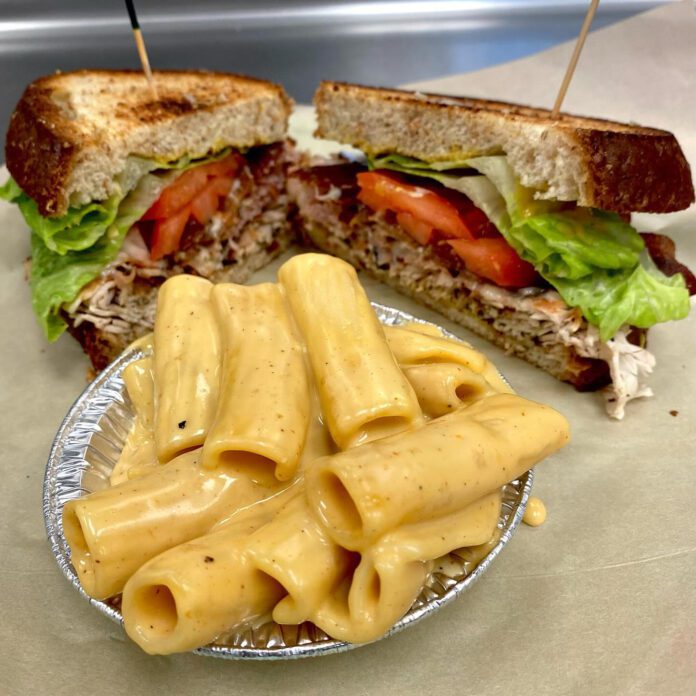
Sandwiches run the gamut and include the Nomad Club, with smoked turkey and ham, bacon, Swiss cheese, mayo, lettuce and tomato, and the Pittsburg Nelly, with pulled pork, sauteed onions, peppers and white cheddar on a hoagie. Classics include the French dip, the Cuban and the smoked pastrami.
If you’re in the mood for nothin’ but BBQ, Nomad has you covered. Offerings include chopped and sliced brisket, smoked wings with your choice of sauce, pulled pork, ribs and sausage links. Even better, all house smoked meats are available in deli slices to take home.
Healthy eaters can try a variety of salads, including the Berkeley with berries, candied nuts, bleu cheese and red onion, or Elaine’s Big Salad with cheddar, tomato, cucumber, carrots, bell peppers and croutons.
Don’t forget to add on sides like housemade potato chips, mac and cheese, fried okra, potato salad, coleslaw, pasta salad and baked beans.
A play on the leading explanation of how the universe was formed and some delicious Chinese noodles, the Big Biang Theory is an OKC hot spot located in the trendy, up-and-coming Film Row district. A glance at the menu will have you torn between a variety of options.
To start, shareables include chipotle garlic shrimp, fried mushrooms and one way fried chicken – thighs fried in a light batter, sauced and topped with jalapenos, sesame seeds and lemon zest. For a more filling starter, try the goku steak, served rare, sliced up and glazed with a sprinkle of garlic and scallions. Other starter items include jalapeno chicken egg rolls and a harvest blend salad.
The namesake dishes include three iterations, starting with the spicy chicken curry – complete with noodles in a coconut curry sauce, marinated with bamboo and peppers with red cabbage, corn and spicy chicken. The traditional option offers biang biang noodles, black vinegar soy sauce, garlic, scallions and gochuaru. The final is the cumin braised beef, with noodles, beef, fried garlic, scallions and chili oil drizzle.
Wash down all these goodies with a variety of drink options. For the beer lover, Big Biang offers Japanese, Thai and Lao lagers, as well as IPAs. You can also opt for mimosas, white and red wines, or a craft cocktail. Standouts include the Dream Theory, with rum, orange cream, bourbon cream and orange zest; the Buckin Mule, with mezcal, Thai basil syrup, ginger beer and lime; or the Biangin’ Old Fashioned, with Ume plum whisky, toasted caramel and bitters.