There’s no doubt about it: May is festival month in the Sooner State.
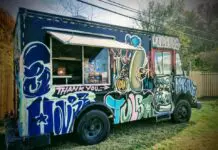
In Tulsa, start with GermanFest, May 1-3 at 2301 E. 15th St., then head over to the Black Wall Street Rally, May 14-16 in the Greenwood District – packed with family-friendly events and the perfect stop for motorcycle enthusiasts. After, you can take a quick trip to Broken Arrow for the Rooster Days Festival, May 14-17 in Central Park, then circle back to Expo Square for Tulsa’s Route 66 Capital Cruise on May 28-30, as Oklahomans make a world-record attempt for the largest classic car parade in history. If you’re peckish after, the Jenks America Food Truck Festival runs May 30 on Main Street.
A hundred or so miles away, you can celebrate Norman Pride Festival Weekend on May 1-3 at various citywide locations, then head to OKC’s Scissortail Park for Kickin’ It on 66 – a celebration of the Mother Road and its exciting centennial.
Other can’t-miss events around the state include the Tumbleweed Calf Fry, through May 2 at Stillwater’s Tumbleweed Dance Hall; the Arts for All Festival, May 8-10 at Lawton’s Shepler Square Park; the Stilwell Strawberry Festival, May 9 in downtown Stilwell; and the Magnolia Festival of Oklahoma, May 28-30 at Durant’s Choctaw Event Center.
May is here! Maybe you’ll see some films! Maybe you won’t! I can’t tell you what to do, but I may be able to give you some ideas! Am I losing my mind? Also maybe!
For some bone breaking action, take a look at Mortal Kombat II. A sequel to the 2021 film Mortal Kombat, the film looks to expand on the universe of the video games with more bloody fights and iconic characters. The cast adds Karl Urban (The Boys) as smart mouth movie star Johnny Cage and the trailer looks to have more of what fans wanted from the first film – tournament fights and accurate lore. We’ll find out if all the Fatalities work out when it opens on May 8.
For an action thriller with style, check out In the Grey. Written and directed by Guy Ritchie, known for his slick heist films like Lock, Stock, and Two Smoking Barrels, this film follows a group of elite agents tracking down a boatload of money that was stolen from them. The cast is full of A-list celebrities including Henry Cavill (The Witcher), Jake Gyllenhaal (Road House) and Eiza Gonzalez (Baby Driver), all looking like they came off a magazine photo shoot and ready to mug the camera for two hours. With tons of explosions and witty quips, this will hopefully be a fun time at the theater when it drops on May 15.
If you want a supernatural horror, look no further than Obsession. Directed by Curry Barker, known for his sketch comedy work under the banner That’s a Bad Idea, the film follows a lovesick man who makes a wish for his crush to fall deeply in love with him – and the results are, to be frank, a monkey’s paw nightmare. Comedians often do great work infusing dark humor into a horror story, and the trailer seems to indicate some truly creepy moments happen as a result of his poorly planned wish. We’ll see how much the monkey’s paw curls when it releases on May 15.
For the Star Wars fan who isn’t too jaded yet, don’t miss The Mandalorian and Grogu. Following the story of Din Djarin (Pedro Pascal, The Last of Us) and his adorable Yoda-like friend Grogu, the film takes place after the TV series TheMandalorian (2019-2023) as they continue their journey around the galaxy. This will require some homework, as you’ll need to get through three seasons of The Mandalorian along with one season of The Book of Boba Fett. Disney is banking that this will pay off, but time will tell. It releases on May 22.
Lastly, a weird sci-fi horror filmed called Backrooms. Based on creepypasta internet lore about abandoned rooms and exiting reality, the trailer definitely has all the right vibes to keep you on edge. Directed by Kane Parsons, who also created a YouTube series based on the lore, it stars Chiwetel Ejiofor (12 Years a Slave), Renate Reinsve (Sentimental Value), and Mark Duplass (The Morning Show). It’s also distributed by A24, lending it even more credence. It releases on May 29.
Kristin Dotson arrived in Tulsa in 1996 and joined Celebrity Attractions when the staff could fit around a single table. Today, she leads the company, presenting nationally touring Broadway in three regional markets. Over the years, she has worked in nearly every corner of the business, from box office to marketing to programming, eventually rising to CEO in 2017. She has helped bring blockbusters like The Phantom of the Opera, The Lion King, Wicked and Hamilton to the region, along with the national tour launch of The Outsiders. A member of the Broadway League and a Tony Awards voter, Dotson also plays a role on the national stage. We caught up with Dotson and got her thoughts on …
… what her journey with Celebrity Attractions has taught her.
Larry Payton, our founder, taught me that relationships are the foundation of success. After his passing, I have carried that theme through everything I do. I prioritize my relationships with staff, partners outside of the office and our patrons.
… how her hands-on experience has affected her leadership style.
Wearing more hats means more experience and perspective. Because I have firsthand knowledge of so many aspects of the business, it is easier to lead and collaborate.
… a career moment that stands out.
Absolutely, by far, the highlight of my career was opening The Outsiders tour in Tulsa last fall. This is a special show with such a uniquely deep connection to our community, and feeling that energy on opening night is something I will never forget!
… what goes into deciding which shows come to Tulsa and other markets.
We put together a big puzzle when we curate the Broadway season: what titles are touring, the route of the tour and the availability of the Tulsa PAC. We also consider the financial component including how we think the market will react (i.e. will we sell tickets?) so we can set ourselves up to succeed.
… how Celebrity Attractions keeps subscribers coming back season after season.
We always cast a wide net for the season. We try to have a family show, maybe something classic and something new. We also strive to provide excellent customer service. Season subscribers trust us to entertain them, and we in turn provide the customer service they deserve.
… elevating the cultural life of Tulsa.
Having a vibrant arts scene in any community is vital to the quality of life. We are blessed in Tulsa to have world-class resident companies with Tulsa Ballet, Tulsa Symphony and Tulsa Opera. Add to that our amazing museums, the BOK Center and of course, nationally touring Broadway, and you can be entertained year-round.
… how her involvements with the Broadway League and the Tony Awards influence what she brings to the stage.
Connecting to others in our industry through the Broadway League allows me to engage with other markets across the country, learning what works and what doesn’t on the road. As a Tony voter, I will see every musical that opens on Broadway. So, when a show announces a national tour, I have firsthand knowledge of the content and how the audience received it.
… defining success at this stage of her life.
I have been a single mom for the last eleven years – just myself and my daughter. So when she left for college last fall, I thought I would fall apart. But at the end of the first week, she called to say “Mom, I am thriving!” I was so relieved and realized that her success is my success. And that applies to my friendships, my team at Celebrity and our partners and patrons. When you have mutually beneficial relationships, everyone wins.
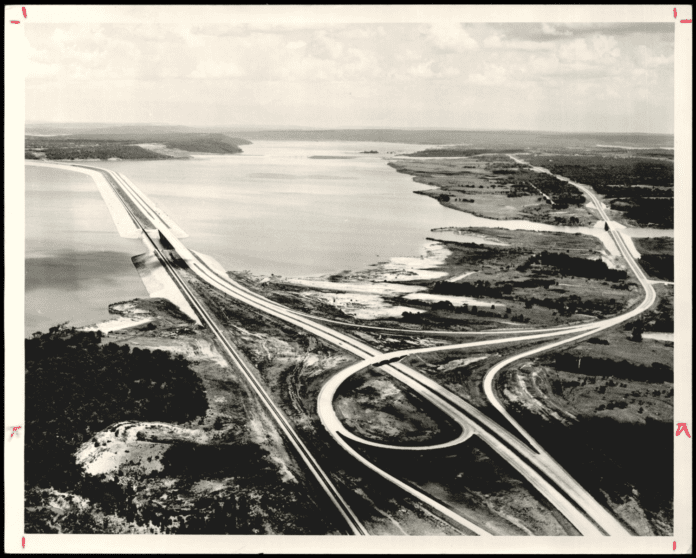
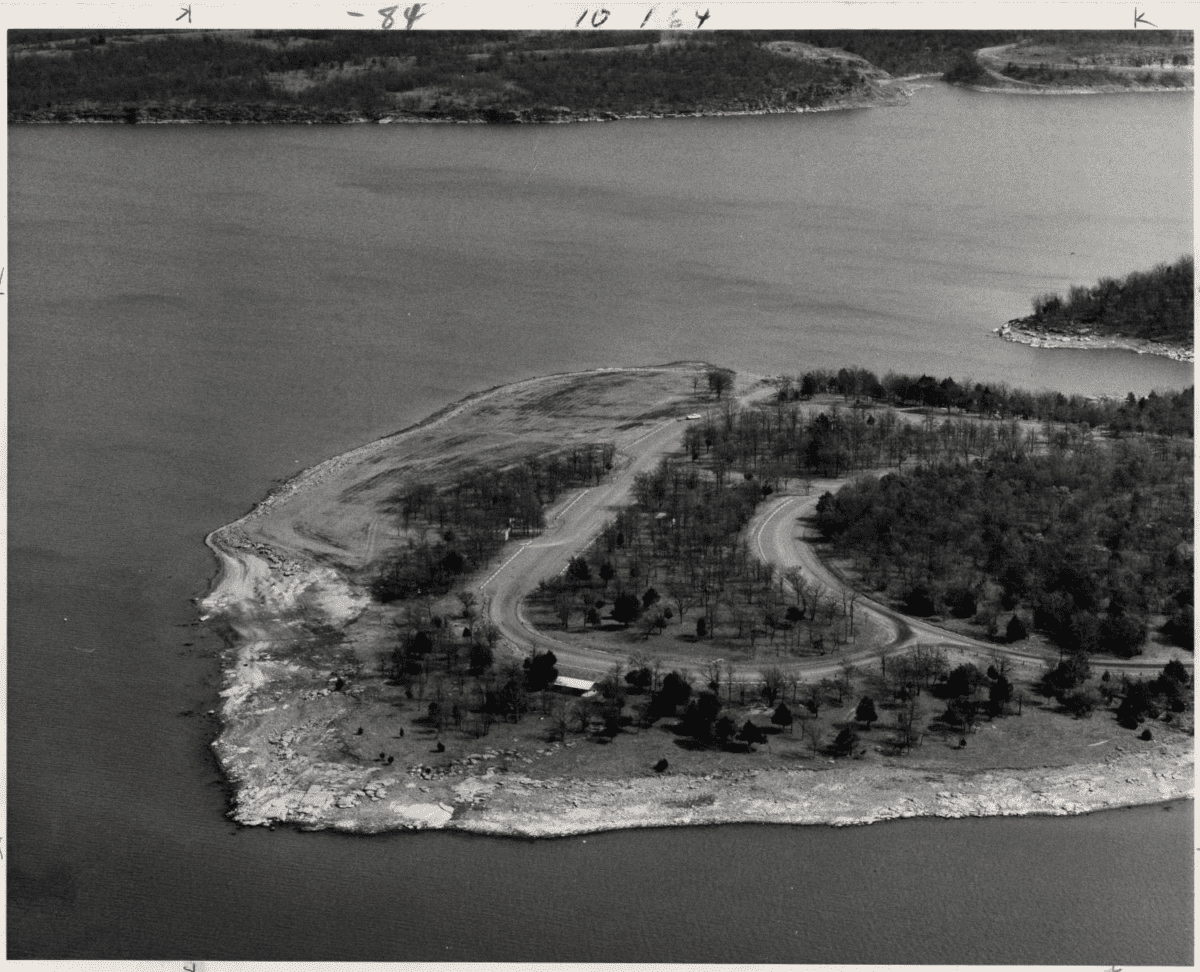
Early construction of one of Oklahoma’s man-made lakes transformed flood-prone rivers into reservoirs built for protection and tourism.
Photo courtesy the Oklahoma Historical Society
The next time you venture out for some on-the-water fun in Oklahoma, stop and reflect on this unique fact: Essentially all of Oklahoma’s major lakes and reservoirs are man-made.
“Most were created by constructing dams across streams. Most lakes were made for flood control, water supply, recreation, fish, wildlife and/or hydroelectric power,” according to The Encyclopedia of Oklahoma History and Culture. “The major lakes in Oklahoma have been constructed by the U.S. Army Corps of Engineers (USACE), the U.S. Bureau of Reclamation and the Grand River Dam Authority (GRDA). Other large lakes are owned and operated by various state and federal agencies, by cities and by other entities.”
Floods along Oklahoma watersheds were extremely common – and disastrous – prior to the construction of reservoirs, says Matthew Pearce, Ph.D., State Historian with the Oklahoma Historical Society.
“Indeed, while Oklahoma is often associated with drought and the Dust Bowl during the Great Depression, more Oklahomans during the 1930s were displaced by floods than they were by dust,” says Pearce.
The town of Hammon in Roger Mills County was the site of a particularly devastating flood in 1934. Fourteen inches of rain fell within five hours, and the associated floods killed seventeen people, says Pearce.
It takes the work of several organizations to keep the waterways working today.
“The USACE is the federal body responsible for civil works, which includes the construction, maintenance and operation of dams and canals for purposes of flood control and navigation,” says Pearce. “For example, the Tulsa District of the USACE oversees a number of facilities and projects along the Arkansas River, including well-known lakes such as Keystone, Oologah and Texoma, as well as the Port of Catoosa and the McClellan-Kerr Arkansas River Navigation System (MKARNS).”
The Corps regularly dredges the navigational channel of MKARNS so that it maintains an adequate depth for river traffic. It also regulates water releases from as many as seven reservoirs, including lakes Keystone, Oologa and Eufaula to maintain the system.
The GRDA is tasked with administering hydroelectric projects along the Grand River, says Pearce. It was created through federal legislation (1935) and modeled somewhat after the better-known Tennessee Valley Authority, or TVA, with the goal of comprehensively developing the Grant River watershed for purposes of flood control and hydroelectricity.
“Grand River Dam, also known as Pensacola Dam (within Grand Lake, or Lake O’ The Cherokees) was completed in 1941 and was the first hydroelectric project built in Oklahoma,” says Pearce. “Kerr Dam (Lake Hudson) is the other notable dam associated with the GRDA.”
Flood control, hydroelectricity and navigability in the case of the Arkansas River were the primary concerns behind the development of many lakes and reservoirs in Oklahoma.
“Oklahoma’s lakes and reservoirs are administered under the principle of multiple use and are expected to provide tourism/recreation services. Tourism/recreation is the primary way through which many Oklahomans and out-of-state visitors experience lakes and reservoirs, while other uses such as flood control and electricity have a tendency to be ignored or taken for granted,” says Pearce.
He continues: “Recreational facilities are administered by a variety of federal, state and private entities, and regular visitation to lakes and reservoirs is a key aspect of Oklahoma’s tourism economy. A good example is Broken Bow Lake in McCurtain County, which experiences well over one million visitors each year.”
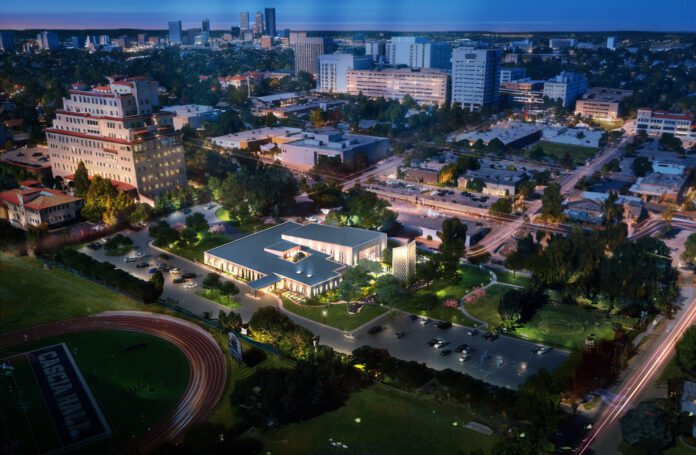
An aerial rendering showcases the layout of the new Temple Israel campus, highlighting the sanctuary, community gathering spaces, landscaped grounds and the sacred outdoor garden. All renderings courtesy Finegold Alexander Architects
Temple Israel, one of Tulsa’s oldest congregations, is preparing to enter a new chapter in its 112-year history. Construction is underway on a new building scheduled to open in 2027, a project designed to balance modern worship needs with the congregation’s deep historical and cultural roots.
The new facility is estimated to cost $14.5 million, with the leading gift donated by the Sanford & Irene Burnstein Family Foundation. It will replace the congregation’s current place of worship, a 43,000-square-foot structure built in 1955. While beloved by many members, the building has become increasingly difficult to maintain and adapt to contemporary religious life, prompting a conversation about whether to renovate the aging facility or start anew.
The First Decision: Renovation vs. New Build
Temple leadership began studying the challenges roughly four years ago, exploring the possibility of renovating the existing structure. However, the building’s age presented significant obstacles; it lacked many systems required in modern buildings, including updated fire suppression technology. Over decades, mechanical systems had been added piece by piece, eventually resulting in dozens of separate units tied into the facility. Maintaining and repairing those systems has become increasingly complex and costly.
Temple Israel chose to build a new worship space after determining its existing structure, built in 1955, would be difficult to modernize. All construction photos by Kenneth Baucum Photography
Renovation would have required substantial investment simply to bring infrastructure up to current standards before any improvements to the worship or community spaces could begin. In addition, leaders realized the large footprint of the building no longer matched how the congregation used its space. Some areas went underutilized, while others lacked the flexibility needed for modern programming and gatherings.
Ultimately, it was determined that constructing a new building would allow the congregation to design a more efficient and intentional facility. The new structure will be about 23,000 square feet – nearly half the size of the existing building – but with every space carefully planned for a specific purpose, and with improved flow between areas.
“It really wasn’t that we made a right decision or a wrong decision,” says David Weil, a Temple Israel congregant helping to lead the new construction project. “It was just what we thought was the better decision after looking at all the options. When we [designed] the new space, every square foot had a purpose. Every flow from one location to another has a place in the plan.”
The decision was not without emotional weight. For generations of congregants who grew up attending services, celebrations and life-cycle events in the original sanctuary, the building held deep personal significance. Temple leadership sought to honor those memories while designing a space capable of serving the congregation for decades to come.
“It’s hard to leave something behind that you’ve watched for your entire life if you grew up in this community,” Weil says. “We want to make sure that we honor the past of that building, [the community] and all the great work that was done by the architect Percival Goodman.”
Finding the Right Partners
To guide that effort, Temple Israel conducted a nationwide search for the right architectural partner. Leaders reviewed roughly 17 firms, focusing on those with experience designing religious buildings. Such projects require specialized knowledge, as the architecture must balance ritual traditions, symbolism and community functions while also meeting modern design standards.
The congregation selected Finegold Alexander Architects, a Boston-based firm with extensive experience working on Jewish cultural buildings. The firm has had a hand in dozens of synagogue projects nationwide and was involved in work connected to the United States Holocaust Memorial Museum. Crossland Construction out of Tulsa was also recruited to lead the construction, adding a local touch to the project.
For the architects, Temple Israel’s story was a compelling one. The congregation’s century-long presence in Tulsa reflects the endurance of the city’s Jewish community, and the project offered an opportunity to honor a historic building while responding to evolving worship practices and community needs.
“The over 100-year history of Temple Israel as a congregation speaks to the resiliency and strength of Tulsa’s Jewish population,” says Rebecca Berry, Principal, President and Director of Sustainability with Finegold Alexander.
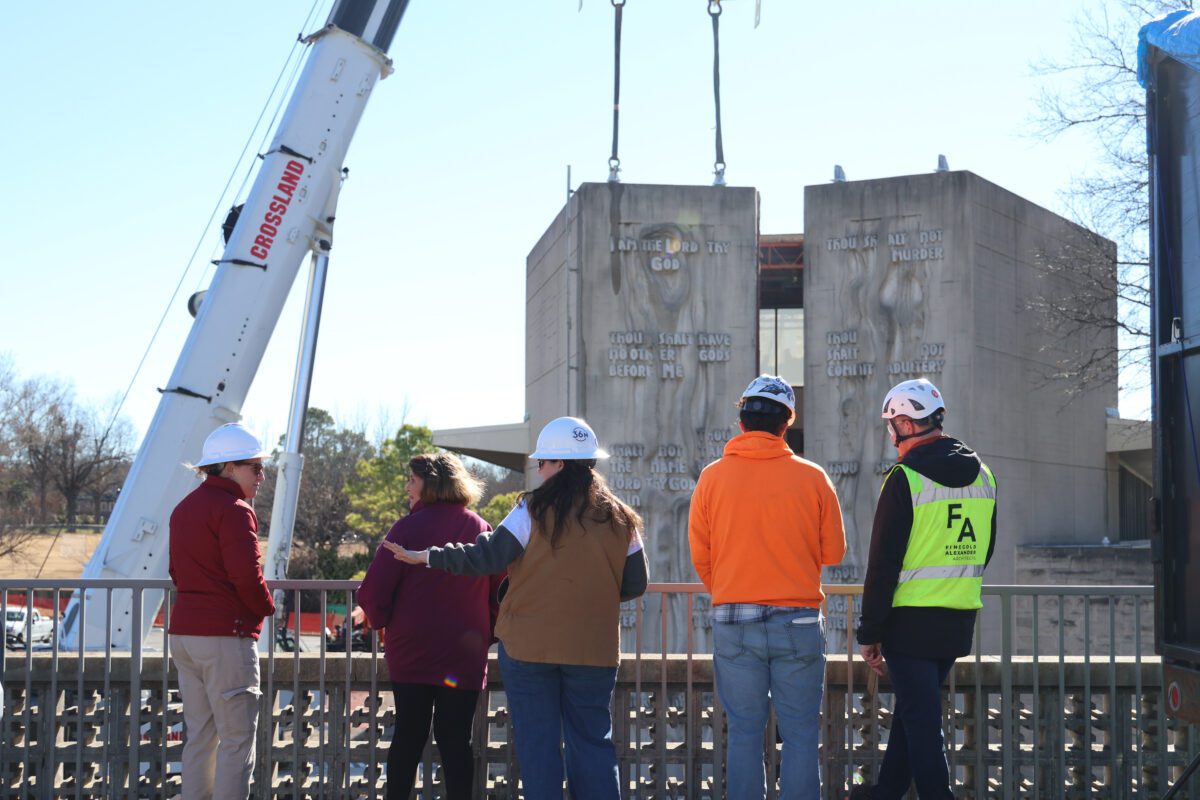
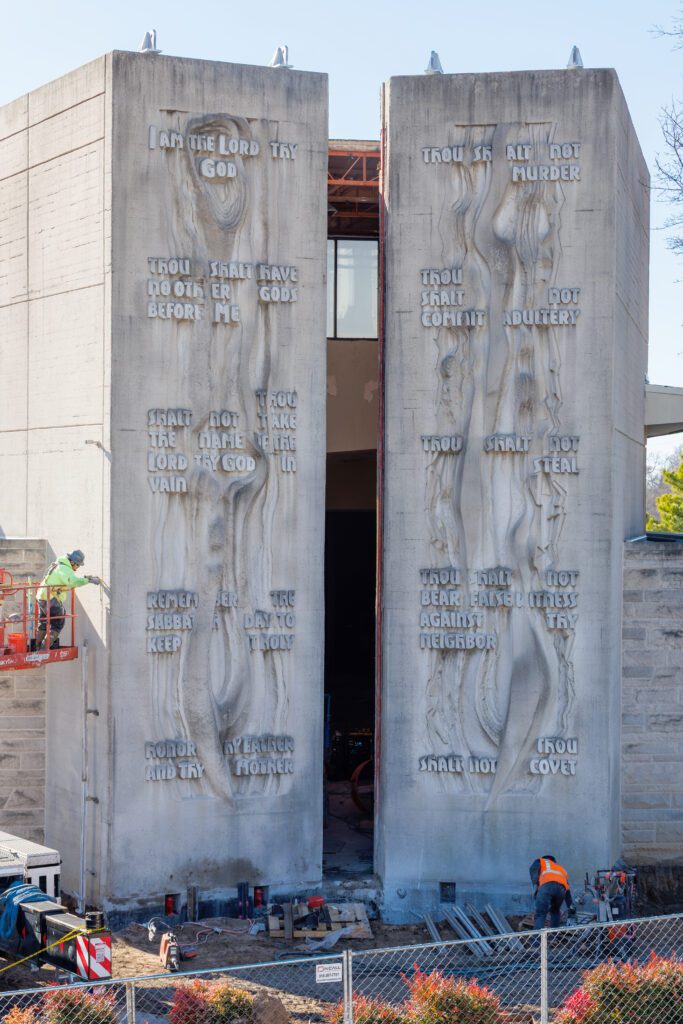
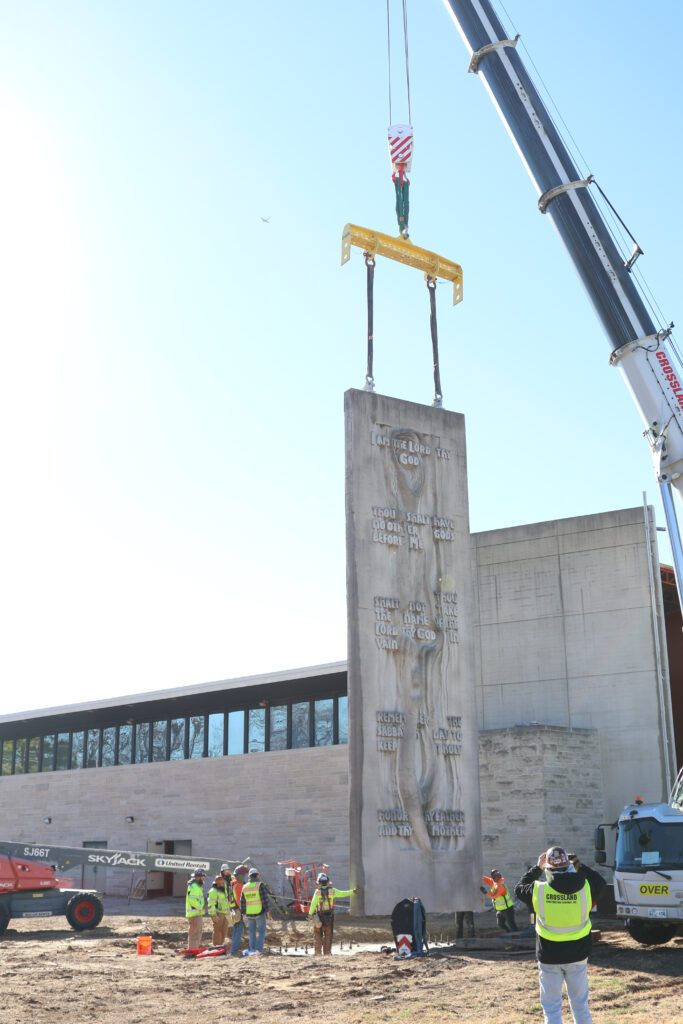
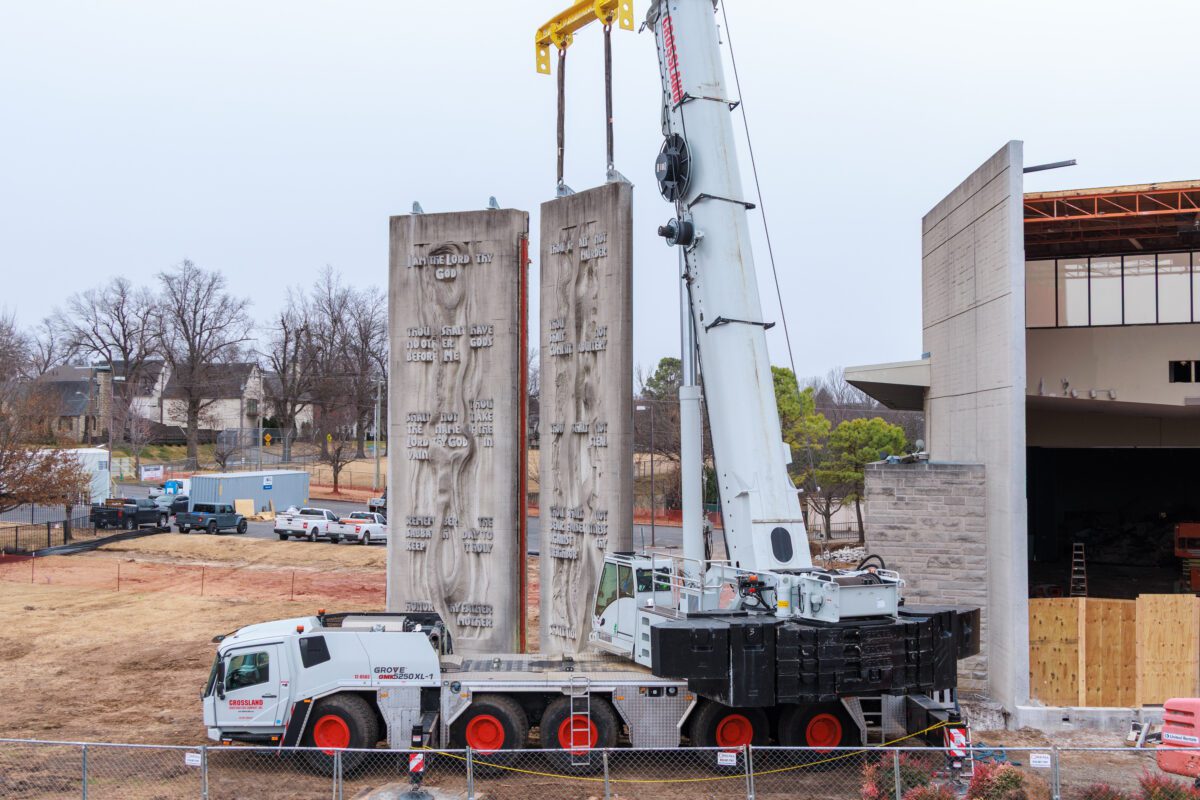
Two massive Ten Commandment tablets, each weighing roughly 90,000 pounds, were carefully removed from Temple Israel’s 1955 sanctuary to be preserved as part of the new campus.Engineers reinforced and lifted the historic tablets from the original sanctuary wall in a complex operation.Previously embedded in the original sanctuary wall, the Ten Commandment tablets will be relocated to a sacred outdoor garden where they will remain visible from inside the new sanctuary.
The Design Elements
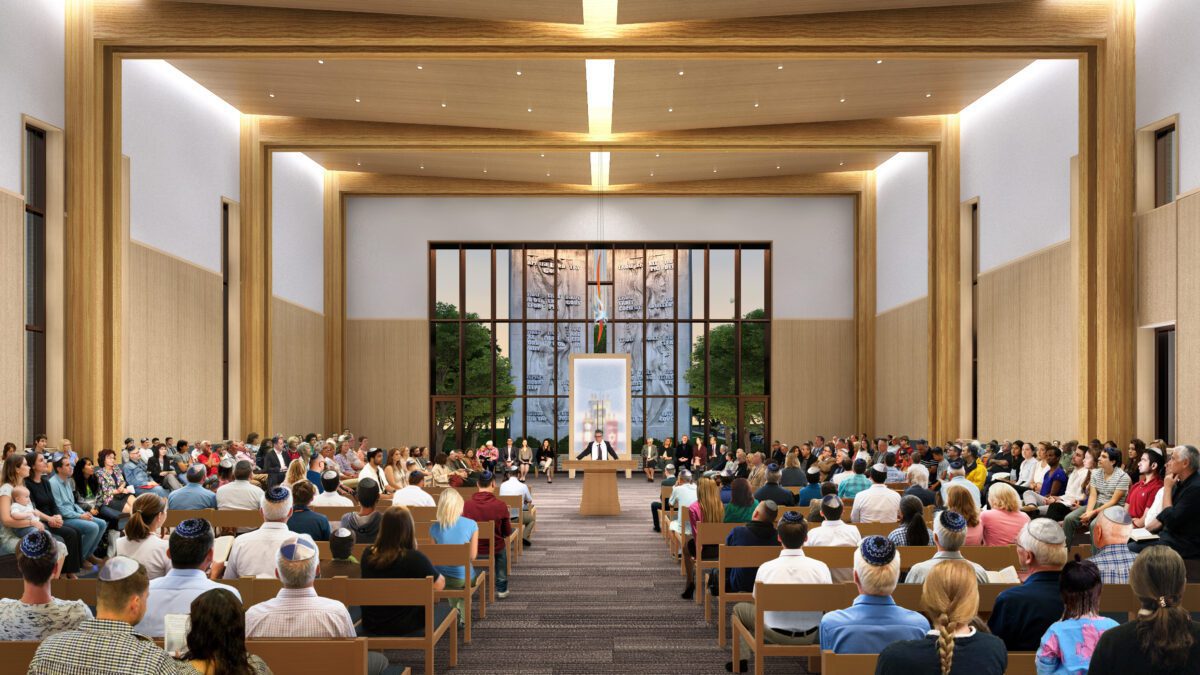
The new design draws heavily on Jewish tradition while remaining grounded in Tulsa’s local character. Salvaged materials from the original building – including Jerusalem stone and wood elements – will be incorporated into the new structure, linking past and present. Natural materials will also appear throughout the building, reflecting longstanding traditions in synagogue architecture while creating a warm and welcoming environment for congregants.
“With every design move that we make in creating these buildings, we ask ourselves how we can ‘respect the past and design for the future,’” Berry says.
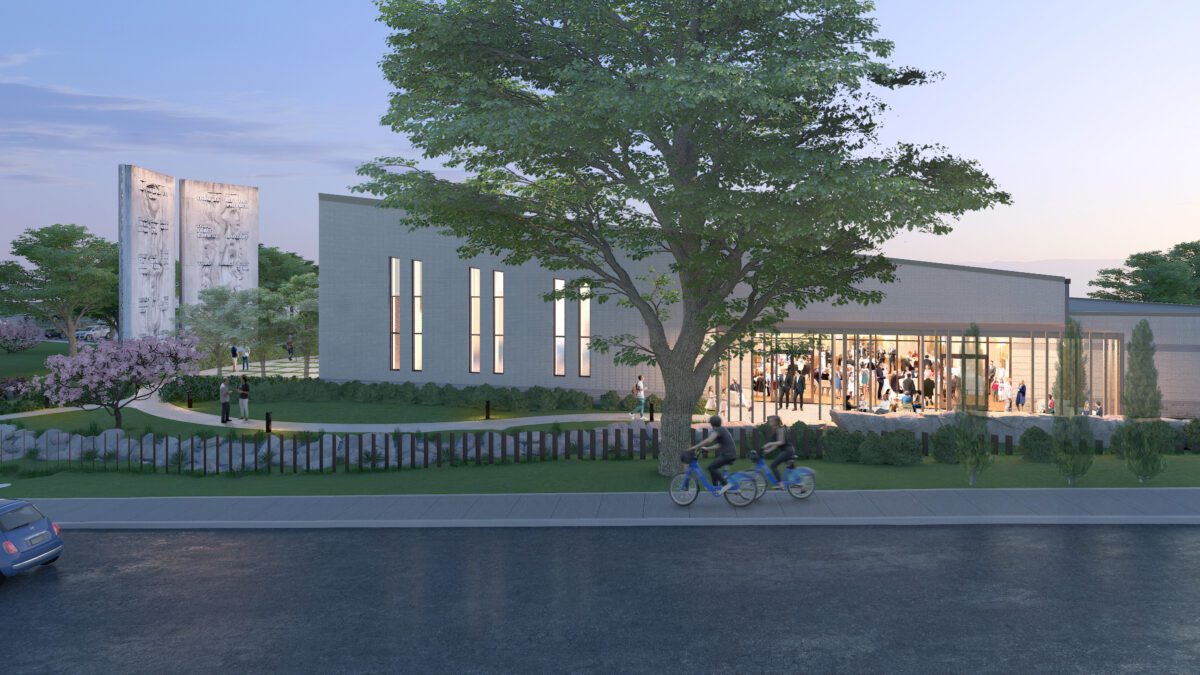
Architecturally, the building will respond to Tulsa’s distinctive landscape and design heritage. Its exterior will feature textured white brick and angular detailing inspired by the city’s Art Deco architecture. Native landscaping and storm-water design elements will respond to the site’s geography, which sits above the buried Crow Creek watershed.
A Major Undertaking: The Ten Commandments Tablets
One of the project’s most complex challenges has been preserving two massive concrete tablets depicting the Ten Commandments from the 1955 building. Each weighs approximately 90,000 pounds and both were integrated directly into the original sanctuary wall.
Moving them safely required a significant engineering effort. Specialists reinforced the tablets by drilling dozens of holes into the concrete and inserting structural pins and plates that distributed their weight across a supporting framework. Once stabilized, the tablets were carefully cut free from the building and lifted for relocation.
“The scariest part of the project right in the beginning was figuring out— can we actually get those [tablets] out?” says Weil.
Another consideration for moving the 45-ton tablets was navigating the site’s flood-prone areas.
“There’s a significant floodplain running through the site,” says Tim Smith, project manager with Wallace Design Collective, an Oklahoma-based engineering consultant that is also involved with the project. “As a result of that, the new building is set roughly four feet higher than what the previous one had been.”
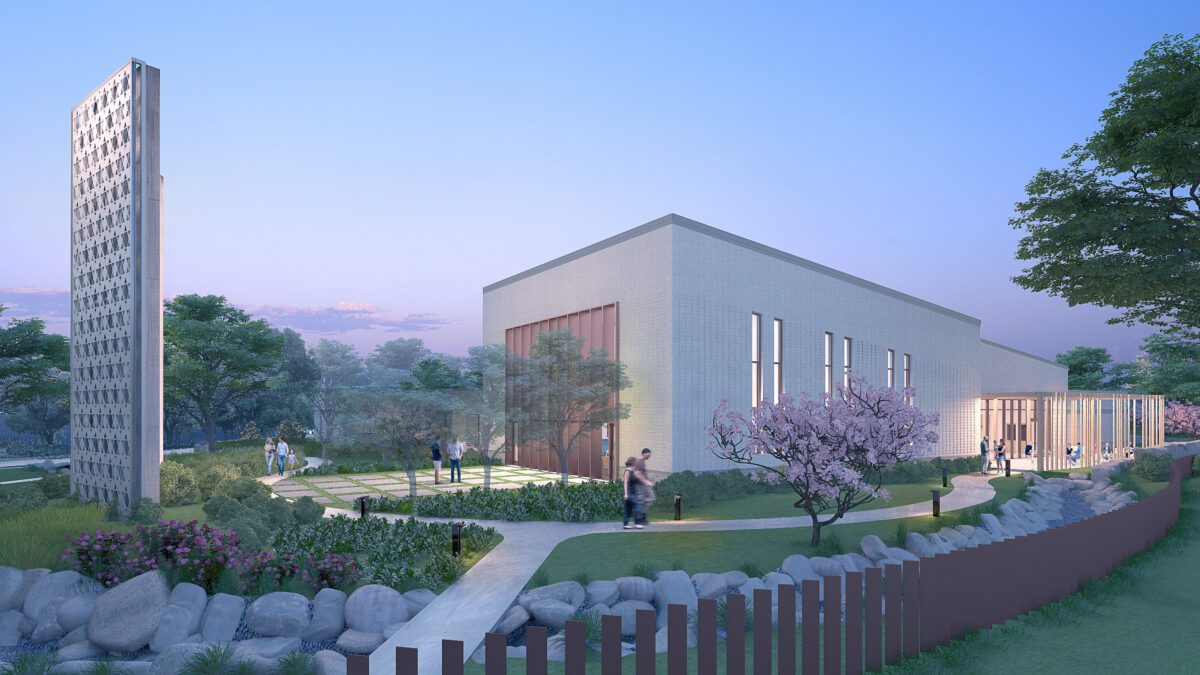
Rather than existing within the place of worship as before, the tablets will now stand as freestanding elements within a sacred outdoor garden adjacent to the new sanctuary. From inside the sanctuary, congregants will be able to see the tablets during services – an intentional design decision meant to strengthen their symbolic presence.
The sacred outdoor garden will feature the Ten Commandment tablets as freestanding elements, allowing congregants to view them from inside the sanctuary. The new sanctuary design emphasizes natural light, warm materials and views toward the Ten Commandment tablets to create a meaningful transition into sacred space. The Temple Israel building will feature textured white brick, angular detailing inspired by Tulsa’s Art Deco heritage and native landscaping.
The Community Court
Another central feature of the new Temple Israel is the “Community Court,” a large, multi-purpose gathering space designed to serve as the heart of the building. Modern Jewish temples increasingly function not only as houses of worship but also as civic and social gathering places. Temple Israel’s new design embraces that role.
The Community Court will serve as a flexible hub for congregational life. Large doors will allow the space to open directly into the sanctuary, expanding seating during high-holiday services. At other times, it can host celebrations such as bar mitzvah and bat mitzvah receptions, educational events, community programs or informal gatherings before and after services.
“[Temple Israel] is more than just a sanctuary – it is a house of worship, a house of gathering and a house of learning,” Berry says.
The space will include lounge seating, a serving area and access to both teaching and commercial kitchens, enabling cooking classes, holiday meal preparation and community events. The design also incorporates memorial displays honoring past congregants and historical artifacts from earlier buildings, ensuring Temple Israel’s history remains visible within the new facility.
Meeting Modern Needs
Throughout the building, architects have emphasized natural light and connections to outdoor courtyards, creating a gradual transition from everyday life into sacred space. Congregants will enter through landscaped grounds before passing interior courtyards and gathering areas on their way to the sanctuary.
The result is intended to reflect the three traditional roles of three traditional roles of a Jewish communal space: a house of worship, a house of learning and a house of gathering. By weaving those functions together through architecture, the design aims to create a spiritual and civic center for the congregation and the broader community.
When the new Temple Israel opens in 2027, it will represent both continuity and transformation – preserving the symbols and memories that shaped generations of Tulsa’s Jewish community while creating a modern space designed for those still to come.
Main image cutline:An aerial rendering showcases the layout of the new Temple Israel campus, highlighting the sanctuary, community gathering spaces, landscaped grounds and the sacred outdoor garden. All renderings courtesy Finegold Alexander Architects
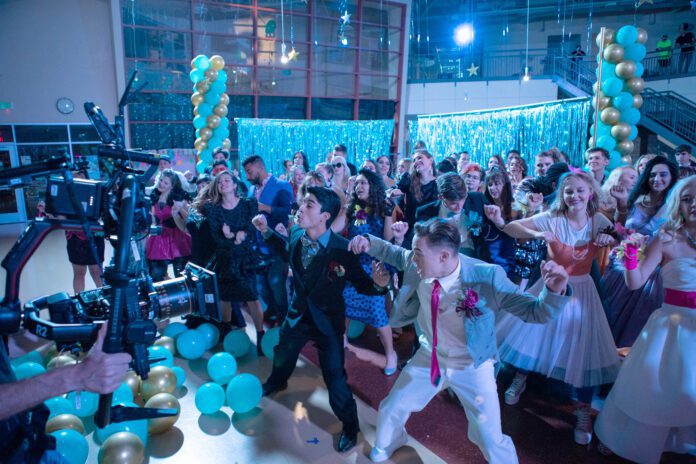
Teen drama What Rhymes With Reason was filmed in Oklahoma, thanks in part to major tax incentives. Photo by Zachary Burns courtesy the OFMO
As the film industry branches out, shooting in more states than California and New York, Oklahoma continues to grow as a viable candidate for all kinds of productions – thanks in part to a generous film incentive.
“Oklahoma was one of the first states in North America to offer a film incentive, and the available programs have steadily evolved since its establishment in 2001,” says Oklahoma Film + Music Office director Jeanette Stanton.
In 2021, the Filmed in Oklahoma Act was established, creating even more opportunities for the Sooner State.
“This program replaced the state’s previous film incentive – the Compete with Canada Act – and raised the annual funding cap from $8 million to $30 million with a base rebate of 20% offered, as well as additional uplifts for filming in rural areas, use of state certified soundstages, post production, music and more,” she continues.
On top of all those incentives and rebates, there are additional offerings from city and tribal partners.
“These incentive programs are administered independently from the state, each with their own respective guidelines, and contribute greatly to the film ecosystem in Oklahoma,” says Stanton.
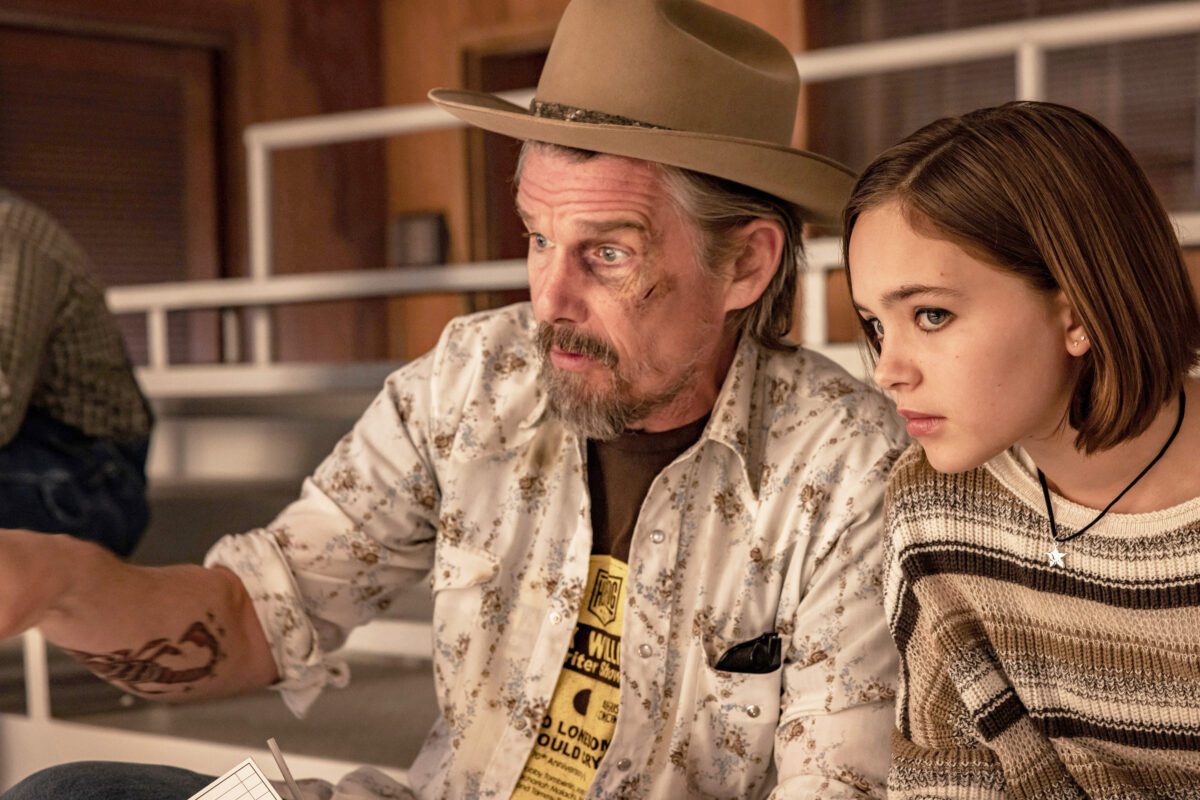
A staggering 36 productions, both in TV and film, came to Oklahoma last year to utilize the Filmed in Oklahoma Act. This led to $67.5 million spent in the state and added 5,336 jobs, according to Stanton. Productions include the likes of The Lowdown – the newest FX television project from Oklahoman Sterlin Harjo – alongside Horrified, South of Stillwater and The Extinction Rule.
“The Lowdown was filmed on location in Tulsa, which served as its production base, as well as multiple film-friendly certified cities including Bartlesville, Collinsville and Owasso as well as Cleveland, Skiatook and Sperry,” explains Stanton. “The series makes the city of Tulsa a character in itself with the use of a number of downtown corridors and districts, historic neighborhoods and small businesses.” Some popular spots include the Gathering Place, Magic City Books, Circle Cinema, The Harweldon Mansion and even Braums.
FX breakout show The Lowdown starring Ethan Hawke is helmed by Oklahoman Sterling Harjo and shot in-state. Photo courtesy FX/Shane Brown
Thankfully, Oklahoma still has plenty of room to grow and expand in the filmmaking world. The production infrastructure has already been steadily growing, with no signs of slowing down anytime soon.
“We’ve seen increased incentive programs launched at the local level, expanding soundstage infrastructure, and a number of film businesses expanding or initiating services provided in our state,” says Stanton. “The state itself continues to remain among the top in the country for low cost of living and best place to start a new business – a major attraction for filmmakers.”
In short, Oklahoma plans to evolve with whatever changes happen along the way.
“In the last several years, the film industry has pivoted numerous times, navigating a global pandemic, industry strikes and more,” says Stanton. “Throughout it all, the state’s film incentive program has generously increased twice, and with continued state, city and tribal support in the future, Oklahoma will be a formidable partner for the film and television industry.”
Main image cutline: Teen drama What Rhymes With Reason was filmed in Oklahoma, thanks in part to major tax incentives. Photo by Zachary Burns courtesy the OFMO
Morel hunter Vernon McIntosh’s raspy voice softens as he recalls every detail of that unforgettable day.
It was April 15, 2021. He and mushroom-hunting buddy Lester Icke were breaking in McIntosh’s new pickup near Woodward.
“Let’s go check my spot,” McIntosh says.
They parked along the fringes of a state park – serious hunters don’t divulge their secret locations – and walked a short distance.
The sight ahead stunned them.
“It was the craziest thing I ever saw!” McIntosh says. “There must have been 300 mushrooms in about a 50-foot area!”
The fungi-frenzied foragers filled mesh bag after mesh bag with the honeycomb-like mushrooms, even stuffing them into their shirts, while leaving some behind as woodland ethics dictate.
“It was the motherlode,” says McIntosh, co-creator of the Oklahoma Morel Mushroom Hunters Facebook page. “You couldn’t take a step without tripping on one.”
His secret spot has since been dry, but the hunt isn’t over. McIntosh and other experts share great fungi foraging tips.
Redbuds, Rain and Fire
Morels – nature’s wild gold nuggets that are uncultivated, elusive and available for only a few short weeks each year – prefer prolonged moisture and soil temperatures in the low-50s to 60 degrees for about five consecutive days, says Stephen Marek, Ph.D., Oklahoma State University associate professor of plant pathology and mycology.
Check the Oklahoma Mesonet website or use a soil thermometer to better determine optimal timing.
“The middle of March to the middle of April, those are the best times,” Marek says.
Blooming red bud trees and oak leaves in the small, pink “mouse ear” stage indicate morels are ready to pop.
Rain and fire are other triggers. Experienced foragers wait a day or two after a spring rain to give mushrooms extra growing time.
“The key is having moisture in the leaf litter,” Marek says.
Wildfires, like the Panhandle blaze in February, also boosts morel growth. Scientists believe forest fires release nutrients, clear competing organisms and allow sunlight to hit the soil.
Best Spots to Forage
McIntosh finds morels in open fields, under cedar trees, in sand, clay soil and even gravel. Prime spots are around dead and decaying trees.
“The best trees are oak, elm, ash and sycamore,” says Jacob DeVecchio, owner of Oklahoma Fungi – an agricultural wholesaler based in OKC – and founder of Oklahoma’s annual October festival OkMushFest.
Bottomlands and creek banks within state parks often hide these delicacies that may fetch $30 to $110 per pound through Facebook, farmer’s markets and upscale restaurants.
“Don’t give up,” says McIntosh. “If you spot one, stop and look around, because chances are there will be more. And don’t be afraid to kick the leaves back.”
Foraging Safety
A key to foraging safely is knowing which mushrooms are edible and how to cook them thoroughly.
Foragers emphasize education via groups like the Oklahoma Mycological Society to distinguish edible mushrooms from toxic ones.
“People may think I’m this crazy guy on the mountain top always talking about mushrooms,” DeVecchio says. “But the reality is the moment I stop, there’s going to be no movement … as far as getting people educated about what mushrooms are edible and which ones are poisonous.”
Education, he says, may make the difference between delicacy and disaster.
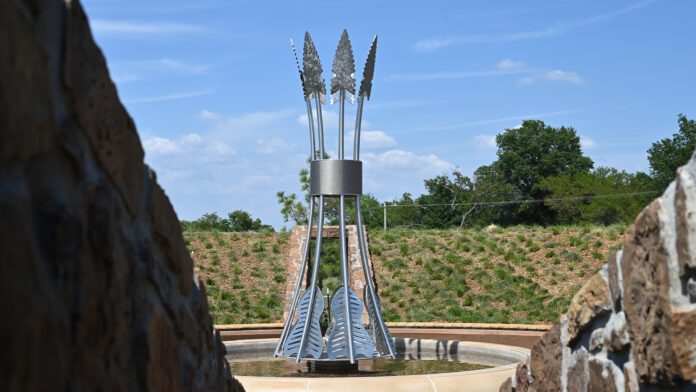
Visitors can explore exhibits and authentic artwork at the Cherokee Nation Anna Mitchell Cultural & Welcome Center, a Route 66 destination. Photo courtesy the Cherokee Nation
With the motoring vacation season fast approaching, Oklahoma’s large travel centers, operated by a major state corporation and several Native American tribal enterprises, are ready to offer most anything a traveler might need.
Centrally located in the U.S., with Interstates 40 and 35 bisecting the state east to west and north to south, and I-44 going from southwest to northeast, Oklahoma offers inviting locations for large travel centers.
In addition to the significant operations already established, rumors were swirling earlier this year about the possibility of another major player – the ever-popular Buc-ee’s – opening its first megastore in Oklahoma, eyeing a spot on I-40 in far west Oklahoma City.
Love’s Travel Stops, meanwhile, is one of Oklahoma’s major operators for the traveling public. The company, headquartered in OKC, operates both Love’s Country Stores – smaller convenience store operations – and Love’s Travel Centers, which run the gamut of merchandise, food and complete service for cross-country truck drivers.
Similarly, the Choctaw Nation operates 18 Travel Plaza stops throughout their 11-county area of southeastern Oklahoma. In 2024, they opened a 12,000-square-foot market in Hochatown. The Cherokee Nation also operates several welcome centers, one along the Will Rogers Turnpike.
“The Cherokee Nation Anna Mitchell Cultural & Welcome Center is a staple in the Vinita community and has become a vessel of Cherokee culture right on Route 66,” says Lori Ballew, gift shop manager. “Through permanent and rotating exhibit spaces, cultural classes and authentic Cherokee artwork, it is more than just a welcome center, but truly a gateway into our rich history and thriving culture.”
The Cheyenne and Arapaho tribe operates a major travel center on I-40 in western Oklahoma, featuring RV hookups, a restaurant, truck services, laundry and showers, and even a dog park.
Love’s Travel Stops’ communications manager Caitlin Jensen says the company’s stores are reliable, clean and safe for daily commuters, professional drivers and long-distance travelers alike.
“Beyond convenience, Love’s adds significant economic value to each town it’s located in, including sales tax revenue and local employment,” she mentions.
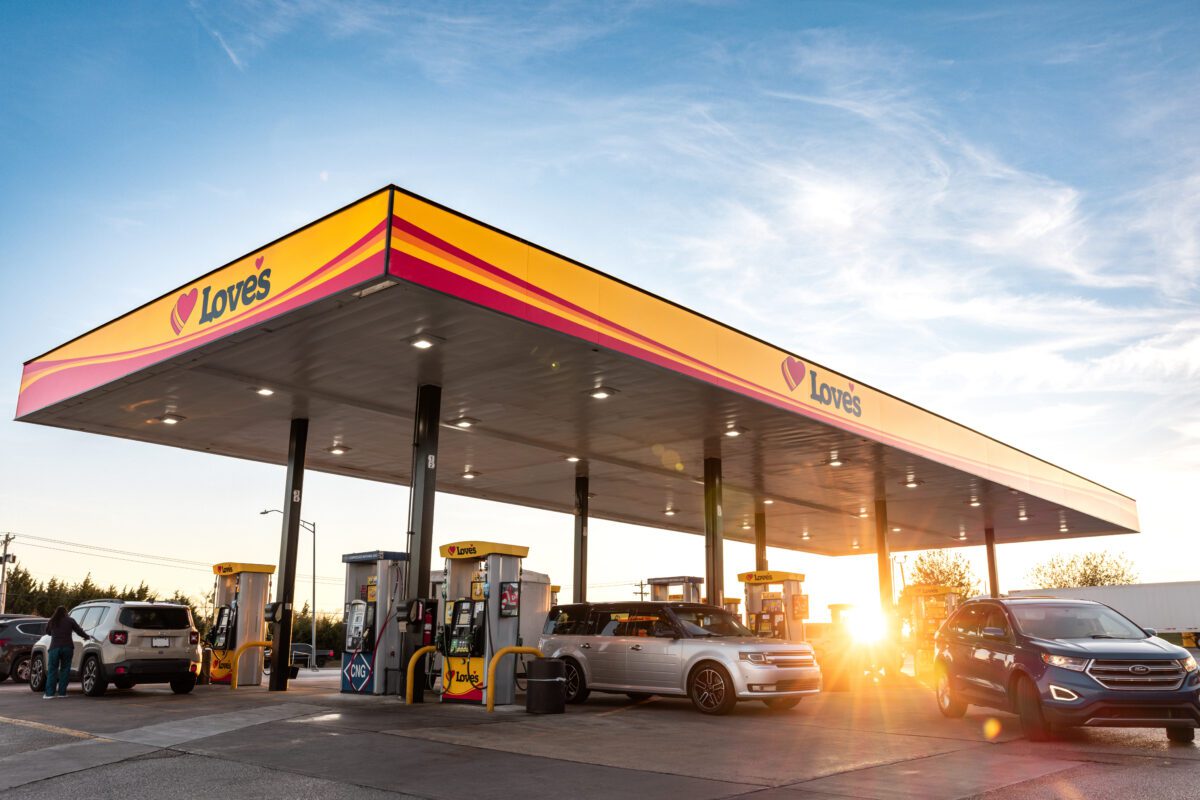
In November, Love’s Travel Stops re-opened a major travel plaza on the Turner Turnpike in Stroud, including a truck service that is the company’s first on an Oklahoma turnpike. Photos courtesy Love’s Travel Stops
In November, Love’s Travel Stops re-opened a major travel plaza on the Turner Turnpike at Stroud, including a truck service that Jensen says is the company’s first on an Oklahoma turnpike, featuring more than 100 parking spots for trucks.
Stroud city manager Bob Pearman says that while no sales tax figures are yet available, a previous travel center at that location was an enormous benefit to the city.
“We do not see them as competition for our stores in town,” Pearman says, because they’re mostly serving turnpike travelers. Stroud residents, however, can access the travel center without having to pay a toll.
Jensen says Love’s Travel Stops seeks to be a good neighbor to the cities near their stores. When a new location opens, store team members select a local nonprofit to receive a $5,000 donation, and an additional $5,000 is donated to the area’s children’s hospital “to make a difference locally,” she says.
Chase Horn, public information coordinator for the state’s Commerce Department, says that while there are no direct incentives to build travel centers, they’re a good thing for Oklahoma nevertheless.
“Communities are interested in having them because they live and die by sales taxes” that big travel centers produce, he says.
Lee Benson, chief communications and marketing officer for the state’s Tourism and Recreation Department, echoed that sentiment. His department promotes travel, with a goal of increasing the numbers of visitors to Oklahoma.
“Travel stops can enhance the visitor experience in our state,” he says.
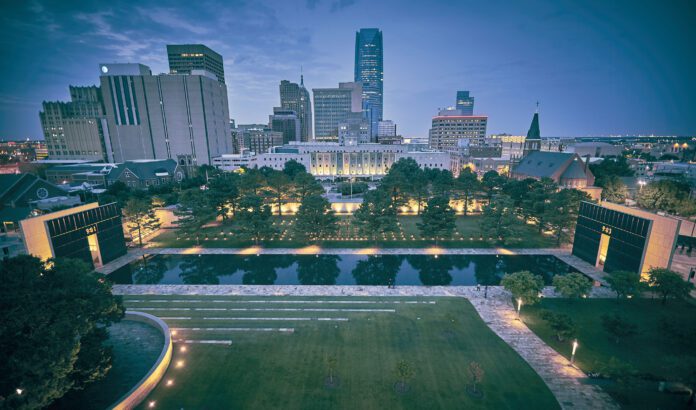
An aerial view showcases the entire outdoor memorial in OKC. Photos courtesy the Oklahoma City National Memorial and Museum
From great tragedy arose great awareness – and the opportunity to rise to the occasion and be the difference.
On April 19, 1995, Oklahoma City, its residents and the whole country were forever changed when a blast exploded from a rental truck downtown at 9:02 a.m in front of the Alfred P. Murrah Federal Building. The blast killed 168, including 19 children, and left more than 650 injured.
This horrendous act of domestic terrorism was meant to tear a city apart, but in reality brought people closer together. Fearless citizens rushed to help, first responders came from around the country to join the two-week rescue efforts and leaders took on the burden of supporting a heartbroken city.
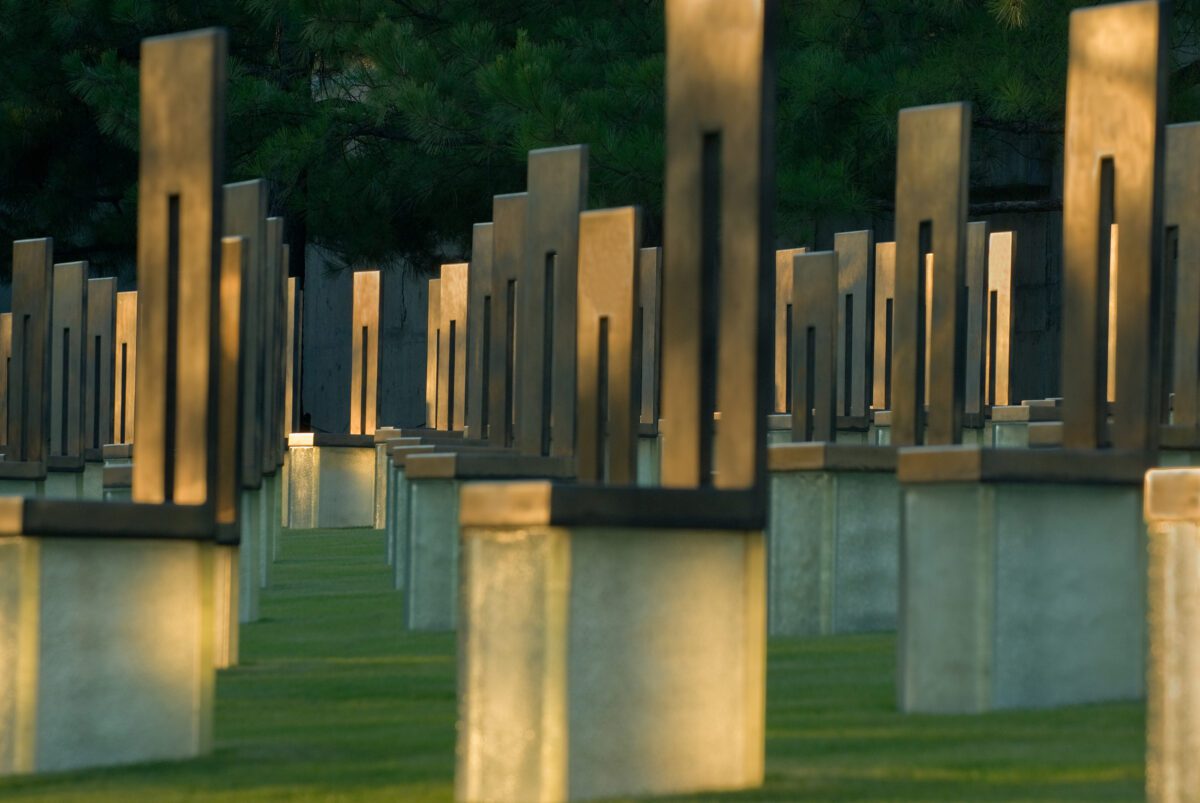
Each chair in the Field of Empty Chairs bears the name of a victim of the Oklahoma City bombing.
“The bombing permanently changed our city, families were changed forever, first responders carried what they witnessed and a generation grew up shaped by that day,” says Payton Bell, the Media Engagement Coordinator at the Oklahoma City National Memorial and Museum. “Alongside the pain came a stronger sense of compassion, resilience and responsibility for one another. In the face of tragedy, neighbors stepped up to help, strangers supported each other and service became central to our identity.”
In the aftermath, former Mayor Ron Norick appointed a 350-member Memorial Task Force that included family members of those killed, survivors and volunteers with expertise ranging from mental health, law and the arts, to fundraising, business, communications and government, to develop a memorial to honor those affected by this event.
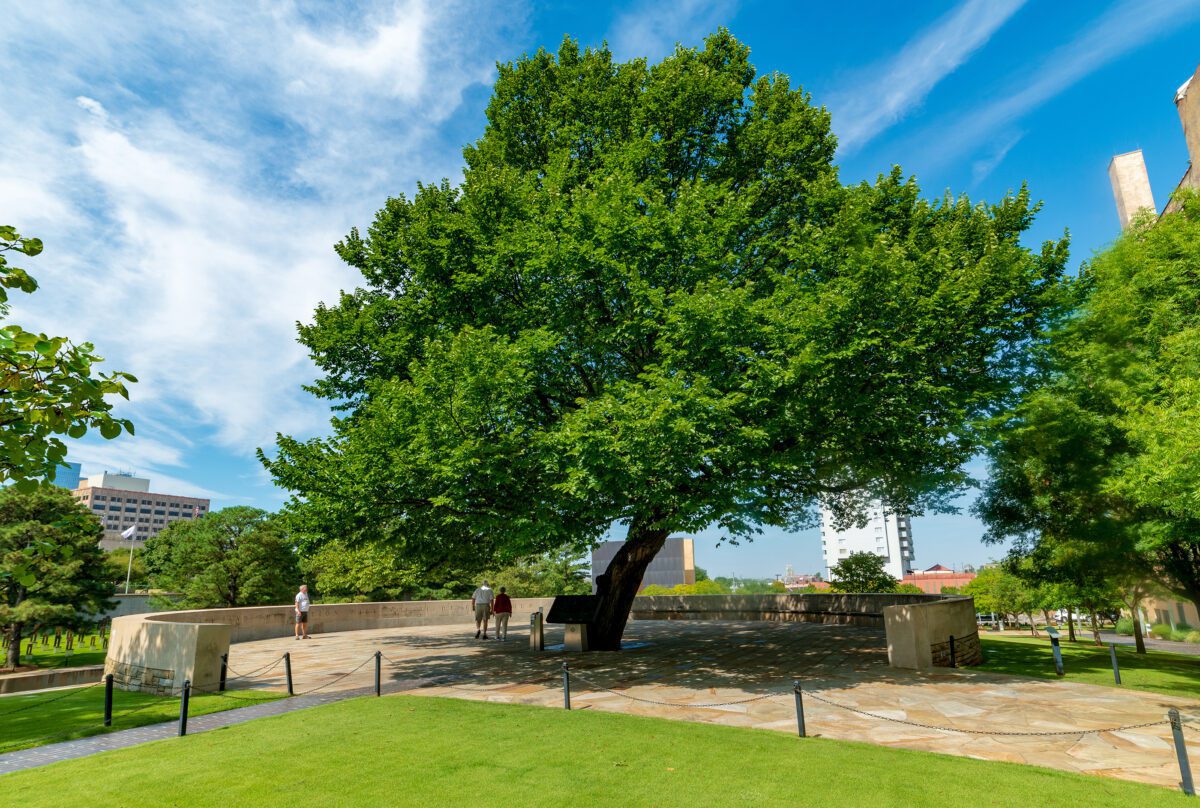
What was once the footprint of the Alfred P. Murrah Federal Building, Fifth Street, the Athenian Building and the Oklahoma Water Resources Board building is now the Oklahoma City National Memorial and Museum, consisting of the museum itself, as well as the Field of Empty Chairs, the Reflecting Pool and Rescuers’ Orchard, including the Survivor Wall and The Survivor Tree, along with the Children’s Area and The Fence.
“We are intentional about keeping the stories of the 168 people who were killed alive in meaningful and personal ways,” says Bell. “Inside the museum, the story of April 19, 1995, is told in chapters, guiding visitors through the events of that day, the aftermath and the powerful journey of resilience and hope that followed.”
The Memorial and Museum, a private non-profit organization, is also dedicated to educating visitors about the impact of violence and terrorism, informing about events surrounding the bombing and inspiring hope and healing through lessons learned by those affected.
At the highest point of the Memorial is the Survivor Tree, a century-old elm that survived severe blast damage, fire and flying debris.
The Memorial Complex is sacred ground – a hallowed place deserving of the respect and solemnity associated with great loss.
In addition to the standing memorial structures, each year, the museum has a Remembrance Ceremony on April 19 and also hosts the Oklahoma City Memorial Marathon – held to celebrate life, honor the memories of those killed and unite the world in hope.
The marathon takes place April 24-26. There’s a race and a distance for everyone, from walker to first-time competitor to elite runner. The Run to Remember takes participants through downtown Oklahoma City and is packed with spectator support.
April 19, 1995, altered the face of Oklahoma – and the nation – forever, and from this came the Oklahoma Standard, a statewide initiative preserving and promoting a culture of caring citizens by encouraging acts of service, honor and kindness as the model by which Oklahomans live their lives in response to the needs of their neighbors, fellow citizens and communities.
What was once the site of the largest domestic terrorist attack on American soil has become a sacred place to remember, educate and learn.
The Metropolitan Library System blends the traditional role of a public library with modern technology, connecting Oklahoma City residents to books, digital media and community resources. Photos courtesy the Metropolitan Library System
For generations, libraries have been quiet cornerstones of their communities, places where shelves of books hold the promise of discovery. But in an era defined by an overhaul of digital infrastructure, libraries are being challenged to redefine their role.
Rather than fading away, many are evolving in creative ways, blending tradition with technology to remain essential gathering places for learning, connection and curiosity. From major urban systems to small-town branches, libraries are proving that their stories are far from over.
“Some libraries are seeing a decrease in overall circulation, but we are not,” says Jason Kuhl, CEO of the Metropolitan Library System in Oklahoma City. “We have a very strong reading community here.”
That means employing all means possible to bring books and information in every form.
“One of the shifts we are seeing is to e-books and audiobooks,” he says. “We do more circulation of that type of material than we do physical material.”
Apps such as Libby and Hoopla allow readers to borrow ebooks, audiobooks and magazines free of charge from their local public library — and it’s not just big city libraries that are partnering with them.
“We have close to 1,200 checkouts a month on just those platforms,” says Kristin Cunningham, director of the Okmulgee Public Library. “That’s pretty good for a library our size.”
But in the community of just over 11,000, face-to-face interaction is still an important part of the process, as homeschool groups meet at the library for classes and research, and parents with children visit for story time and summer reading programs.
“We also offer delivery services for homebound people and people in nursing homes,” Cunningham says. “One of our staff members delivers books weekly — I can’t imagine not being able to get something to read.”
In-person offerings are still an important way to engage the Oklahoma City community, Kuhl says, even as the library redefines literacy in the modern world.
“We have meeting rooms and maker spaces at a number of our locations and we’ve got our toe in a lot of things as we look at what our community needs and in terms of workforce development and what it means to be literate in today’s world,” Kuhl says. “Because it’s not just about being able to read the printed word.”
Most public libraries are funded by their communities, OKC and Okmulgee being no exception.
“Ninety-four percent of our revenue comes from local property taxes here in Oklahoma County,” Kuhl says, “And I’d say we’re probably one of the best uses of that money in terms of bang for the buck. If you’re a regular library user, you are getting many thousands of dollars in value beyond what you pay to the library every year, and that’s something that we take very seriously and make sure we’re maximizing that value and sort of a more global picture of what libraries are.”
Even as libraries are paying dues to a virtual reality, the reader remains at the center of its mission.
“I just want our library to be a place where people can come and enjoy,” Cunningham says, “and just feel welcome and connected to the community.”