Home Blog Page 104

The Downsides of Drinking

When considering the negative effects of heavy or even regular alcohol use, Blake Hilton, Psy.D., says it’s useful to categorize the effects into short and long-term consequences on the body. As an OU Health clinical psychologist and an assistant professor of psychiatry and behavioral sciences, Hilton studies and treats substance use disorders and other mental health concerns.

“In the short-term, drinking heavily or regularly can affect our mood, sleep and how well our brain functions,” he says. “In the long term, heavy or frequent alcohol use can begin to have devastating effects on our bodies, including heart and brain health, liver function and other physical problems. Alcohol can increase our risk for certain cancers as well. It can also lead to deficits in cognitive functions such as in planning, attention and concentration.”

He says one area that’s important to many is their sleep. 

“Heavy drinking affects our sleep architecture and can result in profound insomnia,” says Hilton. “This can be frustrating for some, as alcohol may have initially helped these individuals fall asleep quicker. They end up obtaining worse sleep as a result.”

He’s also quick to note that heavy drinking not only affects a person’s body, but also their relationships, jobs and other important aspects of life. What about someone who may not be a heavy drinker, but utilizes alcohol as part of an evening routine or weekend? Does alcohol still have a profound effect? 

According to Hilton, research is beginning to show that no level of alcohol consumption is completely ‘safe.’

“Although there has been some mixed evidence over the years regarding the protective effects of drinking alcohol in small amounts or in moderation, newer studies with very large samples suggest this is not in fact the case,” he says. “For example, a recent study of about 600,000 drinkers published in [peer-reviewed medical journal] the Lancet demonstrated that even very minimal amounts of alcohol can increase risk for cardiovascular disease and overall mortality, and that this amount was much lower than most current national guidelines. Other recent large-scale analyses suggest the level of alcohol use that minimizes risk for all health outcomes is actually zero.”

Sobering statistics worth considering – as alcohol does play a role in premature aging. 

“We know that heavy drinking negatively affects multiple brain functions, including planning, attention, concentration, memory and visuospatial skills,” says Hilton. “The good news is many of these functions can return to normal following a period of prolonged abstinence. Regarding premature aging of the brain, heavy alcohol use is strongly associated with functional and structural changes to our brain, as well as dementia.” 

Celebrating Safely

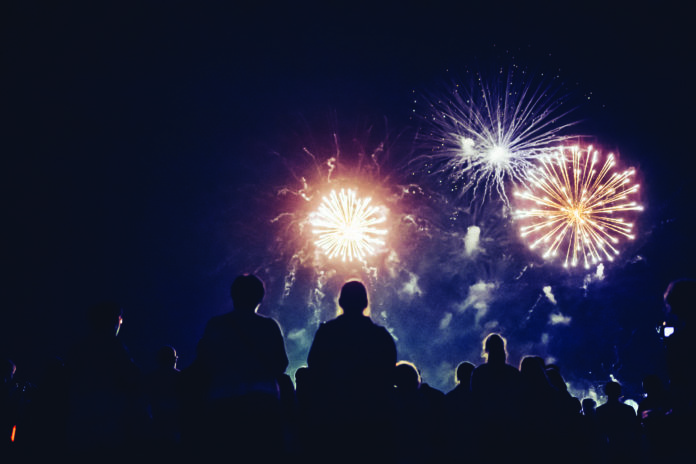
Fireworks season is upon us, and Oklahomans are urged to celebrate, have loads of fun and most importantly, stay safe.

“Leave fireworks to the professionals,” advises Erica Rankin-Riley, the public information officer for the Office of Communications at the Oklahoma State Department of Health (OSDH). “The safest way to enjoy fireworks is by attending one of the professional displays around the state.”

The OSDH realizes that, for many people, setting off fireworks yourself is part of the annual tradition. If you fall into this category, Rankin-Riley has some safety tips for you.

“Ensure fireworks are legal in your area,” she says. “Never use homemade fireworks; only purchase fireworks labeled for consumer use – not for professional use.”

Other tips:

• Never use fireworks while under the influence of drugs or alcohol;

• Never hold lit fireworks in your hand;

• Never point or throw fireworks, including sparklers, at another person;

• Only light one device at a time and point it away from people, homes or other structures;

• Never light devices inside a container, indoors, or outdoors near dry grass, brush, leaves or flammable materials; 

• Move back quickly and maintain a safe distance after lighting fireworks.

“Always have a bucket of water, garden hose, and/or a fire extinguisher nearby,” adds Rankin-Riley. “Know how to use the fire extinguisher properly. Soak used fireworks in water before discarding them to avoid a trash fire.”

She also recommends not wearing loose clothing while using fireworks.

“Wear protective eyewear when using fireworks or standing near the shooting area,” she says. “If an eye injury occurs, do not touch or rub it, as this may cause even more damage. Also, use hearing protection such as earplugs or earmuffs.”

A few simple steps prior to any celebration can lessen the chance of injury to children.

“Never let children ignite, use or play with fireworks,” she says. “And avoid sparklers.”

While sparklers are often thought by parents to be relatively harmless, the opposite is true: Sparklers are the leading cause of fireworks-related injuries.

“Sparklers can burn at a temperature of 2,000 degrees Fahrenheit, which is hot enough to melt metals,” she says. “Children’s arms are not long enough to hold sparklers at a safe distance from their face and body. Sparklers can easily ignite clothing.”

Keep children safe by providing alternatives to sparklers such as colored streamers, confetti poppers and glow sticks.

“Children and young adults comprise the majority of victims injured by fireworks,” she says. 

Pet Safety

The Fourth of July can often be a highly stressful time for animals. Make sure you’re taking precautions to help them feel secure. If you aren’t sure where to start, we offer a few ideas: 

• Understand your pets and their tolerance to loud noise;

• Ask your vet for anti-anxiety medication if you know from past experiences that your animal will negatively react to the loud noises;

• Purchase an anxiety vest for your pet;

• Keep pets on a leash if they are outside, or use a crate/ safe room to keep your pet contained during a display – they may run out of fear or confusion if left unattended;

• Never leave your pet in a parked vehicle during a Fourth of July celebration – even for a few minutes;

• Avoid taking your pets to fireworks displays at all.

My, Oh My, Miami

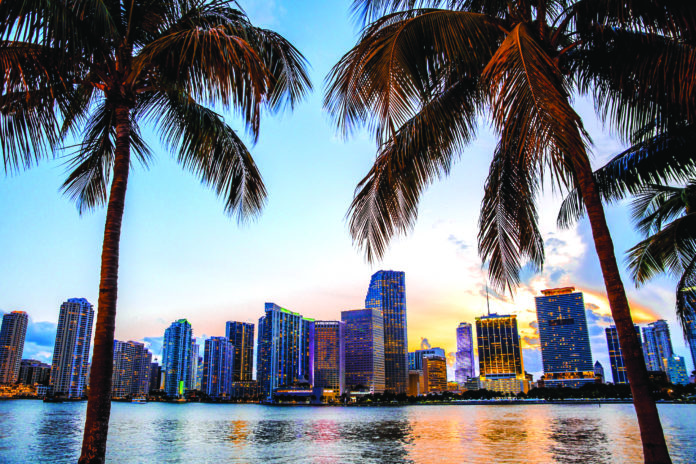
For those with a preference for enlivened destinations, a penchant for fashion and a passion for cuisine, Miami is your place. Mosey through her menagerie of districts. After all, coastal cities have several advantages over their landlocked counterparts … the shore, the sea and the color palette, to name a few. The accessibility, shopping, and excursions, too; it’s a canvas just waiting for brilliant brush strokes. 


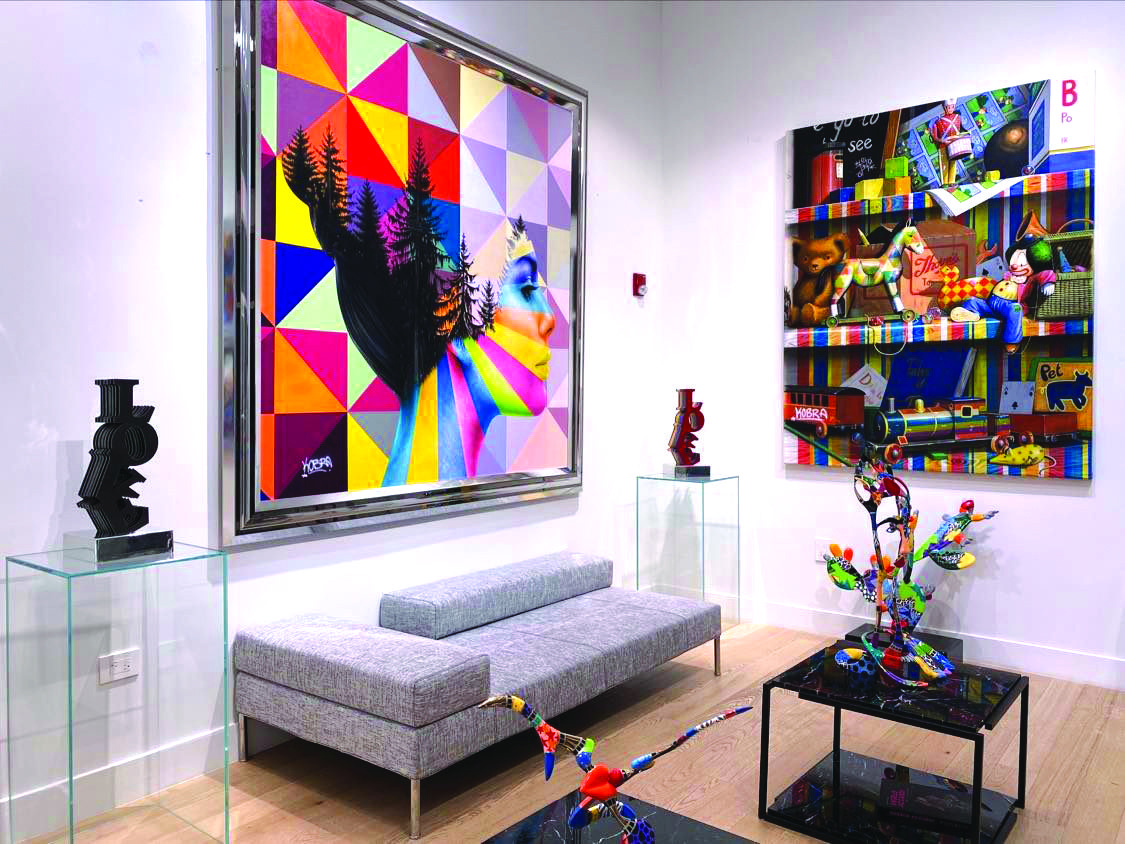
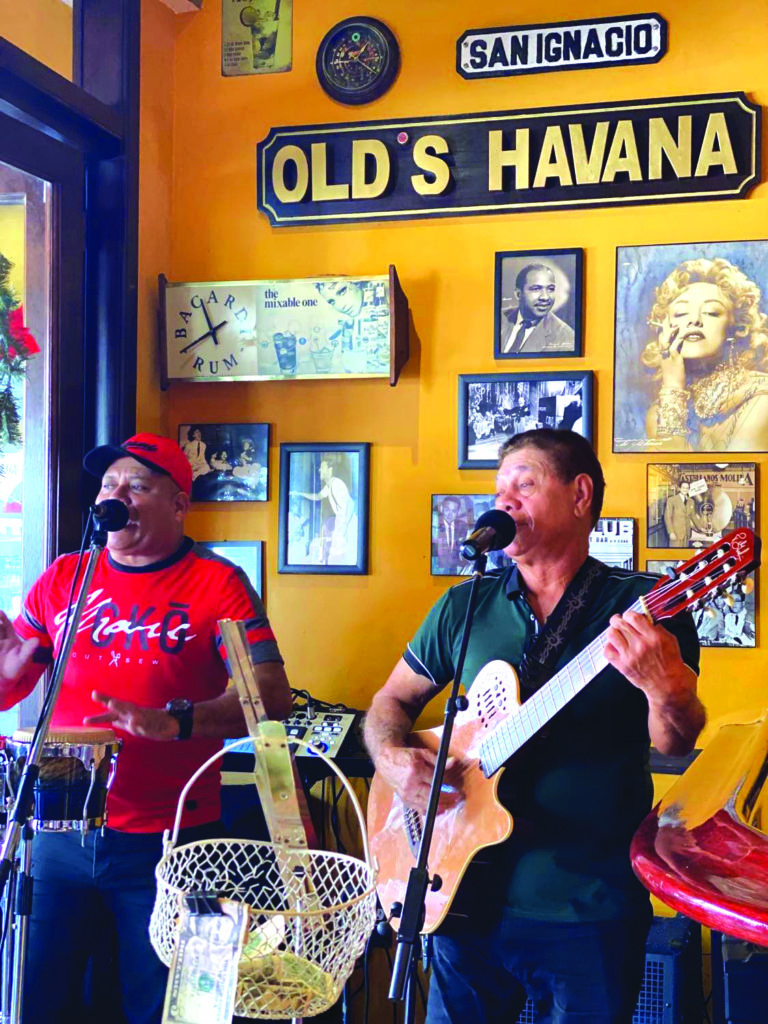
Cuisine, culture, music and architecture – Miami has it all. All photos by Gina Michalopulos Kingsley except primary image 

Riding around the city on a hop-on tour bus is a perfect way to enjoy Miami as the breezes welcome you with gusto. Miami is a vision of shiny, uniform architecture, circling the water like white egrets perched on beaches of serene and pristine water. The city’s fey charm and aesthetic is a vivid color combo of white and aquamarine. 

The Caribbean influence is the formidable force here, making Miami one of the most international cities you’ll experience while still
being on the continental U.S. Fun fact: The word “Miami” is an Indian word meaning “sweet water.”

Major league sports, world-class museums, art galleries and that diverse cuisine are the obvious draws of this metropolis. The cruise ships and shipping containers in the bay remind you that Miami is a major hub and port. You’ll also notice just how much the locals interact with their city through expressive murals, festivals and the frequenting Bayside Park with its Ferris wheel and ample restaurants. 

The scrupulous city planning that goes into places like Miami really shows. In four hours, you can tour the districts and cross over the causeway into other pockets of urbanity. Stopping off in Little Havana is a delightful hour of mellifluous mojitos, daiquiris, tostones and live music. The murals along the way are impressive. Art is the quintessence of Miami and it’s no wonder Art Basel (an international art fair) takes place there. 

Another fun fact? Miami is the only city that lies between two national parks – the Everglades and Biscayne Park. And don’t worry, there are other fascinating factoids about Miami. For example, she owes a lot of gratitude to two specific women: Julia Tuttle and
Barbara Baer Capitman. Julia Tuttle is called “the Mother of Miami” because she’s responsible for encouraging the development of the city. Once the landowner of it, she inspired the wilderness to be developed into a prosperous city. Barbara Baer Capitman, on the other hand, was a political organizer and activist who fought to preserve the Art Deco buildings which were in danger of becoming high-rise condos. 

Districts to explore include South Beach; the Art Deco District; Little Havana; Millionaire Row; Lincoln Road; and Bayside Park. Walk or take the free trolley from South Beach down to Lincoln Road. Consider visiting in December, as the holiday season in Miami is unique. Illuminated palm trees, giant Santas, reindeer and nutcrackers up and down Lincoln Road are surreal elements as you stroll in shorts and sandals. 

Pop into art galleries that provoke your senses. Window displays attract you to fashionable articles of clothing you might not encounter in your hometown. Miami fashion is just so extra – a bastion for glamor and cachet, its style exudes confidence; your closet back home will get a vibrant boost. That’s the effect Miami has: she inspires people to ameliorate their lifestyles and surroundings as soon as they return home – whether it’s via cuisine, fashion or health. 

The Art Deco District is the locus of Miami’s art medium and South Beach is the acme of the city’s vibe. The beach beckons swimmers  as early as 8 a.m. That’s living life to the fullest – you’ll be fulfilled with your vacation in this vibrant, international city.

Escape to the Cabin

The summer months, despite the often oppressive heat, also bring with them prime vacationing time. A popular weekend getaway in Oklahoma often involves a cabin and a lake – a much needed respite from the worries of everyday life. Below are some options for the coming weeks and months, filled with not only cabins as a home away from home, but also outstanding activities to do with family and friends. 

Long Lake Resort
Located in Poteau, Long Lake Resort has everything you’ll need for a perfect summer escape. Choose between lakeside suites, couple’s cabins or two bedroom cabins. 
There’s also an RV park and plenty of activities including biking, boating, disc golf and even a petting barn. Herds of buffalo also roam nearby for some photo opportunities. Prices on rooms range from $125-$250 per night. 
longlakeresort.com

Yogi Bear’s Jellystone ParkCamp-Resort 
Located in Eufaula, this is an all-in-one vacation destination. Perfect for a family outing, rental cabins come with all the modern amenities you’ll need. 
Yogi and Boo Boo make the rounds for pictures, and with 600 miles of shoreline from Lake Eufaula, the activities like putt putt and paddle boating are hot tickets. Cabins run from $158-$262 depending on the amount of rooms needed. 
keystonelakejp.com

The Cabins at Broken Bow Lake 
If you’ve got a massive family gathering to plan, this is an excellent option. 
Located in Broken Bow, the cabins can accommodate anywhere from nine to 22 people. The lake has a variety of recreations like scuba diving, water skiing and jet-skiing. There’s also the Forest Heritage Center Museum located nearby at Beavers Bend State Park, along with horseback riding, fishing, paddle boats and golfing. 
The nine person cabin will run around $450-$500 while the twenty-two person cabin will be near $1,200.
thecabinsatbrokenbowlake.com

Buffalo Trails Cabins & Petting Zoo
For something a bit more intimate, this is just the ticket. 
Located in Hugo, the cabins are decorated and designed to evoke the feeling of the old west. From a bathhouse to a saloon, a stable and a jailhouse, the options are plentiful for a fun weekend back in time and away from city life. There are plenty of mini horses, donkeys and goats to pet and take pictures with, as well as ax-throwing, corn hole, sluice mining, and a party foam machine. Cabins all cost $130 per night.
buffalotrailscabins.com

Rustic Retreat 
For something a bit fancier, this should check all your boxes. 
Located in Broken Bow, the luxury cabins come with king beds, elevated ceilings and a walk-in shower and Jacuzzi. Surrounded by beautiful pine trees and oaks, there are plenty of hiking trails, as well as boating, fishing, canoeing and kayaking. For those seeking some thrills, there’s horseback riding and ATV rentals, too, as well as winery and brewery tours. 
Rentals cost between $200-$1000 depending on the time of year and the size of the cabin.
rusticluxurycabins.com/rusticretreatcabin

Beaver Dunes Park
If instead you just have a day of free time, check out the park. Located in Beaver, the location offers 520 acres of dune buggy riding of 300 acres of sand hills, as well as fishing and hiking. Sand volleyball, basketball, and horseshoes can also be played. 
If you want to spend the night, the grounds have ten campsites with water and electric hookups.
[email protected]

Happy trails!

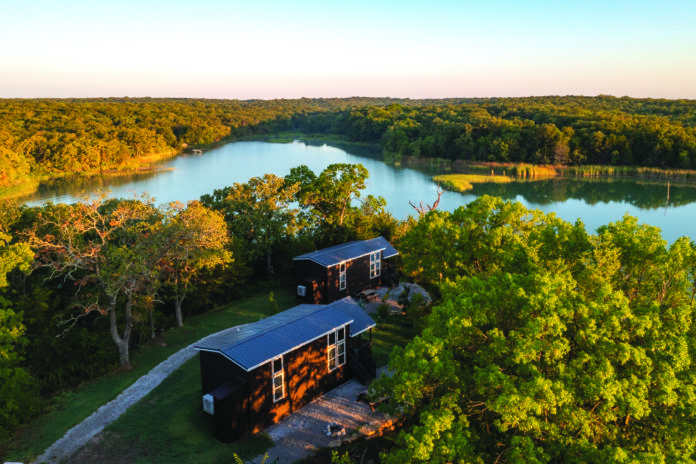
Main image cutline: Cabin rentals are a quintessential part of Oklahoma summer vacations. Photo courtesy Oklahoma Tourism & Recreation

A Path to Enlightenment

Despite its mysterious origins, the labyrinth is one of the most distinct manmade designs, appearing in places all over the world for thousands of years. Although its winding pattern may resemble a maze, a true labyrinth has only one path that leads to and from its center. 

The labyrinth’s unicursal pathway is commonly regarded as a metaphor for enlightenment and introspection, leading those who take it away from outside distractions before returning to the place they started. 

Oklahoma is home to many labyrinths, several of which are located on college campuses. Students can benefit from the solace that labyrinths provide, encouraging mindfulness and reflection. 

“The beauty of a labyrinth is that you take your whole self into it – mind, body and soul,” says Diane Rudebock, professor emerita of kinesiology and health studies at the University of Central Oklahoma. “[While] your body is moving, your mind is free to let thoughts come and go.” 

Retracing the History of Labyrinths

Labyrinths have existed for more than 4,000 years. Although their exact place of origin is unknown, ancient cultures often carved their unique designs into coins, tombs, caves and jewelry. There are several types of labyrinths, which are classified by their number of circuits, or how many times the path encompasses the innermost point. 

One of the most popular designs is the Classical Labyrinth (also known as the Cretan Labyrinth). This design includes seven circuits and originates from the Greek myth of Theseus and the Minotaur. According to legend, King Minos of Crete commissioned Daedalus to build a labyrinth that would imprison a ravenous Minotaur. Against all odds, Theseus braved the labyrinth and reemerged a hero, having slayed the beast. 

The Greek myth inspired architecture during Medieval times, which gave way to another popular design: the Chartres labyrinth. Built around 1200 A.D., the first labyrinth of its kind was inlaid into the floor of the Chartres Cathedral in France. Its design is divided into four quadrants, consisting of 11 circuits. 

Unlike the Greek myth, the Chartres Labyrinth was used as a contemplative tool, paralleling the journey to redemption. Many people continue to use labyrinths as a walking meditation. 

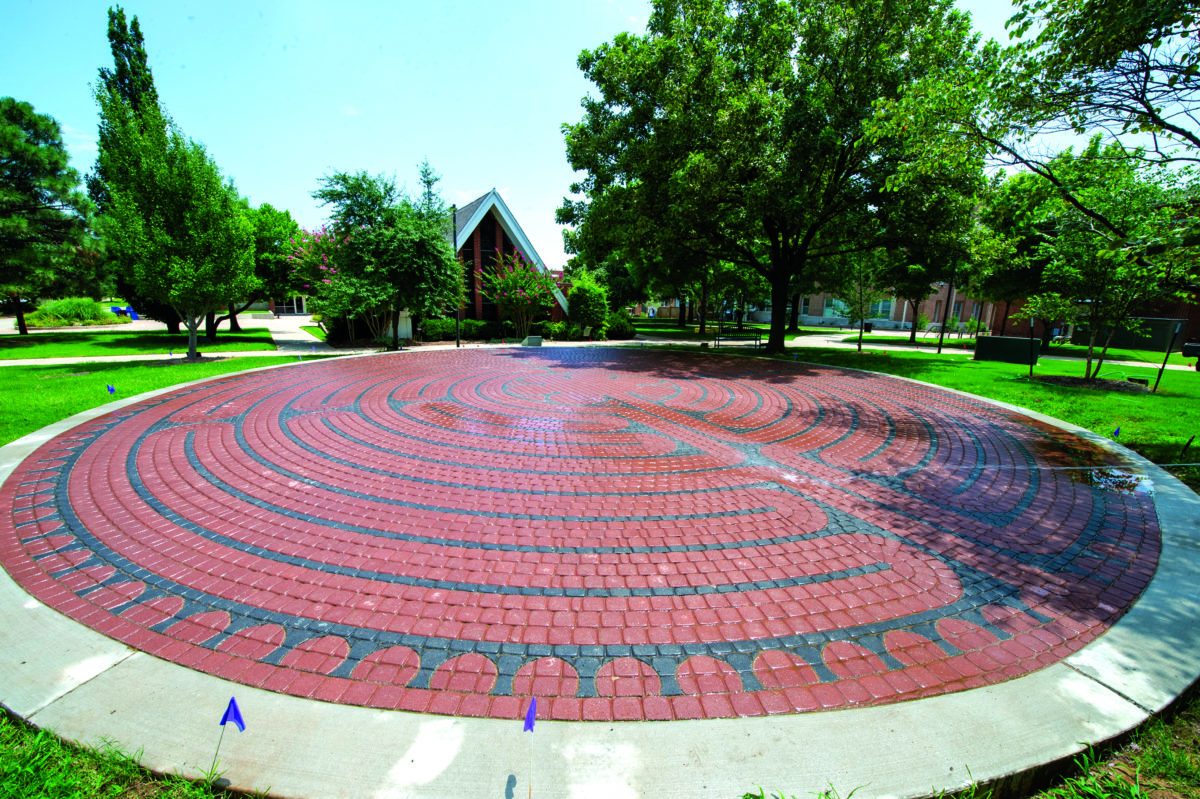
UCO was the first public university in Oklahoma to have a labyrinth. Photo courtesy UCO

Labyrinths at Oklahoma State University

OSU offers two different labyrinths on campus, the Morill Labyrinth and the Botanic Garden Labyrinth, which are free and open to the public. Both labyrinths were constructed in 2016. 

Lou Anella, director of the OSU Botanic Garden, says that the university’s intention was to offer students a space to meditate and find peace. 

The Morrill Labyrinth is located next to the Morill Hall and features three spiraling stone pathways that converge to a center point. The three sides of the labyrinth represent the connection between mind, body and spirit.  

The Botanic Garden Labyrinth is a seven-circuit, Classical design, spanning half of a mile. The university created this labyrinth by planting Bermuda grass and using spray paint and stakes to map where to mow. 

“We’ve really tried to put more things in the garden that entice people to come,” says Anella. “[The labyrinth] is a benefit to the community and is something that families enjoy with their children.” 

The Southeastern Oklahoma State University Labyrinth

Located behind the Fine Arts Building, the SOSU labyrinth is a five-circuit Medieval labyrinth made of bricks and grass. The installation of the labyrinth was spearheaded by Charla Hall, professor emeritus of psychology at the university. As a trained labyrinth facilitator, Hall introduced several of her students to labyrinth walks, which helped build up momentum to construct one on campus.

At the time of the labyrinth’s construction, many students, faculty, and alumni showed up in support of the project. The labyrinth, which was slated as a two-day project, took only one day to finish due to the enthusiasm and cooperation of the community. Adding beauty to SOSU’s campus, the labyrinth provides a peaceful spot for students to reflect and relax in between classes.

Labyrinths at the University of Central Oklahoma 

Labyrinths have become mainstays of UCO’s student life since the construction of its first one in 2013. Rudebock was instrumental in raising awareness about the transformative benefits of labyrinths. Introduced to walking meditations in 2000, Rudebock is also a certified labyrinth facilitator. 

She began bringing a large canvas tarp with a labyrinth design as an activity for students to participate in during UCO’s summer leadership academy in 2003. Over 70 students tried the labyrinth during these retreats. The activity became so popular that the university began spray painting a design into the grass, where it eventually constructed its outdoor labyrinth. 

From then on, students and faculty expressed interest in having a permanent, on-campus labyrinth. In 2013, UCO commissioned Marty and Debbie Keerman of Labyrinth in Stones to create the university’s outdoor design, which is a replica of the 11-circuit Chartres labyrinth in France. 

“We were the first public university to have a labyrinth in Oklahoma,” says Rudebock. “To be able to have that available for our students, our staff, our faculty, the community – it really was a dream come true.” 

In 2022, UCO installed a second labyrinth inside its gymnasium. Painted on the floor, this is a seven-circuit, Classical design. Faculty and students incorporate the indoor-and-outdoor labyrinths into their daily activities, using them as gathering places for musical performances and yoga classes. The university also observes Worldwide Labyrinth Day, which takes place every first Saturday in May.

Rudebock notes that there is no right or wrong way to explore a labyrinth, encouraging others to find one nearby.

“Bring your whole self … and prepare for an experience, whatever it may be,” she says. “When you experience a labyrinth, it meets you where you are.”

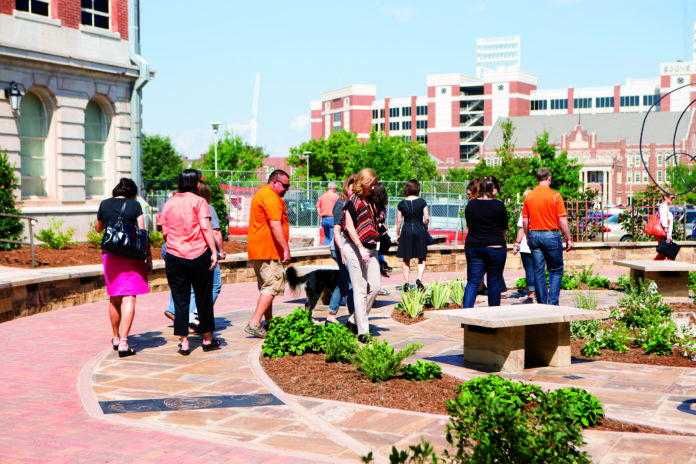
Main image cutline: At Oklahoma State University, the two constructed labyrinths offer students a space to meditate and find peace. Photo courtesy OSU

Accessible, Affordable, Enjoyable

Oklahomans may be looking for a new hobby to take on this summer, and one possibility that is both entertaining and has a very low cost for entry is disc golf. For less than $25, a disc golf player can get started with one or two discs for practice. Even better, any open outdoor area can be the ideal spot to perfect your throws. 

How It Works

Disc golf is played in much the same way as traditional golf. The goal of disc golf is to land a disc in the goal or basket with the fewest amount of throws possible.  Each “hole” has a “tee-off area” as a starting point, and when the two-meter rule is in effect, players receive a penalty stroke if their disc lands two meters above the ground while still in-bounds. This typically occurs on wooded disc golf courses where the disc lands in a tree. Most courses are either nine or 18 holes, and most courses are free to play.

More experienced players may carry a putter, midrange and driver – and some carry anywhere from 15-25 discs during a golf round with a mix of all different styles of discs. Players will carry their discs with either a backpack or, in some cases, they will use a disc golf cart.

Not a Frisbee

A golf disc is not the same as a Frisbee – it is not designed to be caught by human hands, is only 21.2 centimeters in diameter, 1.6 centimeters high and designed to be thrown around 350 to 400 feet. The world record for distance with a golf disc is around 1,100 feet. A Frisbee, on the other hand, is designed to travel 50 to 100 feet and measures 27.4 centimeters in diameter, with a height of 3.2 centimeters. 

Disc golf is often confused with ultimate Frisbee, but the two sports are very different. In “ultimate,” there is only one general disc used. An ultimate Frisbee is a large diameter disc that weighs in at 175 grams, while the object used in disc golf can range from 150 to 180 grams. Due to its smaller size, it’s a denser form of plastic.

Getting Involved

There are over 150 disc golf courses in Oklahoma, with some locations offering multiple course configurations and options. There are seven courses in the Oklahoma City metro and 22 courses in the Tulsa metro. 

Locations are ranked and graded on discgolfscene.com. Tulsa’s busiest course is known as “Bear’s Lair” and is located at the top of Chandler Park, and one of the top rated courses in the state is at The Lodge at Taylor Ranch (Moccasin Creek) in Pawhuska.

There are groups that sponsor competitions and work to expand disc golf awareness and course options in Oklahoma. In Tulsa, the Tulsa Disc Sports Association serves the disc golf community and works in conjunction with the Tulsa City and County Parks Departments, other local clubs and volunteers. The association installs, maintains and improves disc golf courses and has been in operation since the 1970’s.  

In Oklahoma City, the OKC Disc Golf Association does similar work and hosts an annual event in August. The gathering, called “Okie Dubs,” is held on the 12th and 13th and is one of the bigger “doubles” style events in the state, according to Mark Larsen, vice president of the OKCDGA. Okie Dubs usually brings anywhere between 280-300 players. 

Main image cutline: The Oklahoma City Disc Golf Association hosts the Okie Dubs tournament in August, which typically welcomes nearly 300 players to the metro. Photo courtesy the OKCDGA

A Man with a (Five-Year) Plan

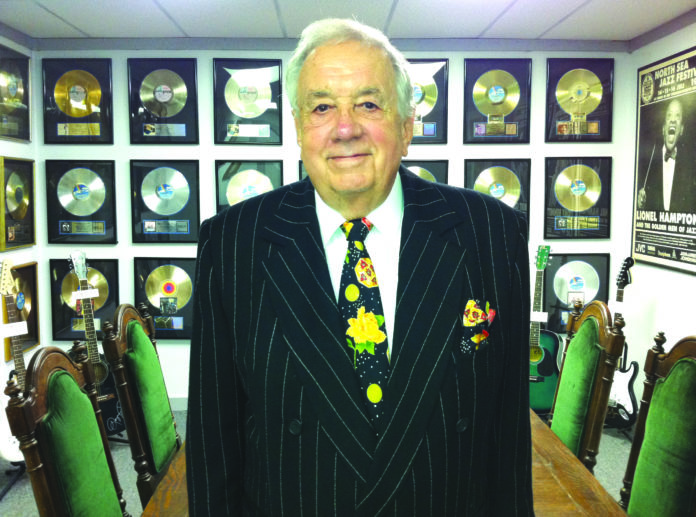
Jim Halsey may be pushing 93, but the Tulsa-based country-music impresario remains remarkably busy, doing what he’s done for decades, and still doing it the way he’s always done it.

“I’m in the middle of a five-year plan,” he says. “This is something I started in 1952 with Hank Thompson, setting out our plans of where we wanted to go, how we were going to achieve our goals, and where we were going to end up in five years. I’ve done that ever since – for 70 years now.

“So we’re about two-and-a-half years into our latest five-year plan. I don’t know of anybody else that does this, but I’ve had one for everybody I’ve ever worked with. It started with Hank Thompson, and then when we went with Roy Clark, we had a five-year plan. Wanda Jackson. Reba McEntire. At the end of our five years with Reba, we’d gotten her two Grammys, two platinum albums, gotten her on television, gotten her in the MGM hotel [in Las Vegas], with all of that culminating in Carnegie Hall.

“With our five-year plans, each artist is different and has different requirements. The same thing is true for my company and myself, personally. It’s ‘Where am I right now? What do I want to accomplish and achieve, and where do I want to be five years from now?’”

No matter whether it’s for his acts or himself and his company, he adds, no five-year plans are ever the same. “They change because we’ve either accomplished something we’d planned, or we’ve grown, or we’ve learned. The business changes. Life changes, but it all harmonizes and it will adjust itself to what we’re doing.”

And speaking of harmonies: One of Halsey’s current five-year plans involves The Oak Ridge Boys, that veteran vocal supergroup he’s been managing for a half-century, ever since he oversaw their transition from gospel to mainstream country music in 1973.

“Part of it includes a fifty-year celebration,” he notes. “How do we recognize and honor those 50 years without doing some sort of a tribute show, where everybody comes out and sings a tribute song? There have been so many recently – Lee Greenwood, George Jones. Ronnie Milsap’s coming out with one. And the Oaks have been on most of them.

“What we’re talking about is something different, honoring where we’ve been, rather than someone else coming up and making the tribute. Of course, we’ll bring in other people to help us, but we’re going to give thanks, and honor our 50 years, and celebrate them.”

His personal five-year plan includes developing a museum to display a portion of the memorabilia he’s acquired over his seven-plus decades in the music business. Since 2020, some of it has been featured in the Jim Halsey Legends of Country Music exhibit at the Wagoner City Historical Museum; at this writing, he says, plans are underway for more of it to be housed in a new building in his hometown of Independence, Kansas. And he’s still looking for other opportunities to display pieces of a personal country-music-related collection that’s as vast as any in the world.

“The only place you’ll find as much memorabilia as we have in Wagoner is in the Country Music Hall of Fame in Nashville,” he says. “We’ve got archival items from the artists we’ve been involved with, and that includes Grammys, gold and platinum records, awards and citations, posters, and important contracts. A lot of museums don’t show contracts. I show contracts – my contracts with Roy, with the Oak Ridge Boys, with Wanda Jackson, Conway Twitty, Dwight Yoakam, Reba McEntire. I don’t display the intimate details, but they show what our obligations were to them, and what their obligations were to the business.”

At one point, during the 1970s and ’80s, the Tulsa-based Jim Halsey Company was the biggest country-music booking agency in the entire world. It seemed at the time as though every country act of any consequence was represented by Halsey and his agency.  

Still, he remembers, there were a few who, for some reason or other, never became clients.  

“One of the first ones was Willie Nelson,” says Halsey. “Joe Allison, the great songwriter and producer, kept touting me on Willie Nelson. He had an album out on Willie – on Liberty Records, I think – with all those great songs that Willie had written. This was in the early ’60s, and of course Willie was clean-shaven and had short hair.

“Willie and I got together, and I had a plan for him, but I couldn’t get anything going at all. Boy, did I believe in him. But I couldn’t get him on package shows. I couldn’t get him interviews or anything. He tried, and we tried, and then we finally got together and I said, ‘Willie, I’ve tried all that I can try, all the magic that I made work with others, and we just can’t do it.’

“But – he did.”

The other big name that comes to Halsey’s mind is Oklahoma superstar Vince Gill.

“You know, every time I see Vince, he says, ‘I tried to sign with your agency and I could never get past your receptionist,’” says Halsey. “And I always tell him, ‘I don’t know how that happened. It must’ve been a substitute.’ You know, I would see everybody.”

On the other hand, there were also immensely talented performers represented by Halsey who he believes didn’t have the impact they should’ve had on a national and international basis. At the top of that list are two Tulsa-based artists, Don White and the late Debbie Campbell.

“Debbie was an outstanding singer, one of the best ever, and while she achieved local success, she never became that national star,” he explains. “The same with Don, a really good songwriter and really good performer.

“There were a lot of artists, too, we worked with before they did hit, and people would say, ‘Why are you sticking with them?’ “

Those acts, he adds, include a performer who became one of Halsey’s biggest success stories.

“People thought that about Roy Clark,” he says. “They’d say, ‘You know, he’s super talented, but there are a lot of people out there who are so talented they never make it.’ He did a little bit of everything. But how do you pinpoint that?

“When I signed Roy and we made our five-year plan, the first person I called was [music promoter] Hap Peebles in Wichita. He had a package show going out, with five or six big stars, playing  dates in Wichita, Kansas City, Lincoln, Omaha, places like that.

“Hap told me, ‘I don’t have any money. We’re all booked up. The show’s all set, and it goes out next week.’

“I said, ‘Would you give him a hundred dollars? Anything?’

“He said, ‘No. I don’t need him.’

“I kept talking to Hap, and I said, ‘Listen, believe me, this guy’s going to be really great, and I need these six dates you’re doing.’

“Finally, he said, ‘I tell you what I’ll do. I’ll have a hotel room for him, and I’ll feed him.’ And those were the first six days I ever booked with Roy.’

“So,” he adds, “Roy went on the show with these big superstars. He opened the show; Hap gave him 15 minutes. And by the time the tour was over, every one of those superstars had gone to Hap and said, ‘Listen, why don’t you put me on before that guy? He just stops the traffic so much that it’s hard to get ‘em back.’ At the end of that tour, a totally unknown person, Roy Clark, was closing
the show.”

Main image cutline: Jim Halsey, a legend in the country music industry, continues working to improve the industry for his clients. Photo courtesy Jim Halsey


Birds and Brews

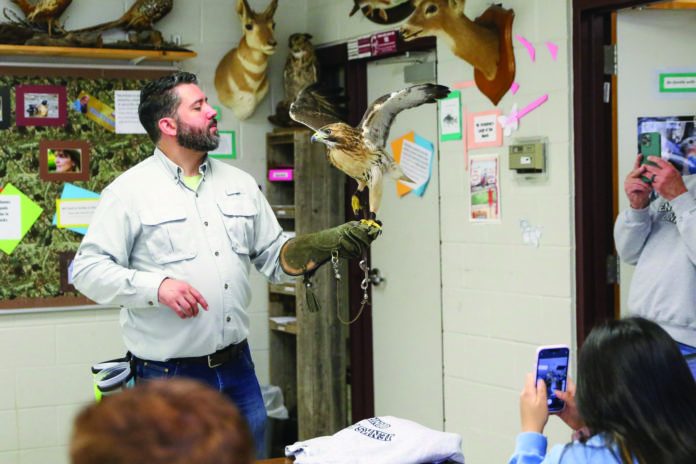
If you’ve got an affinity for birds, beers or perhaps both, the upcoming Wild Brew event is a match made in heaven. The event, helmed by the George Miksch Sutton Avian Research Center, is a one-of-a-kind affair that combines top-notch food from the Tulsa area with first rate local beers, wines and spirits. On top of that, there is live music, demonstrations from local artists, opportunities for selfies with an array of live birds, plus a silent auction. The live birds include a Narragansett turkey, a red-tailed hawk and a golden pheasant. 

Local Tulsa artist Josh Stout will be on site doing a live painting that will be auctioned off during the event. 

“We will have an art gallery set up at the event with donated artwork from well-known local artists who support the Sutton Center’s conservation work,” says Christina King, communications officer with the research center. “People will be able to purchase artwork during the event.” 

The annual fundraiser supports the Sutton Center, an internationally recognized non-profit established in 1983 that’s best known for its work with bald eagles. A decade ago, the bald eagle was on the endangered list. Now, they fly the Oklahoma skies with regularity. After this success, the Sutton Center is now trying to save more endangered birds, such as the masked bobwhite and Attwater’s prairie chicken. The center also keeps tabs on bald eagles through satellite tracking, surveys and a live nest webcam. All in all, the center operates with the goal of finding conservation solutions for birds and the natural world through science and education.

On top of protecting birds like the bald eagle, the Sutton Center also launched a major study of Oklahoma’s breeding birds for a five year statewide survey. The results will help to understand how these Oklahoma animals are faring. 

There are also “All About Birds” Ambassador Programs, meant to share the Sutton Center’s expertise with students all across the state of Oklahoma. Each program combines science and environmental education along with interactive presentations, activities and live animal guests. 

“We have several very exciting projects happening at the Sutton Center and around Oklahoma,” says King. “We are well known nationwide, but a hidden gem locally!”

Conservation internships bring high school and college students into the fold on real projects, as they play a role in wildlife conservation. Satellite tracking of young bald eagles lets students and the public continue to follow the birds on their journey. 

The Sutton Scholarship Award, with support from NatureWorks and corporate sponsors, recognizes Oklahoma high school students who demonstrate the ability to effectively communicate current conservation topics in compelling ways through different art mediums. Coupled with the viewing of baby bald eagles, there are also videos of the eagles hunting, feeding and defending their nests. 

As a non-profit, the best way to help the Sutton Center is through donations or the volunteering of your time. The Wild Brew event, hosted at Tulsa’s Cox Business Convention Center on Aug. 26 from 5-8 p.m., is also a wonderful way to help the center and have a great time doing it. General admission is $75. The live local music includes Shelby Eicher, Kyle Reid, and Biscuits and Gravy. 

Drink a beer and save a bird!

Main image cutline: The George Miksch Sutton Avian Research Center offers education and programming alongside its Wild Brew event. Photo courtesy the Sutton Avian Research Center

Ample Architecture

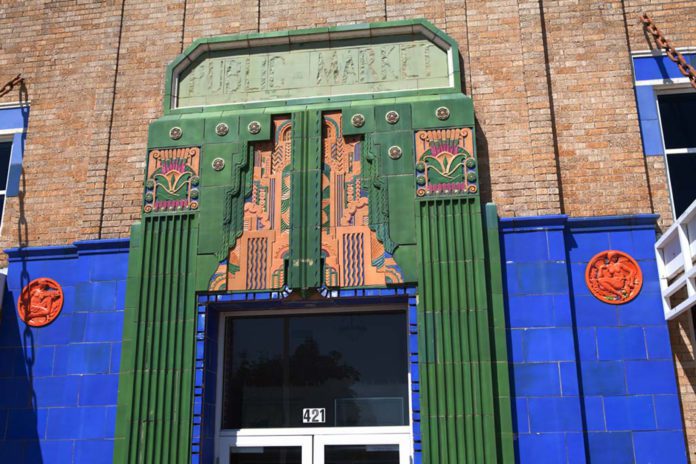
If you’ve lived in Oklahoma long enough, you know the state has a multitude of architectural wonders within its borders. The types of structures vary, from Under Her Wing Was the Universe, a sprawling native prairie structure located in Enid, to the Boston Avenue United Methodist Church in downtown Tulsa – said to be one of the finest examples of Art Deco architecture in the United States. 

Both Tulsa and Oklahoma City have foundations for architecture, and both seek to spread awareness of the ample hidden (and not-so-hidden gems) in the state. 

“The mission of the Oklahoma City Foundation for Architecture is to promote excellence in our built environment through education, recognition and preservation,” says Melissa Hunt, the foundation’s executive director. Offerings include monthly programming alongside events and tours, she says.

The Tulsa Foundation for Architecture is also pushing relevant architectural information out to the people. 

“The TFA is working to spread awareness through our many tours and programs, as well as the work we do advocating for historic preservation in our community,” says Amber Litwack, TFA’s executive director. “Along with our public programs, we keep a calendar of speaking engagements for a variety of audiences.” 

Each foundation has a number of engagements to keep the public excited. A popular event called Drinks x Design sees patrons gather for refreshments and tours of designs throughout OKC. 

“We also have an architecture scholarships program and the Lynne Rostochil National Register Grant program,” says Hunt. 

The grant, named in memory of an architectural historian and photographer who advocated for the preservation of Oklahoma’s heritage, is used to help fund the preparation of National Register nominations for structures, sites and districts in the state. A past program was the Celebrate 100 book, a guide to architecture in central Oklahoma from the past century. 

“It’s out of print now, but I do have a few copies in my office and it’s available online, too,” says Hunt.

Tulsa’s foundation also works diligently to keep its audience connected. 

“We host a wide variety of tours, programs and events for a range of audiences and ages,” says Litwack. Popular choices include the Second Saturday Tours, which feature a different location every month with conversational walking tours, elucidating building features and different historical perspectives. Those who want more can visit the Tulsa Underground Tunnel Tours, featuring the history of prominent buildings and tunnels that connect downtown. 

Everyone has favorites, and although narrowing it down isn’t easy, both Hunt and Litwack have a few of their own. 

“The Gold Dome,” says Hunt. “It’s one of the most recognizable and unique pieces of architecture in our city. We’ve lost so many important landmarks in Oklahoma City, and I hope this one can be saved.” 

Litwack lands on the John Frank House, a home specifically designed by Bruce Goff to showcase Frank’s love of pottery. 

“It’s special to me because the property was clearly a labor of love,” she says. “The home is truly unique.” 

Places to Visit:

Church Studio Tulsa – Historic, state-of-the-art recording studio that’s been fully restored

Coleman Theatre Miami – Iconic theatre built in 1929, home to the “Mighty Wurlitzer” pipe organ

Marland’s Grand HomePonca City – Restored home of oil tycoon and Oklahoma’s tenth governor, E.W. Marland

The Gold Dome Oklahoma City – Geodesic major landmark that originally housed Citizens State Bank

Guthrie Scottish Rite Guthrie – One of the world’s largest Masonic Centers, the great Temple of the Scottish Rite of Freemasonry

Historic Mattie Beal Home Lawton – Restored neoclassical house with self-guided tours and events

Belvidere Mansion Claremore – Three-story mansion built by John M. Bayless in 1902

Main image cutline: Bits of stunning architecture can be found across the state – including in downtown Tulsa at what was once a Warehouse Market. Photo courtesy Tulsa Foundation for Architecture

Celebrating the Red, White and Blue

There’s nothing more American than celebrations for the Fourth of July.

For nearly 250 years, we’ve been taking time during the heat of summer to remember that fateful July day when the future was sealed for our country. And, really, the celebrations remain much as they were that first July holiday.

Considered the curmudgeon of the founding fathers, John Adams insisted for the rest of his life that the celebrations should happen on July 2; but the fourth day of July was chosen for good reason. The vote to declare independence from Britain was taken on July 2, but the Declaration of Independence was formally adopted by the Continental Congress two days later. The final signatures weren’t obtained until Aug. 2, but the struggle for independence from Britain was already underway.

The first celebration of this momentous day took place the very next year in 1777 and has continued annually – though organized events don’t seem to have gained popularity until after 1812. The Fourth of July was established as a federal holiday by Congress in 1870 and became a paid holiday in 1938. These early festivities included frivolity that we would recognize today including food and drink, music and parades, but also included mock funerals for England’s King George III and public readings of the Declaration of Independence.  

Since those days we may have given up the practice of hosting mock funerals for royalty, but we’ve certainly added a lot of fun. Since the end of the war for independence, Americans have enjoyed hosting Fourth of July barbecues, waving sparklers and American flags, attending parades and rodeos, listening to patriotic music and the ever-popular wearing of red, white and blue apparel.  

But there’s one means of celebration that probably comes to mind first when you think of the Fourth of July: fireworks. Fireworks themselves have been around for a lot longer than our country, so how did they become so ubiquitous during this holiday? The answer is that the precedent was set from the beginning. During that first anniversary celebration in 1777 in Philadelphia, cannons from ships on the river fired a 13-gun salute to honor the 13 original colonies. And that evening, a fireworks display also began and ended with 13 rockets. So you could say that we have been using fireworks to celebrate the birth of our nation from the very start. 

Fourth of July Celebrations

No matter where you are in Oklahoma when the Fourth rolls around, there are celebrations galore. Be sure to check websites for the latest info. 

Bethany Freedom Fest

July 2

6700 N.W. 36th St.

cityofbethany.org

LibertyFest

Events through July 4

Citywide, Edmond

libertyfest.org

Jay Fireworks Display

July 4

400 W. Monroe St.

cityofjay.city

Rockin’ the Park

Through July 2

Downtown Medicine Park

medicinepark.com/festivals

Celebration in the Heartland

July 4

Buck Thomas Park, Moore

cityofmoore.com

Folds of Honor FreedomFest 

July 4

River West Festival Park, Tulsa

freedomfesttulsa.com

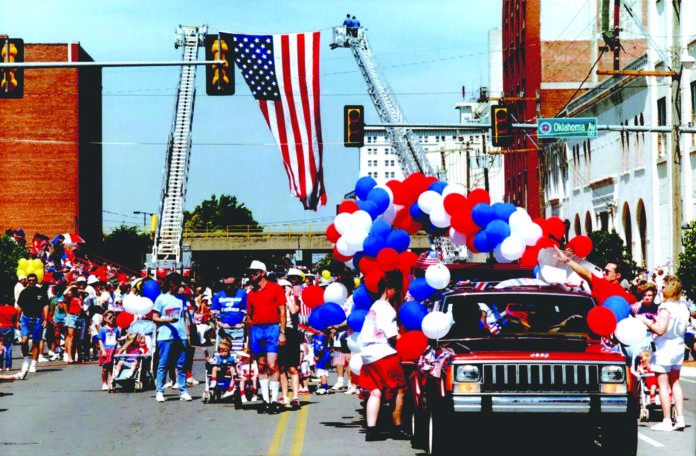
Main image cutline: Oklahomans have always celebrated the Fourth of July in style. Photo by Paul B. Southerland/Oklahoma Historical Society