The National Rural Water Association (NRWA) is the nation’s largest water and wastewater utility membership association. NRWA trains, supports and promotes professionals who serve small communities (under 10,000 in population) in all 50 states. The association draws from numerous federally funded programs to bridge the gap between regulatory requirements and resources available in rural America.
NRWA’s Oklahoma entity, the Oklahoma Rural Water Association (ORWA), focuses on water and wastewater system sustainability for generations to come. ORWA is the primary driver for federal and state programs used to ensure safe and plentiful drinking water and environmentally sound wastewater treatment.
Brandon Bowman, ORWA state programs director, says some programs are funded by NRWA via grants from the USDA-Rural Development and the EPA, which are then implemented by ORWA. Among these are the apprenticeship program, along with the EPA water and wastewater training and technical assistance programs.
Federal/NRWA funded programs also include the Source Water Protection Program – which helps communities develop plans to prevent, reduce and/or eliminate pollution from impacting raw water sources. The Energy Efficiency Program helps systems save power, materials and revenue by improving efficiencies in operations and power consumption.
State funded programs include the Long Range Sustainability Program, the Water Loss Reduction Program, the Rate Analysis Program and the Disadvantaged Community Program. These programs help systems improve technical, managerial and financial sustainability.
“The Circuit Rider Program provides regular on-site technical assistance visits, conducts training classes for operators and provides emergency response assistance,” says Bowman. “Circuit Riders travel from system to system, providing help and solving problems when needed.”
The Wastewater Technician Program involves a team of technicians who also travel from system to system, helping lagoon and small sewer treatment system operators solve issues and improve operations. The techs provide on-site support, particularly for locating leaks in the sewage collection system so they can be rapidly repaired.
And specialists in the EPA training and technical assistance programs, while complementing the work of the Circuit Rider and Wastewater Technician programs, provide training in issues impacting systems, such as emerging contaminants, PFAs, and lead and copper rule revisions.
As a nonprofit, NRWA rallies resources in emergency situations. In Dec. 2021, the NRWA responded to an outbreak of storms and over 30 tornadoes in four states – resulting in water and wastewater systems that were dramatically affected, impacting 13,000 rural Americans.
“Before ORWA’s creation in 1970, small water and wastewater systems had no voice at the state capitol or in Washington, D.C.,” Bowman says. “The majority of Oklahoma water systems are considered small. The strength of our nation lies in rural America, and our water and wastewater systems are the lifeblood of that strength.”
Get Involved
The public may attend governing board meetings for their local water and wastewater systems, and support initiatives that improve system sustainability. It’s also wise for the public to be informed by understanding why systems set rules and take actions, such as rate setting and seeking funding for infrastructure improvements.
Individuals may look for opportunities to run for governing board seats. And if a system is not already a member, the public may encourage their system to join ORWA. With membership open to all Oklahoma public water and wastewater systems, ORWA encourages all systems to become members.
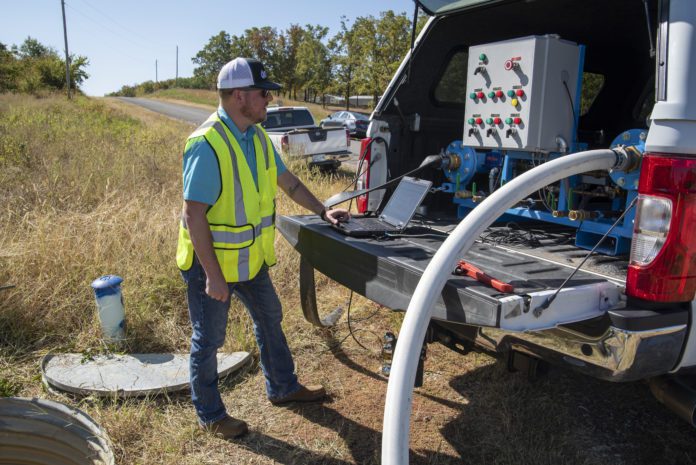
Main image headline:The employees of the Oklahoma Rural Water Association focus on water and wastewater system sustainability for generations to come. Photo courtesy ORWA
Health boxes by Rebecca Fast Doctor profiles by Tracy LeGrand and Rebecca Fast
Photo courtesy Saint Francis Health System
Michael Malloy, M.D. Rheumatology Saint Francis Hospital, Warren Clinic Tulsa
During his residency at Madigan Army Medical Center in Tacoma, Wash., Michael Malloy, M.D., rotated through the field of rheumatology and quickly realized it was the perfect fit for him.
“I loved the long-term relationships with patients, the science and art of diagnosing, and treating the various immune and musculoskeletal related conditions,” says Malloy, who works at Saint Francis Health System’s Warren Clinic – Rheumatology. “Rheumatology is a specialty that combines the immune system and musculoskeletal system in a unique way.”
He says it’s fulfilling to see patients with any sort of disability (such as not being able to close their hands or walk without assistance) receive specialized treatment and then later do those skills, as well as other activities, in their daily lives.
Malloy began his career in the advent of biologic medications within rheumatology.
“I feel like the discovery of biologic medications has truly been the most significant breakthrough in the field of rheumatology in the last 30 years,” he says. “There are also numerous other medications which have been developed recently, including JAK inhibitors.”
Malloy is quick to share the spotlight, and says he works with a wonderful team at Warren Clinic Rheumatology. He mentions that the practice is expanding soon.
“I also feel like what I do is a ministry, and I am reminded daily of the mission statement of the Saint Francis Health System: ‘To extend the presence and healing ministry of Christ in all we do.’” – RF
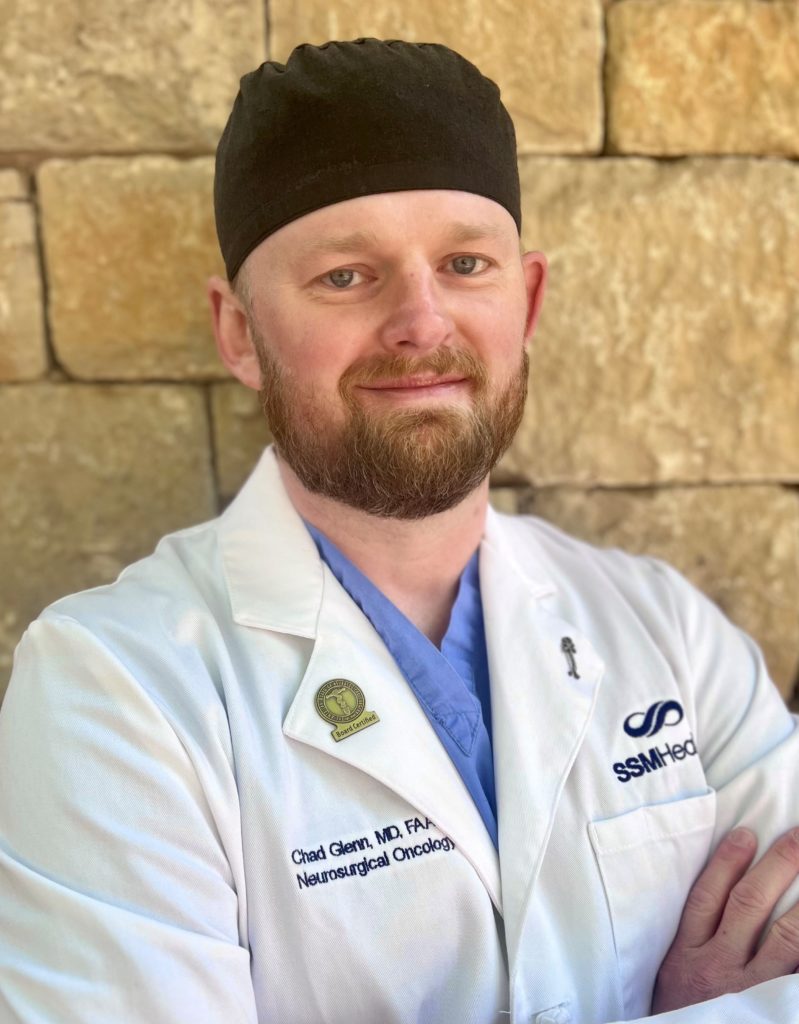
Photo courtesy SSM Health Saint Anthony
Chad Glenn, M.D. Neurological Surgery SSM Health St. Anthony Hospital OKC
A board-certified neurosurgeon specializing in brain tumors, Chad A. Glenn, M.D., is a Louisiana native who earned undergraduate and medical degrees at Louisiana State Univ. – Shreveport before completing his neurosurgery residency at the University of Oklahoma Health Sciences Center. He completed his fellowship – which specialized in the skull base and cerebrovascular issues – at Case Western Reserve University and served as faculty at the University of Oklahoma before transitioning his practice to SSM Health.
The most rewarding part of Glenn’s vocation is helping people during stressful times. He says neuroscience builds “deeper, longer-term connections with patients. Neurosurgery is, no doubt, an opportunity to integrate medical science into many aspects of my job, but the subspecialty where I focus my time allows me to see fewer patients for longer periods, which helps me get to know them and, I hope, helps me make a positive impact on their health and their lives.”
Glenn has amassed a pro team that offers the best possible care.
“Because I focus my practice primarily on brain tumors and other cranial issues, we are able to be very specialized in what we do,” he says. “I’m so fortunate to have been able to select a team that I know is the best of the best; we not only work well together, but everyone keeps patient advocacy at the top of their minds, no matter their role. When a patient has been referred to a brain tumor specialist, they are often very anxious. To us, being present, caring and comforting to them and to their families goes hand-in-hand with providing top-notch medical care.”
Cutting-edge medicine draws patients and referrals to Glenn from around the state to provide individualized treatment.
“There are no ‘one-size-fits-all’ technologies, but rather, we evaluate each person’s unique needs and work together to build the care plan that works best for them,” says Glenn. -TL
Photo courtesy George Monks, M.D.
George Monks, M.D. Dermatology Tulsa Dermatology Clinic Tulsa
Harboring a passion to help people, George Monks, M.D., who works with the Tulsa Dermatology Clinic, was drawn to his specialty because he could care for patients of all ages.
“I love the patient interaction, visual nature of the field, and that it combines so many different disciplines,” he says. “It’s very rewarding to alleviate the pain and suffering – both physical and emotional – that skin conditions can cause.”
He says people may not realize that dermatology is a blend of all medical specialities, requiring a knowledge base of multiple fields.
“Our skin is often a window to understanding manifestations of systemic disease,” he says. “Dermatology residency is the most competitive residency to be accepted into, and major advances in cutaneous therapeutics have revolutionized our field.”
With a special interest in skin cancer and psoriasis, Monks says every day is different, and he performs numerous in-office procedures and surgeries. He also served as president of the Oklahoma State Medical Association during the pandemic, from 2020 to 2021.
“Dermatology has recently undergone a renaissance in treatment advances,” he says. “We now have much more effective treatments for skin cancer, psoriasis and eczema with the development of biologics, JAK inhibitors and other small molecule medications. It’s a very exciting time.” – RF
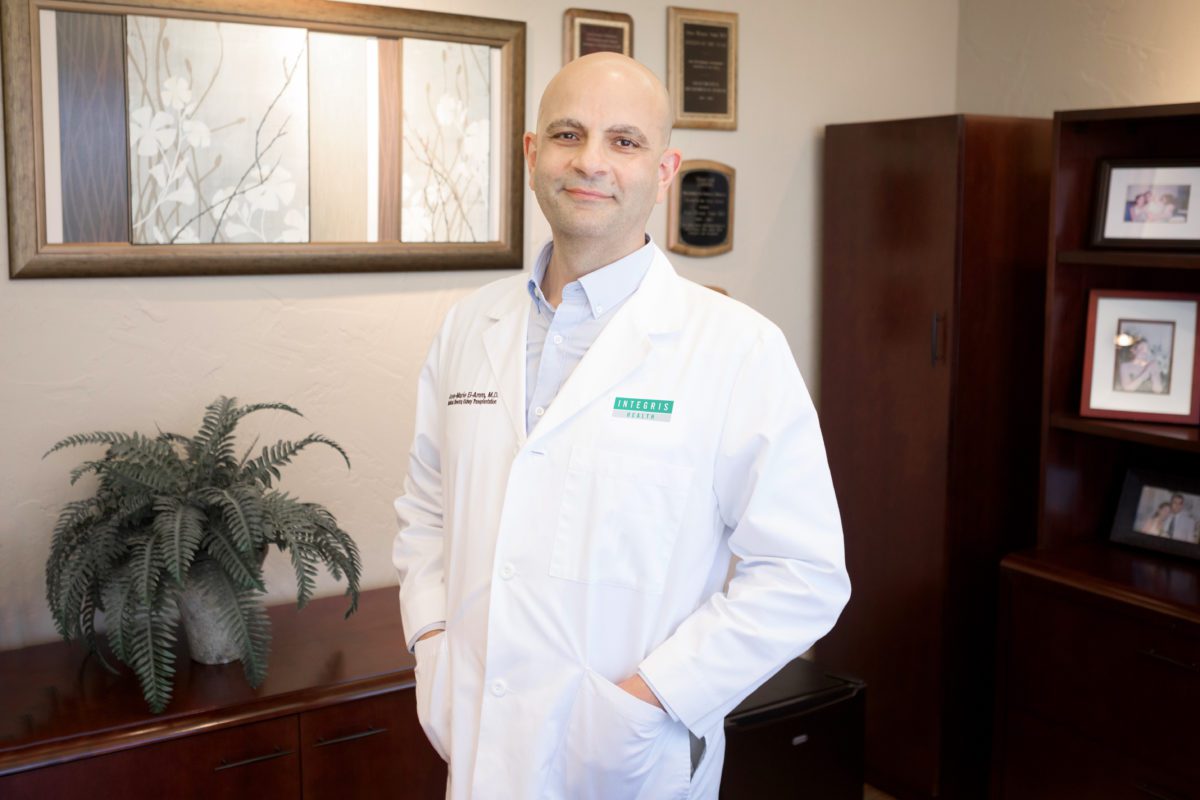
Photo courtesy INTEGRIS Health
Jose El-Amm, M.D. Nephrology INTEGRIS Baptist Medical Center, Nazih Zuhdi Transplant Institute OKC
As the medical director of the INTEGRIS Nazih Zuhdi Transplant Institute – kidney transplant division, Jose El-Amm, M.D., says the most rewarding part of his career is visiting patients after a transplantation.
“The hope and relief on the patients’ faces and family members is indescribable,” he says. “Physicians and surgeons get the most credit, but none of this is possible without a dedicated transplant team. Transplant coordinators, social workers, pharmacists, financial coordinators, administrators, floor nurses and physician assistants are intricate parts of the team and are a must for a successful transplant. And none of this will happen without the extreme generosity of the organ donors and their families.”
When El-Amm relocated from Michigan to Oklahoma City in 2008, he says transplant nephrology was a budding subspecialty. He credits the referring nephrologists for trusting him to take care of their patients following transplantation. Today, the institute performs around 100 kidney and pancreas transplants a year.
El-Amm’s special interests and research in the field of transplantation includes desensitization, paired kidney donation, newer immunosuppressive medication with less toxicities and high risk transplant recipients.
“Transplant patients have to routinely undergo lab testing for the rest of their lives to check on their kidney function and drug toxicities,” he says. “They are usually on multiple medications that suppress the immune system, and unfortunately these drugs have multiple side effects. We try to find the best combination of medications that will protect the kidney and/or pancreas without harming the patient.” – RF
Photo courtesy Norman Regional Health System
Marilyn Appiah, D.O. Obstetrics & Gynecology Norman Regional Health System, Care for Women Norman
Marilyn Appiah, D.O., helps to bring new life into the world. An Oklahoma native and graduate of Oklahoma State University’s College of Osteopathic Medicine, Appiah completed her residency in Akron, Ohio, before returning to Oklahoma to be near family. She joined Moore Medical Center soon after the facility had been ravaged by a May tornado, and later joined Norman Regional Health Center.
The doctor says she continues to be humbled and moved to work in the field of reproductive health, providing best-in-class care to women.
“It has truly been a journey, and continues to be,” says Appiah. “I was called by God at an early age to become a physician and did not deviate from it. Obstetrics and gynecology – OB/GYN – is an exciting field, which can be both rewarding and heartbreaking.
“The most rewarding part is being part of bringing new life into the world,” she continues. “I love hearing the sound of babies [first] crying and seeing patients with their significant others, bonding with their baby, or in some cases babies – plural. I enjoy educating patients, watching them grow in their knowledge, and, in doing so, becoming their advocate.”
Appiah’s typical day includes performing deliveries and then “going back to the office and getting home late at night, only to repeat the next day,” she says. “There is rarely a dull moment. OB/GYN is a complex, evolving field – and an exciting field.”
Giving birth is as old as time, and is a process often enhanced by modern medicine when the need arises.
“One of the biggest breakthroughs are robotics,” she says. “Patients recover faster and are able to return to their everyday lives quicker.” – TL
Photo courtesy OU Health
Barish Edil, M.D. Surgery University of Oklahoma Medical Center, OU Health Stephenson Cancer Center OKC
Barish Edil, M.D., F.A.C.S., a Wisconsin native and University of Wisconsin graduate, came to the University of Oklahoma for a general surgery residency and research fellowship in surgical oncology. He was inspired by both his patients and his mentors to enter “the very technical and challenging field of pancreatic surgery,” he says. He went on to complete highly specialized training at John Hopkins Medicine, and served as faculty there – where he delved deep into cancer vaccine research. Edil was later recruited back to Oklahoma and now serves as the chair of the surgical department at OU, and serves as surgeon-in-chief for OU Health.
“Now as I’m older and more reflective, what drives me in the field are my patients,” says Edil. “They’re very brave in dealing with challenging problems, and to help them through that process is very rewarding.”
With administrative duties involving the oversight of 60 surgeons, Edil spends much of his day ensuring his department is functioning well, and keeping up with the clinical component of his work – seeing patients. In addition, he embraces the role of educating the next generation of physicians in the OU residency program.
Around 50% of people will be diagnosed with a form of cancer in their lifetimes, and pancreatic cancer in particular typically inspires some nihilism, says the doctor. He’s working to change that.
“Cancer care is amazing, and it’s become a team sport,” he says. “I’m a surgeon, and I’m part of a team. We’re hitting for the fences to get as long a life as possible. People should know that care of cancer is changing dramatically and quickly. I’m just one of multiple people taking care of cancer patients. Cancer care is a lot of people.”
Helping people to live longer is Edil’s primary motivation. To that end, during his Hopkins residency, Edil developed a minimally invasive laparoscopic whipple technique; today, the technique is lauded as one of the biggest surgical advancements in thirty years.
“Back in the ’80s, there was a 30% mortality rate with the operation, and in the ’90s, the guy who trained me at Hopkins took it down to 2%,” says Edil. “In the early 2000s, I was part of the generation that made it minimally invasive.” -TL
Photo courtesy Dean McGee
Mahmoud Khaimi, M.D. Ophthalmology Dean McGee Eye Institute, University of Oklahoma Medical Center OKC
A native of Detroit, Mahmoud A. Khaimi, M.D., received his medical education in Michigan, including a residency in ophthalmology. Applying nationwide for a fellowship in the subspeciality of glaucoma, Khaimi was thrilled to join the world-renowned Dean McGee Eye Institute, moving his wife and then-one-month-old baby to OKC. Khaimi was recruited to stay as a glaucoma specialist and cataract surgeon and, a decade later, says his six children are true ‘Okies.’
Khaimi’s non-surgical days start early – seeing patients from newborns to those in their 90s who’ve been battling glaucoma for decades. He finds the most rewarding part of his career involves daily efforts to prevent patient blindness.
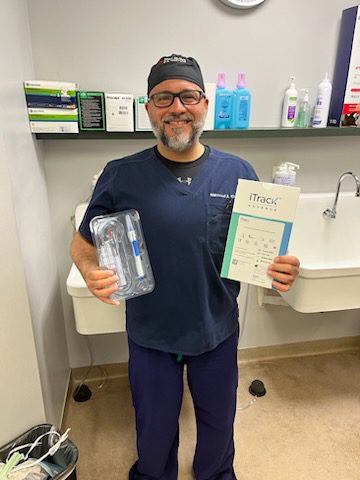
In 2015, the doctor pioneered a new type of canaloplasty – a glaucoma surgical procedure – and recently developed a corresponding ergonomic surgical device to perform it. His surgical innovations have stood the test of time and are now used internationally “so that ophthalmologists worldwide can treat their patients with glaucoma,” says Khaimi.
Preserving eyesight starts with vigilance, he says.
“The biggest thing with glaucoma is awareness, because it can be brewing in your eyes and you have no idea of it. By the time you do, it’s pretty far along in the disease process,” he says. “It can be the silent thief in the night, stealing your vision – and you don’t know until you wake up. It’s a progressive disease, so getting to an eyecare provider to get your eyes dilated and checked out is key. It’s especially recommended if there are risk factors of age, family history, and race – as Black and Hispanic populations are much more likely than other races to develop it. Also, eye trauma and other conditions can lead to glaucoma. You want to have a baseline comprehensive eye exam for comparison.”
Khaimi is pleased with breakthroughs in his field, such as minimally invasive glaucoma surgeries, and is especially proud of the work he and his colleagues are doing at Dean McGee.
“I think I was always a closet Okie, and I would love Oklahoma to know that we at Dean McGee are doing amazing, groundbreaking things that send ripples worldwide,” he says. – TL
Health Boxes
Mental Health According to the National Alliance on Mental Illness, a mental health crisis is any situation in which people’s behavior puts them at risk of hurting themselves or others, and/or prevents them from being able to care for themselves or function effectively. Behaviors surrounding a mental health crisis can include social withdrawal, rapid mood swings, abusive behavior, psychosis and paranoia. If you believe an individual is a threat to him/herself or to those around him/her, call 911 and explain that this person is experiencing a mental health crisis, and ask for someone who is trained to work with people with mental illnesses. – National Alliance on Mental Illness
Heart Health Cardiovascular disease includes heart disease, stroke, heart failure and hypertension, or high blood pressure – and the United States experienced a steep rise in cardiovascular disease deaths during the first year of the COVID-19 pandemic. Heart disease also remains the leading cause of death in the United States and globally. Preventative care is key to avoiding cardiovascular disease and should include knowing your familial risk, eating healthy, being physically active, maintaining a healthy weight, living tobacco free and closely monitoring your blood pressure and cholesterol levels. – American Heart Association
Digestion 101 Constipation is typically described as fewer than three bowel movements a week and can be occasional or chronic. Treating constipation depends on the underlying cause – which can range from having a poor diet and getting too little exercise to more complex issues such as blockages and/or neurological problems in the colon and rectum. To avoid constipation, eat plenty of high-fiber foods, stay active and hydrated, keep stress levels low and try to create a regular schedule for bowel movements. – Mayo Clinic
Common Cancers Approximately 39% of men and women will be diagnosed with cancer during their lifetimes. Common cancers affecting men, an estimated 43%, are prostate, lung and colorectal cancers. For women, an estimated 50% of all new cancer diagnoses will include breast, lung or colorectal cancer. While cancer symptoms vary, they can include bladder issues, a persistent change in bowel habits, a persistent cough, unexplained weight loss or weight gain, and changes in breasts – a lump or firm feeling, nipple discharge and/or itchy, red, scaly, dimpled or puckered skin. – National Cancer Institute
Sleep Recommendations Nightly sleep recommendations vary by age, with suggested quantities being at least 7 hours of sleep for adults, 8 to 10 hours for teenagers, and 9 to 12 hours for school-aged kids. A sleep deficit is created when a person consistently gets less sleep than needed. Despite the number of hours, if you can wake up feeling rested and productive throughout the day, then you’re more than likely getting enough shut eye. – Sleep Foundation
Vision Health A healthy lifestyle not only supports your overall health, it helps protect your eyes. Diabetes, high blood pressure and high cholesterol can all cause eye health and/or vision problems – and smoking increases your risk of macular degeneration and cataracts. To care for your eyes, have routine eye exams, wear sunglasses and protective eyewear when needed, and allow your eyes the chance to rest when working on your computer with the 20-20-20 rule – every 20 minutes, look at something 20 feet away for 20 seconds. – National Eye Institute
Author Carmen Fields prefaces Going Back to T-Town, a fine new book about her Tulsa-based band leading father, Ernie Fields, with lyrics from a well-known song written by another musical Oklahoman, Elk City native Jimmy Webb. The lines, from the Webb composition “Didn’t We,” are all about trying and not quite succeeding, ending with the question, “Didn’t we almost make it this time?”
Although “Didn’t We” is a love song, Carmen Fields chose those lyrics to reflect something else: the whole idea of “making it” as a performer.
“However you measure ‘making it,’ being a big name, a recognizable name throughout the country – he didn’t make it in that sense,” she says of her dad. “He had some close calls. He got the chance to go to New York City, but he was impatient about making the big time and didn’t stay as long as he could have or should have. He was proud of his accomplishments, but he never achieved the level of Duke Ellington, Count Basie or Cab Calloway.”
Yet, throughout his decades as a bandleader and trombonist, Ernie Fields at least carried on a serious, long-term flirtation with music-business stardom. He toured throughout the country, especially early in his career, headlining at many venues and providing a decent living not only for himself but for his band members as well. His music was noticed by critics and industry insiders, with a number of stories and mentions of the Ernie Fields Orchestra seeing print in local and national publications, especially during the 1940s. And he not only recorded periodically for a number of labels; he also had a big hit record later in his career: a rockin’ version of the big-band standard “In the Mood,” which made it all the way up to the No. 4 spot on Billboard magazine’s Hot 100 in late 1959. It earned him a gold record (signifying sales of more than 500,000).
On top of all of that, he may have been the first person ever to lead an integrated orchestra.
“He insisted that he was, and Mother thought so as well,” says Carmen. “But all I could find on Dave Duncan was information from things like the census and the city directories; I couldn’t get a lead on anyone to verify that.”
She does know that in early 1928, her father, who was Black, hired Duncan, a white musician and arranger from Ponca City, as a member of the Ernie Fields Orchestra. It was a revolutionary and potentially dangerous move in those Jim Crow days, especially for a band that regularly toured in the South. According to the book, Fields told him that if it was ever necessary, Duncan could say he was the group’s manager.
Going Back to T-Town is full of revelations like that, eschewing a strictly chronological narrative in favor of one that focuses on the group and its members from the very beginning. This was, the author assures us, intentional.
“I’ve had people ask why I didn’t start with his being born and all of that,” she recalls. “I very purposefully wrote it the way I did because I wanted the arc of his story to start with his discovery by [famed record producer] John Hammond and end with his biggest triumph, ‘In the Mood.’
“I was conscious of the fact that I didn’t want it to be like a doctoral dissertation. That comes from my journalistic background. I wanted to tell a story, and I wanted to anchor the stories in the book, wherever possible, in actual events, which is why I used a lot of newspaper accounts and things like that.”
Carmen Fields went from writing and editing for the Boston Globe to a position as news anchor on Boston’s WGBH-TV. Later, she got into television production and scriptwriting; the 1993 PBS American Experience documentary she wrote about the Greenwood race massacre was also called “Going Back to T-Town” – a line from one of her father’s earliest recordings, 1939’s “T-Town Blues.”
“I would say I’ve been working on the book, on and off, for over 30 years,” she notes. “My father [who died in 1997] was still alive when we started talking about it, and he was very excited and engaged.
“I think the light bulb really went off in my head when the musicians who’d been in his band started dropping like flies. There were a good dozen of them I would’ve liked to have looked in the eye and have them confirm or deny the stories I’d heard – and maybe add new ones.
“The actual writing of the book,” she concludes, “happened during the pandemic; that’s when I no longer had the excuse that I didn’t have the time to get it done.”
Going Back to T-Town combines her father’s memories with reminiscences from many of his band members, along with the newspaper and magazine references she mentions. And, as she dug deeper and deeper into her father’s musical past, she says, “I was surprised by the number of musicians in his band who became famous or had careers in their own right. Before, I’d had no sense of that; I’d just seen them as boys in the band. So I gained a particular respect and even awe for the work that my father did in melding these often talented and brilliant people, with all kinds of problems and personalities, into a great organization.”
The book includes an annotated list of personnel from the Fields bands, and those interested in jazz, blues and big-band-era music will find such familiar names as trumpeter Miles Davis, saxophonist Earl Bostic, trombonist J.J. Johnson and Freddie Green, who left Fields to start his near half-century as Count Basie’s guitarist. Familiar Tulsa-based musicians who appear in the book include Tulsa Sound pioneers Rick Eilerts, Leon Rollerson and Mike Bruce; Ernie Fields’ son (and Carmen’s brother) Ernie Jr., who worked years with his dad before becoming a top music-business figure on the West Coast; and two of T-Town’s top musical legends, Western-swing innovator Bob Wills and impresario Jim Halsey.
“I don’t know how he and Bob Wills met, but for whatever reason, they clicked,” says Carmen. “Bob Wills gave him advice on booking strategies and opened a lot of doors for him.
“Jim Halsey was still in college when he started booking Dad. They just bonded. Even after Dad was no longer leading bands, they continued to collaborate on booking. He was the one who advised Dad to have both a Tulsa and California address on his letterhead, and he did that right up until the end.”
While Ernie Fields was one of the first bandleaders to integrate his orchestra, he was also one of the last – if not the last – of Oklahoma’s so-called “territory” outfits, big-band-styled groups that spent much if not most of their time playing in and around only a few states. After his rivals had given up, he kept the Fields Orchestra going, Carmen says, “through sheer will and business sense. I can remember him getting up and saying, ‘Let’s see …where can I go find me some money today?’” She laughs. “He was a business strategist to the very end.”
Carmen Fields plans to introduce the book at three different events in June. The first is set for June 15 in Oklahoma City, as a part of the Oklahoma Historical Society’s Juneteenth celebration. The second and third are both scheduled for June 17: From 1-4 p.m. at the First Baptist Church North Tulsa, 1414 W. Greenwood Ave., and later that evening at the Oklahoma Blues Hall of Fame in Rentiesville. The latter two are presented in conjunction with Tulsa’s Magic City Books.
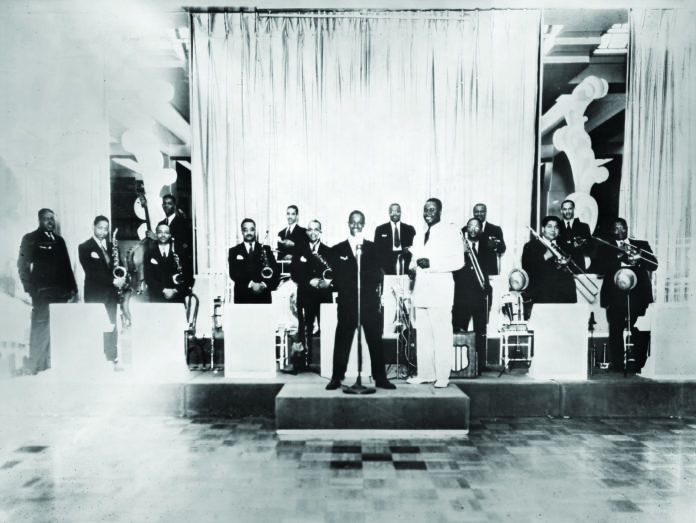
Image cutline: Pictured is the group talent scout John Hammond and agent Willard Alexander heard circa 1940. Photo courtesy the University of Oklahoma Press
After hosting a successful Professional Golfers Association (PGA) Championship, Oklahoma golf is hitting a high, but for reasons one might not expect. One of the most influential factors in the rise of golf participants across the state is the COVID-19 pandemic.
“It’s always great to conduct PGA championship or any major championships in the state, especially here at Southern Hills, and it certainly lends itself to an increasing [number] of participants in the game,” says Nicholas Sidorakis, general manager and chief operating officer of Tulsa’s Southern Hills Country Club. “But COVID forced everyone outside.”
Sidorakis estimates golf participation has increased 15-20% nationwide since the pandemic, primarily in women and children, due to a high volume of indoor activities closing.
Women in Golf
If you are a woman looking for resources, check with your local course for women’s leagues, classes and groups. In addition, the Women’s Oklahoma Golf Association (WOGA) is a nonprofit organization with a mission of “promoting the game of golf for women and junior girls in Oklahoma.” According to its website, benefits of membership include: supporting junior girls’ golf with a portion of annual dues, eligibility to participate in all WOGA events, experiencing tournament golf at premiere venues, competing with other women golfers of similar skill and more.
Children in Golf
As for children and youth, there are programs across the state that introduce life skills through the game of golf. First Tee is a program sponsored by Southern Hills, offering “over 8,500 kids the opportunity to play golf and gain life lessons,” says Sidorakis, adding the program is free of charge and located at Mohawk Park.
Greater Accessibility
First Tee and programs like it are making golf more accessible, welcoming to every person, regardless of socioeconomic background.
“One of the biggest misconceptions is that golf is a game for the elite, only for the country club people, and that’s certainly not the case,” says Aaron Kristopeit, director of golf at OKC’s Lincoln Park Golf Course. Lincoln Park is owned by the city of Oklahoma City and attracts all walks of life to the green.
“Some of the stereotypical norms are loosening in a way that allows other people to come into the game,” says Kristopeit, highlighting a more inviting culture in the sport over generations. “Hooded sweatshirts were kind of a faux pas in the past, but now PGA tour players are wearing them, showing people the game has become more casual.”
Though Kristopeit acknowledges that golf is not the cheapest sport, he urges people interested in playing to not let finances prevent them from getting into the game. He advises to buy used golf clubs, to play on municipal courses and to check for discounted playing times.
Etiquette & Opportunities
Whether you are an experienced or novice golfer, etiquette is important to learn before you take to the green. Both Sidorakis and Kristopeit echo the sentiment. Players need to be mindful of pace of play, allowing faster players the chance to move forward.
Sidorakis says the most important thing for any golfer at any level is to play consistently.
“Get a net and carpet and practice putting in the garage,” he says.
Regardless of weather, Oklahoma has golfing opportunities galore. Businesses like Flying Tee and mini golf courses are a great way to have family fun while practicing golf techniques in climate controlled spaces.
“I’ve had people play here at Lincoln, carrying their own bag, at 92. You can play your entire life,” says Kristopeit. “Golf is a game of a lifetime.”
Image cutline: In recent years, the rise in golf’s popularity has led to greater accessibility around the state. Photo by Andy Johnson courtesy Southern Hills
The wedding world continues to evolve, with new trends, innovations and creations making people’s special days even more jaw dropping. In the wedding guide, we present helpful info on nuptial etiquette, planning, timelines and more.
By Mary Willa Allen
Popular Dates
You’ll likely notice your fridge is extra full of wedding invitations during certain months of the year. The following are 2023’s most popular wedding dates, in order:
September 23
October 7
October 14
May 20
October 20
Also, look out for three-day weekends: Memorial Day, Fourth of July and Labor Day are among the most popular times to schedule a celebration.
Venue 101
Perhaps the most important element to have nailed down early during your wedding planning is your venue choice. Unless you’ve found a hybrid indoor-outdoor venue, you’ll likely be choosing one or the other. Pros and cons exist for both.
Indoor venues offer a bevy of pros:
Security; you don’t need a back-up plan in case of bad weather.
Comfort; you won’t have to battle the elements, like a chill, humidity or pesky mosquitoes.
Noise; you don’t need to worry about noise ordinances if you’re inside a private venue.
But a few cons exist:
Limited space; ensure you aren’t going over your allotted quota of guests.
Higher demand; most people opt for indoor venues out of convenience, so you’ll have to battle others for the date you desire.
More rules; if you book an indoor venue, you’ll likely have more regulations to follow to ensure the space isn’t damaged.
Pros of an outdoor venue:
More space; no cramped guests here! People can spread out and enjoy the great outdoors.
More freedom; with an outdoor space, there will likely be less rules and penalties re: damage.
Better visuals/lighting; nature can do a lot of the aesthetic work for you.
Cons of an outdoor venue:
Less security; whether you’re stressed out about a potential rainstorm or wedding crashers, outdoor venues offer a little less stability.
The elements; aside from weather issues, critters could play a potentially major role in your day depending on where your outdoor venue is.
No grand entrance; if your wedding is outside, people will be able to see everything you’re doing behind the scenes. If you want that dramatic entrance, consider an indoor venue.
A Quick Timeline
You nailed down your engagement; now it’s time to start planning! Here are a few rules of thumb as it pertains to time management.
A year or more out:
Book your venue
Book your caterer
Determine and finalize your budget
Make your guest list
If you want one, hire a wedding planner
10-11 months out:
Hire in-demand vendors, like photographers, videographers, DJs, bands, make-up artists, etc.
Take your engagement photos
Create your wedding website and ensure all relevant info is included
Secure hotel room blocks for guests
8-9 months out:
Send save-the-dates
Purchase your wedding dress
Confirm (and promote) your registry
Meet with potential florists
6-7 months out:
Confirm your rehearsal dinner venue
Hire ceremony musicians
Hire or choose your officiant
Confirm your florist
4-5 months out:
Get the groom and groomsmen’ tuxedos
Book the honeymoon
Confirm transportation for guests and you and your spouse
Finalize your cake
Schedule make-up and hair trials
2-3 months out:
Send out invitations to the wedding and rehearsal dinner
Write your vows
Plan the elements of your goodie bags
Make your wedding playlists
1 month or less out:
Do final venue walk-throughs
Do final dress fittings
Perform general aesthetic maintenance – hair, nails, tans, massages, etc.
Make all final vendor payments
Trend Forecasts
It’s no secret that each new year brings with it a handful of wedding trends on the rise. While some will never go out of style, others are ephemeral. We explore a few.
Popular 2023 color schemes:
Emerald and sage green
Lavender
Dusty rose
Blush pink
Earth tones and neutrals
Hot wedding dress trends:
3D floral elements
Bows
Off-the-shoulder dresses
Pops of color
Transparent sections (on sleeves or sections of the dress)
Capes
Mini dresses for the reception
In-demand florals:
Unique bouquets with less greenery
Floral arches and aisle accessories
Single flower varieties used en masse
Dramatic floral installations in the reception
More living plants (think potted plants instead of bouquets)
General trends:
Wedding maximalism – the more the better!
Private last dances
More pops of color just about everywhere, from flowers to dresses and table settings
Statement aisles
Wedding Party: To Do and Not To Do
One of the most important parts of your wedding is sharing the day with your friends/family members in the wedding party. Of course they’re excited to celebrate you, but what’s appropriate and not appropriate to ask your party to do for you throughout the process? A few do’s and don’t include:
Do expect them to show up to major milestone moments of your wedding journey – like the wedding itself (obviously), the rehearsal dinner, bachelor/bachelorette parties and (ONE) bridal shower.
Don’t expect them to come to every single wedding-related event, like dress fittings or vendor appointments.
Do feel free to ask them for advice on wedding elements.
Don’t expect them to have nuanced opinions on every portion of your wedding – they have lives, too!
Do ask them for small favors in the weeks/days leading up to your wedding, like coffee runs or floral pick-ups.
Don’t expect them to be your personal assistants and run a bevy of errands for you in their limited free time.
Do ask them to look their best on your wedding day.
Don’t expect them to spend unnecessary money to do so, like fake tans, professional make-up and hair, or over-the-top shoes, bags or jewelry – unless you’re willing to foot the bill.
Favors People Will Actually Like
Wedding favors often take up a big chunk of the budget but don’t get a lot of use. What are some favors that will give you bang for your buck? We offer a few suggestions:
His and hers candy
Coasters
Olive oil
Coffee or tea
Custom playing cards
Custom candles
How to Incorporate Children
If you have kids, nieces, nephews or other beloved kiddos coming to your wedding, how can you incorporate them into the ceremony or make them feel included?
Appoint them as flower girls or ring bearers
Give them ‘day-of’ gifts
If they’re a bit older, let them do a short speech at the rehearsal dinner or reception
Include them in the ‘first look’ if you choose to have one
Add them to your wedding party
Cake & Floral 101
Some of the most fun you’ll have when wedding planning will revolve around cake tastings and floral appointments. But how can you get started?
Cakes
First, you’ll want to do a bit of research on bakers in your area. Confirm good reviews, what kind of flavors and fillings they offer, general prices and their portfolio. Other logistics to confirm are how far in advance you need to order, how much a tasting will be, deposit necessities and how big of a cake you’ll need.
Second, visit for a tasting. You’ll have endless combinations to try – a few popular ones include vanilla, buttercream and raspberry; red velvet and cream cheese; lemon, vanilla and butter cream; and carrot, cream cheese and candied pecans.
Third, confirm the style of your wedding cake. How many tiers do you want? How about floral accents or fruit? After you’ve decided on all of these goodies, place your order.
Florals
Much like cakes, you’ll want to do research into potential florists before making a consultation. Have your budget and general needs ready to go. Additionally, have style ideas at the ready, as well as preferred blooms and your ideal color palette.
At the consultation, confirm availability, price, delivery fees and general timelines. Bring mood boards for inspiration. Remember that your florals aren’t just bouquets – there are also boutonnieres, centerpieces, arches, aisle/ceremony decor and corsages. Plan accordingly!
Speech Etiquette
If you’re a person with passionate or outgoing friends and family, it’s only a matter of time before they ask when, exactly, they’re giving their speech for your wedding. But before you’re handed the mic, remember some speech etiquette.
When is it appropriate to give a speech?
Bottom line: it’s only appropriate to give a speech if you’re asked to give one. Don’t attempt to weasel your way to the microphone if you’re not given express permission to do so. The only other time it’s appropriate is if the couple opens up the mic to anyone.
Who should be expected to give a speech, and at which event?
The simple answer is that the bride and groom get to decide that on their own. But tradition dictates that parents and the maid of honor/best man speak at the wedding reception, while other special members of the wedding party/family speak at the rehearsal dinner.
How long should you keep your speech?
The sweet spot for toasts is around 3-5 minutes. You want to have enough time to include tear-jerking memories, sentimental anecdotes or jokes, but not so long that you start to lose your audience.
What is appropriate to mention in your speech?
Do mention: Great memories, compliments, and bride-and-groom-approved jokes or subject matter.
Don’t mention: Any problems you have with the couple, not-safe-for-work memories, any mention of exes, or politics. Profanity is a maybe – but remember who’s in the audience! ■
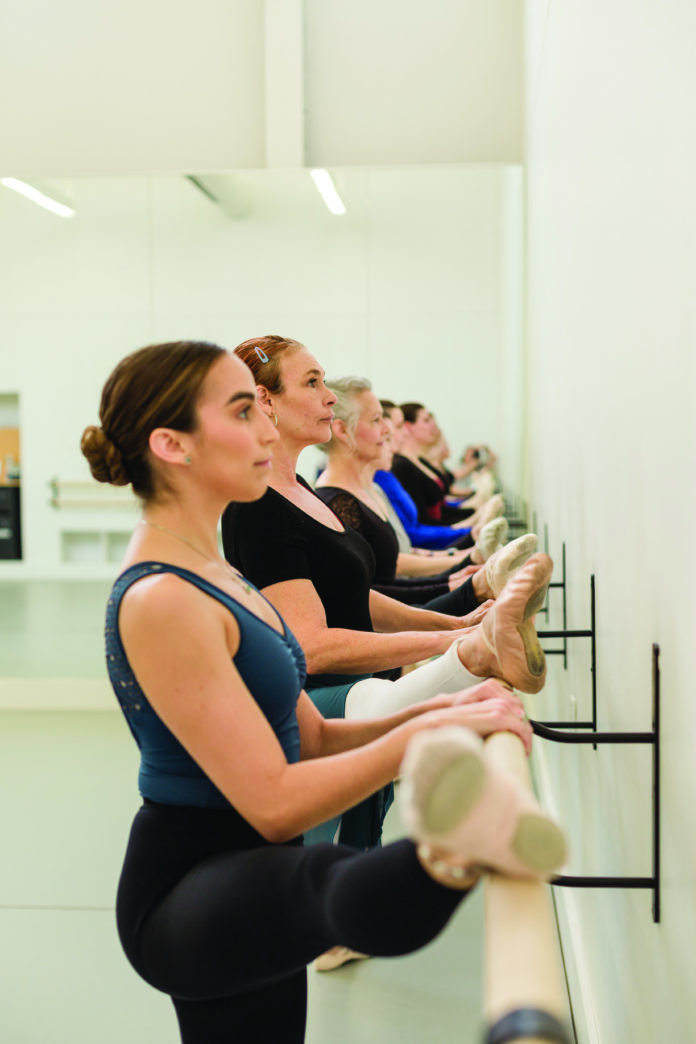
Ballet lessons for children are fairly routine, and many take a visit to a performing arts center to see professional companies perform. But increasingly, more adults are recognizing the benefits of the practice of ballet as novices.
Arlene Minkhorst, director of education for the Tulsa Ballet Center for Dance Education, says people come to adult classes from various age groups, health levels and experience backgrounds.
“I think people are beginning to understand that it’s not too late to start dance at an older age,” she says. People may think they have to be young and look like a conventional ballet dancer to dance. But you don’t – you just have to want to come in and move.
The benefits of ballet classes for adults are vast, going beyond the most obvious of general exercise. Balance, stability and an improvement in posture top the list of benefits for Macaira Pinto, school administrator for the Yvonne Chouteau School of Oklahoma City Ballet.
“Ballet combinations are not designed to be overly physical or aerobic. They are working small muscle groups that you didn’t know you owned until you get up the next morning,” she says with a laugh.
Practicing dance can also improve focus and may ultimately help in fighting off cognitive sluggishness as you age, as the art form requires the use of body and mind in coordination. Pinto also mentions the release of endorphins that happens when a person exercises.
“You’re going to walk out of ballet class happy, even if you don’t know why,” she says.
But starting a ballet class as an adult can be intimidating. Those who are brave enough to try can expect to start with the very basics of foot and arm positions, and to work on holding the body in a proper posture. The teachers will be patient, and excited to answer questions and make modifications to movements for all ability levels. Ballet footwear will be required, but clothing can usually be anything comfortable.
Ultimately, it comes down to taking the plunge.
“Somebody just has to come with an open mind and as little apprehension as they can manage. And just do it for themselves,” says Minkhorst.
If they give it a shot, they just may find the answer to why dance is an important part of culture and an enduring form of expression.
“Dance can be done by everyone – from the baby that starts swaying in front of the television to the 100-year-old that is tapping his foot to the beat,” says Pinto. “Inherently, we have a joy within ourselves when we dance, so it keeps human beings emotional, it keeps them moving, it keeps them expressing, it keeps them joyful.”
Ballet 101
Though no experience is required for most beginning ballet classes for adults, it can help to know some of the terminology – much of which is in French.
Turn out: Rotating the feet out from the hip socket
Plié: Bending the knees while the feet are turned out from the hip
Tendu: To stretch; it involves a movement wherein one foot slides across the floor with the toes touching the floor, then returns.
Relevé: Starting in a plié position and rising up
Rond de jambe: A circular movement of the leg
Dégagé: Pointing the foot
Looking for a class? Both OKC and Tulsa Ballet schools offer options. If these are not convenient, check with your local ballet school. If they don’t offer a class for adults, consider gathering a few friends and asking for a private class. Some schools may even offer “open” classes for anyone to try out – children and adults alike.
Image cutline: Tulsa Ballet adult classes welcome dancers of all experience backgrounds and fitness levels. Photo by Jessie Kenney of Juneberry Photo
As far as stage musicals go, The Lion King is the highest-grossing Broadway show of all time, and the North American tour returns to the Tulsa PAC courtesy Celebrity Attractions from June 1-17.
Michael Reilly, the puppet supervisor for the show, always knew he wanted to work with his hands. Taking classes at a technical school, he studied a variety of subjects, including woodworking and automobile repair.
“I kind of fell into theater,” he says. “As I went along, it became more and more technical.”
He worked on The Lord of the Rings musical – a show that only ran for a year on London’s West End – as the sword and armor prop master.
“I’ll tell you this, it was great and it was terrible,” he says with a laugh.
As puppets eventually came into regular play in the theatre world, Reilly found his niche. He began working on The Lion King in Canada in 1999 and moved to the American tour in 2006, where he’s been ever since.
Nick LaMedica, the actor behind the beloved hornbill bird character, Zazu, got his start early. After seeing his first Broadway show, Jekyll & Hyde, LaMedica waited for lead actor Robert Cuccioli to come out back; he then asked Cuccioli how to get into the field.
“He gave me really practical advice,” says LaMedica. “Take dances class, join chorus, take singing lessons, learn to play the piano. I came home from New York and started doing all of those things.”
Although initially overwhelmed by stage fright, LaMedica eventually took a shine to the art form in high school. Puppetry came later with his first big professional job working on the 2011 film War Horse.
“Since then, I’ve ended up doing a lot more puppetry,” he says.
The pre-show prep work for both Reilly and LaMedica is hefty. There are 230 puppets, and Reilly looks over all the principal players each morning. On a weekly basis, he looks through every other puppet.
Michael Reilly, the puppet supervisor for The Lion King, has been involved with the production since 1999; photo by Selena Moshell courtesy Celebrity Attractions Featured image: Nick LaMedica, the actor behind Zazu, got into puppetry around 2011 and has remained active ever since; photo by Matthew Murphy courtesy Disney/Celebrity Attractions
“My philosophy is if we do our job correctly during the morning and afternoon, the show goes much smoother at night,” he says.
LaMedica does his vocal warm-ups before coming to the theater and then spends 45 minutes in the makeup chair.
“It’s wonderful because I get to have such a great relationship with the makeup artists,” he says. “It’s like a relationship you’d have with your barber, but it’s every single day.”
Working with puppets lends itself to a few risks. During a previous The Lion King stint in Oklahoma, an elephant puppet snapped a leg, and there were no spares. After calling around to aluminum shops, Reilly convinced one to sell him a 24-foot piece, cut into fourths.
“I came back to the shop, bent it, and with ten minutes to spare, I got that thing back on the elephant and down the aisle,” recalls Reilly. “It was a tough day!”
For LaMedica, working on The Lion King truly is his most prized theatrical memory.
“To have the first piece of theater I do out of the pandemic be the world’s No. 1 musical, that’s been seen by millions of people … if I woke up tomorrow and this was all a dream, that would seem completely reasonable.”
Hunting wild game has evolved from an ancient tradition to the formal process it is today, replete with licenses, formalized hunting seasons and more than one hundred legal hunt sites in Oklahoma alone.
To be legal to hunt, licensing depends on the season, resident status and age of the hunter, says Kelly Adams, the Oklahoma Department of Wildlife Conservation’s communications and education supervisor.
The most popular hunting season is the deer gun season, which opens the Saturday before Thanksgiving and runs for sixteen days.
The types of prey most readily available in Oklahoma include deer, elk, antelope, bear, turkey, dove, crow, woodcock, gallinule, various waterfowl, squirrel, rabbit, quail, pheasant, coyote “and other various fur-bearers,” says Adams. “Some species are more abundant than others and some are only regionally abundant.”
Both experienced hunters and those new to the sport should be concerned with what makes for good hunting weather – and what kind of weather is best for just staying home.
“It depends on the hunter’s skill, the species they’re hunting and the method of hunting,” explains Adams. “For example, extremely windy days are hard to hunt, but especially difficult for archery hunters.”
When it comes to the do’s and don’ts of hunting apparel, weaponry choices, and even how much noise to make during a hunt, Adams suggests educating oneself on how each specific season of hunting has different requirements.
For example, “turkey hunters should not wear red, white or blue,” she says. Not for patriotic reasons, but because “red is the color most hunters count on to differentiate a gobbler’s head from the hen’s blue-colored head.”
Want to be effective in time spent hunting? Check out the territory you’re in carefully before you start.
“Scouting is the single most important thing a hunter can do to ensure success,” says Adams. “Being properly licensed and familiar with the rules and regulations is important. If hunting alone, make sure to tell somewhere where you’ll be.”
To learn more about the state’s hunting seasons, visit wildlifedepartment.com.
Gun Safety 101
• Be sure the gun is safe to operate. Use only the correct ammunition for your gun.
• Wear eye and ear protection as appropriate.
• Never drink alcohol or use over-the-counter/prescription drugs before or while shooting.
• Store guns so they are not accessible to unauthorized persons.
• Understand that falls tend to be the most common cause of injuries.
• Always check equipment and stands, and use safety belts to prevent falls.
• Avoid permanent tree stands, as they are more likely to deteriorate.
• Treat every firearm as if it is loaded. Place your finger on the trigger only when you’re ready to shoot.
• Always control the muzzle. Keep your muzzle pointed in a safe direction, and remember that wherever the muzzle points is in the cross hairs. Don’t overlook the possibility of a ricochet.
• Be sure of your target. You’re responsible for knowing what’s in front of your target, near your target and beyond your target. If you aren’t certain about any of the three, don’t take the shot.
Courtesy: The Mayo Clinic Health System and the Firearm Industry Trade Association
Image cutline: Oklahoma has a wide range of hunting seasons throughout the year, with popular prey like deer, elk, turkey and dove. Photo courtesy the Oklahoma Department of Wildlife Conservation
Some people see an empty wall – others see a blank canvas for art that is larger than life. Murals not only enhance an area’s curb appeal, but also represent Oklahoma’s rich culture and diverse communities.
The following is a listing of a few of these murals around Oklahoma – chock-full of symbolism, bold patterns and even historical references.
This Land Mural
By: Rick Sinnett
200 S.E. Fourth St., OKC
Driven by the idea of creating art for the people, Rick Sinnett, a self-taught artist from Mustang, took on one of the most ambitious projects of his career: beautifying Oklahoma City’s grain silos along Route 66. The This Land Mural, which originated from a Kickstarter campaign, took Sinnett three years to complete.
The 100’ by 128’ mural depicts many Oklahoma state symbols, including a bison and scissortail flycatcher, in Sinnett’s signature vibrant, geometric style.
Yukon’s Best
By: Carlos Barboza
220 W. Main, Yukon
Carlos Barboza, a muralist of Costa Rican descent, has left his mark on many buildings throughout Oklahoma. In Yukon’s Best, he pays homage to the place he grew up. With a penchant for portraiture, Barboza covered the exterior of Yukon’s Best Flour Mill in black-and-white, photo realistic renderings of Garth Brooks and the mill’s former mascot, the Czech Queen. The mural has other hidden details, like an excerpt from a 1906 postcard and Yukon High School’s mascot, the Original Miller.
Connected Pathways
By: Nanibah Chacon
533 South Peoria Ave., Tulsa
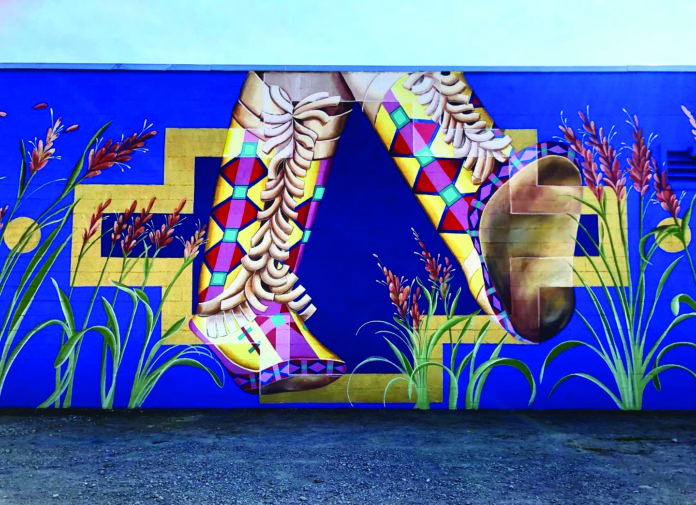
Painted against a bright blue background, the Connected Pathways mural comes alive in movement and dance with three pairs of decorated moccasins. Located next to the Indian Health Clinic in Tulsa, the 110-foot mural is a nod to the Native American communities in the area. Nanibah Chacon, a Diné and Chicano artist, based the design on pairs of ceremonial moccasins that belong to Indigenous women from Tulsa.
Loading Mural
By: Kristopher Kanaly
116 N. Main St., Miami
Kris Kanaly, an award-winning artist and founder of the Oklahoma Mural Syndicate, transformed the side of the Main Attraction Beauty Academy in Miami, Oklahoma, with one of his colorful designs.
The Loading Mural includes ultra-flat abstractions of terracotta buildings, as well as cacti and outdoor landscapes. His murals, which can be found throughout Oklahoma, center on otherworldly themes of time, space and travel.
Wildflower Butterfly Mural
By: Rhiana Deck
406 Flynn St., Alva
Monarch butterflies flutter over clusters of Indian Blankets in the Wildflower Butterfly Mural by Rhiana Deck, an Oklahoma City artist. Although it may appear to be a simple design, the clusters of flowers and butterflies form the shape of a larger butterfly when viewed from a distance. Deck painted the mural on the Cushenberry building while participating in the 2022 Northwest Mural Fest, sponsored by the Alva Mural Society.
Building the City of Legends
By: Palmer Studios
323 S. Dewey Ave., Bartlesville
Building the City of Legends, located on the Southern Abstract building in Bartlesville, recounts the town’s unique history as Oklahoma’s first oil boomtown.
Spearheaded as a community project by the Leadership Bartlesville Class XX, the mural comprises three distinct panels that depict historical events spanning from 1880 to 1929. Artist Bob Palmer, who owns Palmer Studios, drew his inspiration from hundreds of historical images provided by the Bartlesville Area History Museum and the Bartlesville Public Library.
Image cutline: Connected Pathways by Nanibah Chacon showcases three pairs of decorated Native American moccasins. Photo/art by Nanibah Chacon
Did you know Oklahoma is ranked eighth in the nation for most convenient camping states? Oklahomans seem to enjoy camping more than the average American – and for good reason; we have some of the country’s most diverse ecoregions.
In addition to the Great Plains, campers can enjoy four mountain ranges, large and lush forests, and even swamps. The state also has more dam-created lakes than any other state in the nation.
Some of the state’s most popular park sites include Lake Texoma in Kingston, Robbers Cave in Wilburton, Beavers Bend in Broken Bow, Greenleaf in Braggs, Black Mesa in Kenton, and the Chickasaw National Recreation Area in Sulphur, among a large handful others.
An often overlooked gem of the Oklahoma camping ecosystem is Alabaster Caverns State Park in Freedom. Some highlights of Alabaster Caverns include a 50-foot-tall main cavern which spans nearly a mile, plus several natural bridges, varieties of bat species, RV camping near the caves, or unique camping in a cavern with a waterfall (which includes raised sleeping platforms).
Chase Horn, director of communications for the Oklahoma Tourism and Recreation Department, has an exciting announcement for Okie campers: just in time for summer, La Ratatouille, an Oklahoma based company that owns and operates Falcone’s Pizzeria and Joni’s Cakes Bakery, will be operating newly refreshed and upgraded food service operations at six Oklahoma state parks. La Ratatouille has served the OKC Thunder, the Zoo Amphitheater and other notable businesses in the state. Owner and operator JP Wilson grew up in Oklahoma and has numerous childhood memories enjoying the state park systems.
“We are excited to partner with the Oklahoma Tourism and Recreation Department to provide restaurant services,” says Wilson. “The current facilities at these parks are top notch, and we are honored to be trusted with the responsibility of bringing a first-class dining experience to Oklahomans and park visitors from across the country.”
The parks served include Lake Murray in Ardmore, Quartz Mountain in Lone Wolf, Roman Nose State Park in Watonga, Sequoyah State Park in Hulbert, as well as Beavers Bend and Robbers Cave.
Camp Smart
If you’re planning to camp this summer, it’s essential to know the amenities and services available at or near your campsite. Bring plenty of food and drinking water – especially in summer months – and have a first aid kit on hand. You’ll also want to know how to properly make and extinguish a fire, and you should check with your mobile phone provider to determine if you’ll have coverage in that area.
If you plan to build a fire, you’ll discover that most campgrounds in Oklahoma have both small charcoal grills and fire rings available. You should check with park staff before gathering wood from the surrounding area. Also be mindful of local burn bans before lighting a campfire.
Many of Oklahoma’s camping sites are first come, first served, so arriving early is a great best practice.
The most important philosophy of camping can be summed up in the phrase, “Leave no trace.” Be mindful of protecting Oklahoma’s beautiful local ecosystems and ensure that these sites are available for future generations.
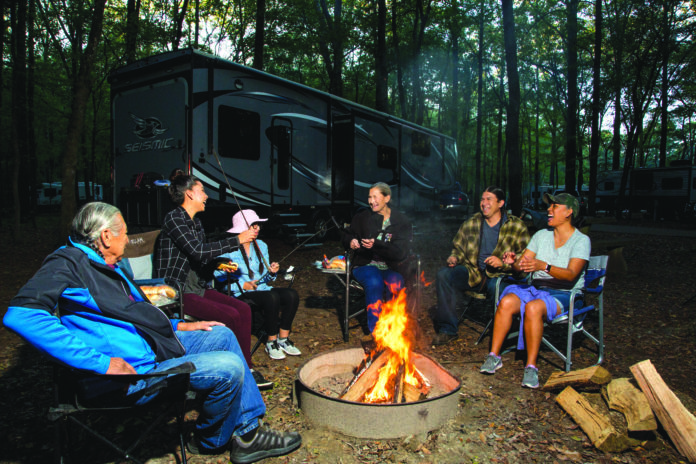
Image cutline: Oklahoma harbors a vast array of well-preserved camping spots, including Beavers Bend State Park in Broken Bow. Photo courtesy Lori Duckworth/Oklahoma Tourism