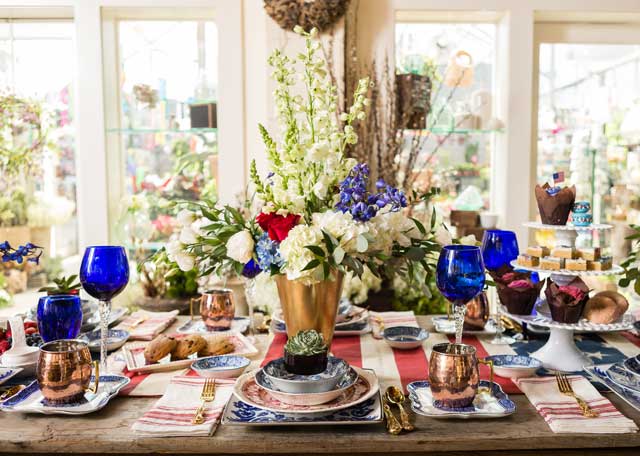
Photo by Chris Humphrey Photographer Setting by Ted and Debbie’s Flower Garden.
Photo by Chris Humphrey Photographer. Setting by Ted and Debbie’s Flower Garden.
[dropcap]The[/dropcap] pinnacle of summer in Oklahoma is the Fourth of July. Every family has unique traditions, and there are plenty of ways to celebrate in style. Go beyond the customary patriotic decor and spice up your holiday with distinctive furnishings that will add a pop to your party.
Debbie Willson of Ted and Debbie’s Flower Garden in Tulsa knows the key to a festive Fourth of July gathering: a creative table setting.
“My family has so much fun with this holiday,” she says. “My daughter Olivia was instrumental in getting the table setting together. We used white hydrangeas and blue delphinium, and since we were thinking about our freedoms in this country, we used freedom roses. We pulled out old plates, red and white napkins and copper cups, too,” she says.
And if you’re looking to host a patriotic party this summer, Willson has some tips to keep your ambiance original.
“I think it’s important not to be too ‘cutesie,’” she says. “You don’t have to use those cheesy bright reds. Silver and gold seem to work well, too.”
[dropcap]For[/dropcap] many years now, whenever I’ve gotten the itch to add to my collection of autographed baseball and football cards, I’ve usually wound up at S&S Sports Cards in Broken Arrow, where the exceptionally knowledgeable young man known by patrons as Tattoo has been an affable source of guidance.
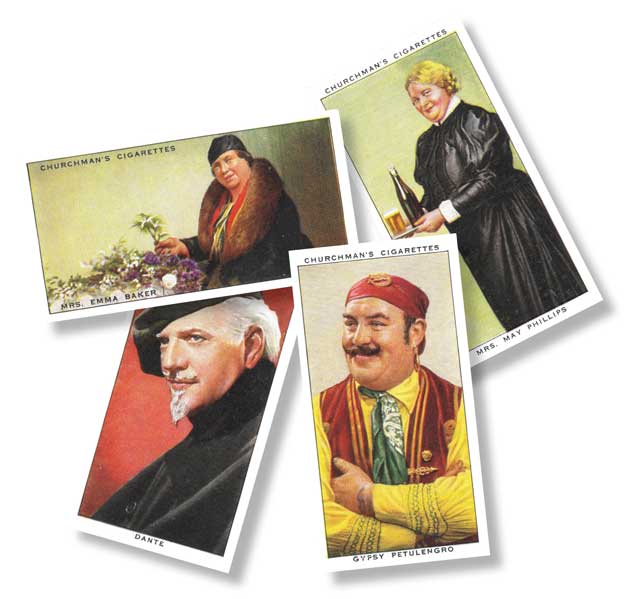
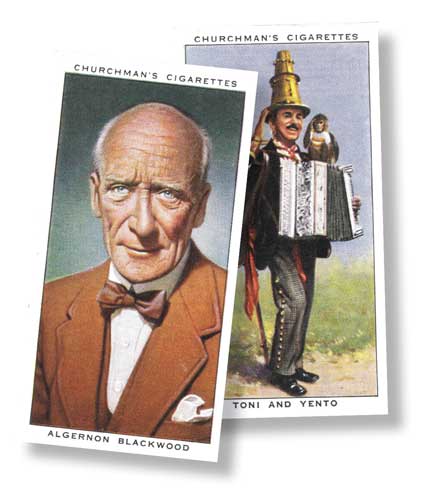
A while ago, however, while I was nosing around there, something caught my eye that had to do with neither baseball nor football nor autographs. Back on one of the store’s tables, encased in plastic sleeves, was a set of color cards called collectively In Town To-Night, with each card measuring roughly 2 ¾ inches by 1 ½ inches and depicting one of a variety of Britishers from a bygone era. Recognizing a couple of the folks depicted, like famed ghost-story writer Algernon Blackwood and Dante the Magician, who’d co-starred with Laurel and Hardy in the 1942 feature A-Haunting We Will Go, I gave the 50-card collection a closer look, saw that the price was right and took it home for further study.
I knew a little about cigarette cards; most baseball-memorabilia collectors do, thanks in part to the hoopla surrounding American Tobacco Company’s Honus Wagner card from the early 20th century. Part of a set of major-leaguers, the card was withdrawn after Wagner, star shortstop of the Pittsburgh Pirates, objected because he didn’t want kids buying cigarettes in order to get it.
By the time the Wagner card first came out in 1909, tobacco companies had been inserting these little tchotchkes in their cigarette packages for a couple of decades, not only to provide extra impetus for purchasing a particular brand, but also to stiffen the packaging. In addition to baseball players, subjects included movie stars, plants and animals, military heroes, and American Indian chiefs, among many others.
And then there was the collection of souls from In Town To-Night. In addition to Blackwood and Dante, both pretty famous guys in their time, those immortalized on cardboard by Britain’s Churchman’s Cigarettes included Mrs. May Phillips, “The Perfect Barmaid” (“Having been a barmaid in various parts of London for over thirty-five years, her tales of days gone by, when barmaids had to endure long and trying hours and were treated little better than dirt, contrast vividly with present-day conditions”); Gypsy Petulengro, “Astrologer and Palmist,” a man who “has read the hands of most of the European monarchy”; Miss May Storey, “Woman Detective” (“[N]ot only is she engaged in detecting shoplifters, but has to shadow people of every type, from dope pedlers to confidence tricksters, and from blackmailers to missing heirs.”); and Toni and Yento, “One-Man Band,” a musician and his monkey “well known in London, at the seaside, and on racecourses.” There’s even one of Mrs. Emma Baker, a woman who’d been selling flowers at Piccadilly Circus for the preceding 28 years.
[pullquote]I’m afraid, as a society, we just don’t find any regular folks very “interesting” any more.[/pullquote]These and the others depicted on this 1938 tobacco-card set all had one thing in common: They’d appeared on the BBC’s Saturday night radio program In Town To-Night, a talk show that had begun in 1933 and would continue until 1960, always introduced by an announcer saying, “Once more we stop the mighty roar of London’s traffic and, from the great crowds, we bring you some of the interesting people who have come by land, sea and air to be In Town To-Night!” Judging from the set, these “interesting people” included, but were not limited to, street entertainers, fruitiers, pilots, synagogue readers, butlers, photographers, explorers, booksellers, artists and plumbers – with those profiled earlier, an egalitarian assemblage if there ever was one.
As I spent some time with photos and profiles of these long-deceased people who did a radio show in London back before most of us were born, I found myself thinking not so much about how remarkable it was that this set of cards printed nearly 80 years ago made it across the Atlantic to land in a ballcard shop in Oklahoma, but how exactly our popular culture got from a talk show featuring “interesting people” from everyday life to the Kardashians and Naked and Afraid.
Don’t get me wrong. I’m no dewy-eyed nostalgiac, pining for a time when things were simpler and easier and lovelier. When those cards came out, the unspeakable horrors of World War II were on the horizon; social, racial and sexual inequality ran rampant; and people were dying en masse of diseases that are now either eradicated or treatable. Even the substance that brought the cards into existence, tobacco, has now been seen for the health menace it represents.
But there’s something here that goes deeper, right to our collective soul. I’m afraid, as a society, we just don’t find any regular folks very “interesting” any more. As is the case with many of us old poops who didn’t grow up with the internet, I have a tendency to lay part of it off on electronic media. Because I came of age in the ‘60s, I also have a tendency to blame disco. Seriously.
Photo courtesy Joey Hambrick.
In the mid-’70s, when the discotheque culture started creeping into Oklahoma, many of my live-music-loving friends and I saw it as a menace, since to a great extent the discos replaced onstage bands with recorded music. I didn’t fully realize why I was anti-disco until many years later, when I taught a college class on the history of rock ‘n’ roll. In our textbook, Rockin’in Time, Casablanca Records president Neil Bogart characterized disco patrons as people “tired of guitarists playing to their amplifiers. They wanted to be the stars.”
Added author David Z. Szatmary, “Disco, unlike most rock-and-roll, allowed the participants to assume primary importance. Not involving musicians standing on the stage, it centered on the audience.”
In other words, the musicians simply weren’t as “interesting” to those who came to the club as they themselves were.
Disco became the perfect soundtrack for the Me Decade, as the 1970s have often been dubbed, and it marked the beginning of a cultural shift in our entertainment and in our lives. Flash-forward to now, when the noise of democracy has become, too often, the sinister silence of a “send” button, electronically whisking anything we want to say to an uncountable audience. Too often others, especially those with whom we disagree, are seen only as ciphers, not as human beings, never mind “interesting” ones. Of course, the fact that so many online comments are made under pseudonyms doesn’t help put a face on anybody.
At the same time, what entertains us when we’re not aggrandizing ourselves must become baser and more exploitative, if only to drag our rapt attention away from ourselves. Don’t get me wrong: I’ve long loved alternative culture. But it’s only “alternative” when there’s a mainstream culture to play against it. Look around and see what’s become “mainstream,’’ in our entertainment and in our politics. How long do you suppose one of the people depicted on the In Town To-Night set would last in 2016 America before his or her head exploded?
Although he’s not well-known today, the pianist and wit Oscar Levant had a long run as an American entertainer. In his introduction to Levant’s 1940 book A Smattering of Ignorance, playwright S.N. Behrman recalls his astonishment when Levant met up with a longtime enemy and the two were nothing but cordial. When Behrman asked him about it, Levant said, “Well, you know I hate ‘em until they say hello to me.”
Nothing beats face-to-face kindness and human interaction. And sometimes, nothing’s kinder and more interactive than interest in another person’s story. That’s one thing that hasn’t changed since InTown To-Night had its nice long run, simply by putting “interesting” people on the air.
[dropcap]Summertime[/dropcap] in Oklahoma means the lakes are filled with people casting a line, zipping by on jet skis and bobbing around on inner tubes. Now another warm-weather activity is emerging – one that may initially seem more at home on saltier waters.
“Wakesurfing is basically using a surfboard similar to those used in the ocean but a little smaller,” says Craig Warnock, an avid wakesurfer. “You’re not being pulled by the boat like wakeboarding but riding the wave once you get pulled up. Wakesurfing gives you more of a free feeling.”
As a slower-paced alternative to wakeboarding, wakesurfing is gaining traction with lake-goers who want to be active without the physical wear and tear.
“My body wouldn’t allow me to wakeboard anymore,” Warnock explains. “I had a friend who introduced me to wakesurfing, which was a lot easier on my body and a lot more fun. With wakeboarding, you are traveling at speeds from 20 to 23 miles per hour and wakesurfing, depending on the boat, you are traveling 9 to 11 miles per hour. [You] don’t take the falls like you do in wakeboarding.”
Wakesurfing is also easier to learn, making it appealing to people of all ages and skill levels.
“It doesn’t take too long to get up, but it takes longer to find the sweet spot to be able to stay behind the boat without the rope,” he says. “It really depends on the individual, but it’s not nearly as hard as you would think to pick up. My 7 year old picked it up in one summer. By the end of summer, she was surfing better than most without the rope. I have my 74-year-old father surfing as well. It took him a few times, and by summer’s end, he was throwing the rope.”
The wakesurfing community is developing at Lake Skiatook through a group of pioneering families who fell in love with the pastime.
“We have a few excellent families that promote the sport with their children,” Warnock says. “They are able to promote the sport due to their passion, which enables them to teach the sport to new riders. We have a lot of people drive beside us just to watch my daughters ride, so there is definitely a curiosity.”
To get started, riders will need a surfboard that is suited to their body size and a boat equipped with a surf system. This summer, Warnock and the team at Cross Timbers Marina are offering Demo Days so people can test out boats and try wakesurfing. There will also be a nationwide event on July 24 called Pass the Handle where new people can give it a go.
“Wakesurfing is a great family sport and a fabulous way for everyone to bond,” says Warnock. “It helps keep the kids off of their electronic devices as well as them getting exercise. It teaches them about getting out and learning to respect one of Mother Nature’s greatest gifts to us. Also, it’s a fun way to meet new families and make friends on the water. Wakesurfing is making waterskiing and wakeboarding a thing of the past with its fast growing popularity.”
Dr. Anthony Marshall has been serving as faculty adviser for Booker T. Washington’s Men of Power since 2007. Photo by Janelle Acevedo.
Dr. Anthony Marshall has been serving as faculty adviser for Booker T. Washington’s Men of Power since 2007. Photo by Janelle Acevedo.
[dropcap]If[/dropcap] the youth are our future, then the future looks good at Booker T. Washington High School. That’s where you’ll meet the Men of Power – a group of African-American male students committed to academic excellence, community engagement and acting as positive role models to younger students. Spend time with them and you’ll be blown away at their drive to excel.
The Men of Power group has been going strong since the fall of 2007, when a group of five students came to their history teacher, Dr. Anthony Marshall, with a very real concern about how young African-American men are viewed by society. They asked Marshall to help them find a way to change the misperceptions many people have.
“We need to change the perception people have of African-American male students,” Marshall recalls them saying. “What can we do?” That first meeting led to the formation of the Men of Power. The group’s goal is to equip young men with the tools necessary for success in every way. “Whatever power within you is motivating you to excel, it’s about developing that power within you to excel,” says Marshall.
[pullquote]Students will rise to whatever level of expectations you set. I set my expectations high, and they exceed them.”[/pullquote]
The Men of Power group has grown exponentially since its inception. The group has more than 60 members, and they’re reaching out to other schools across the Tulsa metro – including Carver Middle School, which now has its own Men of Power program; KIPP Tulsa College Preparatory; and several elementary schools, where they help third-graders improve their reading scores. They also want to show fellow students that academic success leads to success in life, a mission that Mekhi Singleton, a Booker T. senior and the Men of Power’s vice president of recruitment, firmly believes in.
“Elementary and middle school kids look up to high school kids,” Singleton says, which is why he visits the elementary schools. He believes in being a positive role model who makes excellence in school, sports and volunteering “cool.” Fellow Men of Power member and student leader, Malik Thompson, is quick to agree. “It’s almost like a look into the future – everyone wants to be an NFL player, or NBA or a singer. Well, you get your foundation first.”
Singleton agrees. “We have to let younger kids know as soon as possible that you can’t go far without the fundamental things.” Ultimately, building that strong foundation depends on setting the standards high and refusing to quit.
“Students will rise to whatever level of expectations you set,” Dr. Marshall says. “I set my expectations high, and they exceed them.”
For the 2016-2017 school year, the Men of Power’s expectations are higher than ever. Over the summer, Dr. Marshall is moving from Booker T. to Washington D.C., where he will work at a school where the graduation rate is strikingly low and the need for a program like Men of Power is high. That means Booker T.’s Men of Power will be taking the lead without their founding faculty adviser.
But Singleton and Thompson are ready for the challenge. Their goals for the upcoming school year include bringing in at least 20 freshmen as new members. They also are excited about the Men of Power’s partnership with the Sigma Pi Phi fraternity, the nation’s first African-American Greek-lettered organization. They’re ready to continue working with local schools that need their leadership. And on a personal level, Singleton and Thompson both have plans to attend Howard University if all goes well.
It’s hard to imagine it would go otherwise. The Men of Power are nothing if not driven to be the best they can be. “As long as I can motivate these young men to reach their full potential,” Marshall says, “that’s what it’s all about.” And it’s clear that the Men of Power are just as motivated and destined for success.
Formerly the director of the Oklahoma City Bureau of Narcotics, Big Brothers Big Sisters of Oklahoma CEO Darrell Weaver believes mentoring children is the best way to deal with Oklahoma’s drug problem. Photo by Brent Fuchs
Formerly the director of the Oklahoma City Bureau of Narcotics, Big Brothers Big Sisters of Oklahoma CEO Darrell Weaver believes mentoring children is the best way to deal with Oklahoma’s drug problem. Photo by Brent Fuchs
[dropcap]Darrell[/dropcap] Weaver knows what the drug problem in Oklahoma looks like. He looked it in the face every day for more than 28 years as he fought back. But he shares how he never lost sight of the tragic loss of human capital – family loss – that each incarcerated individual represented. He described “watching kids sitting on couches while their mother and father are being handcuffed and taken to jail.” Weaver shared that roughly 75 to 85 percent of incarcerated individuals are involved in some kind of substance abuse issue.
“We’ve got a huge problem,” he says.
Weaver spent nearly three decades as a law enforcement officer, working his way up in the Oklahoma Bureau of Narcotics all the way to director in 2006. Shortly after taking on his role as director, Weaver started to have a shift in his perspective.
“We’ve got to do something preventative,” he says. “We’re not going to arrest our way out of this problem of drugs.”
He had started to realize what a generational issue drugs really were. “You arrested the grandfather, maybe the father, now the son’s doing it,” he says of the illegal drug business. He also recognized the influence parents have over the future choices of their children. “Kids with parents who are incarcerated are five times more likely to be incarcerated themselves,” Weaver says.
So a few years later, the Bureau of Narcotics, led by Weaver, began enhancing their education programs. He realized the importance of reaching kids at a young age and helping them realize they didn’t want to get involved with substance abuse. “We’ve got to keep them from these torments and this peril of drug abuse,” he says.
Then Weaver was introduced to Big Brothers Big Sisters of Oklahoma and the power of the one-on-one mentor relationship. As director of the Bureau of Narcotics, he was often asked how the generational drug problem in Oklahoma was going to be solved, and BBBSOK offered one big piece to that puzzle.
Big Brothers Big Sisters connects children in a community with carefully vetted adults who serve as one-on-one mentors. The national organization started in 1904. “We are really what we call the gold standard of mentoring,” Weaver says. He uses the term “we” because in 2015, two days after retiring as director of the Oklahoma Bureau of Narcotics, Darrell Weaver became the chief executive officer of BBBSOK.
The passion in Weaver’s eyes is evident when he relates how the “littles” are children who need the care and compassion provided by a one-on-one mentoring relationship. Many of them come from homes where there is some sort of stress on the family: an incarcerated parent, a single-parent home or perhaps grandparents raising grandchildren.
“The power of Big Brothers Big Sisters – there’s a couple of them, but one is the outcomes,” Weaver says. Weaver reports statistics such as drastic improvements in scholastics, relationships and confidence as well as decreases in truancy, drug use and early parenting. He is excited to be addressing the crime in the state from a new perspective. “We don’t have all the answers, but we have an antidote for incarceration,” he says.
Weaver firmly believes that at BBBSOK, they have at least one answer to the incarceration and drug problem in Oklahoma.
“We have that special piece of the puzzle,” he says. “We’ve got a corner piece of the puzzle at Big Brothers Big Sisters.”
[dropcap]Whether[dropcap] you’re looking to learn more about the state’s native landscape or be wowed by unusual flora from around the country, Oklahoma’s botanical gardens provide perfect summer getaways.
Myriad Botanical Gardens
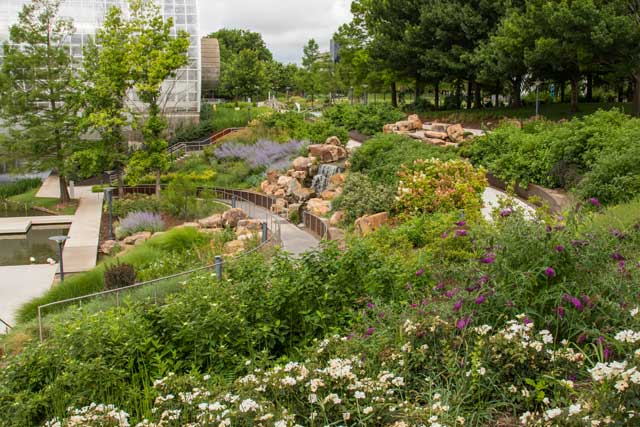
The lush landscape of Oklahoma City’s Myriad Botanical Gardens can come as a surprise to some.
“Because we are right in the middle of downtown, we always hear exclamations of ‘Oh, wow!’ when people walk in,” says Executive Director Maureen Heffernan. “People are often surprised to be greeted by such a beautiful oasis right here in the city.”
The garden first opened in 1988 and was run by the city government, but the grounds looked nothing like they do today. The garden’s major renovation took off about five years ago when Devon Energy began constructing its 50-story tower and enabled the funding for the project through tax increment financing (TIF). The Myriad Botanical Gardens is now a nonprofit.
Photo courtesy Myriad Botanical Gardens.
Nearly $50 million was set aside for the garden’s renovations through the TIF funding, Heffernan says, which included a prairie garden.
“A designer came in and incorporated a lot of naturalistic effects, which came out wonderfully. The prairie garden includes native plants, grasses and all kinds of different flowers from part of the country,” Heffernan says. “It serves educational purposes too, because it gives visitors a sense of place and displays the true beauty of this natural region. We also have a lot of information about ways to help local pollinators.”
Through the renovations, the gardens were transformed to include several distinct expanses in addition to the prairie garden. Today, the 15-acre gardens include a dog park, a children’s garden, walking paths, an outdoor stage and more.
“We’re always working to improve and add new things. There truly is something for everyone here,” Heffernan says.
When planning a trip, Heffernan recommends checking out the events calendar on the Myriad Botanical Gardens website in advance.
“You might want to come at a specific time, since we have a lot of different things going on. We have yoga, swing dancing classes, children’s story times and ‘Weekly Walk-Ups’ activities, and special festivals,” Heffernan says.
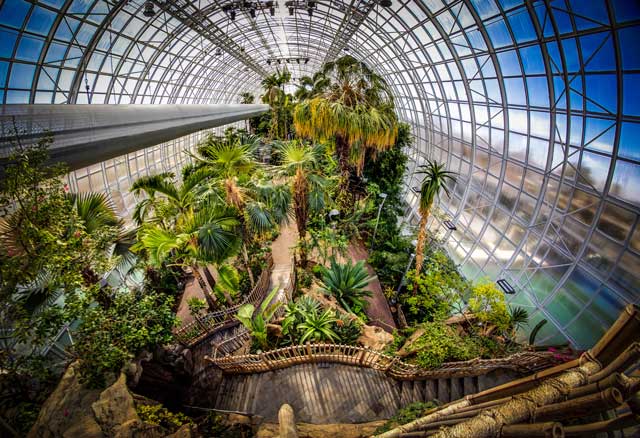
Plant enthusiasts can also access the Garden Explorer plant database on their phones to learn interesting facts about each plant as they are exploring the grounds. The garden also includes the Crystal Bridge Conservatory, a popular wedding spot that features a varied collection of tropical and flowering plants.
Photo by Robin Aguirre.
The Papilion at Honor Heights Park
When the City of Muskogee’s Chamber of Commerce considered different ways of increasing tourism, one type seemed to fit the small town perfectly: agritourism.
“It just seemed like the perfect way to bring people to Muskogee, but they also wanted to do something different,” says Papilion Operations Manager Katherine Coburn.
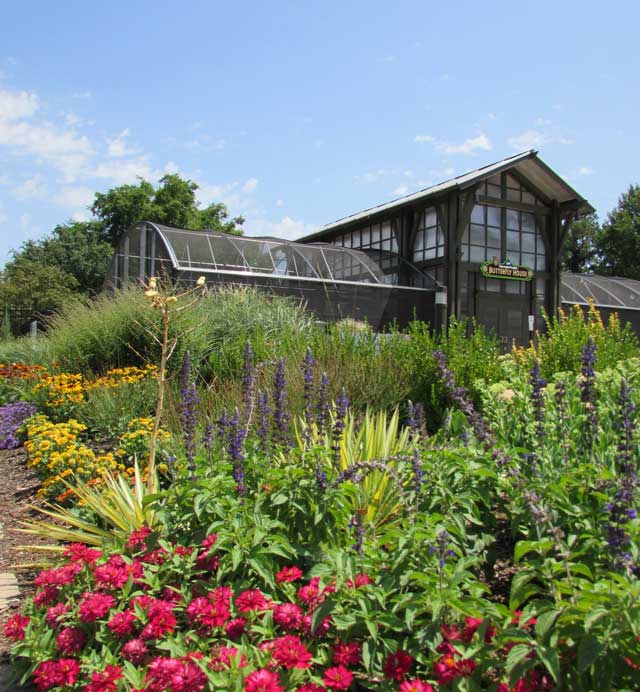
The new idea resulted in the Butterfly House located in the large Honor Heights Park.
“We have between 200 and 300 butterflies here at all times in an open-air garden that is closed in like a greenhouse,” Coburn says. “We’re licensed to have over 200 varieties, so there are so many different ones to see every time you visit.”
The butterflies are actually shipped to the garden because if they are grown from eggs, caterpillars eat all the leaves, killing the plants that the grown butterflies need. Most of the insects are supplied from South Florida, Alabama and Texas.
“They come shipped in packages that look like thin, wax envelopes. They’re on ice because when butterflies get cold, they kind of hibernate in a sleeping state,” Coburn says. “When they arrive, it’s critical that they are released as soon as possible, and you can always recognize the new ones because they’re a little drowsy and disoriented at first. But they wake up soon and find the nectar plants and they’re happy!”
Coburn herself is new to the world of butterflies, having joined the garden staff two years ago, but she says her work with the insects has changed the way she looks at the world.
“I can be driving along, and I’ll just happen to notice a butterfly flying along,” she says. “I’ve learned a lot, and I keep learning new things from them every day. It’s a peaceful place to work!”
The gardens are also popular for field trips at the end of the school year and for the annual Azalea Festival that takes place in April. The grounds include many flowering plants, 10 large raised beds and an event lawn that hosts civic events, wine tastings, weddings and more.
Coming up soon for The Papilion at Honor Heights Park will be a brand-new children’s garden area where programs for kids can take place.
“These programs really give children a chance to learn new things and experience them through all five senses, which they don’t always get very often,” Coburn says.
Photo by Robin Aguirre.
Tulsa Botanic Garden
The staff and board of the Tulsa Botanic Garden are thinking big-picture regarding the garden’s future.
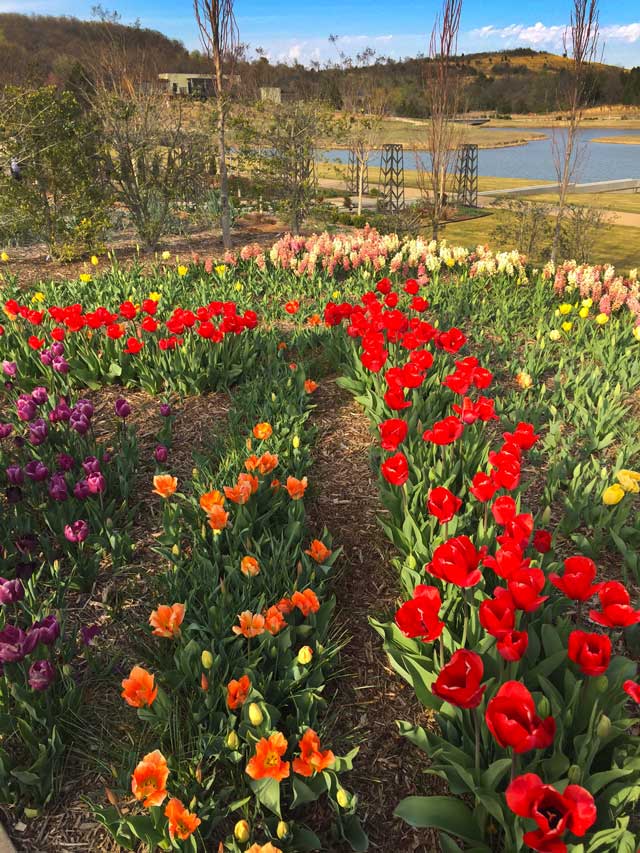
“We’re a few years into a 25-year master plan to develop 70 acres,” says President & CEO Dr. Todd Lasseigne. “We have a very bold vision; it’s exciting to be a part of. We’re developing 70 acres, but the grounds include 170. But we’re not going to develop 100 acres in order to preserve the natural landscape. I think this approach tells a nice tale and provides an interesting duality.”
Set in the Osage Hills, visitors drive about a mile and a half in from the highway before reaching the garden.
“When you walk in, you’re greeted with a beautiful panorama in the visitor center, where you can see lakes and the huge outstretch of land. You can hear the awe in people’s voices when they enter,” Lasseigne says.
The newest additions to the garden include the A.R. & Marylouise Tandy Floral Terraces, set on a fairly steep hill that covers a little over three acres.
“Each terrace has a different theme, such as perennials, Mediterranean plants or roses. And at the top of the terraces, which are wheelchair-accessible, you can see a full view of the Tulsa skyline,” Lasseigne says. “The architect borrows from our Art Deco history, and there are three big water features as well. You can spend a lot of time there with over 400 kinds of plants just in this one garden.”
The Tulsa Botanic Garden also completed the construction of a children’s garden this spring.
“The Children’s Discovery Garden includes a recirculating stream that flows through a meadow landscape that pays homage to prairies, and we also have an art program that we call the fantastical wonderland,” Lasseigne says.
The “wonderland” includes water sculptures, a tree fort and several interactive activities like water painting.
In this phase of the garden’s master plan, two more gardens and a multipurpose building will be added. The grounds currently contain nature trails, a lakeside promenade, a lotus pool and several gardens.
“We want to provide a place where people can truly understand the critical role that plants play in our lives,” Lasseigne says. “A lot of people don’t always think how important plants are, so we hope to provide the plant equivalent of a zoo to show how connected people are to plants.”
[dropcap]With[/dropcap] thousands of options from everything from where you eat dinner to who you choose to do your landscaping, it can be difficult to decide what the best choices are in Oklahoma. Fortunately, you don’t have to – our readers have done it for you.
This month marks the 17th edition of our The Best of the Best feature. The guide gives you the top choices of our readers in multiple categories and can provide assistance when you’re looking for a new hair salon, a great salad or nearly anything else.
July also features our Luxury Homes showcase, which looks at some of the most stylish homes in the state and the designers that created them. Whether you’re looking for ideas for your own home or just appreciate resort-style living, be sure to look at what these Oklahoma designers have created.
[dropcap]Mother[/dropcap], foodie and content creator Amy Belgardt got her start in 2008 when she created her blog momspark.net, where she posts daily content made for parents balancing life, work and raising children. Originating in Edmond, MomSpark gained a following of loyal readers with its regular updates featuring DIY projects, fashion, cooking recipes and travel logs. “It started as a hobby. I was a stay-at-home mom looking for an outlet where I could communicate with other moms. When you are a single mom, you are inside the house a lot – especially when your kids are little – and it was a way that I could have a community, a tribe, but not have to leave the house,” Belgardt says. When social media platforms like Twitter and Facebook gained popularity, MomSpark jumped on board, delivering fresh content for every parent directly to their news feeds. On her YouTube channel, Belgardt creates short-form video content for her subscribers that covers parenting ideas, step-by-step cooking recipes and beauty tips. With over 200,000 followers on Facebook, Twitter, Instagram, Pinterest and YouTube, Belgardt has truly made a name for herself as a premier Oklahoma-based content creator. You can also follow MomSpark on SnapChat, where Belgardt regularly posts behind-the-scenes videos of the content creation process. When asked about her online presence, Belgardt says it isn’t just for parents. “No matter what your interests are, you’re going to find something of value on MomSpark, and hopefully you can be inspired by the ideas there and have a good time. It’s light, inspirational and easy to consume.”
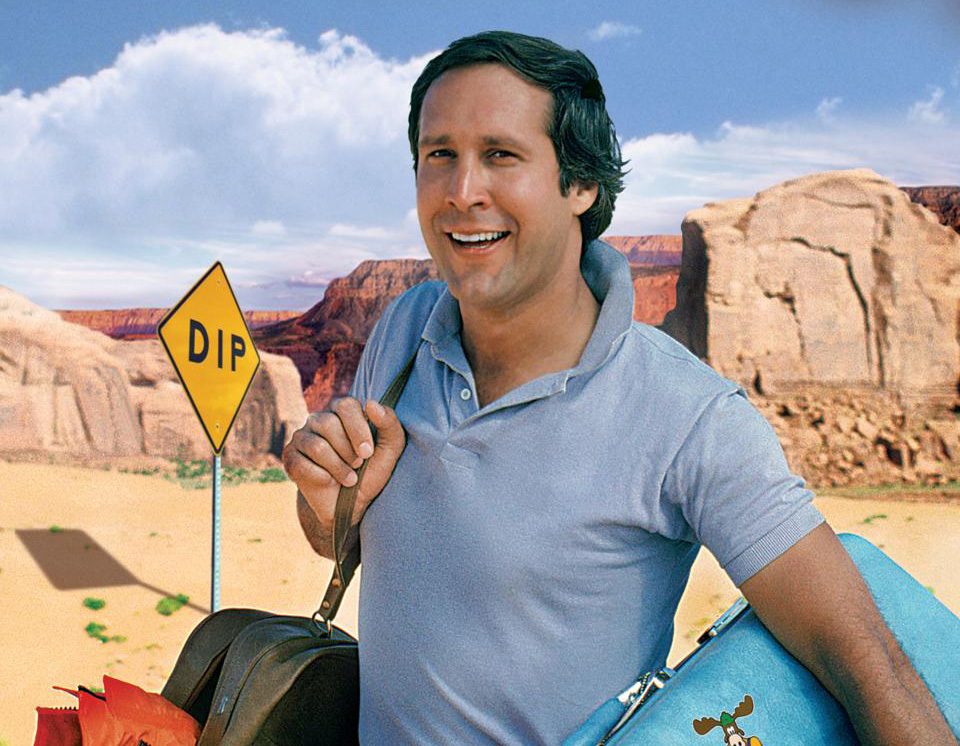
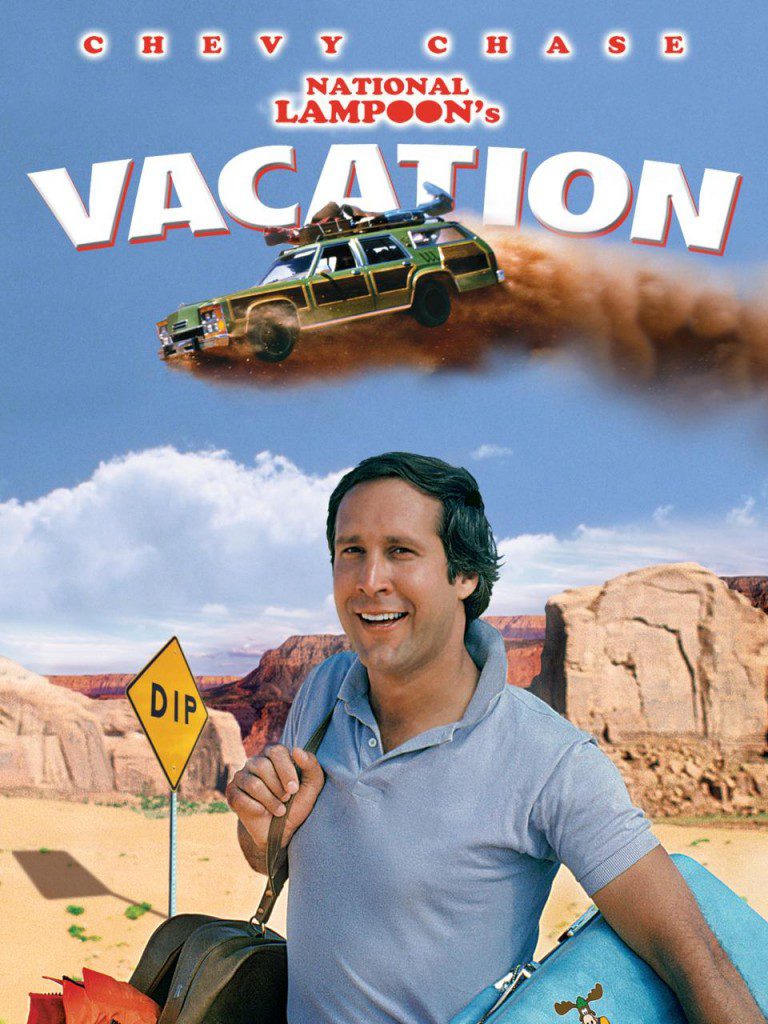
From guthriegreen.com – Every Thursday night from May to October at 8:30 pm, Guthrie Green shows FREE movies in the park. Get out your lawn chairs and blankets and join us for a fun night of film under the stars! Thursday,June 23, 2016 NATIONAL LAMPOONS VACATION (R) 1983 The Griswold family’s cross-country drive to the Walley World theme park proves to be much more arduous than they ever anticipated. Director: Harold Ramis Writers: John Hughes (screenplay), John Hughes (short story “Vacation ’58”) Stars: Chevy Chase, Beverly D’Angelo, Imogene Coca
From soonertheatre.org – There’s trouble in River City when a fast-talking salesman gets his heart stolen by the town librarian.
The Music Manfollows fast-talking traveling salesman Harold Hill as he cons the people of River City, Iowa into buying instruments and uniforms for a boys’ band he vows to organize – this despite the fact he doesn’t know a trombone from a treble clef. His plans to skip town with the cash are foiled when he falls for Marian the librarian, who transforms him into a respectable citizen by curtain’s fall.

























 [dropcap]With[/dropcap] thousands of options from everything from where you eat dinner to who you choose to do your landscaping, it can be difficult to decide what the best choices are in Oklahoma. Fortunately, you don’t have to – our readers have done it for you.
 “
“ “
“
 “
“