











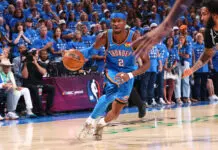









Featured photo: Shai Gilgeous-Alexander’s back-to-back MVP awards underscore his emergence as one of the NBA’s premier players and the centerpiece of the Thunder’s pursuit of sustained excellence. Photo courtesy NBAE/Getty Images
Built to Last: What’s Next for the OKC Thunder
For the Oklahoma City Thunder, the question posed after a championship is not necessarily how to win another one. It is how to build an organization capable of competing for the title year after year.
The team answered part of that question in 2025, winning its first NBA championship since relocating to the city from Seattle in 2008. This season, the Thunder again established themselves as one of the league’s elite teams, finishing 64-18 – and with back-to-back Most Valueable Player awards for point guard Shai Gilgeous-Alexander –before falling in Game 7 of the Western Conference finals.
The offseason has brought change. OKC added promising young talent, selecting Michigan center Aday Mara at No. 12 and acquiring the draft rights to Iowa guard Bennett Stirtz at No. 16. At the same time, the Thunder traded several contributors, including Isaiah Joe, Aaron Wiggins and starter Luguentz Dort, creating questions about what the roster will look like when the next season begins in October.
But those moves fit a larger philosophy that has guided the organization under General Manager Sam Presti: Think beyond the next season.
“Every year our goal is to repeat a process, not chase an outcome,” Presti said at his June 8th end of season press conference. “This process is to position our team and our organization so that if we’re fortunate enough to have things break our way, we can achieve ultimate success.”
That approach extends to how Oklahoma City develops its players. Rather than simply asking whether a young player can immediately contribute, Presti says the organization focuses on helping each player discover how far his potential can take him.
“How can we help the guys? That’s a big part of how we’ve always looked at it is, ‘How can we help the players improve? Not just can they play, [but] what are they going to do for us?”
The philosophy requires patience. Development is not always linear, and individual growth has to fit within the larger needs of the team. Presti described it as a “mutual commitment” between the organization and its players, built around understanding where each player is and determining how the team can help him progress.

Head coach Mark Daigneault offered a similar perspective after the Western Conference finals loss at his end of season presser on May 31st. The disappointment of falling short, he said, should not erase everything that came before it.
“Like I said last night, I think you can be simultaneously disappointed and also proud of the path that took us to the point where we could be disappointed,” he said.
For Oklahoma City, forging a steady path forward remains the priority. The Thunder are not simply trying to assemble one championship roster; they are attempting to create an organization in which young players can develop, established players can grow and success can be sustained.
That long-term vision extends beyond the basketball court.
Construction is now underway on Continental Coliseum, the Thunder’s future downtown home, following a March groundbreaking. The arena is targeted to open in time for the 2028-29 season and will anchor the Thunder’s long-term presence in Oklahoma City.
Thunder spokesperson Gayle Maxwell called the project “an investment in the future of both the Thunder and Oklahoma City,” saying the new arena will provide players with modern facilities while giving fans an elevated game-day experience.
More broadly, Maxwell says, “the arena is another milestone in Oklahoma City’s evolution.”
That may ultimately be the best description of the Thunder themselves. The championship proved Oklahoma City’s process can produce the ultimate result. The challenge now is proving that process can produce something even more difficult: sustained excellence.
The Thunder have already shown they are willing to think years ahead. What comes next may be less about making a splash and more about continuing to build – patiently, deliberately and with the expectation that the next championship team is already taking shape.

Balancing Success as a Student-Athlete
For collegiate athletes, success requires more than performing at a high level on game day. They must also navigate demanding academic schedules, personal responsibilities and the pressures that come with competing with thousands of eyes upon them. At the University of Oklahoma, athletic and academic staff say the goal is to help student-athletes excel in each area without prioritizing one over the others.
“Being a student-athlete at Oklahoma is incredibly rewarding, but it’s also incredibly demanding,” says OU Deputy Athletics Director and Chief of Staff Mackenzie Dilbeck. “Our responsibility is to create an environment where they don’t have to choose between being a great student, a great athlete and a well-rounded person.”
That support begins with collaboration among coaches, staff and student-athletes. Dilbeck says student-athletes have teams designed to help manage the competing demands of college life.

“We also place a premium on communication and planning,” Dilbeck adds. “Every student-athlete has a support network that works together to help them navigate the challenges that come with competing at the highest level while earning a world-class education.”
Academic support is a significant part of that network. Through the Prentice Gautt Academic Center, Oklahoma Athletics provides student-athletes with access to academic advising, individualized learning specialists, tutoring, writing and math support, foreign language assistance, advanced technology resources and the GRIT (Growth Mindset, Resilience, Initiative, Tenacity) mentoring program for incoming freshmen.
“Oklahoma Athletics is committed to developing the whole student-athlete by providing comprehensive academic resources and personalized support that foster success in the classroom and prepare graduates for life after competitive sport,” says Mike Meade, OU Senior Associate Athletics Director for Academic Services.
The resources are designed not only to help students succeed in their current courses but also to develop skills they can carry into their careers. Meade mentions that student-athletes receive guidance in time management, study strategies, critical thinking, communication and problem-solving, along with degree planning, career exploration, résumé development, interview preparation and graduate school readiness.
By providing those resources, the department seeks to create an environment where student-athletes can develop both academically and professionally.
“By creating a collaborative learning environment and equipping student-athletes with the academic tools, professional skills and confidence to achieve their goals, Oklahoma Athletics empowers them to excel during their collegiate careers and thrive long after graduation,” Meade says.
For Dilbeck, however, the definition of success ultimately extends beyond grades and athletic accomplishments.
“Our student-athletes come to Oklahoma to compete and win,” she says. “It matters here a great deal, and it’s part of the fabric of who we are and the type of talent we attract. Of course, the scoreboard isn’t the only measure of success.”
Education, leadership and personal growth are equally important parts of the experience. Student-athletes are exposed to new ideas, learn to think critically, participate as members of teams and have opportunities to develop leadership skills.
“Through sport, they also build resilience and character,” Dilbeck says. “They learn how to win with grace and lose with dignity.”

Those lessons are ultimately preparation for life beyond competition. The combination of athletic achievement, education and personal development can position student-athletes for a future that extends well beyond their playing careers.
“We exist to create opportunities for our student-athletes through the vehicle of education,” Dilbeck says.
For Oklahoma, the balancing act is therefore not simply about helping student-athletes survive the demands of college. It is about providing the resources, relationships and experiences that allow them to pursue excellence while preparing for a meaningful life after sport.
Beyond the Physical: Training the Mind
For elite athletes, physical preparation is only part of the equation. The ability to manage pressure – from fans, coaches and family members, as well as the expectations athletes place on themselves – can be just as important when competition is on the line. Sports psychology gives student-athletes tools to build confidence, sharpen focus, regulate emotions and perform when the stakes are highest.
Psychological Resources for OU Student-Athletes (PROS) works alongside student-athletes as they navigate the demands of competing in the SEC and pursuing championships. Dolores Christensen, PsyD, director of PROS, says mental preparation can make a critical difference when physical abilities are closely matched.
“Elevating their game beyond just physical talent alone, sport psychology supports student-athlete confidence, focus, emotional regulation and the ability to perform under pressure,” she says.
Those skills can help athletes respond to mistakes, block out distractions and maintain confidence rather than becoming overwhelmed by expectations. PROS staff are integrated into the daily student-athlete experience, including practices, locker rooms and travel, reinforcing mental training as a regular part of preparation, not simply something athletes turn to when they are struggling. For competitors chasing championships, training the mind can be as essential as training the body.

Women’s Sports: A Turning Tide
Women’s sports are experiencing a surge of interest in Oklahoma, with growing attendance, increased media exposure and expanding opportunities creating momentum from the collegiate level to the professional ranks.
At OU, that momentum is visible across its women’s programs, where championship success has helped attract fans while raising the profile of female athletes.
“I think it’s one of the most exciting developments in sports today,” OU’s Dilbeck says. “At Oklahoma, we’ve witnessed firsthand what happens when fierce competition, passionate fan support and elite student-athletes converge.”
The numbers and visibility surrounding women’s sports are moving in the same direction. Dilbeck says attendance at competitions is increasing, television audiences are expanding and corporate partners are investing more heavily in women’s athletics.
“Our fans have embraced women’s sports for years, and now we’re seeing that enthusiasm grow across the country and globe,” she adds. “Attendance at competitions is increasing, television audiences are expanding, corporate partners are investing and young girls have more role models than ever before.”
Oklahoma has been particularly well positioned to benefit from that growth. OU’s women’s programs have produced multiple national championships, giving athletes a prominent stage while demonstrating the university’s commitment to women’s athletics.

“We’re fortunate that we have multi-national championship teams throughout our women’s programs,” Dilbeck says. “That kind of success boosts OU’s position in college athletics, but more importantly, it spotlights our commitment to bolstering women’s sports now and in the future.”
So why are more people paying attention now?
For Dilbeck, the answer begins with the product itself.
“Women’s athletics feature extraordinary athletes, compelling competition and remarkable stories,” she says. “Once fans experience that, they come back.”
The expansion of media coverage has also made those stories easier to find, while social media gives athletes a direct connection to supporters. Corporate investment has added another layer of visibility and opportunity.
“All of those factors have created momentum, but ultimately, it starts with the incredible performances taking place during competition.”
That momentum is changing the experience for athletes, too. Larger crowds and increased media attention provide current student-athletes with greater exposure, while name, image and likeness partnerships have created additional opportunities.
Perhaps the most significant impact, however, extends beyond today’s athletes.
“Young girls across our state and nation can now see athletes who look like them competing on national television, vying for and winning championships, and building successful careers,” Dilbeck says. “That visibility and exposure has the power to change the idea of what’s possible for young girls everywhere.”
For Oklahoma’s athletes and programs, the growing crowds and investment suggest the tides may indeed be turning. And for the next generation, the increased visibility could make the path from dreaming about sports to pursuing them at the collegiate and professional levels feel more attainable than ever.