


















Photos by Dan Morgan.



Photos by Dan Morgan.
Photos by Dan Morgan.









When Mike and Sheri Engelbrecht bought this midtown Tulsa home, built in 1946, there had been only two previous owners.
“The original couple lived there almost 60 years,” says Mike Engelbrecht.
Then in 2005, the ranch home was taken back to the studs, and a new addition nearly doubled the space to 5,600 square feet.
When the Engelbrechts bought the home in 2011, they made changes of their own.[pullquote]“Our goal was to keep the contemporary feel, but warm it up.”[/pullquote]
“We moved a few walls, added all new woodwork, except for the kitchen, and renovated all the bathrooms,” says Engelbrecht.
The couple also did extensive landscaping and added a swimming pool and the outdoor fireplace.
“The house was very stark,” says Engelbrecht. “Our goal was to keep the contemporary feel, but warm it up.”

The couple repainted the bright white walls with softer tones. However, they had very few furnishings for the new space, so the couple worked with Lori Sparkman, owner of Fifteenth and Home, located on Tulsa’s Cherry Street.
“We basically gave her carte blanche to furnish the house,” says Engelbrecht.
“Because of the large windows, my inspiration was the outside,” says Sparkman. “I wanted to bring the palette and textures inside.”
The kitchen and dining room are on one level. Steps lead down into the living room, but the spaces are open to one another. The only existing pieces in the living room are the grand piano and the cocktail table made from reclaimed wood.

“I wanted to keep the table because it worked with my goal of bringing the outside in,” says Sparkman.
Sectional sofas by American Leather mirror each other in the large room. The retro furniture brand’s Cole chairs provide additional seating, and the arrangement is softened by a large area rug with tone-on-tone texture. A pair of contemporary Alyssa chairs, also by American Leather, rest on a cowhide rug and flank the fireplace.
The Engelbrechts had six existing dining chairs, so Sparkman used two in the formal entry area to accent a Phillips Collection console table. The other four chairs are in the dining room around a new Phillips Collection natural resin dining table.
“To keep the dining room from being blocked off from the kitchen, I used a pair of benches on the open side,” she says.
Sparkman relocated an existing ivory leather sectional sofa that she says looked lost in the expansive living room to the master bedroom. Also positioned on a Jaipur Rugs hand-knotted wool area rug is a unique cocktail table fabricated of dark wood with a sliding, tiered lacquer shelf. The Vanguard Furniture dresser is stained gray. A wooden sculptural piece from the Phillips Collection hangs over the bed.
In the office/study, the sitting area has a tailored, gray loveseat with subtle lighting from a pair of Pablo Lighting sculptural tower light fixtures. The area rug is from Calvin Klein. The accent chair is solid walnut covered in leather. On the opposite wall are sliding doors that conceal the couple’s computer workstations and office area.
“The house is very symmetrical, and Lori used the same concept when selecting the furnishings,” says Engelbrecht. “It’s just perfect.”








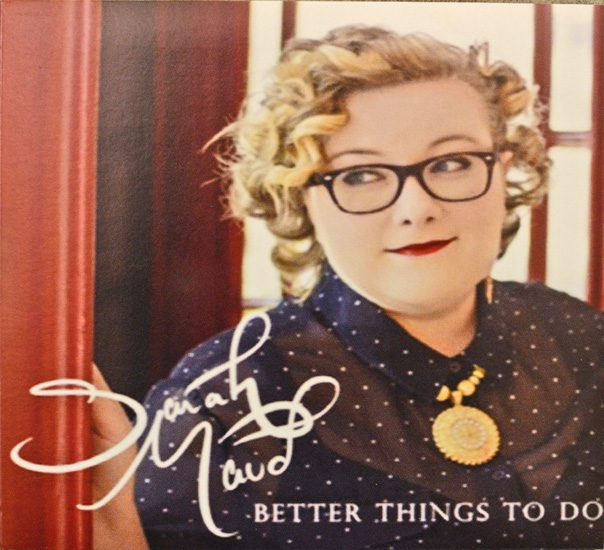
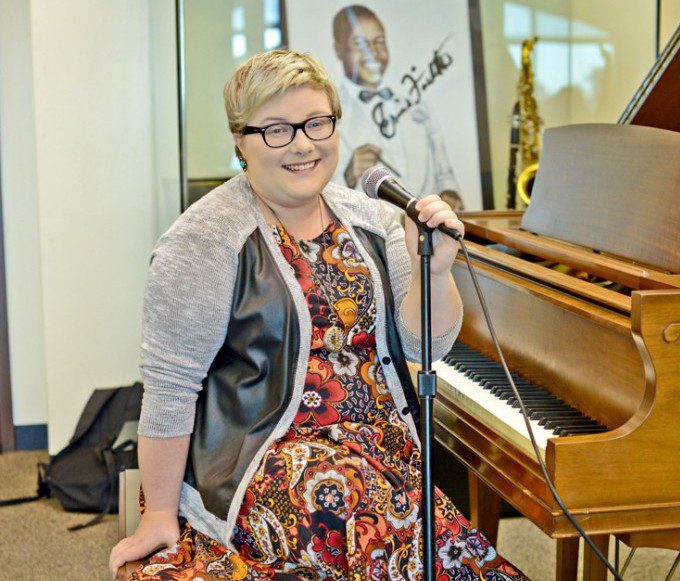
It’s a toss-up as to which is more impressive: The fact that the artist behind the album Better Things to Do is still an undergraduate at The University of Tulsa or that the new disc – a hearty and satisfying jazz platter seasoned with reggae, pop and other musical ingredients – began life as a school project.
That artist, Sarah Maud, credits professor Vernon Howard, TU’s director of jazz studies, for helping take Better Things to Do from academic to commercial. On the CD jacket, Howard and Maud are listed as co-producers.
“Vernon has always been a huge supporter of mine, helping me with everything,” Maud explains. “Also, I realized I needed something to send out to grad school and something to sell and something to help me get gigs – which has been hard, because I didn’t have any recordings of myself and I’m really young and it’s easier just to hire the people you’ve already been hiring. I’m only 21. I get it.
“So I needed something to show people [who run music venues],” she adds, “and this album, for me, is really, really safe. I didn’t do anything too crazy. I guess ‘Escolha’ is the one that’s out there.”[pullquote]”The discipline of classical music was so beneficial to me in writing music and being professional and doing well in a rehearsal setting with a group of people. The only rough thing about it was that you learn [to be] no-nonsense – and when you’ve got a group of jazz people, there’s a lot of nonsense.”[/pullquote]
One of three original songs on the disc, “Escolha” (which, she notes, is Portuguese for “choices”) is a wordless melody she originally composed as part of an ear-training exercise for one of Howard’s classes. Another is the title track – a bouncy, reggae-flavored tune.
“Actually,” she says with a chuckle, “that was a ukulele song, and on the first recording of it that I did, it’s disgustingly adorable. It wasn’t even reggae.
“There was a friend of mine who was in a film-scoring class here, and he needed a song to record,” she says. “I’d written that song a long time ago on my ukulele, and we decided to do it. Jordan started playing some reggae behind it, and it was just kind of perfect.”
“Jordan” is Jordan Hehl, the Tulsa bassist who plays and sings on the standard “Say It Over and Over Again,” a track from Better Things to Do. He plays with Nicholas Foster on drums and Paul Humphrey on guitar. Like Maud, Hehl and Foster are in the forefront of a new wave of Tulsa jazz artists, seen and heard often at the Oklahoma Jazz Hall of Fame’s Jazz Depot as well as on other stages around Tulsa. The three, in fact, have performed together for a couple of years, and a strong bond has developed among them.
“I don’t like to admit it, because he’s basically my [musical] brother,” Maud says, “but Jordan has been the biggest help ever to me here in Tulsa. He was a senior when I came here as a freshman, and Nicholas was a sophomore. Those two are the ones who helped me get started.
“I met Paul here at TU,” she adds. “There are certain people you click with, and with Nicholas and Jordan, Paul just kind of naturally fit.”
The trio, along with Maud, form the Maud Squad, whose repertoire ranges from songs by the rockers Blondie and Radiohead to jazz and pop numbers. Backed by Hehl’s bass and Foster’s drums, Maud’s voice becomes the group’s only lead instrument.
“It takes a lot of listening,” Maud said before Maud Squad’s debut performance at the Jazz Depot in September 2013.
“When you’re a vocalist, you sometimes find yourself having a kind of crutch, and for a lot of vocalists, it’s a chord. If you forget a melody line or something, and you hear the chord, then you’re going to find someplace to go. But here, you don’t have a chord to fall back on. In a lot of it, I end up being the chordal instrument with my voice. It’s a really cool sound if you can pull it off.”
The idea of the human voice as an instrument is something Maud thinks about a lot. The concept worked its way into her head back in her hometown of Coweta, where she became heavily involved in school band programs after a childhood spent singing southern gospel in church with her mother and sister.
“My mom would explain things like harmony to me,” she recalls. “And once she explained what it was, it was really easy for me, because I had a natural ear for it, and it was really fun to do.”
She “kind of forgot about vocals” after joining the school band as a sixth grader, playing a classical repertoire on a French horn.
“I was so focused on that, and I loved it,” she says. “I still love it today. I’m so glad my instrument was French horn, because you have to have a good ear. Also, the discipline of classical music was so beneficial to me in writing music and being professional and doing well in a rehearsal setting with a group of people. The only rough thing about it was that you learn [to be] no-nonsense – and when you’ve got a group of jazz people, there’s a lot of nonsense.”
She laughs.
“Here [at TU], I do classical vocal as well, and French horn really helped me with that. It seems like everything I did with the French horn was exactly what I needed to do vocally for classical music.”
In ninth grade, Maud began playing trumpet in the school jazz band. It helped her remember not only being enthralled as a child by Billie Holiday’s version of “What A Little Moonlight Can Do,” discovered in her mother’s record collection, but also the singing she’d done in church.
“Playing the trumpet was making me want to sing again, and in my junior year of high school, two of my friends basically made me go sing in front of my band director,” she remembers. “So I’m in his office, I’m terrified, and I start singing ‘I’ve Got You Under My Skin.’ He didn’t say a word to me. All I saw was him kind of sink back into his chair with a relaxed look and a smile on his face, and that said everything to me.”
From there, she not only began singing with the school jazz band, but she started composing songs as well. In 2010, just before the start of her senior year, Maud attended a jazz camp co-sponsored by TU and the Oklahoma Jazz Hall for Fame, where “I met some really great people who were so helpful,” she says. “And that just started everything for me in Tulsa.”
Through it all, she never lost sight of the idea of using her voice as a musical instrument.
“I’ve always been very articulate about how important it is to me to keep that idea of musicianship, because I’ve always been a musician,” she notes. “Saying a vocalist is a musician is not a new concept or idea. It’s a true statement. You are a musician. Your instrument is you.”
Sarah Maud’s Better Things to Do is available at the Jazz Depot, and her shows are available on iTunes.
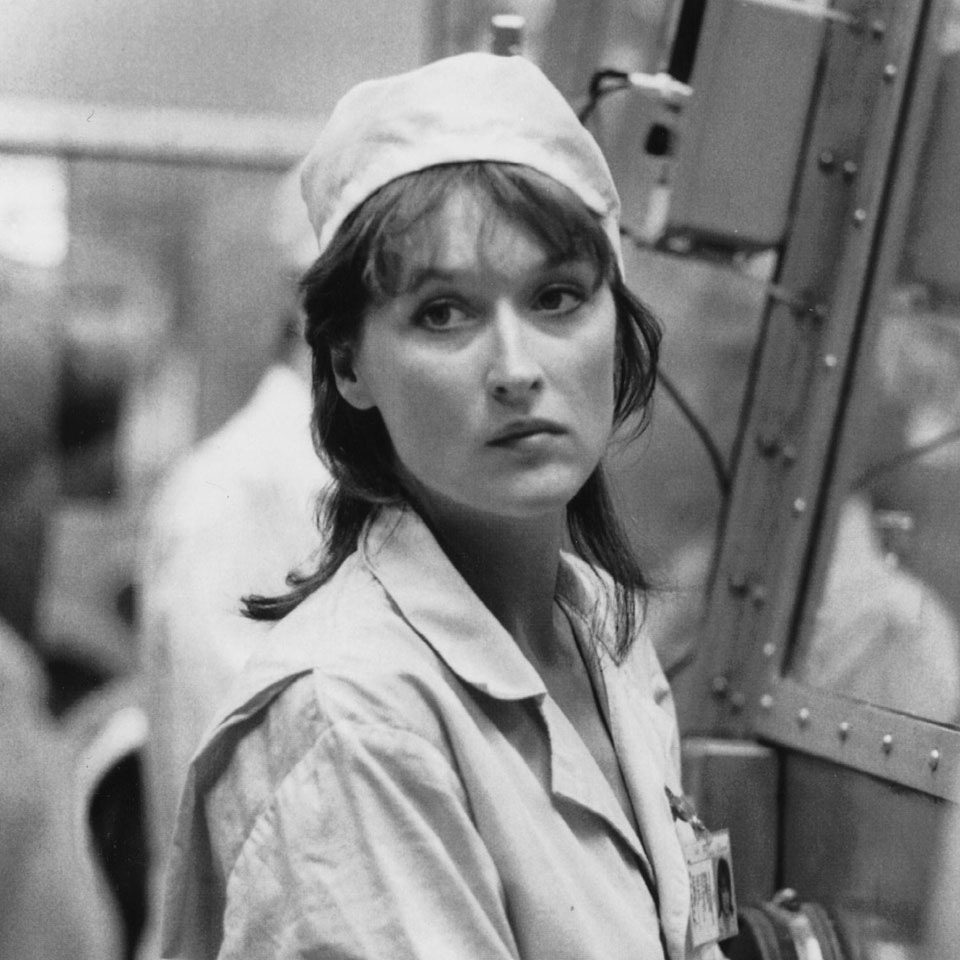
On Nov. 13, 1974, Karen Silkwood set out in her car for Oklahoma City to meet with a national representative from her union and a reporter from The New York Times. With her, witnesses say, were documents substantiating Silkwood’s claims that workers at the Kerr-McGee Corp. Cimarron Fuel Fabrication Site in Crescent, Okla., were endangered due to corner-cutting at the factory. No one ever saw Silkwood alive again.
Not far outside of Crescent, the 28-year-old mother of three was found dead in what appeared to be a one-car, front-end collision. Marijuana and Quaaludes were discovered in the car, and the latter were found undissolved in Silkwood’s stomach during the subsequent autopsy. Authorities determined that Silkwood had fallen asleep at the wheel before striking a culvert. To this day, however, inconsistencies at the crash scene haunt the public imagination. These include evidence of a possible rear-end collision with another car, as well as skid marks on the road.
The incriminating documents that witnesses say Silkwood was taking to the reporter were never found.
Silkwood was a vocal health and safety advocate and union leader at the Kerr-McGee plant, where workers made plutonium pellets for nuclear reactor fuel rods. She and fellow members of the Oil, Chemical and Atomic Workers Union had become concerned that pressure on the Kerr-McGee plant to make deadline for a new reactor had led to dangerous and duplicitous short-cuts at the factory, including the production of faulty rods and falsifying of records, as well as negligence regarding the safety of workers. In the summer of 1974, Silkwood testified before the U.S. Atomic Energy Commission to this effect.
In early November of that year, Silkwood tested positive for abnormal plutonium levels, as did several objects in her home. Along with her roommate and boyfriend, both of whom also tested positive for low levels of plutonium contamination, she was taken to the classified Los Alamos National Laboratory in New Mexico for study and decontamination. Silkwood claimed that conditions at the plant were responsible for her high levels of plutonium, but Kerr-McGee maintained that Silkwood poisoned herself to damage the company’s credibility.
A few days later, Silkwood was found dead under mysterious circumstances, but her story did not end on that lonely Oklahoma road.
In what would become a highly contentious and lengthy trial, Silkwood’s family sued Kerr-McGee for negligence, based on the levels of plutonium that had been discovered in Silkwood’s body. The mystery continued throughout the trial, with one investigator disappearing under allegedly unusual circumstances and another committing suicide shortly before testifying.
The court found for Silkwood’s estate, and her family was awarded $505,000 plus $10 million in punitive damages. On appeal, a federal court later reversed the decision for punitive damages and reduced the amount for damages to $5,000 – the amount of property Silkwood lost when her home had been decontaminated. When the U.S. Supreme Court reviewed the case and upheld the original court verdict, Kerr-McGee settled out of court with the Silkwood family for $1.38 million. The corporation never admitted liability. Shortly after her death, the company closed its nuclear fuel plants.
Silkwood became the subject of an eponymous Academy Award-nominated film, written by Nora Ephron and directed by Mike Nichols. Meryl Streep portrayed the union activist with Cher and Kurt Russell appearing as Silkwood’s roommate and boyfriend. Silkwood’s death also was the basis for the 1981 book The Killing of Karen Silkwood by Richard L. Rashke, and her case has been examined by numerous investigative journalism programs, including PBS’ Frontline.

Sherry Stinson is a pet photographer who donates countless hours to shelters around northeast Oklahoma and Arkansas photographing homeless pets up for adoption.
What inspired you to put your photography skills to use for shelter pets?
A former photography student contacted me several years ago, asking if I had a recommendation for a student who might be interested in photographing shelter animals. Much to her surprise, I told her I’d do it!
The first time I went to do a rescue shoot, I saw a sign hanging on one of the kennels that said, “Going home.” As I looked at the other kennels, full of dogs but lacking an adoption sign, I got a lump in my throat, knowing they may not make it out. That’s when I knew rescue photography was my calling, my passion.
How do your photos make a difference?
I believe our photos give a potential adopter the chance to see the dog or cat in a different light. Sure, photos in kennels and behind bars are sad…Our photos show a happy, healthy animal in a more positive light, so when the potential adopter sees the photo, they can envision the animal going on a hike with them or sitting on the couch watching TV or snuggling on a cold, blustery day. It changes the perception of shelter animals [from] being dirty, unwanted animals to gorgeous, happy animals just waiting for a chance to show you how awesome they are.
What would you say to people thinking about adopting a shelter pet but are unsure of what to expect?
Adopting an animal is a lifetime commitment. First off, you’ll be saving a life by adopting a shelter animal and giving the shelter or rescue the chance to save another homeless animal. If you’re a first-time adopter, do a little research. Spend time at the shelter, and make sure there’s a connection between you and the animal. Don’t just pick one because it’s cute or a puppy or a kitten. Look at your lifestyle. How much time will you have to spend with the animal? Can you walk it at least twice a day? Are you gone for hours on end? …It’s important to take a logical approach to what, for many, is an emotional reaction to adoption. Think things through.
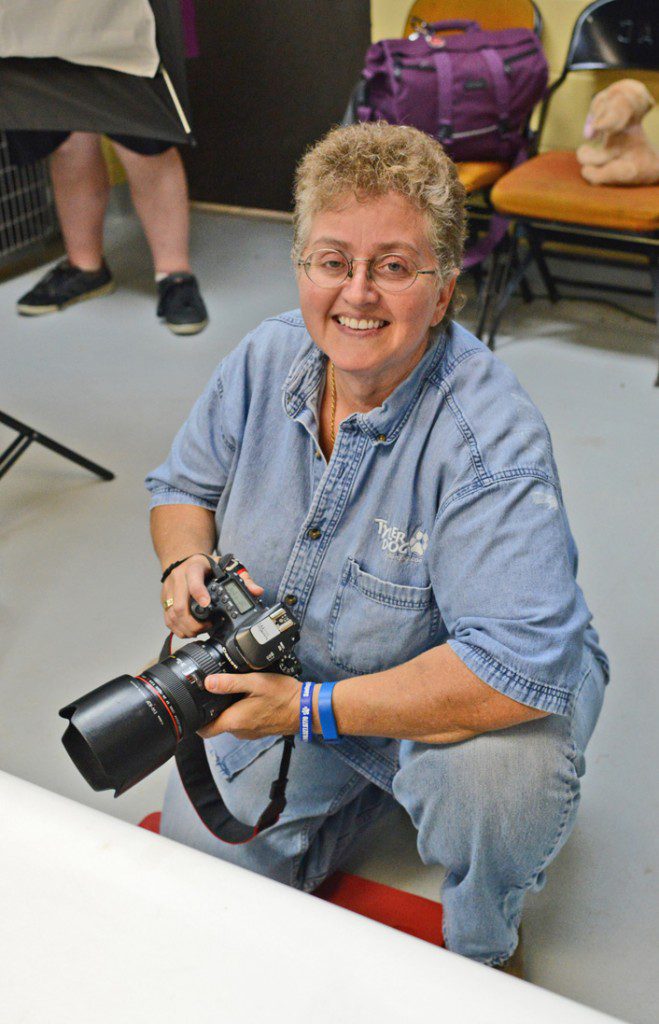
Do you have any big projects for the near future?
I’m currently tossing around the idea for a book about Destiny the Pibble, one of my dogs. She has an amazing story (which was picked up by cable’s Headline News network), and I think it would be one to translate well into a children’s book, given her unique look – the muscles in her head atrophied due to starvation and haven’t ever come back. Sometimes when you don’t quite “look” the way society expects you to, it’s hard, and for kids, especially so. I think her story would definitely relate to kids who don’t quite fit in or feel left out. I’m also tossing around the idea of a photo book documenting Tulsa’s homeless and their dogs. I want to bring light to what’s hidden in the shadows.
What about your own pets?
All are rescues with great stories. I have five: Jazzy the Amazing Wiener, 11, is a miniature dachshund and star of WienerBites (www.wienerbites.com); Katie the Doberman pinscher is 7 and my little princess; Xena the pit bull, 5, is another little star. She was in the middle of a busy street when I rescued her. She was featured in the 2014 Pinups for Pit Bulls calendar as Ms. September. Maggie Monster is a 4-year-old Labrador/Rottweiler mix brought to me by a former student who found her starving and wandering around Circle Mountain in Bartlesville. Then we have Destiny the Pibble, around 1-year-old, of the “We can just feed her and she’ll get better, right?” fame.
For more on Stinson’s work, as well as the story of Destiny the
Pibble, visit www.tylerdog.com.
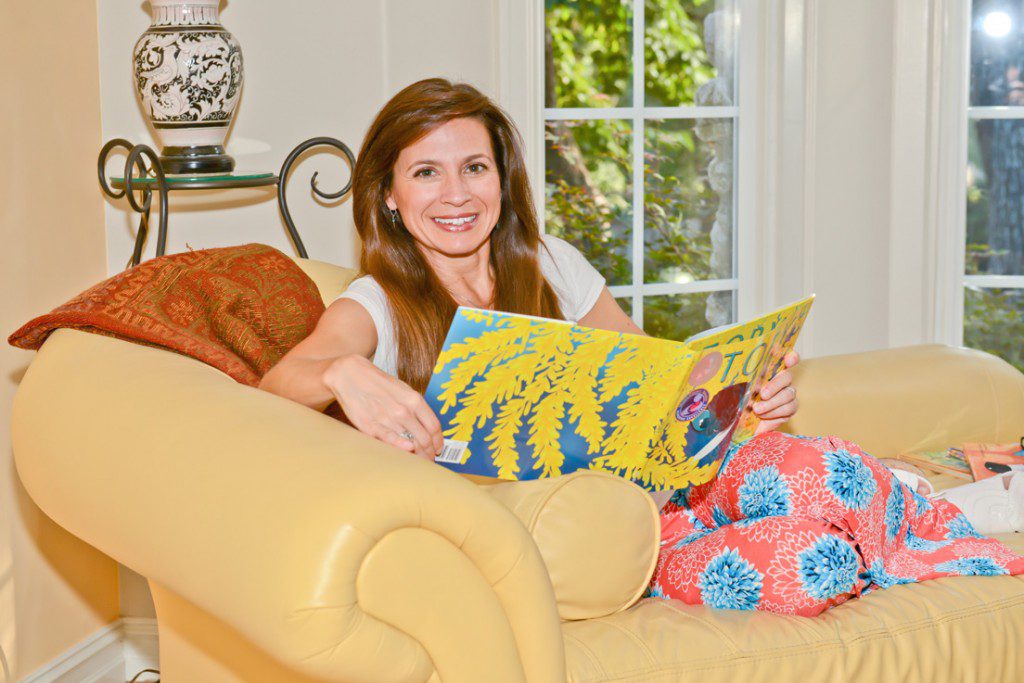
Inspiration can come in many forms. Writers have found it in nature, and musicians have found it in art. In the case of Stacy Nyikos’ new children’s book about an unruly dog, inspiration came from a more destructive place.
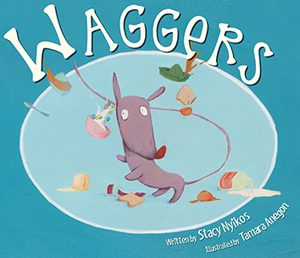
“It took about six months of watching our puppy, Desi, destroy stuff with her tail before it hit me,” Nyikos says of the impetus for Waggers. “[The idea] was just like lightning striking.”[pullquote]“Poetry was always something I did in my free time, but when you’re writing a dissertation, you don’t have much of that.”[/pullquote]
Waggers tells the tale of a lovable and excitable dog whose wagging tail constantly gets in the way. It is the Bixby author’s seventh book and her sixth illustrated children’s book.
She says she’s always loved writing and looked for creative outlets even in her academic studies at the University of Virginia.
“Poetry was always something I did in my free time, but when you’re writing a dissertation, you don’t have much of that,” Nyikos says. “It wasn’t until after I finished my Ph.D. that I started writing poetry for kids, and then that just turned into something bigger.”
Her first book, Squirt, was published in 2005 and tells the story of a squid who loses his imagination. Squirt was followed in 2006 by Shelby, a shy lemon shark, and by Dizzy, about the world’s fastest dolphin, in 2007.
After the publication of Dizzy, Nyikos realized she had a second career on her hands. She eventually had to choose between life in academia at the University of Oklahoma or writing children’s books full time.
“My fourth book (Dragon Wishes, her first young adult novel) was coming out, and I was doing a bunch of traveling,” Nyikos says. “It’s really hard to be doing that and be in my office at a university. It wasn’t an easy decision, especially after all the years of training to be an academic. But this was the thing that puts a little spring in my step in the morning.”
She knows she’s found something special, and with two books already out this year – Waggers and Toby, a story of a sea turtle’s journey to the ocean – she’s found a formula that works.
“The world [of children’s books] is such a magical and new and shiny experience in the eyes of a child, and I love being in that kind of world,” Nyikos says.

Work on the first of several gardens planned for the long-anticipated Tulsa Botanic Garden is set to begin this month. The construction moves ahead following a successful first phase of fundraising to see the long-term project to completion.
“We’ve been working quietly and behind the scenes for the prep work,” says Lori Hutson, communications and programs director for the Tulsa Botanic Garden.
The organization is 14 months into a three-year fundraising campaign to bring in $17 million. Already, the campaign has brought in $10 million, which will fund work on the A.R. and Marylouise Tandy Floral Terraces, a four-acre garden of ornamental plants; the Children’s Discovery Garden, a learning garden for families; the lotus pool, which will feature assorted water plants; and the All-Seasons Garden, which will include plants with year-round appeal.[pullquote]“It’s the same project, it’s just evolved,” she says. “We changed our name last year from Oklahoma Centennial Botanical Garden to Tulsa Botanic Garden, and that was really just to make it easier to represent who we are and what we are.”[/pullquote]
The developing Tulsa Botanic Garden sits on a portion of 170 acres of donated land in the Osage Hills northwest of downtown Tulsa. The project first saw widespread attention as the Oklahoma Centennial Botanical Garden, which was awarded $2.2 million by the Oklahoma Centennial Commission in 2006. Coupled with a $1 million grant from the federal Economic Development Administration received in 2010, the funding has covered much of the cost for necessary infrastructure – including a road and extension of city utility services. The money was also used to pay for construction of the seven-acre lake anchoring the gardens along with an operations facility.
Since the master plan was revealed in 2012, several updates have been made, including tying all the tended gardens around the lake, which will allow about 100 acres of natural growth and untouched cross timbers in the garden to be more contiguous, Hutson says.
“It’s the same project, it’s just evolved,” she says. “We changed our name last year from Oklahoma Centennial Botanical Garden to Tulsa Botanic Garden, and that was really just to make it easier to represent who we are and what we are.”
Groundbreaking on the floral terraces is scheduled for Nov. 16 at 10 a.m. Officials anticipate that feature to open in the fall of 2015. Work on the Children’s Discovery Garden is anticipated to begin next spring, while construction for the lotus pond and adjacent all-seasons garden should begin in 2016. The entire project is on a 25-year plan for completion. For more about the Tulsa Botanic Garden or to visit it, go to www.tulsabotanic.org.
My love of comfort food was instilled early on. My mother cooked most of our meals, and weekday evenings would find my father, mother, brother and me sitting around our dining room table eating supper as a family. The baked chicken meals, complete with mashed potatoes and peas, bring a smile to my face and a rumble to my tummy to this day. I was (and still am) particularly fond of the drumstick. The food was great, sure; but that meal also represents home, and the idea that once you’re home, everything is okay.
We attach emotions to food. Even though scientific studies tell us again and again that eating for emotional release is a bad idea, it’s human nature. Couples return to restaurants to mark first dates and anniversaries. Families gather around tables to celebrate birthdays, while servers sing cheesy songs to them. When tragedy strikes, often the first thought of friends is, “I’ll bring over food.”
To this day, I visit my parents’ home for my birthday. Most years, my mom prepares chicken – extra drumsticks for me – and whips up mashed potatoes and serves them with a side of peas. It’s not a high-dollar steak, and it’s certainly not a greasy, tasty burger, but to me, it’s the best meal every time.
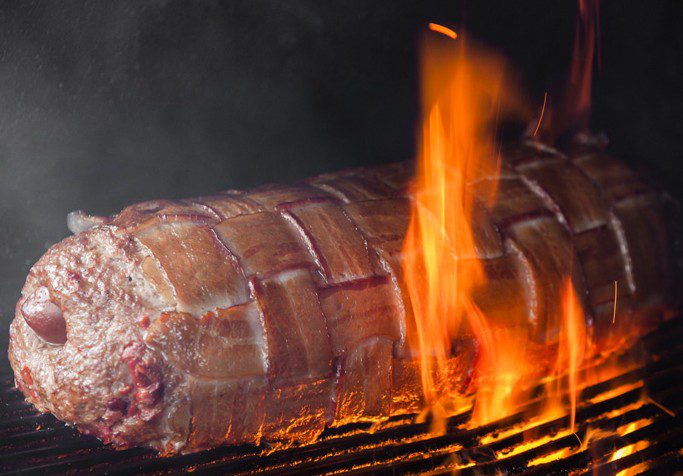
Because we can’t visit every mother’s kitchen in the state, this month we are taking you on a trip around Oklahoma and to some of the state’s most exciting restaurants (“Take A Bite Out Of Oklahoma,” p. 44). We search high and low to find great bites, from a monster steak at Tulsa’s elegant Polo Grill to delicious barbecue at a dive in Sallisaw. Perhaps you’ll recognize your favorite restaurant represented by the 47 listed in the feature, or maybe this will serve as a push for you to explore outside of your comfort zone. If you don’t see your favorite meal on the list, let us hear it. Drop an email to [email protected] and tell us what your favorite bite is in Oklahoma. It may make an appearance in a future story.
– Jami Mattox
Managing Editor
Month after month, we present a colorful kaleidoscope of the people, places and culture that make Oklahoma such a fascinating place.
© Oklahoma Magazine