




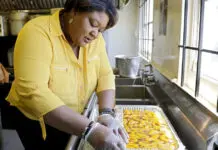
















Etymologists often debate the origin of the term “flea market.” According to some, the bazaars take their name from the famous Marchés aux Puces – literally, “market of fleas” – a marketplace of second-hand goods in Paris where the wares were all too often infested with vermin. Others maintain that the term is a linguistic perversion of the Vallie or Fly Market in revolutionary-era Manhattan.
Regardless of what camp you’re in, most people can agree on one thing: Despite its antiquated roots, the flea market is alive and bustling still.
Oklahoma is home to countless flea markets of all types, from the sprawling stalls of Old Paris Flea Market in Oklahoma City to weekly swap meets at dusty country crossroads. And with no two markets exactly alike, the variety is a huge lure for customers throughout the state.
Some markets, such as Tulsa Flea Market, cater to a certain clientele. This bazaar, operated on Saturdays at the Tulsa County Fairgrounds, is renowned for specializing in hard-to-find antiques, collectibles and vintage memorabilia. This specialty niche sets Tulsa Flea Market apart from many competitors.
“It’s the exception to the flea market rule,” says Melissa Larry, who co-owns and operates the flea market alongside her mother, Patsy.
“We have the luxury of being choosy with our vendors, and we’ve got a great core group of customers and vendors who have been with us since 1972.”
K.O. Jose runs his own unique establishment: the Cherokee Flea Market, one of the state’s oldest. The bazaar is located in Smith Village, a tiny township nestled in the midst of the Oklahoma City metro. Jose, who has been the operator of the flea market for nearly 27 years, calls his meet “an old-fashioned outdoor flea market” where vendor space can still be purchased for the negligible price of $5 to $10. In the summer months – the market’s peak time for business – vendors at the Cherokee Flea Market attract customers looking for rare goods and vendor services, such as hard-to-find tools and onsite lawnmower repair.
But what, after hundreds of years in existence, has kept buyers coming back to these establishments? The answer, much like the origin, is a matter of opinion.
“It’s fun, social thing,” Larry says. “It’s a friendly atmosphere. For a lot people, it’s their Saturday morning ritual. They come out, meet friends and enjoy good shopping together. And you never know what you might find.”
Like Larry, Jose agrees that part of the allure of the flea market is the possibility of stumbling upon those rare and coveted items.
“There are lots of things customers cannot find any other place,” he says.
He also cites the typically reasonable prices of flea market wares as an attraction to attendees.
Regardless of what you’re looking for, you’re likely to find something at any one of Oklahoma’s numerous flea markets.
It’s small – only a dozen or so chairs – and it’s definitely not fast food – entrees are made to order – but the next time you’re in downtown Tulsa, stop by Abear’s on Greenwood for great burgers, sandwiches and comfort food classics. Daily specials ranging from char-cheese burgers to a rib eye steak sandwich, come with fries and a drink and cost anywhere from $6.45 to $8.50. Other favorites on the menu are the pork chop sandwich, hot link sandwich, chicken salad sandwich and the fish sandwich. Fried chicken is also a hot item, with three piece chicken dinners served with fries, salad and Texas toast. Baskets filled with chicken wings, catfish, shrimp or pork chops are also served with fries. Bugers are also in demand at Abear’s, and the patties are chargrilled for great flavor.
Abear’s on Greenwood is located at 111 N. Greenwood in Tulsa, 11 a.m.-5 p.m. Tuesday through Saturday. 918.592.1025. www.abearsongreenwood.com
Mama Veca
A trip to Mama Veca may feel like any other trip to a Tex Mex joint in Oklahoma, but study the menu closely. Though it includes Tex Mex favorites like huevos rancheros and fajitas, it’s the traditional Peruvian food that steals the show. The Ceviche de Mixto is a seafood lover’s paradise. The traditional South American dish includes shrimp, mussels, calamari and fish that are marinated in lime juice and chilies. The dish is served with thinly sliced red onions, sweet potatoes and corn. Also try the traditional Peruvian highlands dish Papa a la Huancaina, a combination of boiled tomatoes and cream sauce with different cheeses, milk, olive oil, lime juice and yellow pepper served with a boiled egg and olives. Chaufas is another popular choice. Peruvian Chinese style fried rice is cooked with eggs, green onions, and soy sauce, and can be ordered with chicken, vegetables or a combination of shrimp, mussels and calamari.
Mama Veca is located at 840 W. Danforth Rd. in Edmond, 11 a.m.-9 p.m. Sunday through Saturday and until 10 p.m. Friday and Saturday. 405.844.8780.
Junkyard Dawg
If it’s a dog you crave, head to Junkyard Dawg for the most extreme hot dogs and sausages around. The small restaurant serves more than a dozen creations on buns, ranging from the basic The T-Town Pup, a traditional coney dog topped with yellow mustard, diced onions, coney chili and shredded cheddar cheese, to the monstrous Mojo Inferno, a jalapeno cheese sausage dog piled with fire sauce, nacho cheese and grilled onions, tomatoes and jalapenos. The Junkyard Dawg’s namesake comes with a quarter-pound all beef dog topped with red mustard, spicy chow chow, grilled onions, shredded cheddar cheese, bacon and topped with Axle’s sauce. Other specialties include The Brueben, a bratwurst topped with spicy brown mustard, sauerkraut and celery salt, and The Bada Bing, an Italian sausage topped with marinara sauce, grilled onions and peppers and shredded mozzarella.Junkyard Dawg also sells their chili by the pint or quart.
Junkyard Dawg is located at 6011 S. Mingo in Tulsa, 11 a.m.-8 p.m. seven days a week. 918.893.4663. www.thejunkyarddawg.com
Chocolate Festival
Nothing says romance quite like chocolate. On Feb. 5, Norman Firehouse Art Center will hold its 29th annual Chocolate Festival, an event that brings together some of the top restaurants and chocolatiers in the state for a day of decadence and sweet delight. More than 30 vendors will offer creations in chocolate, ranging from a blackberry blue corn tamale filled with dark chocolate and drizzled with white chocolate, a unique chocolate chili, chocolate snow cones and tempura cheesecake topped with chocolate drizzle. An Arts Day will also be available at the festival with art activities planned for children.
The fundraiser is a benefit for the Norman Firehouse Art Project, an organization that provides visual art classes and gallery exhibitions to residents in Norman and surrounding communities.
“The Chocolate Festival is the primary way we raise funds for the Firehouse Art Center each year,” says Jennifer Skinner, public relations coordinator for Firehouse Art Center.
The Chocolate Festival will be held Feb. 5 from 10:30 a.m.-2 p.m. at the Thurman J. White Forum Building, 1704 Asp Ave. in Norman. For more information or to purchase tickets, log on to www.normanfirehouse.com or call 405.329.4523.
I was fortunate enough to travel in the Czech Republic shortly after its separation from Slovakia and one of the highlights of the trip was touring the underground storage areas for pilsner production in Plzen. These cool, dark tunnels and caves were where, for the past 150 years, pilsner was stored while bottom-fermenting yeasts worked their magic. It was an exotic and exciting experience and I’ve been a fan of pilsners’ light, hoppy, slightly bitter flavors ever since. Here are a few you should explore if you’re in the market for a light beer heading into spring.
Czechvar Pilsner: Czechvar is produced as “Budweiser Budvar” in the Czech Republic. You can imagine why it’s repackaged for export to the U.S. Czechvar, more grassy and grainy than Wolter’s and less hoppy than Trumer Pils, is solidly in the middle. It’s very light and refreshing and has a zesty lemon quality that is reminiscent of a good Hefeweizen.
Wolters Pilsener: Wolters is a German-style pilsner that is very mild and laid back. Lacking the distinctiveness of Czechvar or the strong hops notes of Trumer, it is a very good session beer that doesn’t exhaust the palate or the stomach. As mentioned, Wolters has grass and grain notes and is a touch maltier than the other two here.
Trumer Pils: Trumer is another German-style pilsner that brings on the hops and, with them, more bitter and aromatic qualities than Wolters or Czechvar. Trumer has a very light body with strong carbonation. This makes it more suited to warmer days when there are snacks lingering nearby. It’s very crisp, a touch dry and is a great expression of how a pilsner should be drinkable while remaining interesting. – GS
The USS Maine was dispatched to Havana harbor in 1897 to ensure U.S. interests in Cuba were protected during the Cuban revolt against Spain. In early 1898, the Maine mysteriously exploded and, blaming Spain, popular opinion swung against the Spanish and rallying cries of, “Remember the Maine, to hell with Spain!,” were repeatedly seen in print and heard in speeches.
Thus the sinking of the Maine, caused by Spanish malfeasance or not, was a precipitating event leading to the Spanish-American War. Fast forward 35 years and we have a brash and intrepid travel writer-cum-cocktail enthusiast in the form of Charles H. Baker giving us a cocktail hearkening back to that disaster, Remember the Maine.
If Baker’s tales are to be believed, he seemingly swam in a sea of second-rate royalty and constantly hovered on the outskirts of classic Hollywood celebrity. Extracting the recipes from his verbose and purple prose is an entertaining and exhausting exercise
Of Remember the Maine, Baker writes this, “REMEMBER the MAINE, a hazy memory of a night in Havana during the unpleasantness of 1933, when each swallow was punctuated with bombs going off on the Prado, or the sound of 3-inch shells being fired at the hotel NACIONAL, then haven for certain anti-revolutionary officers.” You can see why trudging through his The Gentleman’s Companion: Being an Exotic Drinking Book Around the World with Jigger, Beaker and Flask can lead to little actual drinking. Regardless, he eventually arrives at this fine recipe.
This starts as a basic Manhattan and then, with the addition of Cherry Heering and absinthe, morphs into something more aromatic and brightly flavored. The Heering adds a musty herbal sweetness and the absinthe brings a sharp twang that, thanks to the vermouth and rye, doesn’t overwhelm the drink. I suggest Cinzano for the sweet vermouth and Kubler or Lucid for the absinthe. Old Overholt or Wild Turkey are good choices for the rye though they deliver very different expressions of the drink. The cause of the Maine’s demise remains a mystery, whether this drink does it justice is not.
REMEMBER THE MAINE
2 oz. rye whiskey
3/4 oz. sweet vermouth
2 barspoons Cherry Heering
1/2 barspoon absinthe
Stir well with ice and strain into a cocktail glass. Garnish with a lemon twist.
Gabriel Szaszko publishes at cocktailnerd.com and hopes February brings lots of snow on the weekends that melts quickly and cleanly away by Monday.
You’ve heard it a hundred times before. Whether you just started dating or have been settled into your marriage for years now, making food together is the romantic way to celebrate Valentine’s Day. That’s fine if you’re an experienced cook, but what if a four-course meal leaves you trembling at the thought of forgotten ingredients, messy kitchens and messed up timing?
Take a cue from the Danish and celebrate simplicity – make one dish, and make it really well.
The Danish smørrebrød is best described as an elegant open-faced sandwich. Typically made on buttered rye bread, the sandwich can be topped with anything from high quality cold-cuts to hard boiled eggs – the sky’s the limit. Let’s be honest – if you just started dating, this is a great way to learn each other’s preferences. The polite thing to do is to provide a nice assortment of toppings, but not so many that your date becomes overwhelmed.
With smorrebrod you can stay clear of the kitchen except for a little prep. In fact, with a tray of toppings, this finger food is easily assembled with your date in the dining room (or, better yet, while cozied up on the couch). The fun is in the choices – each person can make their smorrebrod according to their tastes. Or, if you feel like getting wild, you can take turns guessing what the other would enjoy and assemble sandwiches for each other.
Smørrebrød
Throughout Scandinavia the smørrebrød, or open-faced sandwich is the pretty way to eat lunch. The original version is eaten with a knife and fork, but by switching the rye bread with tiny pieces of sliced pumpernickel, I’ve turned them into dainty canapés – finger food, perfect for a romantic night in. Serve with chilled champagne or sparkling water.
12 slices of mini pumpernickel bread
Softened butter
1 package of smoked salmon
1/2 cucumber, halved and sliced thinly
Thinly sliced red onion, to taste
1 lemon
A few sprigs of fresh dill
Set out some butter to soften. About an hour before your date arrives, slice up all ingredients and place them on a pretty platter. Keep wet ingredients from dry ingredients. Refrigerate until needed. Assemble with date.
Instructions to make the smørresbrød as pictured:
Butter the bread. This keeps the bread from getting soggy. Lay thinly sliced cucumber halves on top of the bread. The thinner they are, the easier they’ll lay down. Next, add a layer of smoked salmon. Folding each piece in half makes for a pretty presentation. Thinly sliced red onion and a piece of fresh dill make the perfect garnish. Finally, finish things off with a slice of lemon, so that your date can squeeze a bit on the smørresbrød if desired. The lemon can be served on the side, or you can slice it thinly enough so that you can bend it in half like a bow.
OTHER TOPPING IDEAS
Tomato slices
Grated horseradish
Caviar
Shrimp
Steamed asparagus spears
Boiled eggs, sliced
Baby greens
Sliced cheese
Pâté
KNOW YOUR MEAL
DILL: Ancient Romans once claimed that dill, a symbol of vitality, provides energy and vigor to those who consume it. Today, the faintly licorice flavored herb is popular both in Scandinavian and north African cuisine.
LEMON: Lemons used to be a beauty product for ladies. A little on the lips was thought to make them rosy-red, and a splash on the cheeks was thought to make the skin creamy white.
SALMON: Salmon was incredibly popular in Europe during the Middle Ages and was found in all manner of soups, stews and pâtés. People ate so much of the fish that quantities diminished and, eventually, only the elite could afford it. Today, salmon can be found all over the northern hemisphere, especially near Canada, Scotland, Denmark and Norway.
CUCUMBER: The cucumber was first found in the sprawling foothills of the Himalayas. Today there are many varieties at our disposal. While the ones with waxy skins are mostly bland, the long, thin cucumbers sold in shrink wrap – known as European cucumbers, or hothouse cucumbers are excellent and the thin skin can be eaten if desired.
Sasha Martin is cooking her way around the world, one country at a time. Her picky husband and baby girl are along for the ride. Follow the adventure at www.GlobalTableAdventure.com. Cook Global, Shop Local.
We’ve all heard of whole foods and their nutrient-packed super powers. Even though a whole foods diet seems a bit mystical, it is as simple as incorporating more foods in their natural form to your diet.
“It seems more complicated because we often think we have to go to a whole foods store, but whole food choices are available everywhere,” says Karen Sprick, lead clinical dietitian with Hillcrest Medical Center.
“It’s as simple as eating a piece of fruit instead of drinking a cup of juice.”
“Eat the basics,” explains Sonja Stolfa, a registered and licensed dietitian with Saint Francis Health System.
“Choose fruits, vegetables, whole grains and fresh meats. Avoid the processed stuff.”
A diet rich in unprocessed or minimally processed foods provides many health benefits, says Stolfa. Typically, food in its natural state is lower in calories and sugars, higher in fiber and a good source of healthy fats. Whole foods are nutritionally dense and contain high concentrations of antioxidants and numerous other phytochemicals that combat your risk of cancer, heart disease and diabetes, agree Sprick and Stolfa.
“Eating more whole foods can reduce headaches, allergies, gastrointestinal problems and some autoimmune diseases,” explains Stolfa. “It helps with weight management by getting rid of a lot of empty calories.”
“It addresses your whole health,” adds Sprick.
Incorporating whole foods into your day is easy. Start your day with a piece of fruit and a bowl of whole grain cereal.
“Shop the perimeter of your supermarket,” advises Stolfa. “Challenge yourself to try something new. People who have a wide variety of foods in their diet are healthier.”
“And, are less likely to fall off the wagon,” adds Sprick. “Most Americans do not get enough vitamins and minerals.”
Read the nutrition labels. Avoid foods with lengthy ingredient lists, especially foods with partially hydrogenated oils and high fructose corn syrup.
“Your food shouldn’t be made out of 50 ingredients,” says Stolfa.
Look for healthier grain options like 100 percent whole wheat bread.
“Choose breads with whole wheat flour listed as the first ingredient,” recommends Sprick.
You don’t have to limit yourself to exclusively whole foods to see these health benefits.
“Just increase the amount of whole foods and decrease processed foods,” says Sprick.
Money can be an issue when trying to adopt a whole foods diet. Stolfa suggests thinking simple, buying in bulk and shopping locally.
“Convenience foods seem inexpensive but it doesn’t cost a lot to grill some chicken and bake a potato,” says Stolfa. “Buy locally as much as you can. (Local foods) are fresher and better for you.”
6 Simple Ways to Incorporate Whole Foods
Shop the perimeter of your supermarket.
Buy bread with whole wheat flour listed as the first ingredient.
Choose whole grain cereals with at least five grams of fiber per serving.
Snack on fruits and vegetables instead of highly processed snacks like chips
or cookies.
Choose fresh meats over highly processed, packaged options.
The restaurant takes its name from the wood fire grilled steaks and chops – that and its cigar room – but its devotion to the freshest products available, local whenever possible, also sets Smoke apart.
Chef Erik Reynolds, who moved to Tulsa from Austin to cook at Smoke, works with Frontier Produce and other partners to find the best local sources. He can’t wait for spring and the return of the Cherry Street Farmer’s Market, where he plans to purchase many ingredients that will wind up on the menu.
Smoke’s manager Cory Kester says that not only will the food be local, it won’t be foreign to Tulsa-area diners.
“The restaurant concept is inspired by American food, which means you have probably had all of our dishes, but not the way we do them,” says Kester.
The restaurant will offer a seasonal core menu, but they hope to keep customers guessing – and coming back – with a menu that is always fresh and somewhat in flux depending on what is available and in season. The Market Fish and Chips are an example. One day it might be made using wild salmon, the next day fresh cod.
Reynolds uses the wood fire grill to full advantage across the menu. For instance, the Grilled Romaine salad is like a Caesar salad but is tossed on the grill, giving it a smoky flavor. Starters, such as the Grilled Blue Point Oysters and decadent Smoked Tenderloin Tartar, also benefit from the grill.
The star of the show, of course, is the meat selection. The menu includes a 24 oz. rib eye, 16 oz. strip steak and 12 oz. tenderloin. There’s also a hangar steak, a cut not found on many Oklahoma menus, served with bacon-Tabasco butter. Market fish selections, lamb, chicken, pork and even quail are also on the menu.
All the steaks are hand cut daily. Smoke’s team maintains that this technique allows for superior carmelization of the proteins in the meat, which gives it a unique sweetness not found in aged meat.
This attention to detail carries through to every corner of the menu. Practically everything – including ketchup and mayonnaise – is made in house. The only thing that isn’t housemade is the ice cream, and Kester says an ice cream maker is on its way.
Carrying the locally sourced theme a step further, Smoke partners with Tulsa-based Marshall Brewing Company and Krebs’ Choc Beer to offer a selection of craft beers well suited to the menu. An impressive selection of all American wines is also available.
The restaurant owners updated the dining room of the old Bourbon Street Café space with a sleek look and expansive windows looking out onto Cherry Street. Rotating exhibits by local artists complete the décor.
A cigar room, separated from the dining room by hermetically sealed glass doors and a ventilation system, is outfitted with leather chairs, high top tables and television. Smoke works with Fogue and Bates to provide a selection of premium cigars.
Smoke, located at 1542 E. 15th St. in Tulsa, is open Monday – Saturday 11 a.m.-midnight and Sunday 11 a.m.-9 p.m. 918.949.4440. www.smoketulsa.com.
Recently opened at 18th and Boston, in the space formerly occupied by Oscar’s Gastropub, Treehouse serves rustic comfort food and barbecue that is stick-to-your-ribs satisfying.
Southern staples like deviled eggs, skillet cornbread and hushpuppies are available to start the meal. But the star of the show, barbecue, is what keeps the masses coming. Barbecued bologna, ribs, pork, brisket and other meats are served on a sandwich or in a basket. Sides include dill potato salad, cole slaw, smoked corn on the cob, mashed sweet potatoes, baked beans or a side salad.
In addition to food, Treehouse also has a packed calendar of live shows and entertainment.
Treehouse BBQ, located at 1738 S. Boston in Tulsa, is open 11 a.m.-2 a.m. Wednesday through Saturday and 4 p.m.-2 a.m. Sunday. 918.292.8855. www.treehouseonboston.com
Nestled among the chains and big box restaurants along Memorial Road is Nunu’s Mediterranean Café & Market, a haven for those who love traditional Mediterranean favorites like hummus, tabouli and pita along with deliciously seasoned meats, veggies and rice.
Nunu’s signature hashwa is browned ground beef mixed with rice, butter and toasted almonds and seasoned with traditional Mediterranean spices and served alongside dishes such as beef tenderloin and on the sampler platter. Another favorite, the falafel sandwich served in a pita with a cucumber sauce and topped with lettuce and tomato, manages to stay light and refreshing.
Nunu’s also operates a market that sells meats, cheeses and prepared foods by the pint. The next time you are looking for a quick, delicious dinner, swing by the market to pick up containers of hashwa, hummus and Nunu’s tasty pita chips.
Nunu’s Mediterranean Café & Market, located at 3131 W. Memorial Rd. in Oklahoma City, is open 11 a.m.-7 p.m. Monday through Thursday, 11 a.m.-8 p.m. Friday and Saturday and closed Sunday. 405.751.7000
It’s never too late to focus on your health. The National Center for Health Statistics reports that life expectancy rates have hit an all-time high at 77.9 years, so it makes sense that our longer lives should be as full and vital as possible. From modifying eating habits to incorporating a fitness routine and trying something new, there is something out there for everyone.
“The most important thing a person can do is take care of this preventative medicine,” says Dr. Charlyce Davis with INTEGRIS Family Care Edmond – Coffee Creek Clinic.
“Establishing a physician, going in for annual checkups, discussing your past medical history and any family history is important for life-long health and to catch any potential issues early.”
Davis also says that immunizations are very important and often overlooked elements of being healthy. She recommends that at a minimum, seniors should receive an annual flu shot and the shingles vaccine.
Dr. Serena Mitroo, an internal medicine specialist with OU Physicians in Edmond, says that prior to beginning any fitness routine, setting a schedule and allotting time helps to keep focused on specific goals.
“If a senior wants to work out to lose weight, he should do at least 50 minutes of exercise five days a week. If he has never exercised or it’s been a long time, 30 minutes three times a week is recommended to start.”
Arthritis, osteoporosis and joint issues are most commonly associated with aging, but seniors with any of these challenges can find a workout that fits their capabilities and limitations.
St. John Siegfried Health Club aquatic coordinator Brooke Rusher believes that the only limitations we have are the ones we set for ourselves.
“There really is no excuse. There are many programs that can accommodate anybody,” she says.
Rusher knows a thing or two about not accepting excuses, having designed a swimming program for a patient who had become blind and deaf.
“This gentleman had mentioned that he had previously enjoyed swimming. I would write in his palm – he could discern letters – and give him directions like ‘swim 10 laps.’ It got to the point where he could count the number of strokes before he reached the end of the pool so he wouldn’t bump the edge.”
St. John offers two pools with three entry methods – a ramp, stairs and a lift for wheelchairs. But before starting any fitness routine, it is highly recommended to consult a physician to discuss your plans, goals and what types of exercises are appropriate.
According to Rusher, the aquatic classes are the most popular among seniors since 75 percent of their body weight is supported in chest-deep water, helping with arthritis, back pain and similar ailments.
“Because weight is supported by the water, you can do more, like running or kicking. It definitely allows for an increased range of motion and increases balance and stability. Since water is denser than air, it’s a great cardiac workout.”
If getting into a swimsuit sounds like an exercise in awkwardness, there are also chair workouts available for those who can’t stand and exercise that utilizes dumbbells, resistance bands and tubing, creating an excellent cardio workout.
“In group classes, you’re also getting a social network,” Rusher says. “I think that’s what keeps people coming. A class-type setting builds camaraderie. Our class members care if someone is missing – they want to know what’s going on in each person’s life. It’s a support system.”
Exercise is just one part of the equation to maintain a healthy lifestyle. Nutrition is equally important to keep the body’s systems firing on all cylinders.
“There are two main things that seniors need to focus on – water and balanced nutrition,” says registered dietician Suzanne Forsberg at St. John Healthy Lifestyles
“We see a lot of urinary tract infections. Most seniors really do need to drink more water.”
According to Forsberg, as you age, your taste buds decrease, leaving primarily the sweet area of taste. Many older Americans prefer sweet or sugary foods, resulting in a lack of varied nutritional foods.
“I like to use the Basic Four guidelines – fruits and veggies, dairy, bread and meat – when working with seniors,” she says. “Most remember the Basic Four from before the Food Pyramid was established.”
Forsberg speaks with everyone about dietary pitfalls she calls “zingers” – foods that are high in sugar, salt and fat.
“Fat, sugar and salt hits the Hedonist hotspot – the pleasure center of the brain. Fries are a good example of a zinger. Doughnuts as well. If you take two of the three out of a meal, like replacing milk and butter in mashed potatoes with onions, you are full without feeling like always going back to the dish for more.”
Breakfast food can often be loaded with zingers. Replacing fattening and sugary foods in the morning with healthier options can set the tone for the rest of day.
“I suggest protein like non-fat Greek yogurt with blueberries for breakfast, or egg whites and soy sausage,” says Forsberg. “Protein is very important in the morning – it gives you that alertness. Once you get the fat, sugar, salt combo out of your system, you start wanting healthier foods.”
Another tip she offers is to get colorful with your meals. Easy to remember, eating fruits and vegetables of red, yellow, green, blue and purple are essential to getting much-needed antioxidants.
“Seniors tend to go to restaurants all the time,” Forsberg says. “I recommend more homemade meals. Going out is a social activity, but you can have that same social interaction with meals at home. Host a dinner party. People tend to eat with people who have the same eating habits.”
While organic and non-processed foods are receiving a lot of attention, Forsberg doesn’t believe that you have to remove pre-packaged foods from your diet to be healthy.
“You don’t have to eliminate processed foods – they have their place. Not everything has to be organic or fresh – frozen veggies are just as good. Packaged food can work in a healthy meal, and they are good for people with orthopedic issues who can’t stand and cook all the time.”
The best side effect of exercising in a group setting or hosting dinner parties is the socialization it promotes.
Being around groups of people helps combat one of the quietly discussed issues of aging: depression.
“I think most senior patients have some mood issues – depression, being isolated,” says Mitroo. “Being active and social is very important. Volunteering is a popular method of interacting and most of my patients feel good that they are giving back to the community.”
Adds Davis, “I have many older patients who are starting new careers. I really don’t accept age as an excuse. It’s just a number.”